


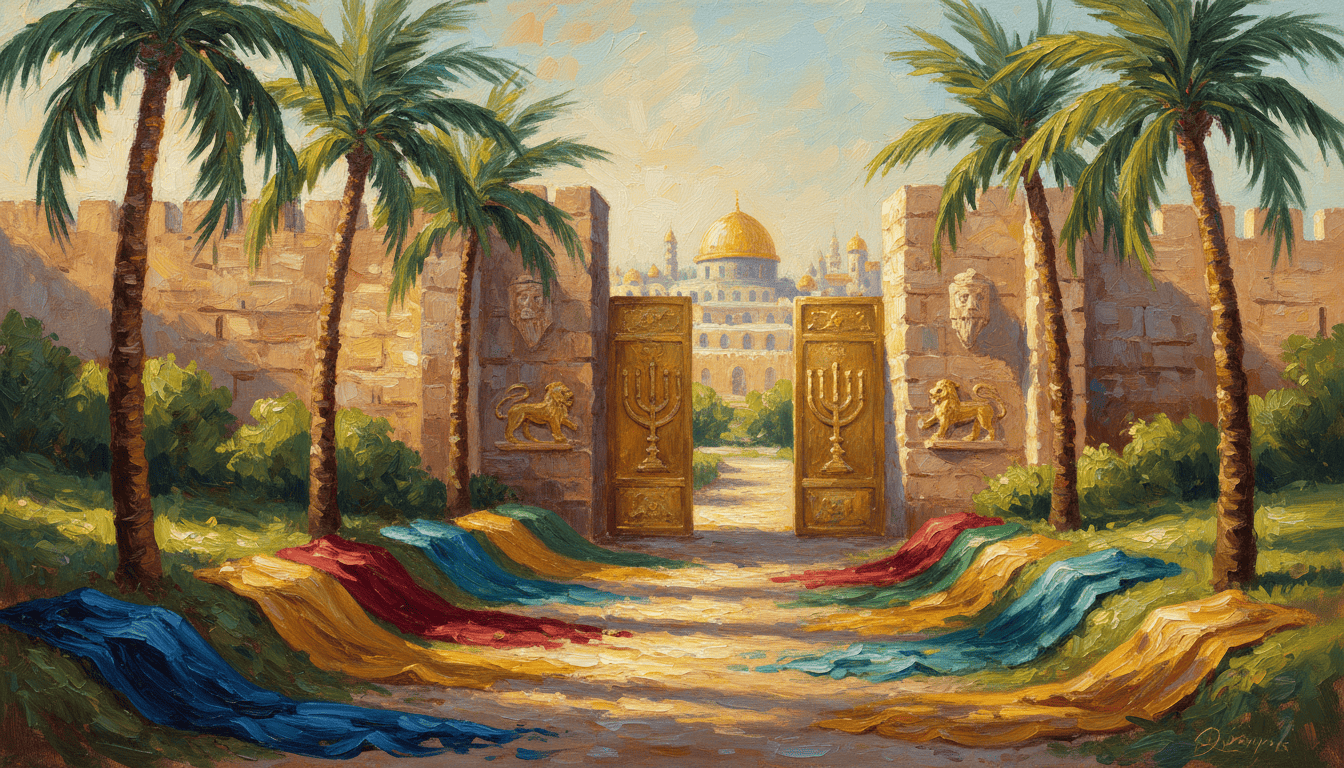
Palm SundayThe Triumphal Entry
Introduction
Palm Sunday marks Jesus's triumphal entry into Jerusalem, a pivotal moment that inaugurated the final week of his earthly ministry. The crowds welcomed him as their king, spreading cloaks and palm branches on the road before him, shouting "Hosanna to the Son of David!" Yet within days, many of these same voices would cry "Crucify him!" Palm Sunday reveals both the glory of Christ's kingship and the tragedy of humanity's fickleness. It is a prophetic fulfillment, a deliberate claim to messianic identity, and a somber foreshadowing of the cross that awaited just days ahead.
The Prophetic Fulfillment
Zechariah, writing five centuries before Christ, prophesied that Jerusalem's king would come "lowly, and riding upon an ass, and upon a colt the foal of an ass." This prophecy specified not a warhorse—the mount of conquerors—but a donkey, the mount of peace. Jesus deliberately fulfilled this prophecy, instructing his disciples to bring him a colt that had never been ridden.
Rejoice greatly, O daughter of Zion; shout, O daughter of Jerusalem: behold, thy King cometh unto thee: he is just, and having salvation; lowly, and riding upon an ass, and upon a colt the foal of an ass.
Zechariah 9:9
KJV
Matthew explicitly notes that this event fulfilled Zechariah's prophecy. Jesus was not accidentally or coincidentally riding a donkey; he was making a public, unmistakable claim to be the promised Messiah-King. Every detail was intentional, from the specific animal to the manner of entry.
All this was done, that it might be fulfilled which was spoken by the prophet, saying, Tell ye the daughter of Sion, Behold, thy King cometh unto thee, meek, and sitting upon an ass, and a colt the foal of an ass.
Matthew 21:4-5
KJV
The disciples brought the colt and placed their cloaks on it, and Jesus sat upon it. This simple act carried significance. In ancient Israelite culture, placing one's garment under a king was an act of submission and homage. When Jehu was proclaimed king, the commanders placed their garments under him on the steps. The disciples' actions declared Jesus's kingship.
The Crowd's Response: Hosanna to the Son of David
As Jesus entered Jerusalem, a great multitude spread their cloaks on the road, while others cut branches from the trees and spread them before him. The crowds going before him and those following him shouted, "Hosanna to the Son of David: Blessed is he that cometh in the name of the Lord; Hosanna in the highest."
And a very great multitude spread their garments in the way; others cut down branches from the trees, and strawed them in the way. And the multitudes that went before, and that followed, cried, saying, Hosanna to the Son of David: Blessed is he that cometh in the name of the Lord; Hosanna in the highest.
Matthew 21:8-9
KJV
These words came from Psalm 118, a messianic psalm traditionally sung during Passover. "Hosanna" literally means "save now" or "save, we pray." By addressing Jesus as "Son of David," the crowd explicitly acknowledged his messianic claim. David's son and heir was the promised Messiah who would sit on David's throne forever.
Save now, I beseech thee, O LORD: O LORD, I beseech thee, send now prosperity. Blessed be he that cometh in the name of the LORD: we have blessed you out of the house of the LORD.
Psalms 118:25-26
KJV
The palm branches held additional significance. During the Feast of Tabernacles, worshipers would wave palm branches while reciting Psalm 118. Palms symbolized victory, joy, and the coming kingdom. When the crowd waved palms and quoted this messianic psalm, they were proclaiming Jesus as the conquering King who would restore Israel.
Luke records that the whole multitude of disciples began to rejoice and praise God with a loud voice for all the mighty works they had seen. They declared, "Blessed be the King that cometh in the name of the Lord: peace in heaven, and glory in the highest." This was an unmistakable declaration of Jesus's kingship.
And when he was come nigh, even now at the descent of the mount of Olives, the whole multitude of the disciples began to rejoice and praise God with a loud voice for all the mighty works that they had seen; Saying, Blessed be the King that cometh in the name of the Lord: peace in heaven, and glory in the highest.
Luke 19:37-38
KJV
The Pharisees' Objection and Jesus's Response
The Pharisees were horrified by these messianic proclamations. They commanded Jesus to rebuke his disciples, to silence their declarations of his kingship. But Jesus refused. He replied, "I tell you that, if these should hold their peace, the stones would immediately cry out." The truth of Jesus's identity could not be suppressed. Creation itself would testify to the presence of the Creator-King if his disciples were silenced.
And some of the Pharisees from among the multitude said unto him, Master, rebuke thy disciples. And he answered and said unto them, I tell you that, if these should hold their peace, the stones would immediately cry out.
Luke 19:39-40
KJV
This response echoes the principle found throughout Scripture that all creation declares God's glory. The heavens proclaim his handiwork; even the stones would cry out if necessary. Jesus's identity as Messiah and King was not dependent on human recognition; it was an objective reality that demanded acknowledgment.
To the chief Musician, A Psalm of David. The heavens declare the glory of God; and the firmament sheweth his handywork.
Psalms 19:1
KJV
Jesus Weeps Over Jerusalem
As Jesus drew near to Jerusalem and saw the city, he wept over it. Despite the celebration surrounding him, Jesus saw beyond the momentary enthusiasm to the tragic future awaiting Jerusalem. He lamented, "If thou hadst known, even thou, at least in this thy day, the things which belong unto thy peace! But now they are hid from thine eyes."
And when he was come near, he beheld the city, and wept over it, Saying, If thou hadst known, even thou, at least in this thy day, the things which belong unto thy peace! but now they are hid from thine eyes.
Luke 19:41-42
KJV
Jesus prophesied Jerusalem's destruction, which would occur in AD 70 when Roman armies would surround the city, destroy the temple, and kill hundreds of thousands of inhabitants. This judgment would come because they did not recognize "the time of their visitation"—they failed to recognize the Messiah when he came to them.
For the days shall come upon thee, that thine enemies shall cast a trench about thee, and compass thee round, and keep thee in on every side, And shall lay thee even with the ground, and thy children within thee; and they shall not leave in thee one stone upon another; because thou knewest not the time of thy visitation.
Luke 19:43-44
KJV
This weeping reveals Jesus's heart. Even as he knew that many in the crowds would soon turn against him, even as he foresaw the terrible judgment coming upon the city, he mourned for them. The King came to his own people, offering peace and salvation, yet they would reject him and face the consequences of that rejection.
Cleansing the Temple
After entering the city, Jesus went to the temple and drove out those who were buying and selling there. He overturned the tables of the money changers and the seats of those selling doves. He declared, "Is it not written, My house shall be called of all nations the house of prayer? but ye have made it a den of thieves."
And they come to Jerusalem: and Jesus went into the temple, and began to cast out them that sold and bought in the temple, and overthrew the tables of the moneychangers, and the seats of them that sold doves; And would not suffer that any man should carry any vessel through the temple. And he taught, saying unto them, Is it not written, My house shall be called of all nations the house of prayer? but ye have made it a den of thieves.
Mark 11:15-17
KJV
This action demonstrated Jesus's authority over the temple and his zeal for true worship. The Court of the Gentiles, which should have been a place where non-Jews could pray and seek God, had been turned into a marketplace. The religious establishment had corrupted worship, turning it into an opportunity for profit. Jesus, as the true Lord of the temple, executed judgment on this corruption.
The chief priests and scribes heard this and sought a way to destroy him, for they feared him because the whole crowd was astonished at his teaching. Jesus's actions and words challenged their authority and exposed their hypocrisy. From this moment, they actively plotted his death.
The Fig Tree and True Faith
On the morning after the triumphal entry, Jesus cursed a fig tree that had leaves but no fruit. The next day, the disciples saw that the fig tree had withered from the roots. This miracle served as an enacted parable of judgment against fruitless Israel. The nation had the appearance of life—the temple, the rituals, the religious system—but lacked the fruit of genuine faith and righteousness.
And on the morrow, when they were come from Bethany, he was hungry: And seeing a fig tree afar off having leaves, he came, if haply he might find any thing thereon: and when he came to it, he found nothing but leaves; for the time of figs was not yet. And Jesus answered and said unto it, No man eat fruit of thee hereafter for ever. And his disciples heard it.
Mark 11:12-14
KJV
And in the morning, as they passed by, they saw the fig tree dried up from the roots. And Peter calling to remembrance saith unto him, Master, behold, the fig tree which thou cursedst is withered away.
Mark 11:20-21
KJV
Jesus used this incident to teach about faith and prayer. He declared that whoever says to this mountain, "Be thou removed, and be thou cast into the sea," and does not doubt in his heart but believes that what he says will come to pass, it will be done for him. True faith produces results; fruitless religion accomplishes nothing.
And Jesus answering saith unto them, Have faith in God. For verily I say unto you, That whosoever shall say unto this mountain, Be thou removed, and be thou cast into the sea; and shall not doubt in his heart, but shall believe that those things which he saith shall come to pass; he shall have whatsoever he saith. Therefore I say unto you, What things soever ye desire, when ye pray, believe that ye receive them, and ye shall have them.
Mark 11:22-24
KJV
Conclusion: The King Has Come
Palm Sunday presents us with the same choice faced by the crowds in Jerusalem: How will we respond to Jesus's claim to kingship? Will we welcome him with genuine worship and lasting commitment, or will our enthusiasm prove shallow and temporary? Jesus entered Jerusalem knowing exactly what awaited him—rejection, suffering, and death. Yet he came anyway, because he is the good shepherd who lays down his life for his sheep. The King who rode into Jerusalem on a donkey would soon hang on a cross, wearing a crown of thorns instead of gold. But that cross would become his throne, and through his death he would purchase people from every tribe and nation. Palm Sunday reminds us that Jesus is the King—not the king that the crowds wanted, but the King that the world needed. He came not to deliver Israel from Rome, but to deliver humanity from sin, death, and the devil. And he calls us not to political allegiance but to total surrender—to lay down our own ambitions and follow him, crying not "Hosanna!" only when it's popular, but "Blessed is the King!" even when it costs us everything.