


EasterThe Resurrection of Christ
Introduction
Easter Sunday is the cornerstone of the Christian faith. Without the resurrection, Christianity collapses into just another failed messianic movement, and Jesus becomes merely one more prophet who died for his convictions. But if Jesus truly rose from the dead—conquering sin, death, and the grave—then everything changes. As Paul declares, if Christ has not been raised, our faith is futile and we are still in our sins. But Christ has been raised from the dead, the firstfruits of those who have fallen asleep. Easter celebrates this world-altering reality: death has been defeated, the grave has been conquered, and eternal life is offered to all who believe.
The Evidence of the Empty Tomb
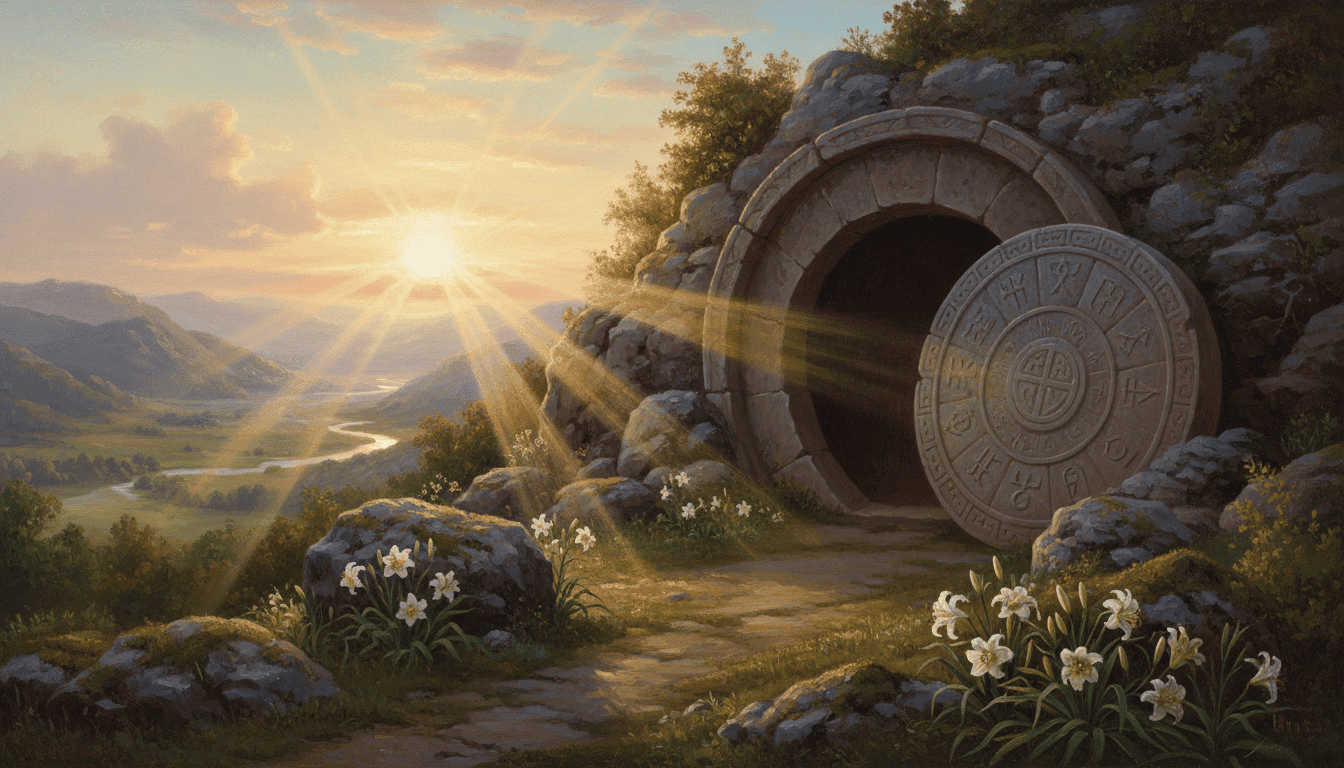
On the first day of the week, at early dawn, women who had followed Jesus came to the tomb carrying spices they had prepared. They found the stone rolled away from the entrance, and upon entering, they did not find the body of the Lord Jesus. What they discovered instead were two angels who asked, "Why seek ye the living among the dead? He is not here, but is risen."
Now upon the first day of the week, very early in the morning, they came unto the sepulchre, bringing the spices which they had prepared, and certain others with them. And they found the stone rolled away from the sepulchre. And they entered in, and found not the body of the Lord Jesus. And it came to pass, as they were much perplexed thereabout, behold, two men stood by them in shining garments: And as they were afraid, and bowed down their faces to the earth, they said unto them, Why seek ye the living among the dead? He is not here, but is risen: remember how he spake unto you when he was yet in Galilee,
Luke 24:1-6
KJV
The empty tomb is the foundation of resurrection faith. If Jesus's body remained in the grave, his claims were false and his followers were either deceived or deceivers. But the tomb was empty—a fact that even Jesus's enemies could not dispute. The Roman guard had been posted specifically to prevent the disciples from stealing the body, yet on Sunday morning the tomb stood open and empty. The grave clothes were left behind, lying in the place where Jesus's body had been, as if he had simply passed through them.
Peter and John rushed to the tomb after Mary Magdalene reported it empty. John arrived first but waited for Peter before entering. When Peter entered the tomb, he saw the linen cloths lying there and the face cloth that had been on Jesus's head, not lying with the linen cloths but folded up in a place by itself. This detail suggests careful, purposeful action—not the hasty work of grave robbers.
Peter therefore went forth, and that other disciple, and came to the sepulchre. So they ran both together: and the other disciple did outrun Peter, and came first to the sepulchre. And he stooping down, and looking in, saw the linen clothes lying; yet went he not in. Then cometh Simon Peter following him, and went into the sepulchre, and seeth the linen clothes lie, And the napkin, that was about his head, not lying with the linen clothes, but wrapped together in a place by itself. Then went in also that other disciple, which came first to the sepulchre, and he saw, and believed.
John 20:3-8
KJV
Appearances of the Risen Christ
The resurrection accounts include multiple appearances of Jesus to his followers, providing compelling eyewitness testimony. Mary Magdalene encountered Jesus near the tomb, initially mistaking him for the gardener until he spoke her name. Two disciples met him on the road to Emmaus, their hearts burning as he explained how all the Scriptures spoke of him, only recognizing him when he broke bread with them. Jesus appeared to Peter, to the twelve, and to more than five hundred brothers at one time—most of whom were still alive when Paul wrote his first letter to the Corinthians, allowing verification of the testimony.
For I delivered unto you first of all that which I also received, how that Christ died for our sins according to the scriptures; And that he was buried, and that he rose again the third day according to the scriptures: And that he was seen of Cephas, then of the twelve: After that, he was seen of above five hundred brethren at once; of whom the greater part remain unto this present, but some are fallen asleep. After that, he was seen of James; then of all the apostles. And last of all he was seen of me also, as of one born out of due time.
These appearances were not visions or hallucinations but physical encounters with the risen Christ. Jesus invited Thomas to touch his wounds, proving his identity and the reality of his bodily resurrection. He ate fish with his disciples, demonstrating that he was not a ghost or spirit. He showed that his resurrection body was both continuous with his pre-crucifixion body (bearing the marks of crucifixion) and transformed (able to appear in locked rooms and disappear at will).
But Thomas, one of the twelve, called Didymus, was not with them when Jesus came. The other disciples therefore said unto him, We have seen the Lord. But he said unto them, Except I shall see in his hands the print of the nails, and put my finger into the print of the nails, and thrust my hand into his side, I will not believe. And after eight days again his disciples were within, and Thomas with them: then came Jesus, the doors being shut, and stood in the midst, and said, Peace be unto you. Then saith he to Thomas, Reach hither thy finger, and behold my hands; and reach hither thy hand, and thrust it into my side: and be not faithless, but believing. And Thomas answered and said unto him, My Lord and my God. Jesus saith unto him, Thomas, because thou hast seen me, thou hast believed: blessed are they that have not seen, and yet have believed.
John 20:24-29
KJV
The transformation in the disciples themselves provides powerful evidence for the resurrection. These men had fled in fear when Jesus was arrested, and Peter had denied even knowing him. Yet after encountering the risen Christ, they became bold proclaimers of the resurrection, willing to suffer persecution and martyrdom rather than recant their testimony. People may die for a lie they believe to be true, but they rarely die for a lie they know to be false. The disciples knew whether they had seen Jesus alive after his death, and their willingness to die for this testimony speaks powerfully.
Old Testament Foreshadowing
Jesus's resurrection was not an afterthought but the fulfillment of ancient prophecies and Old Testament patterns. David prophetically declared that God would not abandon his Holy One to Sheol or let him see corruption. Peter applies this psalm to Jesus on the day of Pentecost, arguing that David could not have been speaking of himself since David's tomb remained among them. Rather, David foresaw the resurrection of the Messiah.
For thou wilt not leave my soul in hell; neither wilt thou suffer thine Holy One to see corruption. Thou wilt shew me the path of life: in thy presence is fulness of joy; at thy right hand there are pleasures for evermore.
Psalms 16:10-11
KJV
The prophet Isaiah described the suffering servant who would be "cut off out of the land of the living" for the transgression of God's people, yet would "see his offspring" and "prolong his days"—a paradox only resolved by resurrection. This servant would bear the sins of many and make intercession for the transgressors, yet afterward see the fruit of his suffering and be satisfied.
Yet it pleased the LORD to bruise him; he hath put him to grief: when thou shalt make his soul an offering for sin, he shall see his seed, he shall prolong his days, and the pleasure of the LORD shall prosper in his hand. He shall see of the travail of his soul, and shall be satisfied: by his knowledge shall my righteous servant justify many; for he shall bear their iniquities. Therefore will I divide him a portion with the great, and he shall divide the spoil with the strong; because he hath poured out his soul unto death: and he was numbered with the transgressors; and he bare the sin of many, and made intercession for the transgressors.
Isaiah 53:10-12
KJV
Jonah's three days in the belly of the great fish were a sign pointing to Jesus's time in the tomb. Jesus himself referenced this typology, declaring that as Jonah was in the belly of the fish three days and three nights, so the Son of Man would be three days and three nights in the heart of the earth. Just as Jonah emerged alive from what should have been certain death, so Jesus would emerge from the tomb victorious.
For as Jonas was three days and three nights in the whale's belly; so shall the Son of man be three days and three nights in the heart of the earth.
Matthew 12:40
KJV
The Theological Significance of Resurrection
Paul develops the theological implications of Christ's resurrection extensively. Jesus was delivered up for our trespasses and raised for our justification—meaning the resurrection is God's declaration that the payment for sin has been accepted. If Jesus had remained dead, it would indicate that his sacrifice was insufficient. But the resurrection proves that the Father accepted the Son's offering and that those who trust in Christ are justified.
But for us also, to whom it shall be imputed, if we believe on him that raised up Jesus our Lord from the dead; Who was delivered for our offences, and was raised again for our justification.
Romans 4:24-25
KJV
The resurrection also guarantees the future resurrection of believers. Christ is the firstfruits of those who have fallen asleep—the first installment of the harvest, guaranteeing that the full harvest will follow. Because he lives, we too shall live. Our mortal bodies will be raised imperishable, our weak bodies raised in power, our natural bodies raised spiritual. Just as we have borne the image of the man of dust (Adam), we shall also bear the image of the man of heaven (Christ).
But now is Christ risen from the dead, and become the firstfruits of them that slept. For since by man came death, by man came also the resurrection of the dead. For as in Adam all die, even so in Christ shall all be made alive. But every man in his own order: Christ the firstfruits; afterward they that are Christ's at his coming.
So also is the resurrection of the dead. It is sown in corruption; it is raised in incorruption: It is sown in dishonour; it is raised in glory: it is sown in weakness; it is raised in power: It is sown a natural body; it is raised a spiritual body. There is a natural body, and there is a spiritual body. And so it is written, The first man Adam was made a living soul; the last Adam was made a quickening spirit. Howbeit that was not first which is spiritual, but that which is natural; and afterward that which is spiritual. The first man is of the earth, earthy: the second man is the Lord from heaven. As is the earthy, such are they also that are earthy: and as is the heavenly, such are they also that are heavenly. And as we have borne the image of the earthy, we shall also bear the image of the heavenly.
Furthermore, the resurrection is the basis for Christ's present heavenly ministry. He was raised from the dead and seated at God's right hand, far above all rule and authority and power and dominion. From this position of supreme authority, he intercedes for his people and rules over all things for the benefit of the church. The risen Christ is not a distant memory but a living Lord actively engaged in the lives of his followers.
And what is the exceeding greatness of his power to us-ward who believe, according to the working of his mighty power, Which he wrought in Christ, when he raised him from the dead, and set him at his own right hand in the heavenly places, Far above all principality, and power, and might, and dominion, and every name that is named, not only in this world, but also in that which is to come: And hath put all things under his feet, and gave him to be the head over all things to the church, Which is his body, the fulness of him that filleth all in all.
Victory Over Death and Sin
The resurrection represents Jesus's triumph over humanity's greatest enemies. Death entered the world through sin, and death held dominion over all of Adam's descendants. But Christ, through his death and resurrection, destroyed the one who has the power of death—that is, the devil—and delivered all those who through fear of death were subject to lifelong slavery.
Forasmuch then as the children are partakers of flesh and blood, he also himself likewise took part of the same; that through death he might destroy him that had the power of death, that is, the devil; And deliver them who through fear of death were all their lifetime subject to bondage.
Hebrews 2:14-15
KJV
Paul taunts death with the words of the prophet Hosea: "O death, where is your victory? O death, where is your sting?" The sting of death is sin, and the power of sin is the law. But thanks be to God, who gives us the victory through our Lord Jesus Christ. Death has been swallowed up in victory, and believers need no longer fear the grave. Christ has removed death's sting by removing the guilt of sin that gave death its power.
So when this corruptible shall have put on incorruption, and this mortal shall have put on immortality, then shall be brought to pass the saying that is written, Death is swallowed up in victory. O death, where is thy sting? O grave, where is thy victory? The sting of death is sin; and the strength of sin is the law. But thanks be to God, which giveth us the victory through our Lord Jesus Christ.
Our Resurrection Life
The resurrection is not only a historical event to celebrate but a present reality to experience. Paul teaches that believers have been united with Christ in his death and resurrection. We were buried with him through baptism into death, in order that just as Christ was raised from the dead by the glory of the Father, we too might walk in newness of life. The old self was crucified with Christ; we now live as those who have been raised from spiritual death to spiritual life.
Know ye not, that so many of us as were baptized into Jesus Christ were baptized into his death? Therefore we are buried with him by baptism into death: that like as Christ was raised up from the dead by the glory of the Father, even so we also should walk in newness of life. For if we have been planted together in the likeness of his death, we shall be also in the likeness of his resurrection:
Romans 6:3-5
KJV
This resurrection life is characterized by new desires, new power, and new purpose. We are to set our minds on things above, not on earthly things, for we have died and our life is hidden with Christ in God. When Christ who is our life appears, we will appear with him in glory. Until then, we put to death what is earthly in us and put on the new self, which is being renewed in knowledge after the image of its Creator.
If ye then be risen with Christ, seek those things which are above, where Christ sitteth on the right hand of God. Set your affection on things above, not on things on the earth. For ye are dead, and your life is hid with Christ in God. When Christ, who is our life, shall appear, then shall ye also appear with him in glory.
Colossians 3:1-4
KJV
Conclusion: Living in Resurrection Power
Easter is the Christian's great declaration: Christ is risen! He is risen indeed! This proclamation changes everything. Because Jesus lives, death is not the end but the doorway to eternal life. Because he conquered the grave, we need not fear judgment. Because he rose in power, we can live in that same power, experiencing victory over sin and transformation into his likeness. The resurrection is both our hope for the future and our power for the present. As we celebrate Easter, we rejoice in the living Christ who has defeated our enemies, secured our salvation, and promised to raise us up on the last day. He is the resurrection and the life; whoever believes in him, though he die, yet shall he live, and everyone who lives and believes in him shall never die.