


Acts 27:33
- ἌχριAchriUntilG891PREPPreposition
- δὲdethenG1161CONJConjunction
- οὗhouthatG3739R-GSMRelative pronoun Genitive Singular Masculine
- ἡμέραhēmeradayG2250N-NSFNoun Nominative Singular Feminine
- ἤμελλενēmellenwas aboutG3195V-IAI-3SVerb Imperfect Active Indicative 3rd Singular
- γίνεσθαιginesthaito comeG1096V-PNNVerb Present Middle Or Passive Deponent Infinitive
- παρεκάλειparekaleiwas urgingG3870V-IAI-3SVerb Imperfect Active Indicative 3rd Singular
- ὁho<the>G3588T-NSMDefinite article Nominative Singular Masculine
- ΠαῦλοςPaulosPaulG3972N-NSM-PNoun Nominative Singular Masculine Individual
- ἅπανταςhapantasallG537A-APMAdjective Accusative Plural Masculine
- μεταλαβεῖνmetalabeinto partakeG3335V-2AANVerb 2nd Aorist Active Infinitive
- τροφῆςtrophēsof foodG5160N-GSFNoun Genitive Singular Feminine
- λέγων·legōnsayingG3004V-PAP-NSMVerb Present Active Participle Nominative Singular Masculine
- τεσσαρεσκαιδεκάτηνtessareskaidekatēn[the] fourteenthG5065A-ASFAdjective Accusative Singular Feminine
- σήμερονsēmerontodayG4594ADVAdverb
- ἡμέρανhēmeran[is] dayG2250N-ASFNoun Accusative Singular Feminine
- προσδοκῶντεςprosdokōnteswatchingG4328V-PAP-NPMVerb Present Active Participle Nominative Plural Masculine
- ἄσιτοιasitoiwithout eatingG777A-NPMAdjective Nominative Plural Masculine
- διατελεῖτεdiateleiteyou continueG1300V-PAI-2PVerb Present Active Indicative 2nd Plural
- μηθὲνmēthennothingG3367A-ASN-NAdjective Accusative Singular Neuter Negative
- προσλαβόμενοιproslabomenoihaving takenG4355V-2AMP-NPMVerb 2nd Aorist Middle Participle Nominative Plural Masculine
English is a literal word-by-word gloss of the Greek, not the KJV's wording. Why?
This is the original text the KJV's translators worked from — each Greek word with its own literal English meaning in this verse, prepared by scholars at Tyndale House, Cambridge. The KJV translates whole sentences, not word by word, so its wording differs: one Greek word can become several English words, and the KJV may choose “charity” where the gloss reads “love”. Both are faithful — they answer different questions. For the KJV's own rendering, switch to the KJV text.
Details
See on the biblical-era map
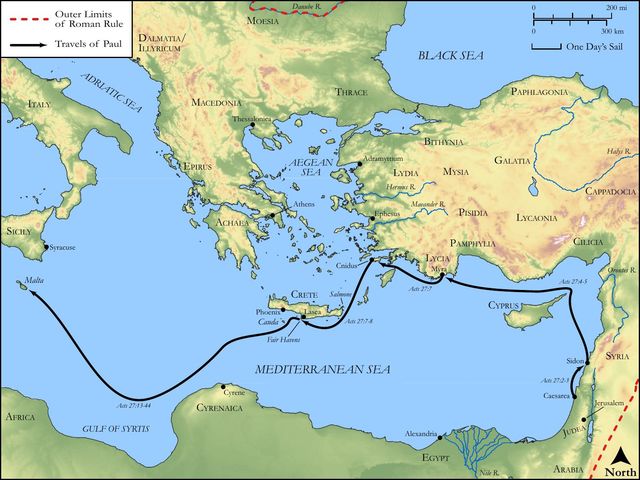
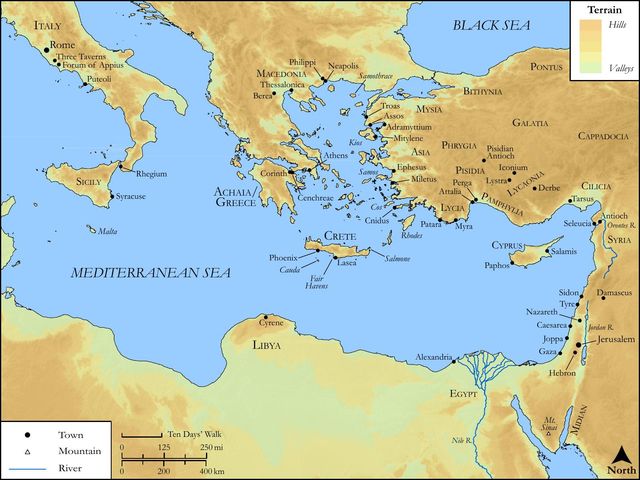
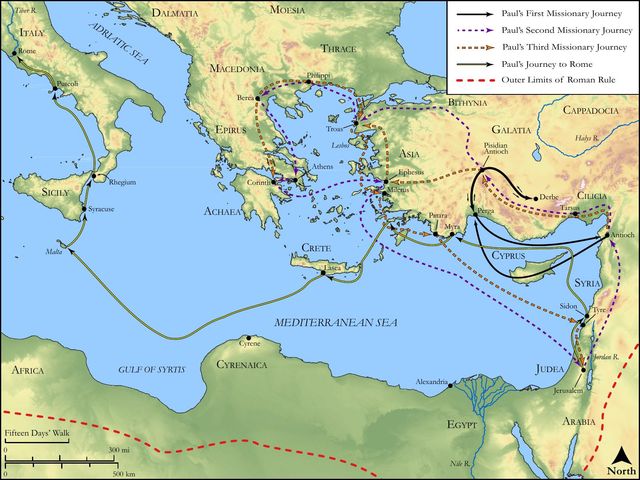
Study this verse
Public-domain commentary
Matthew Henry
From his Commentary on the Whole Bible. Henry comments on passages, not single verses — this entry covers Acts 27:21–44. His four-level outline is real structure in the source text, so it is rendered as structure.
We have here the issue of the distress of Paul and his fellow-travellers; they escaped with their lives and that was all, and that was for Paul's sake. We are here told (v. 37) what number there were on board—mariners, merchants, soldiers, prisoners, and other passengers, in all two hundred and seventy-six souls; this is taken notice of to make us the more concerned for them in reading the story, that they were such a considerable number, whose lives were now in the utmost jeopardy, and one Paul among them worth more than all the rest. We left them in despair, giving up themselves for gone. Whether they called every man on his God, as Jonah's mariners did, we are not told; it is well if this laudable practice in a storm was not gone out of fashion and made a jest of. However, Paul among these seamen was not, like Jonah among his, the cause of the storm, but the comforter in the storm, and as much a credit to the profession of an apostle as Jonah was a blemish to the character of a prophet. Now here we have,
I.The encouragement Paul gave them, by assuring them, in the name of God, that their lives should all be saved, even when, in human appearance, all hope that they should be saved was taken away. Paul rescued them from their despair first, that they might not die of that, and starve themselves in that, and then they were in a fair way to be rescued from their distress. After long abstinence, as if they were resolved not to eat till they knew whether they should live or die, Paul stood forth in the midst of them. During the distress hitherto Paul hid himself among them, was one of the crowd, helped with the rest to throw out the tackling (v. 19), but now he distinguished himself, and, though a prisoner, undertook to be their counsellor and comforter.
1.He reproves them for not taking his advice, which was to stay where they were, in the road of Lasea (v. 8): "You should have hearkened to me and not have loosed from Crete, where we might have made a shift to winter well enough, and then we should not have gained this harm and loss, that is, we should have escaped them." Harm and loss in the world, if sanctified to us, may be truly said to be gain; for if they wean us from present things, and awaken us to think of a future state, we are truly gainers by them. Observe, They did not hearken to Paul when he warned them of their danger, and yet if they will but acknowledge their folly, and repent of it, he will speak comfort and relief to them now that they are in danger, so compassionate is God to those that are in misery, though they bring themselves into it by their own incogitancy, nay, by their own wilfulness, and contempt of admonition. Paul, before administering comfort, will first make them sensible of their sin in not hearkening to him, by upbraiding them with their rashness, and probably, when he tells them of their gaining harm and loss, he reflects upon what they promised themselves by proceeding on their voyage, that they should gain so much time, gain this and the other point: "But," says he, "you have gained nothing but harm and loss; how will you answer it?" That which they are blamed for is their loosing from Crete, where they were safe. Note, Most people bring themselves into inconvenience, because they do not know when they are well off, but gain harm and loss by aiming against advice to better themselves.
2.He assures them that though they should lose the ship yet they should none of them lose their lives: "You see your folly in not being ruled by me:" he does not say, "Now therefore expect to fare accordingly, you may thank yourselves if you be all lost, those that will not be counselled cannot be helped." No, "Yet now there is hope in Israel concerning this thing; your case is sad, but it is not desperate, now, I exhort you to be of good cheer." Thus we say to sinners that are convinced of their sin and folly, and begin to see and bewail their error, "You should have hearkened unto us, and should have had nothing to do with sin; yet now we exhort you to be of good cheer: though you would not take our advice when we said, Do not presume, yet take it now when we say, Do not despair." They had given up the cause, and would use no further means, because all hope that they should be saved was taken away. Now Paul quickens them to bestir themselves yet in working for their own safety, by telling them that it they would resume their vigour they should secure their lives. He gives them this assurance when they were brought to the last extremity, for now it would be doubly welcome to them to be told that not a life should be lost when they were ready to conclude they must inevitably be all lost. He tells them,
(1.)That they must count upon the loss of the ship. Those who were interested in that and the goods were probably those greater part that were for pushing forward the voyage and running the venture, notwithstanding Paul's admonition, and they are made to pay for their rashness. Their ship shall be wrecked. Many a stately, strong, rich, gallant ship is lost in the mighty waters in a little time; for vanity of vanities, all is vanity and vexation of spirit. But,
(2.)Not a life shall be lost. This would be good news to those that were ready to die for fear of dying, and whose guilty consciences made death look very terrible to them.
3.He tells them what ground he had for this assurance, that it is not a banter upon them, to put them into humour, nor a human conjecture, he has a divine revelation for it, and is as confident of it as that God is true, being fully satisfied that he has his word for it. An angel of the Lord appeared to him in the night, and told him that for his sake they should all be preserved (v. 23-25), which would double the mercy of their preservation, that they should have it not only by providence, but by promise, and as a particular favour to Paul. Now observe here,
(1.)The solemn profession Paul makes of relation to God, the God from whom he had this favourable intelligence: It is he whose I am, and whom I serve. He looks upon God,
[1.]As his rightful owner, who has a sovereign incontestable title to him, and dominion over him: Who I am. Because God made us and not we ourselves, therefore we are not our own but his. His we are by creation, for he made us; by preservation, for he maintains us; by redemption, for he bought us. We are more his than our own.
[2.]As his sovereign ruler and master, who, having given him being, has right to give him law: Whom I serve. Because his we are, therefore we are bound to serve him, to devote ourselves to his honour and employ ourselves in his work. It is Christ that Paul here has an eye to; he is God, and the angels are his and go on his errands. Paul often calls himself a servant of Jesus Christ; he is his, and him he serves, both as a Christian and as an apostle; he does not say, "Whose we are, and whom we serve," for most that were present were strangers to him, but, "Whose I am, and whom I serve, whatever others do; nay, whom I am now in the actual service of, going to Rome, not as you are, upon worldly business, but to appear as a witness for Christ." Now this he tells the company, that, seeing their relief coming from his God whose he was and whom he served, they might thereby be drawn in to take him for their God, and to serve him likewise; for the same reason Jonah said to his mariners, I fear the Lord, the God of heaven, who has made the sea and the dry land, Jonah i. 9.
(2.)The account he gives of the vision he had: There stood by me this night an angel of God, a divine messenger who used formerly to bring him messages from heaven; he stood by him, visibly appeared to him, probably when he was awake upon his bed. Though he was afar off upon the sea (Ps. lxvi. 5), on the uttermost parts of the sea (Ps. cxxxix. 9), yet this could not intercept his communion with God, nor deprive him of the benefit of divine visits. Thence he can direct a prayer to God, and thither God can direct an angel to him. He knows not where he is himself, yet God's angel knows where to find him out. The ship is tossed with winds and waves, hurried to and fro with the utmost violence, and yet the angel finds a way into it. No storms nor tempests can hinder the communications of God's favour to his people, for he is a very present help, a help at hand, even when the sea roars and is troubled, Ps. xlvi. 1, 3. We may suppose that Paul, being a prisoner, had not a cabin of his own in the ship, much less a bed in the captain's cabin, but was put down into the hold (any dark or dirty place was thought good enough for him in common with the rest of the prisoners), and yet there the angel of God stood by him. Meanness and poverty set none at a distance from God and his favour. Jacob, when he has no pillow but a stone, no curtains but the clouds, yet has a vision of angels. Paul had this vision but this last night. He had himself been assured by a former vision that he should go to Rome (ch. xxiii. 11), from which he might infer that he himself should be safe; but he has this fresh vision to assure him of the safety of those with him.
(3.)The encouragements that were given him in the vision, v. 14.
[1.]He is forbidden to fear. Though all about him are at their wits' end, and lost in despair, yet, Fear not, Paul; fear not their fear, nor be afraid, Isa. viii. 12. Let the sinners in Zion be afraid, but let not the saints be afraid, no, not at sea, in a storm; for the Lord of hosts is with them, and their place of defence shall be the munitions of rocks, Isa. xxxiii. 14-16.
[2.]He is assured that for his part he shall come safely to Rome: Thou must be brought before Cæsar. As the rage of the most potent enemies, so the rage of the most stormy sea, cannot prevail against God's witnesses till they have finished their testimony. Paul must be preserved in this danger, for he is reserved for further service. This is comfortable for the faithful servants of God in straits and difficulties, that as long as God has any work for them to do their lives shall be prolonged.
[3.]That for his sake all that were in the ship with him should be delivered too from perishing in this storm: God hath given thee all those that sail with thee. The angel that was ordered to bring him this message could have singled him out from this wretched crew, and those that were his friends too, and have carried them safely to shore, and have left the rest to perish, because they would not take Paul's counsel. But God chooses rather, by preserving them all for his sake, to show what great blessings good men are to the world, than by delivering him only to show how good men are distinguished from the world. God has given thee all those that sail with thee, that is, spares them in answer to thy prayers, or for thy sake. Sometimes good men deliver neither sons nor daughters, but their own souls only, Ezek. xiv. 18. But Paul here delivers a whole ship's crew, almost three hundred souls. Note, God often spares wicked people for the sake of the godly; as Zoar for Lot's sake, and as Sodom might have been, if there had been ten righteous persons in it. The good people are hated and persecuted in the world as if they were not worthy to live in it, yet really it is for their sakes that the world stands. If Paul had thrust himself needlessly into bad company, he might justly have been cast away with them, but, God calling him into it, they are preserved with him. And it is intimated that it was a great favour to Paul, and he looked upon it to be so, that others were saved for his sake: They are given thee. There is no greater satisfaction to a good man than to know that he is a public blessing.
4.He comforts them with the same comforts wherewith he himself was comforted (v. 25): "Wherefore, Sirs, be of good cheer, you shall see even this will end well; for I believe God, and depend upon his word, that it shall be even as it was told me." He would not require them to give credit to that to which he did not himself give credit; and therefore solemnly professes that he believes it himself, and the belief of it makes him easy: "I doubt not but it shall be as it was told me." Thus he staggers not at the promise of God through unbelief. Hath God spoken, and shall he not make it good? No doubt he can, no doubt he will; for he is not a man that he should lie. And shall it be as God hath said? Then be of good cheer, be of good courage. God is ever faithful, and therefore let all that have an interest in his promise be ever cheerful. If with God saying and doing are not two things, then with us believing and enjoying should not.
5.He gives them a sign, telling them particularly what this tempestuous voyage would issue in (v. 26): "We must be cast upon a certain island, and that will both break the ship and save the passengers; and so the prediction in both respects will be fulfilled." The pilot had quitted his post, the ship was left to run at random, they knew not what latitude they were in, much less how to steer their course; and yet Providence undertakes to bring them to an island that shall be a refuge for them. When the church of God, like this ship, is tossed with tempests, and not comforted, when there is none to guide her of all her sons, yet God can bring her safely to shore, and will do it.
II.Their coming at length to an anchor upon an unknown shore, v. 27-29.
1.They had been a full fortnight in the storm, continually expecting death: The fourteenth night, and not sooner, they came near land; they were that night driven up and down in Adria, not in the Adriatic Gulf on which Venice stands, but in the Adriatic Sea, a part of the Mediterranean, containing both the Sicilian and Ionian seas, and extending to the African shore; in this sea they were tossed, and knew not whereabouts they were.
2.About midnight the mariners apprehended that they drew near to some shore, which confirmed what Paul had told them, that they must be driven upon some island. To try whether it was so or no, they sounded, in order to their finding the depth of the water, for the water would be shallower as they drew nearer to shore; by the first experiment they found they drew twenty fathoms deep of water, and by the next fifteen fathoms, which was a demonstration that they were near some shore; God has wisely ordered such a natural notice to sailors in the dark, that they may be cautious.
3.They took the hint, and, fearing rocks near the shore, they cast anchor, and wished for the day; they durst not go forward for fear of rocks, and yet would not go back in hope of shelter, but they would wait for the morning, and heartily wished for it; who can blame them when the affair came to a crisis? When they had light, there was no land to be seen; now that there was land near them, they had no light to see it by; no marvel then they wished for day. When those that fear God walk in darkness, and have no light, yet let them not say, The Lord has forsaken us, or, Our God has forgotten us; but let them do as these mariners did, cast anchor, and wish for the day, and be assured that the day will dawn. Hope is an anchor of the soul, sure and stedfast, entering into that within the veil. Hold fast by that, think not of putting to sea again, but abide by Christ, and wait till the day break, and the shadows flee away.
III.The defeating of the sailors' attempt to quit the ship; here was a new danger added to their distress, which they narrowly escaped.
Observe, 1. The treacherous design of the seamen, and that was to leave the sinking ship, which, though a piece of wisdom in others, yet in those that were entrusted with the care of it was the basest fraud that could be (v. 30): They were about to flee out of the ship, concluding no other than that when it ran ashore it must be broken all to pieces; having the command of the boat, the project was to get all of them into that, and so save themselves, and leave all the rest to perish. To cover this vile design, they pretended they would cast anchors out of the fore-ship, or carry them further off, and in order to this they let down the boat, which they had taken in (v. 16, 17), and were going into it, having agreed among themselves, when they were in to make straight for the shore. The treacherous seamen are like the treacherous shepherd, who flees when he sees the danger coming, and there is most need of his help, John x. 12. Thus true is that of Solomon, Confidence in an unfaithful man in time of trouble is like a broken tooth or a foot out of joint. Let us therefore cease from man. Paul had, in God's name, assured them that they should come safely to land, but they will rather trust their own refuge of lies than God's word and truth. 2. Paul's discovery of it, and protestation against it, v. 31. They all saw them preparing to go into the boat, but were deceived by the pretence they made; only Paul saw through it, and gave notice to the centurion and the soldiers concerning it, and told them plainly, Except these abide in the ship, you cannot be saved. The skill of a mariner is seen in a storm, and, in the distress of the ship, then is the proper time for him to exert himself. Now the greatest difficulty of all was before them, and therefore the seamen were now more necessary than ever yet; it was indeed not by any skill of theirs that they were brought to land, for it was quite beyond their skill, but, now that they are near land, they must use their art to bring the ship to it. When God has done that for us which we could not, we must then in his strength help ourselves. Paul speaks humanly, when he says, You cannot be saved except these abide in the ship; and he does not at all weaken the assurances he had divinely given that they should infallibly be saved. God, who appointed the end, that they should be saved, appointed the means, that they should be saved by the help of these seamen; though, if they had gone off, no doubt God would have made his word good some other way. Paul speaks as a prudent man, not as a prophet, when he says, These are necessary to your preservation. Duty is ours, events are God's; and we do not trust God, but tempt him, when we say, "We put ourselves under his protection," and do not use proper means, such as are within our power, for our own preservation. 3. The effectual defeat of it by the soldiers, v. 32. It was not time to stand arguing the case with the seamen, and therefore they made no more ado, but cut the ropes of the boat, and though it might otherwise have done them service in their present distress, they chose rather to let it fall off, and lose it, than suffer it to do them this disservice. And now the seamen, being forced to stay in the ship whether they would or no, are forced likewise to work for the safety of the ship as hard as they could, because if the rest perish they must perish with them.
IV.The new life which Paul put into the company, by cheerfully inviting them to take some refreshment, and by the repeated assurances he gave them that they should all of them have their lives given them for a prey. Happy they who had such a one as Paul in their company, who not only had correspondence with Heaven, but was of a hearty lively spirit with those about him, that sharpened the countenance of his friend, as iron sharpens iron. Such a friend in distress, when without are fightings and within are fears, is a friend indeed. Ointment and perfume rejoice the heart; so doth the sweetness of a man's friend by hearty counsel, Prov. xxvii. 9. Such was Paul's here to his companions in tribulation. The day was coming on: those that wish for the day, let them wait awhile, and they shall have what they wish for. The dawning of the day revived them a little, and then Paul got them together. 1. He chid them for their neglect of themselves, that they had so far given way to fear and despair as to forget or not to mind their food: This is the fourteenth day that you have tarried, and continued fasting, having taken nothing; and that is not well, v. 33. Not that they had all, or any of them, continued fourteen days without any food, but they had not had any set meal, as they used to have, all that time; they ate very little, next to nothing. Or, "You have continued fasting, that is, you have lost your stomach; you have had no appetite at all to your food, nor any relish of it, through prevailing fear and despair." A very disconsolate state is thus expressed (Ps. cii. 4), I forget to eat my bread. It is a sin to starve the body, and to deny it its necessary supports; he is an unnatural man indeed that hateth his own flesh, and does not nourish and cherish it; and it is a sore evil under the sun to have a sufficiency of the good things of this life, and not to have power to use them, Eccl. vi. 2. If this arise from the sorrow of the world, and from any inordinate fear or trouble, it is so far from excusing it that it is another sin, it is discontent, it is distrust of God, it is all wrong. What folly is it to die for fear of dying! But thus the sorrow of the world works death, while joy in God is life and peace in the greatest distresses and dangers. 2. He courts them to their food (v. 34): "Wherefore I pray you to take some meat. We have a hard struggle before us, must get to shore as well as we can; if our bodies be weak through fasting, we shall not be able to help ourselves." The angel bade Elijah, Arise and eat, for otherwise he would find the journey too great for him, 1 Kings xix. 7. So Paul will have these people eat, or otherwise the waves will be too hard for them: I pray you, parakalo, "I exhort you, if you will be ruled by me, take some nourishment; though you have no appetite to it, though you have fasted away your stomach, yet let reason bring you to it, for this is for your health, or rather your preservation, or safety, at this time; it is for your salvation, you cannot without nourishment have strength to shift for your lives." As he that will not labour, let him not eat; so he that means to labour must eat. Weak and trembling Christians, that give way to doubts and fears about their spiritual state, continue fasting from the Lord's supper, and fasting from divine consolations, and then complain they cannot go on in their spiritual work and warfare; and it is owing to themselves. If they would feed and feast as they ought, upon the provision Christ has made for them, they would be strengthened, and it would be for their souls' health and salvation. 3. He assures them of their preservation: There shall not a hair fall from the head of any of you. It is a proverbial expression, denoting a complete indemnity. It is used 1 Kings i. 51; Luke xxi. 18. "You cannot eat for fear of dying; I tell you, you are sure of living, and therefore eat. You will come to shore wet and cold, but sound wind and limb; your hair wet, but not a hair lost." 4. He himself spread their table for them; for none of them had any heart to do it, they were all so dispirited: When he had thus spoken, he took bread, fetched it from the ship's stores, to which every one might safely have access when none of them had an appetite. They were not reduced to short allowance, as sailors sometimes are when they are kept longer at sea than they expected by distress of weather; they had plenty, but what good did that do them, when they had no stomach? We have reason to be thankful to God that we have not only food to our appetite, but appetite to our food; that our soul abhors not even dainty meat (Job xxxiii. 20), through sickness or sorrow. 5. He was chaplain to the ship, and they had reason to be proud of their chaplain. He gave thanks to God in presence of them all. We have reason to think he had often prayed with Luke and Aristarchus, and what others there were among them that were Christians, that they prayed daily together; but whether he had before this prayed with the whole company promiscuously is not certain. Now he gave thanks to God, in presence of them all, that they were alive, and had been preserved hitherto, and that they had a promise that their lives should be preserved in the imminent peril now before them; he gave thanks for the provision they had, and begged a blessing upon it. We must in every thing give thanks; and must particularly have an eye to God in receiving our food, for it is sanctified to us by the word of God and prayer, and is to be received with thanksgiving. Thus the curse is taken off from it, and we obtain a covenant-right to it and a covenant-blessing upon it, 1 Tim. iv. 3-5. And it is not by bread alone that man lives, but by the word of God, which must be met with prayer. He gave thanks in presence of them all, not only to show that he served a Master he was not ashamed of, but to invite them into his service too. If we crave a blessing upon our meat, and give thanks for it in a right manner, we shall not only keep up a comfortable communion with God ourselves, but credit our profession, and recommend it to the good opinion of others. 6. He set them a good example: When he had given thanks, he broke the bread (it was sea-biscuit) and he began to eat. Whether they would be encouraged or no, he would; if they would be sullen, and, like froward children, refuse their victuals because they had not every thing to their mind, he would eat his meat, and be thankful. Those that teach others are inexcusable if they do not themselves do as they teach, and the most effectual way of preaching is by example. 7. It had a happy influence upon them all (v. 36): Then were they all of good cheer. They then ventured to believe the message God sent them by Paul when they plainly perceived that Paul believed it himself, who was in the same common danger with them. Thus God sends good tidings to the perishing world of mankind by those who are of themselves, and in the same common danger with themselves, who are sinners too, and must be saved, if ever they be saved, in the same way in which they persuade others to venture; for it is a common salvation which they bring the tidings of; and it is an encouragement to people to commit themselves to Christ as their Saviour when those who invite them to do so make it to appear that they do so themselves. It is here upon this occasion that the number of the persons is set down, which we took notice of before: they were in all two hundred threescore and sixteen souls. See how many may be influenced by the good example of one. They did all eat, nay, they did all eat enough (v. 38), they were satiated with food, or filled with it; they made a hearty meal. This explains the meaning of their fasting before for fourteen days; not that they did not eat during all that time, but they never had enough all that time, as they had now. 8. They once more lightened the ship, that it might escape the better in the shock it was now to have. They had before thrown the wares and the tackle overboard, and now the wheat, the victuals and provisions they had; better they should sink the food than that it should sink them. See what good reason our Saviour had to call our bodily food meat that perishes. We may ourselves be under a necessity of throwing that away to save our lives which we had gathered and laid up for the support of our lives. It is probable that the ship was overloaded with the multitude of the passengers (for this comes in just after the account of the number of them) and that this obliged them so often to lighten the ship.
V.Their putting to shore, and the staving of the ship in the adventure.
It was about break of day when they ate their meat, and when it was quite day they began to look about them; and here we are told,
1.That they knew not where they were; they could not tell what country it was they were now upon the coast of, whether it was Europe, Asia, or Africa, for each had shores washed by the Adriatic Sea. It is probable that these seamen had often sailed this way, and thought they knew every country they came near perfectly well, and yet here they were at a loss. Let not the wise man then glory in his wisdom, since it may perhaps fail him thus egregiously even in his own profession.
2.They observed a creek with a level shore, into which they hoped to thrust the ship, v. 39. Though they knew not what country it was, nor whether the inhabitants were friends or foes, civil or barbarous, they determined to cast themselves upon their mercy; it was dry land, which would be very welcome to those that had been so long at sea. It was a pity but they had had some help from the shore, a pilot sent them, that knew the coast, who might steer their ship in, or another second ship, to take some of the men on board. Those who live on the sea-coast have often opportunity of succouring those who are in distress at sea, and of saving precious lives, and they ought to do their utmost in order to it, with all readiness and cheerfulness; for it is a great sin, and very provoking to God, to forbear to deliver those that are driven unto death, and are ready to be slain; and it will not serve for an excuse to say, Behold, we knew it not, when either we did, or might, and should, have known it, Prov. xxiv. 11, 12. I have been told there are some, and in our own nation too, who when from the sea-coast they see a ship in distress and at a loss will, by misguiding fires or otherwise, purposely lead them into danger, that the lives may be lost, and they may have the plunder of the ship. One can scarcely believe that any of the human species can possibly be so wicked, so barbarously inhuman, and can have so much of the devil in them; if there be, let them know of a truth that they shall have judgment without mercy who have shown no mercy. 3. They made straight to the shore with wind and tide (v. 40): They took up the anchors, the four anchors which they cast out of the stern, v. 29. Some think that they took pains to weigh them up, hoping they should have use for them again at the shore; others that they did it with such precipitation that they were forced to cut the cables and leave them; the original will admit either. They then committed themselves to the sea, the wind standing fair to carry them into the port, and they loosed the rudder-bands, which were fastened during the storm for the greater steadiness of the ship, but, now that they were putting into the port, were loosed, that the pilot might steer with the greater freedom; they then hoisted up the main-sail to the wind, and made towards shore. The original words here used for the rudder-bands and the main-sail find the critics a great deal of work to accommodate them to the modern terms; but they need not give us any difficulty who are content to know that when they saw the shore they hastened to it as fast as they could, and perhaps made more haste than good speed. And should not a poor soul that has long been struggling with winds and tempests in this world long to put into the safe and quiet haven of everlasting rest? Should it not get clear from all that which fastens it to this earth, and straitens the out-goings of its pious and devout affections heavenward? And should it not hoist up the main-sail of faith to the wind of the Spirit, and so with longing desires make to shore? 4. They made a shift among them to run the ship aground, in a shelf or bed of sand, as it should seem, or an isthmus, or neck of land, washed with the sea on both sides, and therefore two seas are said to meet upon it, and there the forepart stuck fast; and then, when it had no liberty to play, as a ship has when it rides at anchor, but remained immovable, the hinder part would soon be broken of course by the violence of the waves. Whether the seamen did not do their part, being angry that they were disappointed in their design to escape, and therefore wilfully ran the ship aground, or whether we may suppose that they did their utmost to save it, but God in his providence overruled, for the fulfilling of Paul's word, that the ship must be lost (v. 22), I cannot say; but this we are sure of that God will confirm the word of his servants, and perform the counsel of his messengers, Isa. xliv. 26. The ship, that had strangely weathered the storm in the vast ocean, where it had room to roll, is dashed to pieces when it sticks fast. Thus if the heart fixes in the world, in love and affection, and adherence to it, it is lost. Satan's temptations beat against it, and it is gone; but, as long as it keeps above the world, though it be tossed with its cares and tumults, there is hope of it. They had the shore in view, and yet suffered shipwreck in the harbour, to teach us never to be secure.
VI.A particular danger that Paul and the rest of the prisoners were in, besides their share in the common calamity, and their deliverance from it. 1. In this critical moment, when every man hung in doubt of his life, the soldiers advised the killing of the prisoners that were committed to their custody, and whom they were to give an account of, lest any of them should swim out and escape, v. 42. There was no great danger of that, for they could not escape far, weak and weary as they were; and, under the eye of so many soldiers that had the charge of them, it was not likely they should attempt it; and if it should so happen, though they might be obnoxious to the law for a permissive escape, yet in such a case as this equity would certainly relieve them. But it was a brutish barbarous motion, and so much the worse that they were thus prodigal of other people's lives when without a miracle of mercy they must lose their own. 2. The centurion, for Paul's sake, quashed this motion presently. Paul, who was his prisoner, had found favour with him, as Joseph with the captain of the guard. Julius, though he despised Paul's advice (v. 11), yet afterwards saw a great deal of cause to respect him, and therefore, being willing to save Paul, he prevented the execution of that bloody project, and in favorem vitæ—from a regard to his life, he kept them from their purpose. It does not appear that they were any of them malefactors convicted, but only suspected, and waiting their trial, and in such a case as this better ten guilty ones should escape than one that was innocent be slain. As God had saved all in the ship for Paul's sake, so here the centurion saves all the prisoners for his sake; such a diffusive good is a good man.
VII.The saving of the lives of all the persons in the ship, by the wonderful providence of God.
When the ship broke under them, surely there was but a step between them and death; and yet infinite mercy interposed, and that step was not stepped.
1.Some were saved by swimming: The centurion commanded his soldiers in the first place, as many of them as could swim, to get to land first, and to be ready to receive the prisoners, and prevent their escape. The Romans trained up their youth, among other exercises, to that of swimming, and it was often of service to them in their wars: Julius Caesar was a famous swimmer. It may be very useful to these who deal much at sea, but otherwise perhaps more lives have been lost by swimming in sport, and learning to swim, than have been saved by swimming for need.
2.The rest with much ado scrambled to the shore, some on boards that they had loose with them in the ship, and others on the broken pieces of the ship, every one making the best shift he could for himself and his friends, and the more busy because they were assured their labour should not be in vain; but so it came to pass that through the good providence of God none of them miscarried, none of them were by accident turned off, but they escaped all safely to land. See here an instance of the special providence of God in the preservation of people's lives, and particularly in the deliverance of many from perils by water, ready to sink, and yet kept from sinking, the deep from swallowing them up and the water-floods from overflowing them, the storm turned into a calm. They were rescued from the dreaded sea, and brought to the desired haven. O that men would praise the Lord for his goodness! Ps. cviii. 30, 31. Here was an instance of the performance of a particular word of promise which God gave, that all the persons in this ship should be saved for Paul's sake. Though there be great difficulty in the way of the promised salvation, yet it shall without fail be accomplished; and even the wreck of the ship may furnish out means for the saving of the lives, and, when all seems to be gone, all proves to be safe, though it be on boards, and broken pieces of the ship.
Historical interpretation
Three Centuries of Reception
4 surviving comments on this verse. Each one is dated, so this reads as a timeline rather than a list.
Select a marker to jump to its quote. Markers stagger vertically where authors wrote within a few decades of each other.
And how, say you, did they go without food, having taken nothing? How did they bear it? Their fear possessed them, and did not let them fall into a desire of food, being, as they were, at the point of extreme jeopardy; but they had no care for food. Moreover, the place is a trying one, for it was in the Adriatic, and then their long abstinence. They were in the midst of death. It was now the fourteenth day that they were going without food, having taken nothing.
Let us examine by what formula the memorable mysteries of the godly figure have significance: the multitude was ordered to be fed from the flesh of a lamb at that time when the lights of the first month shone forth, on the day proceeding from this number [fourteen]; when the protection of this [flesh] had been tasted, the free [multitude] deserved to avoid the darkness of the Nile. Paul at a similar interval persuades those whom he wishes to take out of the sea of the world to feast with him and to taste sacred food. He is following the esteemed footsteps of Moses. The actions of Moses and Paul, if looked at intently, are different in their locations but alike in their causes, and the repeated deliverance is raised out of one font: in it Christ is the Lamb, [and] Christ too is considered the Bread from heaven, which he himself also teaches. One who will have consumed Jesus in his body is free from the Enemy, nor do Pharaoh and Egypt now keep their powers. Immediately all the weapons of the demon are sunk in these waters, from which he who had been a captive is reborn as a child. The surge of the salty depths is also left behind, and the marshes of the foul serpent are overcome. Christ lavishes pastures upon his rescued flock, in their own names, as true Shepherd to one who now eats.
"And when it began to be light, Paul besought," etc. After fourteen days of storm, Paul besought them to take food, since it was clear that, of two hundred seventy-six men, not even a hair of their heads had been lost. To encourage others by his own example, he broke bread and himself began to eat. When it was day, catching sight of a certain creek, they made towards the nearby shores. The ship, however, was broken up by reefs and waves, and the decision was that everyone should swim out. It thus came to pass that, while the ship was lost, everyone quickly reached the wished-for land unhurt.
And as the day was about to dawn, Paul urged everyone to take some food. In this passage, the most beautiful sense of allegory is laid open, as Paul urged those he promised would be saved from the wreck to take food. And because they were being guided by four anchors amid the force of the waves in the middle of the night, at daybreak, they made for the shore; for no one escapes the tempests of this age unless he is fed with the bread of life. And he who in the night of present tribulations leans with all his might on wisdom, fortitude, temperance, and justice, soon achieves, with the Lord's assistance shining forth, the haven of safety he sought, so long as he seeks only the flame of love to warm his heart.
Continue studying Acts 27:33 across the web’s major study libraries — every link below opens this exact verse, chapter, or book on the destination site.
Read & Compare
 BibleGatewayThis verse in more than 200 translations and 70 languages.
 Bible.comThe YouVersion reader — hundreds of translations, reading plans, and highlights.
 ESV.orgCrossway's official English Standard Version reader.
 NET BibleThe NET translation with 60,000+ translators' notes on every rendering decision.
 STEP BibleTyndale House's free study tool — original text, vocabulary, and scholarly resources.
 BibliaLogos Bible Software's free web reader.
 USCCBThe New American Bible (Revised Edition) with the U.S. bishops' study notes.
Commentaries
 BibleHub CommentariesDozens of classic commentaries on this verse, gathered on one page.
 StudyLightMore than 100 commentary sets — the largest collection on the web.
 BibleRefPlain-English commentary on what this verse means, verse by verse.
 Enduring WordDavid Guzik's free commentary on this chapter, widely used by Bible teachers.
 Bible Study ToolsVerse commentary alongside Greek and Hebrew study aids.
Original Language & Research
- BibleHub InterlinearThe verse word by word — original language, transliteration, and English.
- BibleHub LexiconEvery word's original-language definition and Strong's entry.
 Blue Letter BibleDeep-study tools — Strong's numbers, concordance, and word studies.
 CNTR CollationThe earliest Greek manuscripts of this verse, collated letter by letter.
Sermons, Hymns & Audio


TrulyRandomVerse is not affiliated with these sites and doesn’t control their content. They’re linked because they’re genuinely useful.
Summary
Acts 27:33 presents a poignant moment of practical leadership and compassionate care from Paul during a desperate sea voyage. As the ship's passengers and crew endured their fourteenth day adrift in a violent storm, exhausted and despairing from prolonged fasting, Paul urged them to eat. Recognizing their severe physical weakness and the critical need for strength to face the impending shipwreck, Paul's intervention highlights his profound faith in God's promise of deliverance, coupled with a deep understanding of human need and the necessity of practical action.
Context
ShowHideLiterary Context
This verse is deeply embedded within the dramatic narrative of Paul's perilous voyage to Rome as a prisoner, detailed in Acts 27. For fourteen days, the ship had been relentlessly battered by a fierce northeasterly tempest, the "Euroclydon," as described in Acts 27:14. Hope of survival had completely vanished among the 276 people on board, and their morale had plummeted to its lowest point. Despite his status as a prisoner, Paul had, through divine revelation and his calm, authoritative demeanor, become the de facto spiritual and practical leader. His exhortation to eat in Acts 27:33 follows his earlier, divinely given assurance of safety for all on board, provided they remained with the ship, as recorded in Acts 27:23-26. This act of urging them to eat is a crucial step in preparing them physically for the impending shipwreck and their subsequent rescue.
Historical & Cultural Context
Ancient sea travel was inherently dangerous, especially outside the calmer sailing seasons. The Mediterranean Sea was notorious for sudden, violent storms, and navigation relied heavily on celestial observations and coastal landmarks, which were impossible during prolonged tempestuous conditions. Shipwrecks were common, and survival depended on the ship's integrity and the crew's skill. The prolonged "fasting" mentioned in the text was not a religious observance but a consequence of extreme fear, despair, and the inability to prepare or consume food amidst the violent pitching of the ship. In such dire circumstances, people often lost their appetite or were too overwhelmed to eat. For a Roman prisoner like Paul, his influence over a ship's captain and centurion, as seen throughout Acts 27, was remarkable and speaks to the respect he had garnered through his character and divine insight. The Roman legal system, though holding Paul captive, inadvertently placed him in a position where his spiritual authority could manifest practically.
Key Themes
ShowHideActs 27:33 contributes significantly to several major themes within the chapter and the broader book of Acts. Firstly, it powerfully illustrates Leadership in Crisis. Paul, though a prisoner, emerges as the true leader, demonstrating remarkable spiritual insight and practical wisdom by addressing the physical needs of everyone on board. His actions underscore the theme of Divine Providence, showing how God's sovereign plan for Paul to reach Rome unfolds even amidst extreme adversity, with Paul acting as an instrument of that providence, caring for those around him. The verse also highlights Human Vulnerability and Endurance, portraying the profound despair and physical toll of prolonged hardship, where basic sustenance is neglected. Finally, it powerfully demonstrates the essential balance between Faith and Practicality. Paul's encouragement to eat is not a sign of doubt in God's promise, but rather an understanding that divine intervention often works through human responsibility and practical wisdom, preparing individuals for the next stage of God's unfolding plan, as seen in the subsequent events of Acts 27:39-44.
Exposition and Analysis
ShowHideKey Word Analysis
ShowHideThis word, derived from a root meaning "to sit" or "tame," refers literally to the time space between dawn and dark, or the whole 24 hours. Figuratively, it denotes a period, always defined by context. In this verse, it emphasizes the literal passage of time—fourteen full days—underscoring the prolonged nature of their ordeal and the depth of their physical deprivation.
From dia (through) and teleō (to accomplish), this verb means to accomplish thoroughly or, subjectively, to persist. Its use here highlights the unbroken, persistent nature of their fasting. They had not merely skipped a meal, but had continuously abstained from food for an extended, unbroken period, leading to severe debilitation.
Derived from trephō (to nourish), this term signifies nourishment in general, whether literal food or figurative sustenance, and by implication, rations or wages. In the KJV, "meat" often refers to food of any kind, not exclusively animal flesh. Paul's exhortation was for them to take any available food to regain strength, emphasizing the fundamental need for sustenance to preserve life and vitality.
Verse Breakdown
ShowHide"And while the day was coming on"
This phrase sets the scene at dawn, indicating the beginning of a new day after a long, terrifying night. It suggests a moment of transition, perhaps a slight easing of the storm or the first glimmer of hope, providing an opportune moment for Paul to address the weary travelers.
"Paul besought [them] all to take meat, saying,"
Paul, exercising his spiritual and practical authority, earnestly urged or exhorted every single person on board—passengers, sailors, and soldiers alike—to consume food. His address was not a command but a compassionate plea, recognizing their desperate state and the need for their cooperation for their own good.
"This day is the fourteenth day that ye have tarried and continued fasting, having taken nothing."
Paul articulates the precise duration of their ordeal, emphasizing the extreme length of their deprivation. "Fourteenth day" underscores the sheer endurance of the storm and their continuous, unbroken abstinence from food ("continued fasting, having taken nothing"). This statement serves to validate their suffering while simultaneously highlighting the urgent necessity of breaking their fast to regain the strength essential for survival.
Literary Devices
ShowHideActs 27:33 masterfully employs several literary devices to heighten its impact. The most prominent is Pathos, as Paul's words evoke deep sympathy for the suffering passengers and crew, who have endured fourteen days of terror and starvation. His compassionate plea directly addresses their profound physical and emotional exhaustion. There is also a strong element of Irony, as Paul, a prisoner, acts as the true leader and caregiver for his captors and fellow travelers, demonstrating a moral authority that transcends his chains. The scene also functions as Foreshadowing, as Paul's insistence on eating is not just for immediate survival but for the strength needed to endure the impending shipwreck and the swim to shore, which is about to unfold. Finally, the simple act of eating serves as Symbolism, representing a return to hope, life, and the practical means of preservation, contrasting sharply with the despair and neglect of sustenance that had characterized the previous two weeks.
Theological and Thematic Connections
ShowHideActs 27:33 profoundly connects to the broader biblical themes of God's providential care, the holistic nature of human existence, and the importance of practical wisdom in faith. Paul's actions demonstrate that divine promises of deliverance do not negate human responsibility or the need for physical sustenance. Just as God provides spiritual nourishment, He also expects His people to attend to their physical well-being, especially when facing trials. This passage underscores that true faith is not passive but actively engages with reality, applying wisdom and care for oneself and others. Paul's leadership here mirrors the pastoral heart of God, who cares for His creation in every aspect.
Reflection and Application
ShowHideActs 27:33 offers powerful lessons for contemporary life, especially concerning resilience, holistic care, and leadership in times of crisis. In our own "storms" of life—whether personal, professional, or spiritual—it is easy to become overwhelmed by despair, neglecting basic self-care. Paul's example reminds us that true faith is not detached from physical reality; rather, it informs and empowers practical action. Just as the passengers needed physical strength to survive the shipwreck, we need to nourish our bodies, minds, and spirits to endure our trials and be ready for the next steps God has for us. This includes prioritizing rest, healthy eating, and seeking support, even when we feel like giving up. Furthermore, Paul's compassionate leadership challenges us to look beyond our own immediate struggles and extend care to those around us, recognizing that often, the most impactful ministry is meeting fundamental human needs. His actions teach us to be instruments of hope and practical aid, helping others find the strength to endure, even when hope seems lost.
Questions for Reflection
ShowHideFAQ
ShowHideWhy had the people on the ship been fasting for fourteen days?
ShowHideThe "fasting" mentioned in Acts 27:33 was not a religious or voluntary spiritual discipline. Instead, it was a consequence of the extreme and prolonged distress caused by the violent storm. For fourteen days, the ship had been tossed by the "Euroclydon" (Acts 27:14), making it impossible to prepare or eat meals. The passengers and crew were consumed by fear, despair, and seasickness, leading to a complete loss of appetite and neglect of basic sustenance. Their physical weakness was a direct result of this involuntary deprivation, further exacerbating their hopelessness.
Christ-Centered Fulfillment
ShowHidePaul's compassionate exhortation to "take meat" in Acts 27:33 foreshadows and reflects the ultimate provision and sustenance found in Christ. Just as Paul, a prisoner, became the source of physical life and hope for those lost at sea, so Jesus, though innocent, became the ultimate sacrifice and the source of eternal life for a lost humanity. Paul's act of breaking bread and eating before them (Acts 27:35) mirrors Christ's own actions of feeding the multitudes (Mark 6:34-44) and offering Himself as the Bread of Life who gives spiritual sustenance. Paul's concern for their physical strength for the journey ahead points to Christ's ongoing provision of spiritual strength for believers to endure the trials of life and to persevere in their faith. Ultimately, Jesus is the one who truly sustains us, providing not just physical food but the very spiritual nourishment necessary for eternal life, ensuring that through Him, we "take nothing" that can truly harm our ultimate salvation.