


Acts 25:8
- ἀπολογουμένουapologoumenouwas presenting a defenseG626V-PNP-GSMVerb Present Middle Or Passive Deponent Participle Genitive Singular Masculine
- αὐτοῦautouof himG846P-GSMPersonal pronoun Genitive Singular Masculine
- ὅτιhotithatG3754CONJConjunction
- οὔτεouteNeither [I sinned]G3777CONJ-NConjunction Negative
- εἰςeisagainstG1519PREPPreposition
- τὸνtontheG3588T-ASMDefinite article Accusative Singular Masculine
- νόμονnomonlawG3551N-ASMNoun Accusative Singular Masculine
- τῶνtōnof theG3588T-GPMDefinite article Genitive Plural Masculine
- ἸουδαίωνIoudaiōnJewsG2453N-GPM-PGNoun Genitive Plural Masculine Person Gentilic
- οὔτεoutenor [I sinned]G3777CONJ-NConjunction Negative
- εἰςeisagainstG1519PREPPreposition
- τὸtotheG3588T-ASNDefinite article Accusative Singular Neuter
- ἱερὸνhi'erontempleG2411N-ASNNoun Accusative Singular Neuter
- οὔτεoutenorG3777CONJ-NConjunction Negative
- εἰςeisagainstG1519PREPPreposition
- ΚαίσαράKaisaraCaesarG2541N-ASM-TNoun Accusative Singular Masculine Title
- τιti[in] anythingG5100X-ASNIndefinite pronoun Accusative Singular Neuter
- ἥμαρτονhēmartonhave I sinnedG264V-2AAI-1SVerb 2nd Aorist Active Indicative 1st Singular
English is a literal word-by-word gloss of the Greek, not the KJV's wording. Why?
This is the original text the KJV's translators worked from — each Greek word with its own literal English meaning in this verse, prepared by scholars at Tyndale House, Cambridge. The KJV translates whole sentences, not word by word, so its wording differs: one Greek word can become several English words, and the KJV may choose “charity” where the gloss reads “love”. Both are faithful — they answer different questions. For the KJV's own rendering, switch to the KJV text.
Details
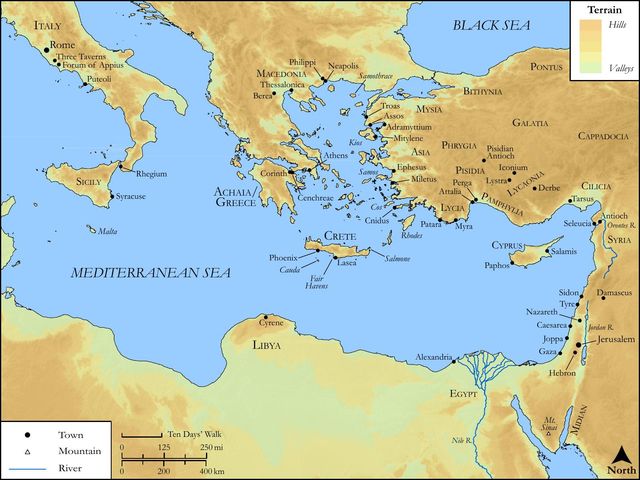
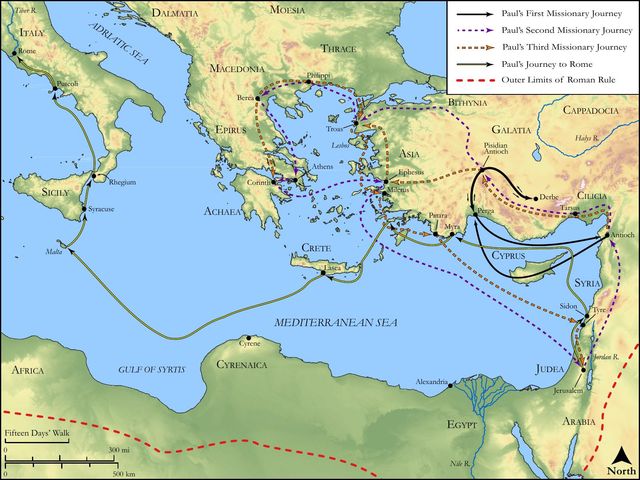
See on the biblical-era map
Study this verse
Public-domain commentary
Matthew Henry
From his Commentary on the Whole Bible. Henry comments on passages, not single verses — this entry covers Acts 25:1–12. His three-level outline is real structure in the source text, so it is rendered as structure.
We commonly say, "New lords, new laws, new customs;" but here was a new governor, and yet Paul had the same treatment from him that he had from the former, and no better. Festus, like Felix, is not so just to him as he should have been, for he does not release him; and yet not so unjust to him as the Jews would have had him to be, for he will not condemn him to die, nor expose him to their rage. Here is,
I.The pressing application which the high priest and other Jews used with the governor to persuade him to abandon Paul; for to send him to Jerusalem was in effect to abandon him.
1.See how speedy they were in their applications to Festus concerning Paul. As soon as ever he had come into the province, and had taken possession of the government, into which, probably, he was installed at Caesarea, within three days he went up to Jerusalem, to show himself there, and presently the priests were upon him to proceed against Paul. He staid three days at Caesarea, where Paul was a prisoner, and we do not find that in that time Paul made any application to him to release him, though, no doubt, he could have made good friends, that he might hope to have prevailed by; but as soon as ever he comes up to Jerusalem the priests are in all haste to make an interest with him against Paul. See how restless a thing malice is. Paul more patiently bears the lengthening out of his imprisonment than his enemies do the delay of his prosecution even to the death.
2.See how spiteful they were in their application. They informed the governor against Paul (Act 25:2) before he was brought upon a fair trial, that so they might, if possible, prejudge the cause with the governor, and make him a party who was to be the judge. But this artifice, though base enough, they could not confide in; for the governor would be sure to hear him himself, and then all their informations against him would fall to the ground; and therefore they form another project much more base, and that is to assassinate Paul before he came upon his trial. These inhuman hellish methods, which all the world profess at least to abhor, have these persecutors recourse to, to gratify their malice against the gospel of Christ, and this too under colour of zeal for Moses. Tantum religio potuit suadere malorum - such was their dire religious zeal.
3.See how specious the pretence was. Now that the governor was himself at Jerusalem they desired he would send for Paul thither, and try him there, which would save the prosecutors a great deal of labour, and looked most reasonable, because he was charged with having profaned the temple at Jerusalem, and it is usual for criminals to be tried in the court where the fact was committed; but that which they designed was to way-lay him as he was brought up, and to murder him upon the road, supposing that he would not be brought up under so strong a guard as he was sent down with, or that the officers that were to bring him up might be bribed to give them an opportunity for their wickedness. It is said, They desired favour against Paul. The business of prosecutors is to demand justice against one that they suppose to be a criminal, and, if he be not proved so, it is as much justice to acquit him as it is to condemn him if he be. But to desire favour against a prisoner, and from the judge too, who ought to be of counsel for him, is a very impudent thing. The favour ought to be for the prisoner, in favorem vitae - to favour his life, but here they desire it against him. They will take it as a favour if the governor will but condemn Paul, though they can prove no crime upon him.
II.The governor's resolution that Paul shall take his trial at Caesarea, where he now is, Act 25:4, Act 25:5. See how he manages the prosecutors.
1.He will not do them the kindness to send for him to Jerusalem; no, he gave orders that Paul should be kept at Caesarea. It does not appear that he had any suspicion, much less any certain information, of their bloody design to murder him by the way, as the chief priests had when he sent him to Caesarea (Act 23:30); but perhaps he was not willing so far to oblige the high priest and his party, or he would maintain the honour of his court at Caesarea and require their attendance there, or he was not willing to be at the trouble or charge of bringing Paul up; whatever was his reason for refusing it, God made use of it as a means of preserving Paul out of the hands of his enemies. Perhaps now they were more careful to keep their conspiracy secret than they had been before, that the discovery of it might not be now, as it was then, the defeat of it. But though God does not, as then, bring it to light, yet he finds another way, as effectual, to bring it to nought, by inclining the heart of the governor, for some other reasons, not to remove Paul to Jerusalem. God is not tied to one method, in working out salvation for his people. He can suffer the designs against them to be concealed, and yet not suffer them to be accomplished; and can make even the carnal policies of great men to serve his gracious purposes.
2.Yet he will do them the justice to hear what they have to say against Paul, if they will go down to Caesarea, and appear against him there: "Let those among you who are able, able in body and purse for such a journey, or able in mind and tongue to manage the prosecution - let those among you who are fit to be managers, go down with me, and accuse this man; or, those who are competent witnesses, who are able to prove any thing criminal upon him, let them go and give in their evidence, if there be any such wickedness in him as you charge upon him." Festus will not take it for granted, as they desire he should, that there is wickedness in him, till it is proved upon him, and he has been heard in his own defence; but, if he be guilty, it lies upon them to prove him so.
III.Paul's trial before Festus.
Festus staid at Jerusalem about ten days, and then went down to Caesarea, and the prosecutors, it is likely, in his retinue; for he said they should go down with him; and, since they are so eager in the prosecution, he is willing this cause should be first called; and, that they may hasten home, he will despatch it the next day. Expedition in administering justice is very commendable, provided more haste be not made than good speed. Now here we have,
1.The court set, and the prisoner called to the bar. Festus sat in the judgment-seat, as he used to do when any cause was brought before him that was of consequence, and he commanded Paul to be brought, and to make his appearance, Act 25:6. Christ, to encourage his disciples and keep up their spirits under such awful trials of their courage as this was to Paul, promised them that the day should come when they should sit on thrones, judging the tribes of Israel.
2.The prosecutors exhibiting their charges against the prisoner (Act 25:7): The Jews stood round about, which intimates that they were many. Lord, how are they increased that trouble me! It intimates also that they were unanimous, they stood by one another, and resolved to hold together; and that they were intent upon the prosecution, and eager in clamouring against Paul. They stood round about, if possible, to frighten the judge into a compliance with their malicious design, or, at least, to frighten the prisoner, and to put him out of countenance; but in vain: he had too just and strong an assurance to be frightened by them. They compassed me about like bees, but they are quenched as the fire of thorns, Psa 118:12. When they stood round about him, they brought many and grievous accusations against Paul, so it should be read. They charged him with high crimes and misdemeanors. The articles of impeachment were many, and contained things of a very heinous nature. They represented him to the court as black and odious as their wit and malice could contrive; but when they had opened the cause as they thought fit, and came to the evidence, there they failed: they could not prove what they alleged against him, for it was all false, and the complaints were groundless and unjust. Either the fact was not as they opened it, or there was no fault in it; they laid to his charge things that he knew not, nor they neither. It is no new thing for the most excellent ones of the earth to have all manner of evil said against them falsely, not only in the song of the drunkards, and upon the seat of the scornful, but even before the judgment-seat.
3.The prisoner's insisting upon his own vindication, Act 25:8. Whoever reproaches him, his own heart does not, and therefore his own tongue shall not; though he die, he will not remove his integrity from him. When it came to his turn to speak for himself, he insisted upon his general plea, Not guilty: Neither against the law of the Jews, nor against the temple, nor yet against Caesar, have I offended any thing at all.
(1.)He had not violated the law of the Jews, nor taught any doctrine destructive of it. Did he make void the law by faith? No, he established the law. Preaching Christ, the end of the law, was no offence against the law.
(2.)He had not profaned the temple, nor put any contempt at all upon the temple-service; his helping to set up the gospel temple did not at all offend against that temple which was a type of it.
(3.)He had not offended against Caesar, nor his government. By this it appears that now his cause being brought before the government, to curry favour with the governor and that they might seem friends to Caesar, they had charged him with some instances of disaffection to the present higher powers, which obliged him to purge himself as to that matter, and to protest that he was no enemy to Caesar, not so much as those were who charged him with being so.
IV.Paul's appeal to the emperor, and the occasion of it.
This gave the cause a new turn. Whether he had before designed it, or whether it was a sudden resolve upon the present provocation, does not appear; but God puts it into his heart to do it, for the bringing about of that which he had said to him, that he must bear witnesss to Christ at Rome, for there the emperor's court was, Act 23:11. We have here,
1.The proposal which Festus made to Paul to go and take his trial at Jerusalem, Act 25:9. Festus was willing to do the Jews a pleasure, inclined to gratify the prosecutors rather than the prisoner, as far as he could go with safety against one that was a citizen of Rome, and therefore asked him whether he would be willing to go up to Jerusalem, and clear himself there, where he had been accused, and where he might have his witnesses ready to vouch for him and confirm what he said. He would not offer to turn him over to the high priest and the sanhedrim, as the Jews would have had him; but, Wilt thou go thither, and be judged of these things before me? The president, if he had pleased, might have ordered him thither, but he would not do it without his own consent, which, if he could have wheedled him to give it, would have taken off the odium of it. In suffering times, the prudence of the Lord's people is tried as well as their patience; being sent forth therefore as sheep in the midst of wolves, they have need to be wise as serpents.
2.Paul's refusal to consent to it, and his reasons for it. He knew, if he were removed to Jerusalem, notwithstanding the utmost vigilance of the president, the Jews would find some means or other to be the death of him; and therefore desires to be excused, and pleads,
(1.)That, as a citizen of Rome, it was most proper for him to be tried, not only by the president, but in that which was properly his court, which sat at Caesarea: I stand at Caesar's judgment-seat, where I ought to be judged, in the city which is the metropolis of the province. The court being held in Caesar's name, and by his authority and commission, before one that was delegated by him, it might well be said to be his judgment seat, as, with us, all writs run in the name of the sovereign, in whose name all courts are held. Paul's owning that he ought to be judged at Caesar's judgment-seat plainly proves that Christ's ministers are not exempted from the jurisdiction of the civil powers, but ought to be subject to them, as far as they can with a good conscience; and, if they be guilty of a real crime, to submit to their censure; if innocent, yet to submit to their enquiry, and to clear themselves before them.
(2.)That, as a member of the Jewish nation, he had done nothing to make himself obnoxious to them: To the Jews have I done no wrong, as thou very well knowest. It very well becomes those that are innocent to plead their innocency, and to insist upon it; it is a debt we owe to our own good name, not only not to bear false witness against ourselves, but to maintain our own integrity against those who bear false witness against us.
(3.)That he was willing to abide by the rules of the law, and to let that take its course, Act 25:11. If he be guilty of any capital crime that deserves death, he will not offer either to make resistance or to make his escape, will neither flee from justice nor fight with it: "I refuse not to die, but will accept of the punishment of my iniquity." Not that all who have committed any thing worthy of death are obliged to accuse themselves, and offer themselves to justice; but, when they are accused and brought to justice, they ought to submit, and to say both God and the government are righteous; as it is necessary that some should be made examples. But, if he be innocent, as he protests he is, "If there be none of these things whereof these accuse me, - if the prosecution be malicious and they are resolved to have my blood right or wrong, - no man may deliver me unto them, no, not the governor himself, without palpable injustice; for it is his business as much to protect the innocent as to punish the guilty;" and he claims his protection.
3.His appealing to court. Since he is continually in danger of the Jews, and one attempt made after another to get him into their hands, whose tender mercies were cruel, he flies to the dernier resort - the last refuge of oppressed innocency, and takes sanctuary there, since he cannot have justice done him in any other way: "I appeal unto Caesar. Rather than be delivered to the Jews" (which Festus seems inclined to consent to) "let me be delivered to Nero." When David had divers times narrowly escaped the rage of Saul, and concluded he was such a restless enemy that he should one day perish by his hands, he came to this resolution, being in a manner compelled to it, There is nothing better for me than to take shelter in the land of the Philistines, Sa1 27:1. So Paul here. But it is a hard case that a son of Abraham must be forced to appeal to a Philistine, to a Nero, from those who call themselves the seed of Abraham, and shall be safer in Gath or Rome than in Jerusalem. How is the faithful city become a harlot!
V.The judgment given upon the whole matter.
Paul is neither released nor condemned. His enemies hoped the cause would be ended in his death; his friends hoped it would be ended in his deliverance; but it proved neither so nor so, they are both disappointed, the thing is left as it was. It is an instance of the slow steps which Providence sometimes takes, not bringing things to an issue so soon as we expect, by which we are often made ashamed both of our hopes and of our fears, and are kept still waiting on God. The cause had before been adjourned to another time, now to another place, to another court, that Paul's tribulation might work patience.
1.The president takes advice upon the matter: He conferred with the council - meta tou sumbouliou, not with the council of the Jews (that is called sunedrion), but with his own counsellors, who were always ready to assist the governor with their advice. In multitude of counsellors there is safety; and judges should consult both with themselves and others before they pass sentence.
2.He determines to send him to Rome. Some think Paul meant not an appeal to Caesar's person, but only to his court, the sentence of which he would abide by, rather than be remitted to the Jew's council, and that Festus might have chosen whether he would have sent him to Rome, or, at least, whether he would have joined issue with him upon the appeal. But it should seem, by what Agrippa said (Act 26:32), that he might have been set at liberty if he had not appealed to Caesar - that, by the course of the Roman law, a Roman citizen might appeal at any time to a superior court, even to the supreme, as causes with us are removed by certiorari, and criminals by habeas corpus, and as appeals are often made to the house of peers. Festus, therefore, either of choice or of course, comes to this resolution: Hast thou appealed unto Caesar? Unto Caesar thou shalt go. He found there was something very extraordinary in the case, which he was therefore afraid of giving judgment upon, either one way or other, and the knowledge of which he thought would be an entertainment to the emperor, and therefore he transmitted it to his cognizance. In our judgment before God those that by justifying themselves appeal to the law, to the law they shall go, and it will condemn them; but those that by repentance and faith appeal to the gospel, to the gospel they shall go, and it will save them.
Historical interpretation
Historical reception
2 surviving comments on this verse. Each one is dated, so this reads as a timeline rather than a list.
While as yet he had not got acquainted with the Jews, nor experienced the honor paid to him by them, he answered rightly: but now that he had been in Jerusalem ten days, he too wants to pleasure them by sacrificing Paul to them: then, also to receive Paul, "Wilt thou," says he, "be judged there of these things by me?" I am not giving thee up to them - but this was the fact - and he leaves the point to his own choice, that by this mark of respect he might get him to yield: since his was the sentence, and it would have been too barefaced, when he had been convicted of nothing here, to take him back thither.
But after they came down, they forthwith made their accusations shamelessly and with more vehemence: and not having been able to convict him on grounds relating to the Law, they again according to their custom stirred the question about Caesar, being just what they did in Christ's case. For that they had recourse to this is manifest by the fact, that Paul defends himself on the score of offences against Caesar.
Continue studying Acts 25:8 across the web’s major study libraries — every link below opens this exact verse, chapter, or book on the destination site.
Read & Compare
 BibleGatewayThis verse in more than 200 translations and 70 languages.
 Bible.comThe YouVersion reader — hundreds of translations, reading plans, and highlights.
 ESV.orgCrossway's official English Standard Version reader.
 NET BibleThe NET translation with 60,000+ translators' notes on every rendering decision.
 STEP BibleTyndale House's free study tool — original text, vocabulary, and scholarly resources.
 BibliaLogos Bible Software's free web reader.
 USCCBThe New American Bible (Revised Edition) with the U.S. bishops' study notes.
Commentaries
 BibleHub CommentariesDozens of classic commentaries on this verse, gathered on one page.
 StudyLightMore than 100 commentary sets — the largest collection on the web.
 BibleRefPlain-English commentary on what this verse means, verse by verse.
 Enduring WordDavid Guzik's free commentary on this chapter, widely used by Bible teachers.
 Bible Study ToolsVerse commentary alongside Greek and Hebrew study aids.
Original Language & Research
- BibleHub InterlinearThe verse word by word — original language, transliteration, and English.
- BibleHub LexiconEvery word's original-language definition and Strong's entry.
 Blue Letter BibleDeep-study tools — Strong's numbers, concordance, and word studies.
 CNTR CollationThe earliest Greek manuscripts of this verse, collated letter by letter.
Sermons, Hymns & Audio


TrulyRandomVerse is not affiliated with these sites and doesn’t control their content. They’re linked because they’re genuinely useful.
Summary
Acts 25:8 encapsulates the Apostle Paul's resolute and comprehensive defense before Porcius Festus, the Roman governor, in Caesarea. During this pivotal trial, Paul unequivocally asserts his innocence against the grave accusations leveled by the Jewish leaders, declaring that his actions have in no way violated the sacred Jewish Law, defiled the revered Temple, nor committed any offense against the authority of Caesar, thereby maintaining his integrity and blamelessness in all spheres.
Context
ShowHideLiterary Context
This verse is situated within a protracted period of Paul's imprisonment and trials, following his arrest in Jerusalem and subsequent transfer to Caesarea. The immediate literary context involves Festus, the newly appointed Roman governor, arriving in Judea and seeking to establish good relations with the Jewish leadership. The Jewish high priest and leading men from Jerusalem had traveled to Caesarea to press their charges against Paul, accusing him of sedition, profaning the Temple, and being a ringleader of the Nazarene sect (Acts 24:5-6). Festus, perhaps hoping to appease the Jews, offered to try Paul in Jerusalem, but Paul, recognizing the danger, appealed to Caesar, leading to this formal hearing where he reiterates his defense. This specific verse summarizes Paul's concise rebuttal to the three primary categories of accusations.
Historical & Cultural Context
Paul's trial unfolds within the complex political and religious landscape of first-century Roman Judea. The Roman Empire governed the region, but Jewish religious law (Torah) and institutions, particularly the Temple in Jerusalem, held immense cultural and spiritual significance for the Jewish people. Accusations against Paul touched on all these sensitive areas: violating Jewish law (a matter for the Sanhedrin but with Roman oversight), defiling the Temple (a capital offense in Jewish law, often requiring Roman intervention), and sedition against Caesar (a direct challenge to Roman authority, punishable by death). Paul's defense, therefore, was not merely a legalistic one but a strategic declaration of his loyalty to both his Jewish heritage (as he understood it in light of Christ) and the Roman state, while simultaneously affirming his innocence of any wrongdoing.
Key Themes
ShowHideActs 25:8 powerfully contributes to several overarching themes within the book of Acts and beyond. Firstly, it highlights Paul's unwavering integrity and commitment to truth. Despite facing persistent and often life-threatening opposition, Paul consistently maintains his blamelessness, not out of self-righteousness, but as a testament to the lawful and non-seditious nature of the Gospel he preaches. Secondly, the verse underscores the theme of false accusations and unjust suffering endured by early Christians. Paul's accusers were motivated by religious jealousy and misunderstanding, mirroring the unjust trials faced by Jesus himself (Matthew 26:59-60). Finally, Paul's defense demonstrates a profound respect for established authority, both religious and civil. While his ultimate allegiance is to Christ, he navigates the legal systems of his day with dignity, appealing to the law and to Caesar's justice, a principle he would later articulate in his epistles, such as in Romans 13:1-7.
Exposition and Analysis
ShowHideKey Word Analysis
ShowHideThis verb means "to give an account (legal plea) of oneself, to exculpate oneself, to make a defense." It signifies a formal, legal self-vindication. Paul is not merely explaining but actively defending himself against specific charges, presenting a reasoned and lawful rebuttal. This word emphasizes the forensic nature of the setting.
Referring to the Mosaic Law, or the Torah, this term encompasses the entire body of Jewish religious and moral regulations. Paul's denial of offending against the "law of the Jews" means he claimed not to have violated any of its commandments, particularly as interpreted by the Jewish authorities, even though his understanding of the law was transformed by Christ.
This word fundamentally means "to miss the mark," and figuratively, "to err, especially (morally) to sin or trespass." Paul's use of this term here is a strong, absolute declaration that he has committed no wrong, no sin, no transgression, no error, against any of the three named authorities. It's a comprehensive denial of guilt.
Verse Breakdown
ShowHide"While he answered for himself"
This phrase sets the scene, indicating Paul's active and personal defense. He is not relying on an advocate but is directly addressing the charges and the governor, demonstrating his confidence and the clarity of his conscience.
"Neither against the law of the Jews"
Paul first addresses the religious accusations. He asserts that his preaching and actions, including his interactions with Gentiles and his understanding of the Gospel, have not constituted a violation of the Torah, the foundational legal and religious code for the Jewish people. This directly refutes the claims that he taught Jews to forsake Moses.
"neither against the temple"
This clause directly refutes the specific charge of profaning the Temple. Paul denies any act that would desecrate the sacred precinct, such as bringing Gentiles into forbidden areas, which was a capital offense. His presence in the Temple was for a purification rite, not for defilement.
"nor yet against Caesar"
This is a crucial denial of political sedition. Paul explicitly states he has committed no act of rebellion or disloyalty against the Roman emperor or the Roman state. This counters any accusation that he was stirring up unrest or promoting a rival kingdom, which would be a grave charge in Roman law.
"have I offended any thing at all"
This concluding phrase serves as a powerful, absolute summation of Paul's innocence. The Greek emphasizes the totality of his blamelessness—"not a single thing" has he done wrong. It's a sweeping denial that covers all possible interpretations of the accusations against him.
Literary Devices
ShowHideThe verse employs several significant literary devices. Repetition is prominent with the triple negative "Neither... neither... nor yet against," which serves to emphasize the comprehensive nature of Paul's denial. This rhetorical device underscores his absolute innocence across all categories of accusation: religious law, sacred space, and civil authority. Furthermore, the verse utilizes Legal Language and Forensic Rhetoric, characteristic of a courtroom setting. Paul's concise, declarative statements are typical of a defendant presenting a clear and unambiguous plea. The structure of his defense, systematically addressing and refuting each charge, demonstrates a logical and persuasive Assertion of truth against false claims.
Theological and Thematic Connections
ShowHidePaul's defense in Acts 25:8 is more than a legal maneuver; it is a profound theological statement about the nature of the Gospel and the conduct of its adherents. His declaration of innocence highlights that the Christian faith, properly understood and lived, does not inherently contradict established laws or legitimate authorities, whether religious or civil. Rather, it transcends and fulfills them, operating on a higher principle of righteousness that is not bound by human systems but often aligns with their best intentions. Paul's blamelessness, though unrecognized by his accusers, underscores the truth that living according to Christ's teachings leads to a life of integrity, even when facing persecution. This commitment to truth and lawful conduct, even unto suffering, becomes a powerful witness to the transformative power of the Gospel.
Reflection and Application
ShowHideActs 25:8 offers a timeless model for believers navigating a world that may misunderstand or even oppose their faith. Paul's unwavering commitment to truth and his clear conscience in the face of false accusations challenge us to live lives of integrity that are above reproach. Our actions, words, and intentions should be so aligned with Christ's teachings that, even if accused, we can honestly declare our blamelessness regarding any genuine offense against God's law or human justice. This does not mean avoiding all conflict, but rather ensuring that any suffering we endure is "for righteousness' sake," not for actual wrongdoing. Paul's example also reminds us of the importance of respecting legitimate authority, even when that authority is flawed or used unjustly. Our witness is often strengthened when we demonstrate how our faith enables us to be good citizens and neighbors, seeking the welfare of our communities while remaining faithful to our ultimate calling. In moments of trial, Paul's resolute defense encourages us to stand firm, trusting that God is sovereign and will use even our difficult circumstances to advance His purposes, just as He promised Paul he would bear witness in Rome (Acts 23:11).
Questions for Reflection
ShowHideFAQ
ShowHideWhat was the significance of Paul's triple denial of offense against the Law, the Temple, and Caesar?
ShowHidePaul's triple denial was strategically significant because it directly addressed the three primary categories of accusations brought against him by the Jewish leaders, each carrying severe implications. By denying offense against "the law of the Jews," he countered the charge of apostasy or undermining Jewish tradition, which was a religious grievance. His denial regarding "the temple" refuted the accusation of profaning the sacred Jewish sanctuary, a capital offense in Jewish law that often led to mob violence or Roman intervention. Finally, his denial of offense against "Caesar" was a crucial refutation of sedition, a political charge that could lead to execution under Roman law. Paul's comprehensive denial demonstrated that his actions were neither religiously heretical nor politically rebellious, effectively stripping his accusers of any legitimate grounds for conviction under either Jewish or Roman jurisdiction. This strategic defense aimed to show that his only "crime" was his belief in Jesus as the Messiah, which was not an offense against any established law.
Christ-Centered Fulfillment
ShowHidePaul's unwavering declaration of innocence in Acts 25:8 resonates deeply with the perfect blamelessness of Jesus Christ, who is the ultimate fulfillment of all righteousness. Like Paul, Jesus faced relentless false accusations from religious and political authorities, yet He "committed no sin, neither was deceit found in his mouth" (1 Peter 2:22). While Paul was a faithful servant seeking to live righteously under the law, Jesus Himself perfectly fulfilled the Law (Matthew 5:17) and was the spotless Lamb of God, unjustly condemned despite Pilate's declaration of His innocence (John 19:4). Paul's defense, though a human effort, points to the divine truth that the Kingdom of God, which he proclaimed, does not operate by earthly rebellion or lawbreaking, but by spiritual transformation. Jesus's innocent suffering and death, not His political overthrow, established a new covenant, demonstrating that true victory comes through righteousness and self-sacrifice, providing the ultimate example for all who are falsely accused for His name's sake.