


2 Samuel 23:37
Bible text: King James Version (1769 Blayney text) · Public domain
Bible text: King James Version with Strong's numbers · Public domain
Bible text: Berean Standard Bible · Public domain
Bible text: American Standard Version (1901) · Public domain
Bible text: World English Bible, Messianic edition · Public domain
Bible text: Geneva Bible (1599) · Public domain
Bible text: Young's Literal Translation · Public domain
- צֶלֶקTze·lekZelekH6768N-proper-mNoun Proper Masculine
- הָעַמֹּנִיha·'a·mo·Nithe AmmoniteH5984Art ¦ N-msNoun Gentilic Singular Masculine AbsoluteהָtheעַמֹּנִיAmmonite
- נַחְרַיnach·RaiNaharaiH5171N-proper-mNoun Proper Masculine
- הַבְּאֵרֹתִיha·be·'E·ro·Tithe BeerothiteH886Art ¦ N-msNoun Gentilic Singular Masculine AbsoluteהַtheבְּאֵרֹתִיBeerothite
- נֹשֵׂאno·se·'ei'[the] bearer ofH5375V-Qal-Prtcpl-msVerb Qal Participle Singular Masculine Construct
- כְּלֵיke·Lei[the] armor<s> ofH3627N-mpcNoun Plural Masculine Construct
- יוֹאָבyo·'AvJoabH3097N-proper-mNoun Proper Masculine
- בֶּןben[the] son ofH1121N-mscNoun Singular Masculine Construct
- צְרֻיָהtze·ru·YahZeruiahH6870N-proper-fNoun Proper Feminine
English is a literal word-by-word gloss of the Hebrew, not the KJV's wording. Why?
This is the original text the KJV's translators worked from — each Hebrew word with its own literal English meaning in this verse, prepared by scholars at Tyndale House, Cambridge. The KJV translates whole sentences, not word by word, so its wording differs: one Hebrew word can become several English words, and the KJV may choose “the LORD” where the gloss reads “Yahweh”. Both are faithful — they answer different questions. For the KJV's own rendering, switch to the KJV text.
Details
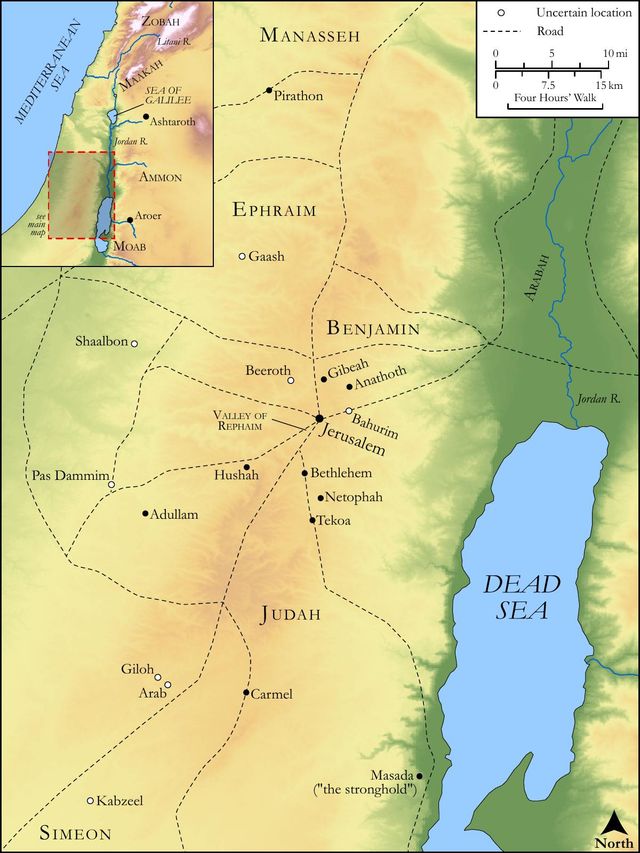
See on the biblical-era maps

Study this verse
Continue studying 2 Samuel 23:37 across the web’s major study libraries — every link below opens this exact verse, chapter, or book on the destination site.
Read & Compare
 BibleGatewayThis verse in more than 200 translations and 70 languages.
 Bible.comThe YouVersion reader — hundreds of translations, reading plans, and highlights.
 ESV.orgCrossway's official English Standard Version reader.
 NET BibleThe NET translation with 60,000+ translators' notes on every rendering decision.
 STEP BibleTyndale House's free study tool — original text, vocabulary, and scholarly resources.
 BibliaLogos Bible Software's free web reader.
 USCCBThe New American Bible (Revised Edition) with the U.S. bishops' study notes.
Commentaries
 BibleHub CommentariesDozens of classic commentaries on this verse, gathered on one page.
 StudyLightMore than 100 commentary sets — the largest collection on the web.
 BibleRefPlain-English commentary on what this verse means, verse by verse.
 Enduring WordDavid Guzik's free commentary on this chapter, widely used by Bible teachers.
 Bible Study ToolsVerse commentary alongside Greek and Hebrew study aids.
Original Language & Research
- BibleHub InterlinearThe verse word by word — original language, transliteration, and English.
- BibleHub LexiconEvery word's original-language definition and Strong's entry.
 Blue Letter BibleDeep-study tools — Strong's numbers, concordance, and word studies.
 SefariaThe Hebrew text with Rashi and centuries of Jewish commentary.
Sermons, Hymns & Audio


TrulyRandomVerse is not affiliated with these sites and doesn’t control their content. They’re linked because they’re genuinely useful.
Summary
2 Samuel 23:37 introduces two significant figures among King David's elite warriors, "the Mighty Men": Zelek the Ammonite and Naharai the Beerothite, who served as the armourbearer to Joab, David's formidable military commander. This verse, part of an esteemed honor roll, not only highlights the diverse origins of David's most loyal supporters but also profoundly underscores the critical importance of both prominent and supportive roles in achieving national success and fulfilling divine purposes within God's unfolding plan.
Context
ShowHideLiterary Context
This verse is strategically placed within a crucial appendix to the book of 2 Samuel, specifically in the passage detailing "David's Mighty Men" (2 Samuel 23:8-39). This comprehensive list functions as a "roll of honor," meticulously cataloging the most valiant and unwavering warriors who served King David throughout his extensive reign. Its primary purpose is to serve as a powerful testament to the strength, dedication, and divine favor bestowed upon David's kingdom, showcasing the exceptional bravery and faithfulness of individuals whose contributions were foundational to his military triumphs and the overall stability of his rule. A parallel, though not entirely identical, account of these heroes is also meticulously preserved in 1 Chronicles 11:10-47. The deliberate placement of this distinguished list near the culmination of David's narrative arc emphasizes the indispensable role these men played in both establishing and meticulously maintaining his kingdom, serving as a poignant and enduring tribute to their unwavering commitment and extraordinary valor.
Historical & Cultural Context
The inclusion of Zelek the Ammonite within this elite cadre is particularly striking and culturally significant, given the deeply entrenched historical animosity between Israel and Ammon. The Ammonites, descendants of Lot through his younger daughter (Genesis 19:38), were perennial adversaries of Israel, frequently engaging in fierce conflicts (e.g., Judges 10:6-9 and 1 Samuel 11:1-11). Zelek's presence among David's most trusted warriors speaks volumes about David's exceptional leadership and his remarkable ability to integrate diverse peoples into his service, thereby transcending traditional ethnic and national boundaries. Naharai the Beerothite's identity also carries considerable historical weight; Beeroth was one of the four Gibeonite cities, a people who had famously secured a covenant with Joshua through deception (Joshua 9). Though initially condemned to perpetual servitude, their presence in Israel's history was firmly established. The role of an armourbearer was one of profound trust and intimate proximity to a military leader. An armourbearer was responsible for carrying the commander's weapons, protecting him in the chaos of battle, and often serving as a personal attendant and confidant. This position was absolutely vital, demanding absolute loyalty, exceptional courage, and considerable skill, as the armourbearer was frequently the last line of defense for their esteemed leader. Joab, David's nephew, was David's long-serving, often ruthless, and highly effective commander of the army (e.g., 2 Samuel 8:16).
Key Themes
ShowHideThis verse, meticulously situated within the broader context of David's Mighty Men, contributes significantly to several overarching themes within the biblical narrative. Firstly, it powerfully illustrates the theme of divine sovereignty and radical inclusion, demonstrating God's remarkable ability to providentially use individuals from unexpected and even traditionally hostile backgrounds to accomplish His grand purposes. Zelek's presence among the elite points to a broader, more expansive vision of God's kingdom that transcends rigid ethnic boundaries, profoundly foreshadowing the eventual and glorious inclusion of Gentiles into the covenant community. Secondly, it emphasizes the enduring theme of unwavering loyalty and faithful service. The entire list of Mighty Men serves as a profound celebration of individuals who demonstrated unwavering devotion to David and his kingdom, often at immense personal risk and sacrifice. Their names are meticulously preserved as an enduring testament to their profound commitment and valor. Thirdly, the specific mention of Naharai as an armourbearer powerfully underscores the indispensable importance of supportive roles. While not a prominent commander, Naharai's position was absolutely crucial, illustrating that victory, success, and the flourishing of the kingdom are achieved not solely by prominent leaders but also, and equally, through the diligent, faithful, and often unsung service of those who support them from behind the scenes. This theme resonates deeply with the New Testament concept of the body of Christ, where every single member, regardless of perceived prominence, is utterly indispensable and vital to the whole, as profoundly articulated in 1 Corinthians 12:12-27.
Exposition and Analysis
ShowHideKey Word Analysis
ShowHideThis term, derived from H5984, denotes a descendant of Ammon, the son of Lot, and specifically refers to a member of the Ammonite nation, historically situated east of the Jordan River. The Ammonites were notorious for their bitter enmity towards Israel, frequently engaging in warfare and often associated with idolatrous practices, particularly the abhorrent worship of Molech. Zelek's identity as an Ammonite is profoundly significant, as it powerfully demonstrates David's unique capacity to integrate individuals from traditionally hostile nations into the very core of his military and administrative elite. This inclusion highlights a remarkable degree of trust and loyalty that transcended deep-seated ethnic and historical animosities.
This term, derived from H886, refers to an inhabitant of Beeroth, one of the four Gibeonite cities mentioned in Joshua 9:17. The Gibeonites famously secured a covenant with Israel through deception during Joshua's conquest, resulting in their perpetual servitude as "hewers of wood and drawers of water" (Joshua 9:27). Naharai's identity as a Beerothite indicates his lineage from this group, who, despite their initial deceptive entry into Israel's sphere, became a recognized, albeit subservient, part of the nation. His elevation to the prestigious and highly trusted role of Joab's armourbearer signifies a remarkable ascent from the Gibeonites' original status, showcasing the potential for individuals from even overlooked groups to achieve positions of honor and vital service within David's kingdom based on their proven faithfulness and capability.
This compound role is derived from two key Hebrew words. nâsâʼ (H5375) means "to lift, bear, carry," indicating the act of carrying or bearing something. kᵉlîy (H3627) refers to "something prepared, i.e., any apparatus (as an implement, utensil, dress, vessel or weapon)," with "armour" being a specific application. Together, these terms describe one who bears or carries weapons and equipment for a commander. This position was not merely menial; it signified a highly trusted personal assistant responsible for ensuring the commander's readiness in battle, protecting him, and often fighting alongside him. The armourbearer was intimately familiar with the commander's needs and often served as a close confidant, making it a role demanding exceptional loyalty, courage, and skill.
Verse Breakdown
ShowHide"Zelek the Ammonite"
This phrase immediately introduces an individual whose very identity challenges conventional expectations and historical norms. Zelek, an Ammonite, represents a people group with a long, bitter history of antagonism and conflict towards Israel. His inclusion among David's elite "Mighty Men" signifies a profound and radical breaking of ethnic and national barriers, powerfully demonstrating David's unique leadership that could inspire deep loyalty even from former adversaries. It implicitly testifies to a kingdom whose strength and success were not solely derived from ethnic purity but from the diverse valor, skill, and unwavering commitment of its loyal subjects, potentially foreshadowing God's broader redemptive plan for the inclusion of all nations.
"Naharai the Beerothite"
This clause identifies another distinguished member of David's elite corps, Naharai, whose origin from Beeroth links him directly to the Gibeonites. While the Gibeonites were initially bound to a status of perpetual servitude within Israel, Naharai's prominent presence in this esteemed list indicates that individuals from this lineage could indeed rise to positions of significant trust, honor, and responsibility within David's administration. His inclusion powerfully underscores the principle that faithfulness, proven capability, and unwavering loyalty, rather than solely lineage or initial social standing, were paramount criteria for service in David's inner circle and for contributing to the kingdom's success.
"armourbearer to Joab the son of Zeruiah"
This final clause precisely specifies Naharai's crucial and highly responsible role. An armourbearer was far more than a mere servant; this was a highly trusted personal assistant, directly responsible for carrying a commander's weapons, actively protecting him in the heat of battle, and often serving as a close confidant and last line of defense. This position demanded exceptional courage, unwavering loyalty, and considerable skill in combat. By serving Joab, David's formidable, often ruthless, and highly effective commander-in-chief, Naharai held a vital, if supporting, position at the very heart of Israel's military power. This highlights the profound truth that victory and the overall success of the kingdom depended not only on the prowess and strategic genius of its prominent leaders but also, and equally, on the indispensable, diligent, and faithful service of those in supportive, yet critically important, roles.
Literary Devices
ShowHideThe primary literary device at play in 2 Samuel 23:37, and indeed throughout the entire list of David's Mighty Men, is the Honorific List or Roll of Honor. This device serves to immortalize and celebrate the exceptional bravery, unwavering loyalty, and dedicated service of individuals who contributed profoundly to the establishment and stability of David's reign. By meticulously naming each man and often detailing a specific heroic feat (though not explicitly in this particular verse), the text elevates their status, ensures their enduring legacy, and provides a lasting tribute to their valor. Furthermore, there is a subtle but powerful element of Juxtaposition in the inclusion of Zelek the Ammonite. This contrasts the deeply ingrained historical enmity between Israel and Ammon with Zelek's loyal and dedicated service to David. This striking contrast subtly highlights David's trust in faithful foreigners, as well as the surprising breadth of his kingdom. Finally, the collective presence of these diverse men within the list employs Symbolism, where their combined strength, varied origins, and unified purpose symbolize the divine favor and providential hand that both established and sustained David's kingdom, powerfully demonstrating that God can indeed use a wide array of individuals, from all backgrounds, to accomplish His grand and sovereign purposes.
Theological and Thematic Connections
ShowHide2 Samuel 23:37 offers profound theological insights into the expansive nature of God's kingdom and the divine value placed on faithful service in all its forms. The inclusion of Zelek the Ammonite, originating from a nation historically hostile to Israel, powerfully illustrates God's sovereign ability to transcend human divisions, prejudices, and historical animosities, utilizing individuals from any background for His redemptive purposes. This inclusion profoundly foreshadows the New Testament revelation of God's universal redemptive plan, where ethnicity, nationality, and past enmities are no longer barriers to belonging in God's family. Similarly, Naharai the Beerothite's role as Joab's armourbearer emphasizes the divine value placed on all forms of service, particularly those supportive roles that may not receive public acclaim but are, nonetheless, indispensable to the overall mission and flourishing of God's work. God values faithfulness and dedication in every calling, reminding us that every member of His body is crucial and contributes uniquely to His glory.
Reflection and Application
ShowHideThe profound narrative of Zelek and Naharai, enshrined in this ancient honor roll, challenges us to critically re-evaluate our own perceptions of who God can use and the diverse ways in which He chooses to accomplish His will. Zelek's unexpected presence among David's elite warriors encourages us to look beyond conventional boundaries, societal prejudices, and historical enmities, recognizing that God's kingdom is infinitely more inclusive and expansive than our limited human constructs often allow. It calls us to actively embrace and celebrate diversity within the body of Christ, welcoming, valuing, and integrating those from vastly different backgrounds, cultures, and pasts, understanding that God's transformative grace unites and empowers all. Naharai's vital role as an armourbearer serves as a powerful reminder that every single position, no matter how seemingly secondary, "behind-the-scenes," or lacking in public visibility, is utterly vital and indispensable in God's divine economy. Faithfulness and diligence in supportive roles are just as crucial as prominent leadership, and all contributions, when rendered unto the Lord, are seen, valued, and eternally remembered by God. This verse inspires us to serve diligently and with excellence in whatever capacity we are called, knowing that our service, when offered with a heart of devotion, contributes directly to the greater work of His kingdom and brings Him profound glory. It prompts us to intentionally honor, appreciate, and uplift those who serve faithfully in less visible, yet absolutely critical, roles within our churches, communities, and families.
Questions for Reflection
ShowHideFAQ
ShowHideWhy is an Ammonite included in David's Mighty Men, given Israel's history with the Ammonites?
ShowHideThe inclusion of Zelek the Ammonite in David's elite forces is profoundly significant and points to several deep theological truths. Firstly, it powerfully demonstrates David's remarkable leadership and his extraordinary ability to inspire loyalty and devotion across traditional ethnic and national divides. David's kingdom, though rooted in Israel, showed a surprising and forward-looking capacity for universal reach. Secondly, it reflects God's sovereign hand at work, showing that He can providentially use anyone, regardless of their background or the historical enmity of their people, to accomplish His divine purposes. This inclusion powerfully foreshadows the broader New Testament theme of radical Gentile inclusion into God's family, a truth profoundly articulated in Ephesians 2:11-22. Zelek's presence suggests that even in the Old Testament, God's redemptive plan was not exclusively confined to one nation, but had a universal scope, welcoming those who would commit themselves faithfully to His chosen king.
What was the significance of Naharai's role as an armourbearer to Joab?
ShowHideThe role of an armourbearer was far more than simply carrying weapons; it was a position of immense trust, intimacy, and vital importance in ancient warfare. An armourbearer was a close personal attendant, a dedicated protector, and often a confidant to a military commander. They were directly responsible for ensuring their leader had the right weapons at the right time, protecting him fiercely in the chaos of battle, and often fighting bravely alongside them, serving as the last line of defense. This role demanded exceptional courage, considerable skill in combat, and unwavering loyalty. For Naharai, a Beerothite (from the Gibeonite lineage, a group historically bound to servitude), to hold such a highly trusted and critical position under Joab, David's formidable chief commander, profoundly underscores the value placed on his proven faithfulness, competence, and reliability. It highlights that success in battle and in the grand work of building a kingdom depended not only on the strategic genius and prowess of its prominent leaders but also, and equally, on the indispensable and often unsung contributions of those in supportive, yet absolutely critical, roles.
Christ-Centered Fulfillment
ShowHide2 Samuel 23:37, with its vivid portrayal of Zelek the Ammonite and Naharai the Beerothite serving faithfully in David's elite corps, powerfully foreshadows the expansive, inclusive, and unified nature of Christ's eternal kingdom. Just as David, who serves as a significant type of the Messiah, gathered loyal followers from diverse and even traditionally hostile backgrounds, so too does Christ establish a spiritual kingdom that transcends all earthly divisions of ethnicity, nationality, social status, and past allegiances. Zelek, an Ammonite, serving the King of Israel, prefigures the radical and glorious inclusion of Gentiles into the very family of God, a profound truth supremely revealed in the New Testament where Christ, through His atoning work, "has broken down in his flesh the dividing wall of hostility" between Jew and Gentile, creating one new humanity (Ephesians 2:14). Naharai, the Beerothite armourbearer, highlights the intrinsic value of every single member and every unique role within God's kingdom. In Christ, there is no insignificant part; every believer, regardless of their background, perceived prominence, or the visibility of their service, is a vital, cherished, and indispensable member of the body of Christ, essential to its healthy functioning and global mission (1 Corinthians 12:27). Ultimately, the unwavering loyalty of these men to King David points to the ultimate and supreme loyalty we owe to Christ, the true and eternal King, under whom people "from every tribe and language and people and nation" will joyfully serve, worship, and reign with Him forever (Revelation 7:9).