


2 Samuel 19:6
- לְאַהֲבָהle·'a·ha·Vahby lovingH157Prep-l ¦ V-Qal-InfVerb Qal Infinitive Constructלְbyאַהֲבָהloving
- אֶת'et<obj.>H853DirObjMParticle Object Indicator
- שֹׂנְאֶיךָso·ne·'Ei·kha[those who] hate youH8130V-Qal-Prtcpl-mp ¦ 2msVerb Qal Participle Plural Masculine Constructשֹׂנְאֶי[those who] hateךָyou
- וְלִשְׂנֹאve·lis·No'and by hatingH8130Conj-w ¦ Prep-l ¦ V-Qal-InfVerb Qal Infinitive Constructוְandלִbyשְׂנֹאhating
- אֶת'et<obj.>H853DirObjMParticle Object Indicator
- אֹהֲבֶיךָ'o·ha·Vei·kha[those who] love youH157V-Qal-Prtcpl-mp ¦ 2msVerb Qal Participle Plural Masculine Constructאֹהֲבֶי[those who] loveךָyou
- כִּיkithatH3588PrtParticle Conditional
- הִגַּדְתָּhi·Gad·tayou have made knownH5046V-Hiphil-Perf-2msVerb Hiphil Perfect 2nd Singular Masculine
- הַיּוֹםhai·Yomthis dayH3117Art ¦ N-msNoun Singular Masculine Absoluteהַthisיּוֹםday
- כִּיkithatH3588PrtParticle Conditional
- אֵין'einnotH369N-mscNoun Singular Masculine Construct
- לְךָle·Kha[are] to <the> youPrep-l ¦ 2msSuffix Personal 2nd Singular Masculineלְ[are] to <the>ךָyou
- שָׂרִיםsa·RimcommandersH8269N-mpNoun Plural Masculine Absolute
- וַעֲבָדִיםva·'a·va·Dimand servantsH5650Conj-w ¦ N-mpNoun Plural Masculine Absoluteוַandעֲבָדִיםservants
- כִּיkithatH3588PrtParticle Conditional
- יָדַעְתִּיya·Da'·tiI knowH3045V-Qal-Perf-1csVerb Qal Perfect 1st Singular common gender
- הַיּוֹםhai·Yomthis dayH3117Art ¦ N-msNoun Singular Masculine Absoluteהַthisיּוֹםday
- כִּיkithatH3588PrtParticle Conditional
- לוּloifH3863ConjConjunction
- אַבְשָׁלוֹם'av·sha·LomAbsalomH53N-proper-mNoun Proper Masculine
- חַיchai[were] aliveH2416Adj-msAdjective Singular Masculine Absolute
- וְכֻלָּנוּve·khu·La·nuand all of usH3605Conj-w ¦ N-msc ¦ 1cpNoun Singular Masculine Constructוְandכֻלָּall ofנוּus
- הַיּוֹםhai·yOmthis dayH3117Art ¦ N-msNoun Singular Masculine Absoluteהַthisיּוֹםday
- מֵתִיםme·Tim[were] deadH4191V-Qal-Prtcpl-mpVerb Qal Participle Plural Masculine Absolute
- כִּיkithatH3588PrtParticle Conditional
- אָז'azthenH227AdvAdverb
- יָשָׁרya·Shar[it would be] rightH3477Adj-msAdjective Singular Masculine Absolute
- בְּעֵינֶיךָbe·'ei·Nei·khain your viewH5869Prep-b ¦ N-fdc ¦ 2msNoun Dual Feminine Constructבְּinעֵינֶיviewךָyour
English is a literal word-by-word gloss of the Hebrew, not the KJV's wording. Why?
This is the original text the KJV's translators worked from — each Hebrew word with its own literal English meaning in this verse, prepared by scholars at Tyndale House, Cambridge. The KJV translates whole sentences, not word by word, so its wording differs: one Hebrew word can become several English words, and the KJV may choose “the LORD” where the gloss reads “Yahweh”. Both are faithful — they answer different questions. For the KJV's own rendering, switch to the KJV text.
Details
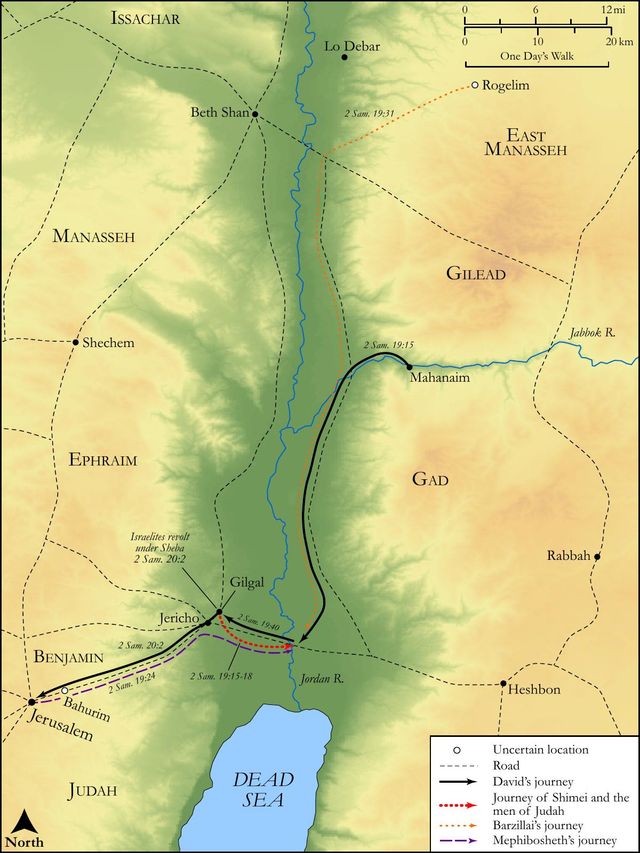
See on the biblical-era maps

Study this verse
Public-domain commentary
Matthew Henry
From his Commentary on the Whole Bible. Henry comments on passages, not single verses — this entry covers 2 Samuel 19:1–8. His two-level outline is real structure in the source text, so it is rendered as structure.
Soon after the messengers had brought the news of the defeat and death of Absalom to the court of Mahanaim, Joab and his victorious army followed, to grace the king's triumphs and receive his further orders. Now here we are told,
I.What a damp and disappointment it was to them to find the king in tears for Absalom's death, which they construed as a token of displeasure against them for what they had done, whereas they expected him to have met them with joy and thanks for their good services: It was told Joab, v. 1 The report of it ran through the army (Sa2 19:2), how the king was grieved for his son. The people will take particular notice what their princes say and do. The more eyes we have upon us, and the greater our influence is, the more need we have to speak and act wisely and to govern our passions strictly. When they came to the city they found the king in close mourning, Sa2 19:4. He covered his face, and would not so much as look up, nor take any notice of the generals when they attended him. It could not but surprise them to find, 1. How the king proclaimed his passion, of which he ought to have been ashamed, and which he would have striven to smother and conceal if he had consulted either his reputation for courage, which was lessened by his mean submission to the tyranny of so absurd a passion, or his interest in the people, which would be prejudiced by his discountenancing what was done in zeal for his honour and the public safety. Yet see how he avows his grief: He cries with a loud voice, O my son Absalom! "My servants have all come home safe, but where is my son? He is dead; and, dying in sin, I fear he is lost for ever. I cannot now say, I shall go to him, for my soul shall not be gathered with such sinners; what shall be done for thee, O Absalom! my son, my son!" 2. How he prolonged his passion, even till the army had come up to him, which must be some time after he received the first intelligence. If he had contented himself with giving vent to his passion for an hour or two when he first heard the news, it would have been excusable, but to continue it thus for so bad a son as Absalom, like Jacob for so good a son as Joseph, with a resolution to go to the grave mourning and to stain his triumphs with his tears, was very unwise and very unworthy. Now see how ill this was taken by the people. They were loth to blame the king, for whatever he did used to please them (Sa2 3:36), but they took it as a great mortification to them. Their victory was turned into mourning, Sa2 19:2. They stole into the city as men ashamed, Sa2 19:3. In compliment to their sovereign, they would not rejoice in that which they perceived so afflictive to him, and yet they could not but be uneasy that they were thus obliged to conceal their joy. Superiors ought not to put such hardships as these on their inferiors.
II.How plainly and vehemently Joab reproved David for this indiscreet management of himself in this critical juncture.
David never more needed the hearts of his subjects than now, nor was ever more concerned to secure his interest in their affections; and therefore whatever tended to disoblige them now was the most impolitic thing he could do, and the greatest wrong imaginable to his friends that adhered to him. Joab therefore censures him, Sa2 19:5-7. He speaks a great deal of reason, but not with the respect and deference which he owed to his prince. Is is fit to say to a king, Thou art wicked? A plain case may be fairly pleaded with those that are above us, and they may be reproved for what they do amiss, but it must not be done with rudeness and insolence. David did indeed need to be roused and alarmed; and Joab thought it no time to dally with him. If superiors do that which is foolish, they must neither think it strange nor take it ill if their inferiors tell them of it, perhaps too bluntly.
1.Joab magnifies the services of David's soldiers: "This day they have saved thy life, and therefore deserve to be taken notice of, and have reason to resent it if they be not." It is implied that Absalom, whom he honoured with his tears, sought his ruin and the ruin of his family, while those whom by his tears he puts a slight upon were such as preserved from ruin him and all that was dear to him. Great mischiefs have arisen to princes from the contempt of great merits.
2.He aggravates the discouragement David had given them: "Thou hast shamed their faces; for, while they have shown such a value for thy life, thou hast shown no value for theirs, but preferrest a spoiled wicked youth, a false traitor to his king and country, whom we are happily rid of, before all thy wise counsellors, brave commanders, and loyal subjects. What can be more absurd than to love thy enemies and hate thy friends?" 3. He advises him to present himself immediately at the head of his troops, to smile upon them, welcome them home, congratulate their success, and return them thanks for their services. Even those that may be commanded yet expect to be thanked when they do well, and ought to be. 4. He threatens him with another rebellion if he would not do this, intimating that rather than serve so ungrateful a prince he himself would head a revolt from him, and then (so confident is Joab of his own interest in the people) "there will not tarry with thee one man. If I go, they will go. Thou hast now nothing to mourn for: but, if thou persist, I will give thee something to mourn for (as Josephus expresses it) with a true and more bitter mourning."
III.How prudently and mildly David took the reproof and counsel given him, Sa2 19:8.
He shook off his grief, anointed his head, and washed his face, that he might not appear unto men to mourn, and then made his appearance in public in the gate, which was as the guild-hall of the city. Hither the people flocked to him to congratulate his and their safety, and all was well. Note, When we are convinced of a fault, we must amend, though we are told of it by our inferiors, and indecently, or in heat and passion.
Continue studying 2 Samuel 19:6 across the web’s major study libraries — every link below opens this exact verse, chapter, or book on the destination site.
Read & Compare
 BibleGatewayThis verse in more than 200 translations and 70 languages.
 Bible.comThe YouVersion reader — hundreds of translations, reading plans, and highlights.
 ESV.orgCrossway's official English Standard Version reader.
 NET BibleThe NET translation with 60,000+ translators' notes on every rendering decision.
 STEP BibleTyndale House's free study tool — original text, vocabulary, and scholarly resources.
 BibliaLogos Bible Software's free web reader.
 USCCBThe New American Bible (Revised Edition) with the U.S. bishops' study notes.
Commentaries
 BibleHub CommentariesDozens of classic commentaries on this verse, gathered on one page.
 StudyLightMore than 100 commentary sets — the largest collection on the web.
 BibleRefPlain-English commentary on what this verse means, verse by verse.
 Enduring WordDavid Guzik's free commentary on this chapter, widely used by Bible teachers.
 Bible Study ToolsVerse commentary alongside Greek and Hebrew study aids.
Original Language & Research
- BibleHub InterlinearThe verse word by word — original language, transliteration, and English.
- BibleHub LexiconEvery word's original-language definition and Strong's entry.
 Blue Letter BibleDeep-study tools — Strong's numbers, concordance, and word studies.
 SefariaThe Hebrew text with Rashi and centuries of Jewish commentary.
Sermons, Hymns & Audio


TrulyRandomVerse is not affiliated with these sites and doesn’t control their content. They’re linked because they’re genuinely useful.
Summary
2 Samuel 19:6 captures Joab's blunt and critical confrontation with King David, delivered in the immediate aftermath of Absalom's failed rebellion. David, overwhelmed by profound personal grief for his deceased rebellious son, had inadvertently neglected and demoralized his loyal army, who had just secured a vital victory for his kingdom. Joab's audacious words, though harsh, served as a crucial and pragmatic intervention, accusing David of a perceived preference for his enemy (Absalom) over his faithful subjects, thereby gravely jeopardizing the morale of his victorious troops and the very stability of his re-established reign.
Context
ShowHideLiterary Context
This verse marks a critical turning point in the narrative following the decisive battle in the forest of Ephraim and Absalom's death, detailed in 2 Samuel 18. David's intense and public lamentation for Absalom, despite the victory that saved his throne, is powerfully depicted in 2 Samuel 18:33. This excessive grief profoundly demoralized the victorious Israelite army, transforming their triumph into a somber retreat, causing the soldiers to feel unappreciated and even scorned. Joab, David's formidable and often ruthless general, immediately recognized the severe threat this posed to the king's authority and the army's cohesion. His direct confrontation with David, spanning 2 Samuel 19:5-8, is a no-holds-barred intervention designed to compel David to acknowledge his loyal subjects and resume his kingly duties, thereby averting further disaffection and the potential disintegration of his support base. This pivotal exchange directly sets the stage for David's return to Jerusalem and the complex political maneuvering required to fully re-establish his rule.
Historical & Cultural Context
In the ancient Near East, the public image and morale of a king's army were absolutely vital for maintaining power, stability, and control over a kingdom. Victories were typically celebrated with great joy, public feasts, and the honoring of valiant soldiers. David's profound, personal grief, while deeply human and understandable, was politically catastrophic. It communicated to his loyal fighting men that their lives, their sacrifices, and their hard-won victory were less valuable than the life of the rebel who had sought to overthrow the king and usurp his throne. Furthermore, Joab's position as a powerful and influential general meant he had a direct and vested interest in the army's well-being and the king's effective leadership. His characteristic bluntness, though shocking, was consistent with his pragmatic and results-oriented approach, often evident when David's personal sentiments jeopardized the kingdom's stability (e.g., his decisive action in killing Absalom in 2 Samuel 18:14-15). The prevailing cultural expectation was for a king to prioritize the welfare, recognition, and public affirmation of his loyal subjects over personal sorrow, especially in the aftermath of a successful military campaign.
Key Themes
ShowHideThis verse powerfully encapsulates several significant themes prevalent throughout the books of Samuel. Firstly, it highlights the profound tension between personal emotion and kingly duty. David's overwhelming love for his son, Absalom, directly clashes with his solemn responsibility to his kingdom and his loyal subjects, vividly illustrating the immense and often agonizing burden of leadership. Secondly, it underscores the critical importance of effective leadership and military morale, demonstrating how a leader's actions and perceived priorities directly impact the loyalty, unity, and effectiveness of their followers. Joab's intervention emphasizes that a king must actively value and affirm those who serve him faithfully. Thirdly, the passage continues the pervasive theme of the consequences of sin and rebellion, as Absalom's rebellion, though decisively crushed, continues to inflict severe emotional and political fallout on David and his kingdom. Finally, it touches on the complex interplay of loyalty and betrayal, contrasting Absalom's treachery with the steadfastness of David's army, yet paradoxically showing David's grief for the former over his appreciation for the latter. This intricate interplay of themes reveals the profound human complexities and moral dilemmas inherent in David's divinely appointed reign, even amidst God's favor.
Exposition and Analysis
ShowHideKey Word Analysis
ShowHideWhile literally meaning "to hate," in biblical Hebrew, especially in comparative contexts, sânêʼ can also convey a sense of "loving less," "preferring less," or "disregarding." Joab employs this term hyperbolically to shock David, implying that David's actions were perceived as a severe slight and rejection of his loyal supporters, effectively treating them as if he "hated" them in comparison to his profound and public grief for Absalom. It powerfully highlights the extreme perception of David's misplaced affection and priorities.
This term, derived from the word for "eye," is used figuratively here to mean "to consider," "to value," or "to think best." Joab's accusation that David "regardest neither princes nor servants" implies that David had failed to properly value, consider, or even acknowledge the lives and sacrifices of anyone in his loyal army, from the highest-ranking officials ("princes") to the lowest soldiers ("servants"). This perceived lack of regard was deeply insulting and threatened to undermine the entire structure of loyalty and service to the king.
Meaning "to be straight," "to be right," or "to be pleasing/well." Joab's biting conclusion, "if Absalom had lived, and all we had died this day, then it had pleased thee well," is the ultimate rhetorical blow. It suggests that David's grief was so overwhelming that he would have preferred the death of his entire loyal army, including Joab himself, if it meant Absalom had survived. This extreme accusation aims to expose the perceived depth of David's emotional disconnect and force him to confront the devastating and dangerous impact of his actions on the morale and loyalty of his people.
Verse Breakdown
ShowHide"In that thou lovest thine enemies, and hatest thy friends."
This is the core of Joab's hyperbolic and shocking accusation. David's "enemy" here is Absalom, who rebelled against him, sought his throne, and endangered his life. His "friends" are the loyal soldiers who fought valiantly and risked their lives to preserve his kingdom and his reign. Joab implies that David's public mourning for Absalom, while seemingly ignoring or overlooking the victorious army, was tantamount to loving the one who sought his destruction and despising those who saved him. This rhetorical exaggeration is designed to shame David into recognizing the profound gravity and dangerous implications of his actions.
"For thou hast declared this day, that thou regardest neither princes nor servants:"
Joab immediately explains the basis for his severe accusation. David's behavior "this day" – the day of their hard-won victory – has made it undeniably clear to everyone that he places no value on the lives, sacrifices, or dedicated service of his loyal subjects, regardless of their rank or position. This statement underscores the widespread demoralization and feeling of worthlessness among the victorious troops, from the highest commanders ("princes") to the common soldiers ("servants"), all of whom had put their lives on the line for David.
"for this day I perceive, that if Absalom had lived, and all we had died this day, then it had pleased thee well."
This is the most cutting, confrontational, and emotionally charged part of Joab's rebuke. He states his personal perception, which he believes accurately reflects the sentiment of the entire army: David's grief for Absalom was so profound and consuming that he would have genuinely preferred the death of his entire loyal army, including Joab himself, if it meant Absalom had survived. This extreme hypothetical scenario is intended to violently shock David out of his self-absorbed sorrow and force him to grasp the immediate and devastating implications of his public display of grief for the future of his kingdom and his vital relationship with his people.
Literary Devices
ShowHideJoab's speech in 2 Samuel 19:6 is a masterful display of rhetorical force, employing several powerful literary devices to achieve its intended impact. The most prominent is Hyperbole, particularly evident in the phrase "lovest thine enemies, and hatest thy friends." This is not a literal statement of David's affections but an extreme exaggeration designed to highlight the perceived imbalance of his grief and to shock him into immediate action. Joab also skillfully uses Juxtaposition, starkly contrasting David's deep mourning for the rebellious Absalom with his apparent disregard for the loyal soldiers who risked their lives to save his kingdom. This stark comparison powerfully underscores the injustice and demoralizing effect of David's behavior on his troops. Furthermore, there is a profound element of Irony in David's position: the king who should be celebrating a hard-won victory and honoring his loyal subjects is instead consumed by grief for the very son who sought his downfall. Joab's bluntness functions as a form of Direct Address and Rebuke, characteristic of prophetic or authoritative confrontation, aiming not merely to express displeasure but to compel a swift and necessary change in behavior for the sake of the kingdom's stability and the army's morale.
Theological and Thematic Connections
ShowHideThe profound tension in 2 Samuel 19:6 between David's personal grief and his public duty as king highlights a recurring biblical theme: the inherent challenges and complexities of human leadership, even for those divinely chosen and favored by God. David, despite being described as "a man after God's own heart," demonstrates a profound human flaw – a temporary inability to subordinate overwhelming personal emotion to the greater good of his people and the stability of his divinely appointed kingdom. This incident serves as a poignant reminder that even the most favored and anointed leaders are imperfect, prone to misjudgment, and susceptible to emotional excess. Theologically, it underscores God's enduring patience and His continued work through flawed human vessels, while also emphasizing the crucial importance of wise counsel (even when it is harsh and confronting) in guiding leaders back to their responsibilities. Ultimately, it speaks to the divine expectation that leaders, especially those entrusted with God's covenant people, must prioritize the well-being, morale, and affirmation of their charges, reflecting God's own meticulous and compassionate care for His people.
Reflection and Application
ShowHideJoab's blunt and uncomfortable words to David offer timeless and profound lessons on the nature of leadership, the necessity of appreciation, and the critical discerning of priorities. In any sphere of influence—be it family, church, workplace, or community—leaders are consistently called to balance their personal feelings and emotional responses with the overarching well-being and needs of those they lead. David's oversight was not necessarily a lack of genuine love for his army, but rather a public display of grief that communicated a severe lack of appreciation and acknowledgment, profoundly demoralizing those who had sacrificed greatly for him. This passage compels us to critically examine how our actions, even those stemming from deeply genuine personal emotions, are perceived by others, especially by those who look to us for guidance, affirmation, and leadership. True and effective leadership often requires the courage to make difficult choices, to consistently prioritize the collective good over personal comfort, and to actively and consistently affirm and value those who are loyal, committed, and serve faithfully. It serves as a powerful reminder that gratitude must be expressed clearly and consistently, and loyalty must be reciprocated, lest those who serve feel unacknowledged, unappreciated, and ultimately disaffected, leading to a breakdown of trust and morale.
Questions for Reflection
ShowHideFAQ
ShowHideWhy was Joab so harsh with David?
ShowHideJoab's harshness stemmed from a profound pragmatic necessity and a deep, immediate concern for the stability of David's kingdom and the critical morale of his army. David's excessive and public mourning for Absalom, the rebel who had sought to overthrow him and usurp his throne, was profoundly demoralizing for the soldiers who had just risked their lives to preserve David's reign. Instead of celebrating their hard-won victory and acknowledging their loyalty and sacrifice, David's grief made them feel unappreciated, unvalued, and even despised. Joab, as the seasoned commander of the army, understood that this could quickly lead to widespread disaffection, mass desertion, or even another rebellion, thereby jeopardizing David's very reign. His bluntness, though shocking and personally risky, was a desperate and calculated measure to force David to immediately resume his kingly duties, publicly acknowledge his loyal subjects, and prevent the potential collapse of his support base and the kingdom itself. It was a stark example of a necessary, albeit painful, intervention to save the crown. Joab's directness ultimately led to David's return to the city gate to greet his people, as recorded in 2 Samuel 19:8.
Was David's grief for Absalom wrong?
ShowHideDavid's grief for Absalom was, on a purely personal level, a natural, deeply human, and understandable response to the death of his son, regardless of Absalom's rebellion. From a private, paternal perspective, it was profoundly understandable. However, from the perspective of his kingly duty and public responsibility, his public display of overwhelming grief was indeed problematic and politically disastrous. It sent the wrong message to his loyal army, implying that their lives, their sacrifices, and the kingdom's preservation were less important than the life of the rebel who had sought to destroy it all. The issue was not the emotion itself, but its public expression and the disproportionate focus on the enemy at the expense of the loyal and victorious. A king's primary duty was to his people and the stability of the kingdom, and David's grief was actively undermining that sacred trust.
What happened immediately after this confrontation?
ShowHideJoab's harsh and direct rebuke had its immediate and intended effect. David, though undoubtedly wounded by the words, listened to Joab's counsel, however painful and confronting it was. Immediately following this confrontation, David ceased his public mourning, went to the city gate, and sat there to greet his victorious army (as detailed in 2 Samuel 19:8). This public act of acknowledgment, appreciation, and resumption of his kingly duties instantly restored the morale of the troops and signaled David's return to his responsibilities. The army, seeing their king back in his rightful place and publicly acknowledging their sacrifice, rallied around him, and the crucial process of restoring order and bringing David back to Jerusalem began.
Christ-Centered Fulfillment
ShowHideThe profound tension in 2 Samuel 19:6, where a human king is rebuked for seemingly "loving his enemies and hating his friends," finds its ultimate resolution and perfect antithesis in the person and work of Jesus Christ, the true and perfect King. David, though a man after God's own heart, was flawed, allowing personal grief to overshadow his kingly duty and alienate his loyal subjects. In stark contrast, Jesus, the perfect King, truly loved His enemies and demonstrated the ultimate, self-sacrificial love for His friends. While David was accused of valuing a rebel son over loyal soldiers, Christ willingly laid down His life not only for His disciples, whom He intimately called "friends" in John 15:13, but profoundly, for those who were His enemies, those who were dead in their transgressions and actively hostile to God, as beautifully declared in Romans 5:8. Unlike David, whose grief for Absalom caused division and demoralization, Jesus' suffering, death, and resurrection brought about ultimate reconciliation and profound unity, bridging the chasm between a holy God and sinful humanity, as illuminated in Colossians 1:20. He is the King who perfectly balances divine justice and boundless compassion, always prioritizing the eternal welfare of His people, not through a pragmatic calculation, but through perfect, self-giving love that extends even to His foes, transforming them into loyal subjects and beloved children of God. His leadership is never flawed by misplaced affection or human weakness but is always perfectly aligned with the Father's will, ensuring the eternal well-being of His everlasting kingdom and His redeemed people, for His throne is forever and ever, as proclaimed in Hebrews 1:8.