


2 Samuel 19:4
- וְהַמֶּלֶךְve·ha·Me·lekhand the kingH4428Conj-w ¦ Art ¦ N-msNoun Singular Masculine Absoluteוְandהַtheמֶּלֶךְking
- לָאַטla·'Athe coveredH3813V-Qal-Perf-3msVerb Qal Perfect 3rd Singular Masculine
- אֶת'et<obj.>H853DirObjMParticle Object Indicator
- פָּנָיוpa·Navhis faceH6440N-mpc ¦ 3msNoun Plural Masculine Constructפָּנָיfaceוhis
- וַיִּזְעַקvai·yiz·'Akand he cried outH2199Conj-w ¦ V-Qal-ConsecImperf-3msVerb Qal Consecutive Imperfect 3rd Singular Masculineוַandיִּזְעַקhe cried out
- הַמֶּלֶךְha·Me·lekhthe kingH4428Art ¦ N-msNoun Singular Masculine Absoluteהַtheמֶּלֶךְking
- קוֹלKola voiceH6963N-msNoun Singular Masculine Absolute
- גָּדוֹלga·DolgreatH1419Adj-msAdjective Singular Masculine Absolute
- בְּנִיbe·Nimy O sonH1121N-msc ¦ 1csNoun Singular Masculine ConstructבְּנִO sonיmy
- אַבְשָׁלוֹם'av·sha·LomAbsalomH53N-proper-mNoun Proper Masculine
- אַבְשָׁלוֹם'av·sha·LomAbsalomH53N-proper-mNoun Proper Masculine
- בְּנִיbe·Nimy sonH1121N-msc ¦ 1csNoun Singular Masculine Constructבְּנִsonיmy
- בְנִיve·Nimy sonH1121N-msc ¦ 1csNoun Singular Masculine Constructבְנִsonיmy
English is a literal word-by-word gloss of the Hebrew, not the KJV's wording. Why?
This is the original text the KJV's translators worked from — each Hebrew word with its own literal English meaning in this verse, prepared by scholars at Tyndale House, Cambridge. The KJV translates whole sentences, not word by word, so its wording differs: one Hebrew word can become several English words, and the KJV may choose “the LORD” where the gloss reads “Yahweh”. Both are faithful — they answer different questions. For the KJV's own rendering, switch to the KJV text.
Details
See on the biblical-era maps

Study this verse
Public-domain commentary
Matthew Henry
From his Commentary on the Whole Bible. Henry comments on passages, not single verses — this entry covers 2 Samuel 19:1–8. His two-level outline is real structure in the source text, so it is rendered as structure.
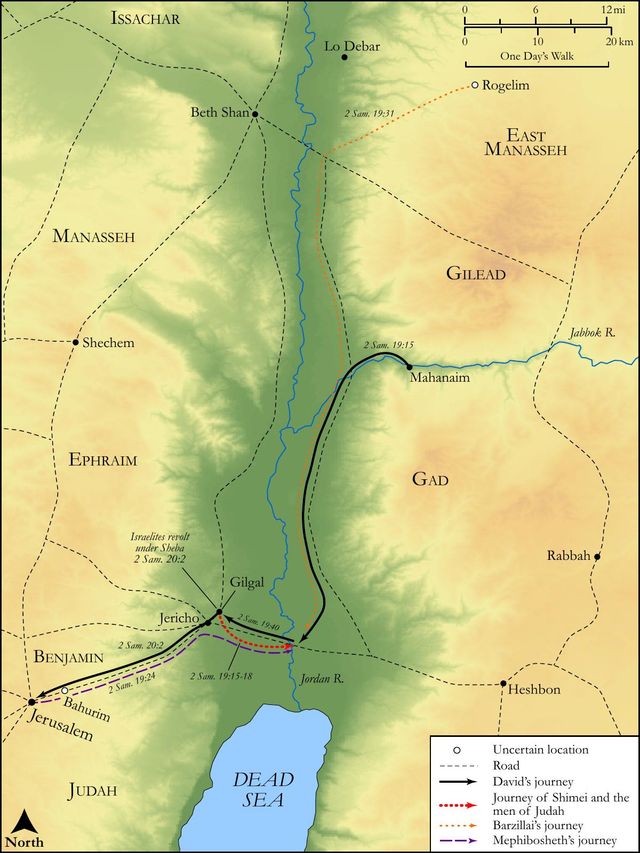
Soon after the messengers had brought the news of the defeat and death of Absalom to the court of Mahanaim, Joab and his victorious army followed, to grace the king's triumphs and receive his further orders. Now here we are told,
I.What a damp and disappointment it was to them to find the king in tears for Absalom's death, which they construed as a token of displeasure against them for what they had done, whereas they expected him to have met them with joy and thanks for their good services: It was told Joab, v. 1 The report of it ran through the army (Sa2 19:2), how the king was grieved for his son. The people will take particular notice what their princes say and do. The more eyes we have upon us, and the greater our influence is, the more need we have to speak and act wisely and to govern our passions strictly. When they came to the city they found the king in close mourning, Sa2 19:4. He covered his face, and would not so much as look up, nor take any notice of the generals when they attended him. It could not but surprise them to find, 1. How the king proclaimed his passion, of which he ought to have been ashamed, and which he would have striven to smother and conceal if he had consulted either his reputation for courage, which was lessened by his mean submission to the tyranny of so absurd a passion, or his interest in the people, which would be prejudiced by his discountenancing what was done in zeal for his honour and the public safety. Yet see how he avows his grief: He cries with a loud voice, O my son Absalom! "My servants have all come home safe, but where is my son? He is dead; and, dying in sin, I fear he is lost for ever. I cannot now say, I shall go to him, for my soul shall not be gathered with such sinners; what shall be done for thee, O Absalom! my son, my son!" 2. How he prolonged his passion, even till the army had come up to him, which must be some time after he received the first intelligence. If he had contented himself with giving vent to his passion for an hour or two when he first heard the news, it would have been excusable, but to continue it thus for so bad a son as Absalom, like Jacob for so good a son as Joseph, with a resolution to go to the grave mourning and to stain his triumphs with his tears, was very unwise and very unworthy. Now see how ill this was taken by the people. They were loth to blame the king, for whatever he did used to please them (Sa2 3:36), but they took it as a great mortification to them. Their victory was turned into mourning, Sa2 19:2. They stole into the city as men ashamed, Sa2 19:3. In compliment to their sovereign, they would not rejoice in that which they perceived so afflictive to him, and yet they could not but be uneasy that they were thus obliged to conceal their joy. Superiors ought not to put such hardships as these on their inferiors.
II.How plainly and vehemently Joab reproved David for this indiscreet management of himself in this critical juncture.
David never more needed the hearts of his subjects than now, nor was ever more concerned to secure his interest in their affections; and therefore whatever tended to disoblige them now was the most impolitic thing he could do, and the greatest wrong imaginable to his friends that adhered to him. Joab therefore censures him, Sa2 19:5-7. He speaks a great deal of reason, but not with the respect and deference which he owed to his prince. Is is fit to say to a king, Thou art wicked? A plain case may be fairly pleaded with those that are above us, and they may be reproved for what they do amiss, but it must not be done with rudeness and insolence. David did indeed need to be roused and alarmed; and Joab thought it no time to dally with him. If superiors do that which is foolish, they must neither think it strange nor take it ill if their inferiors tell them of it, perhaps too bluntly.
1.Joab magnifies the services of David's soldiers: "This day they have saved thy life, and therefore deserve to be taken notice of, and have reason to resent it if they be not." It is implied that Absalom, whom he honoured with his tears, sought his ruin and the ruin of his family, while those whom by his tears he puts a slight upon were such as preserved from ruin him and all that was dear to him. Great mischiefs have arisen to princes from the contempt of great merits.
2.He aggravates the discouragement David had given them: "Thou hast shamed their faces; for, while they have shown such a value for thy life, thou hast shown no value for theirs, but preferrest a spoiled wicked youth, a false traitor to his king and country, whom we are happily rid of, before all thy wise counsellors, brave commanders, and loyal subjects. What can be more absurd than to love thy enemies and hate thy friends?" 3. He advises him to present himself immediately at the head of his troops, to smile upon them, welcome them home, congratulate their success, and return them thanks for their services. Even those that may be commanded yet expect to be thanked when they do well, and ought to be. 4. He threatens him with another rebellion if he would not do this, intimating that rather than serve so ungrateful a prince he himself would head a revolt from him, and then (so confident is Joab of his own interest in the people) "there will not tarry with thee one man. If I go, they will go. Thou hast now nothing to mourn for: but, if thou persist, I will give thee something to mourn for (as Josephus expresses it) with a true and more bitter mourning."
III.How prudently and mildly David took the reproof and counsel given him, Sa2 19:8.
He shook off his grief, anointed his head, and washed his face, that he might not appear unto men to mourn, and then made his appearance in public in the gate, which was as the guild-hall of the city. Hither the people flocked to him to congratulate his and their safety, and all was well. Note, When we are convinced of a fault, we must amend, though we are told of it by our inferiors, and indecently, or in heat and passion.
Continue studying 2 Samuel 19:4 across the web’s major study libraries — every link below opens this exact verse, chapter, or book on the destination site.
Read & Compare
 BibleGatewayThis verse in more than 200 translations and 70 languages.
 Bible.comThe YouVersion reader — hundreds of translations, reading plans, and highlights.
 ESV.orgCrossway's official English Standard Version reader.
 NET BibleThe NET translation with 60,000+ translators' notes on every rendering decision.
 STEP BibleTyndale House's free study tool — original text, vocabulary, and scholarly resources.
 BibliaLogos Bible Software's free web reader.
 USCCBThe New American Bible (Revised Edition) with the U.S. bishops' study notes.
Commentaries
 BibleHub CommentariesDozens of classic commentaries on this verse, gathered on one page.
 StudyLightMore than 100 commentary sets — the largest collection on the web.
 BibleRefPlain-English commentary on what this verse means, verse by verse.
 Enduring WordDavid Guzik's free commentary on this chapter, widely used by Bible teachers.
 Bible Study ToolsVerse commentary alongside Greek and Hebrew study aids.
Original Language & Research
- BibleHub InterlinearThe verse word by word — original language, transliteration, and English.
- BibleHub LexiconEvery word's original-language definition and Strong's entry.
 Blue Letter BibleDeep-study tools — Strong's numbers, concordance, and word studies.
 SefariaThe Hebrew text with Rashi and centuries of Jewish commentary.
Sermons, Hymns & Audio


TrulyRandomVerse is not affiliated with these sites and doesn’t control their content. They’re linked because they’re genuinely useful.
Summary
This poignant verse captures the raw, overwhelming grief of King David upon receiving news of his son Absalom's death. Despite Absalom's treasonous rebellion and the devastating civil war he instigated, David's profound paternal love superseded the political victory, plunging him into a public and unrestrained lament that highlighted the immense personal cost of the conflict and the enduring sorrow of a father for his lost child.
Context
ShowHideLiterary Context
2 Samuel 19:4 immediately follows the decisive defeat of Absalom's rebellion and the tragic news of his death. In the preceding verses, particularly 2 Samuel 18:19-32, messengers race to inform David of the victory, but his singular concern, as seen in his earlier command to "deal gently for my sake with the young man Absalom" (2 Samuel 18:5), is for Absalom's welfare. The verse itself builds directly upon David's initial, heart-wrenching lament recorded in 2 Samuel 18:33, amplifying and extending his expression of sorrow. David's intense, public display of grief in this verse stands in stark contrast to the expected celebration of his victorious army, creating a dramatic tension that leads directly to a tense and critical confrontation with his commander, Joab, who rebukes the king for his perceived ingratitude and demoralizing behavior towards his loyal troops (2 Samuel 19:5-7). This dramatic shift from military triumph to profound personal tragedy underscores the complex emotional and political landscape of David's reign.
Historical & Cultural Context
In ancient Near Eastern cultures, public displays of intense grief, including wailing, tearing clothes, and covering the face, were common and expected expressions of mourning, particularly for the death of a close family member. For a king, such a display, while deeply personal, also carried significant political implications. David's action of covering his face could signify profound sorrow, shame, or a deliberate withdrawal from public view in a moment of overwhelming personal anguish. The repetition of names and phrases in lament was a recognized rhetorical device used to emphasize the depth and intensity of emotion, signaling profound distress to the community. Furthermore, the concept of a king's family was intrinsically linked to the stability and future of the kingdom. Absalom's rebellion, a direct challenge to David's throne and divinely appointed authority, was a grave offense, yet David's reaction transcends political considerations, revealing the enduring bond of paternal love, a theme explored throughout the book of Samuel.
Key Themes
ShowHideThis verse powerfully contributes to several key themes within 2 Samuel and the broader Deuteronomistic History. Firstly, it highlights the profound parental grief that transcends political victory and even personal betrayal. David's repeated cries underscore the universal agony of a parent mourning a child, even a rebellious one, echoing his earlier sorrow over the death of the child born to Bathsheba (2 Samuel 12:18-23). Secondly, it implicitly underscores the tragic cost of rebellion and sin. Absalom's ambition led to civil war, widespread bloodshed, his own untimely death, and his father's devastating heartbreak, illustrating the destructive consequences of defying established authority and divine order, a recurring motif in the books of Kings. Finally, the verse showcases David's enduring humanity and frailty. Despite being described as "a man after God's own heart" (1 Samuel 13:14), David is depicted here as deeply vulnerable, capable of immense love and profound sorrow, reminding readers that even divinely chosen leaders are not immune to personal burdens and emotional complexities.
Exposition and Analysis
ShowHideKey Word Analysis
ShowHideThis verb signifies to "muffle" or "cover." In this context, David's act of covering his face is a powerful non-verbal expression of profound grief, shame, or deep distress. It suggests a desire to withdraw from public view or to hide the overwhelming anguish that consumes him, a common ancient Near Eastern mourning custom.
A primitive root meaning "to shriek (from anguish or danger)." This word emphasizes the intensity and public nature of David's lament. It was not a quiet, private weeping but an unrestrained, guttural wail, audible to those around him. This public display of grief was a common and accepted form of mourning in ancient Israel, demonstrating the depth of his emotional pain and the profound shock of his loss.
Derived from a root meaning "to build," referring to a son as a builder of the family name. The repeated use of "my son" (Hebrew, b'ni') highlights the deep, personal, and paternal bond that transcends Absalom's rebellious actions. Despite Absalom's treason, David's primary identity in this moment is that of a grieving father, emphasizing the enduring nature of familial love over political conflict.
Verse Breakdown
ShowHide"But the king covered his face,"
This opening clause immediately sets a somber tone, creating a stark contrast with the expected jubilation of a victorious army. David's action of covering his face signifies a profound internal struggle, a withdrawal into the depths of his personal sorrow, and perhaps a physical manifestation of his inability to bear the news or the sight of his victorious but now sorrowful men. It marks a moment of intense, private anguish made public.
"and the king cried with a loud voice,"
This clause describes the audible and unrestrained outpouring of David's grief. The "loud voice" indicates a public, uninhibited lament, characteristic of deep mourning in ancient cultures. It signifies that his sorrow was too immense to be contained, breaking through any royal decorum or military stoicism. This wail is the raw, visceral expression of a father's heartbreak, heard by all who were near.
"O my son Absalom, O Absalom, my son, my son!"
This climactic exclamation is the heart of David's lament. The repeated invocation of Absalom's name, coupled with the possessive "my son," powerfully conveys David's overwhelming sorrow, love, and perhaps regret. The triple repetition of "my son" at the end emphasizes the paternal bond above all else, highlighting that despite Absalom's rebellion and the pain he caused, David's love for him as a son remained paramount and agonizingly present in death.
Literary Devices
ShowHideThis verse is rich with literary devices that amplify its emotional impact. The most prominent is Epizeuxis, the immediate repetition of words or phrases for emphasis, seen vividly in "O my son Absalom, O Absalom, my son, my son!" This repetition is not merely stylistic but conveys the overwhelming, almost unbearable nature of David's grief, as if his mind can articulate nothing else. The verse also employs Pathos, evoking intense emotion in the reader by portraying David's raw, unvarnished sorrow. This deep emotional appeal allows the audience to connect with the universal experience of parental loss. Furthermore, there is a powerful Contrast between the military victory just achieved and the profound personal tragedy experienced by the king. The public nature of David's "loud voice" alongside his act of "covering his face" creates a stark visual and auditory juxtaposition, highlighting the tension between his public role as king and his private agony as a father.
Theological and Thematic Connections
ShowHideDavid's lament for Absalom is a profound portrayal of human grief, revealing that even God's chosen leaders are not immune to the deepest sorrows and the tragic consequences of sin, both their own and others'. The scene underscores the enduring power of familial love, even in the face of betrayal and rebellion, and implicitly points to the devastating ripple effects of sin within families and nations. Theologically, it reminds us that while God's justice prevails, the human cost of sin is immense and often felt most acutely by those who love the transgressor. David's sorrow is a testament to the brokenness of a world marred by sin, where even righteous leaders experience profound suffering, and where the most profound personal agonies can arise from the very relationships meant to bring joy.
Reflection and Application
ShowHideDavid's raw lament in 2 Samuel 19:4 offers a powerful invitation to reflect on the nature of grief, love, and the consequences of human choices. It reminds us that sorrow is a universal human experience, transcending status, power, or even the deservingness of the one mourned. David's profound anguish for Absalom, despite his son's rebellion, speaks to the enduring, unconditional nature of parental love, even when it is met with betrayal. For us, this verse encourages empathy for those who grieve, regardless of the circumstances, and acknowledges that healing from deep wounds often involves a painful process of lament. It also serves as a stark reminder of the devastating impact of sin and rebellion, not only on the individual but on their loved ones and the wider community. Leaders, in particular, can find solace and understanding here, recognizing that their burdens are not solely public but often deeply personal and emotionally taxing, requiring both strength in governance and vulnerability in personal suffering.
Questions for Reflection
ShowHideFAQ
ShowHideWhy was David so deeply saddened by Absalom's death, given Absalom's rebellion against him?
ShowHideDavid's profound sorrow, despite Absalom's rebellion, highlights the enduring and often unconditional nature of parental love. While Absalom was a political enemy who sought David's throne and life, he was first and foremost David's son. The bond of kinship, particularly between father and son, was extremely strong in ancient Israelite culture. David had a history of deep affection for his children, even those who caused him pain or died tragically, as seen in his earlier grief for the child born to Bathsheba (2 Samuel 12:18-23). His lament reflects the crushing personal cost of the civil war and the tragic loss of a son, regardless of his actions. It speaks to the universal human experience of grieving a lost child, where love often transcends the wrongs committed, demonstrating that even a king's heart is not immune to the deepest human affections and sorrows.
Christ-Centered Fulfillment
ShowHideDavid's agonizing lament for Absalom, a rebellious son whose actions brought immense suffering, offers a profound, albeit imperfect, foreshadowing of God's own grief over humanity's rebellion. While David mourned a son who justly faced the consequences of his actions, God, in Christ, grieves over humanity's sin and rebellion, yet provides a path to reconciliation. The ultimate Lamb of God, Jesus Christ, the perfect Son, did not rebel but willingly laid down His life, bearing the full weight of humanity's sin and rebellion, so that those who were enemies of God might be reconciled to Him (Romans 5:8-10). Just as David longed for his son, God longs for His creation, and in Jesus, He provides the means for that longing to be fulfilled. Christ's suffering in Gethsemane (Matthew 26:36-46) and His cry from the cross (Matthew 27:46) echo the depths of sorrow, not for His own rebellion, but for the sin of the world He came to save. Through His death and resurrection, the ultimate rebellious children can be brought home, not through their own demise, but through the sacrificial love of the obedient Son, who makes all things new and restores broken relationships (Revelation 21:5).