


2 Samuel 19:7
Bible text: King James Version (1769 Blayney text) · Public domain
Bible text: King James Version with Strong's numbers · Public domain
Bible text: Berean Standard Bible · Public domain
Bible text: American Standard Version (1901) · Public domain
Bible text: World English Bible, Messianic edition · Public domain
Bible text: Geneva Bible (1599) · Public domain
Bible text: Young's Literal Translation · Public domain
- וְעַתָּהve·'a·Tahand thereforeH6258Conj-w ¦ AdvAdverbוְandעַתָּהtherefore
- קוּםkumariseH6965V-Qal-Imp-2msVerb Qal Imperative 2nd Singular Masculine
- צֵאTze'go outH3318V-Qal-Imp-2msVerb Qal Imperative 2nd Singular Masculine
- וְדַבֵּרve·da·Berand speakH1696Conj-w ¦ V-Piel-Imp-2msVerb Piel Imperative 2nd Singular Masculineוְandדַבֵּרspeak
- עַל'altoH5921PrepPreposition
- לֵבlev[the] heart ofH3820N-mscNoun Singular Masculine Construct
- עֲבָדֶיךָ'a·va·Dei·khayour servantsH5650N-mpc ¦ 2msNoun Plural Masculine Constructעֲבָדֶיservantsךָyour
- כִּיkiforH3588PrtParticle Conditional
- בַיהוָהba·Yah·wehby YahwehH3068Prep-b ¦ N-properNoun Proper TitleבַbyיהוָהYahweh
- נִשְׁבַּעְתִּיnish·Ba'·tiI swearH7650V-Niphal-Perf-1csVerb Niphal Perfect 1st Singular common gender
- כִּיkithatH3588PrtParticle Conditional
- אֵינְךָ'ei·ne·Khanot youH369N-msc ¦ 2msNoun Singular Masculine Constructאֵינְnotךָyou
- יוֹצֵאyo·Tze'[are] coming outH3318V-Qal-Prtcpl-msVerb Qal Participle Singular Masculine Absolute
- אִם'imifH518PrtParticle Conditional
- יָלִיןya·Linhe will lodgeH3885V-Qal-Imperf-3msVerb Qal Imperfect 3rd Singular Masculine
- אִישׁ'isha manH376N-msNoun Singular Masculine Absolute
- אִתְּךָ'i·te·Khawith youH854Prep ¦ 2msPreposition Definiteאִתְּwithךָyou
- הַלַּיְלָהha·Lay·lahthis nightH3915Art ¦ N-msNoun Singular Masculine Absoluteהַthisלַּיְלָהnight
- וְרָעָהve·ra·'Ahand it will be badH7489Conj-w ¦ V-Qal-ConsecPerf-3fsVerb Qal Consecutive Perfect 3rd Singular Feminineוְandרָעָהit will be bad
- לְךָle·Khafor <the> youPrep-l ¦ 2msSuffix Personal 2nd Singular Masculineלְfor <the>ךָyou
- זֹאתZotthisH2063PrtParticle Demonstrative
- מִכָּלmi·kolmore than allH3605Prep-m ¦ N-mscNoun Singular Masculine Constructמִmore thanכָּלall
- הָרָעָהha·ra·'Ahthe harmH7451Art ¦ N-fsNoun Singular Feminine Absoluteהָtheרָעָהharm
- אֲשֶׁר'a·SherwhichH834RelParticle Relative
- בָּאָהBa·'ahit has comeH935V-Qal-Perf-3fsVerb Qal Perfect 3rd Singular Feminine
- עָלֶיךָ'a·Lei·khaon youH5921Prep ¦ 2msPreposition Definiteעָלֶיonךָyou
- מִנְּעֻרֶיךָmi·ne·'u·Rei·khasince your youth<s>H5271Prep-m ¦ N-mpc ¦ 2msNoun Plural Masculine Constructמִsinceנְּעֻרֶיyouth<s>ךָyour
- עַד'aduntilH5704PrepPreposition
- עָתָּה'A·tahnowH6258AdvAdverb
English is a literal word-by-word gloss of the Hebrew, not the KJV's wording. Why?
This is the original text the KJV's translators worked from — each Hebrew word with its own literal English meaning in this verse, prepared by scholars at Tyndale House, Cambridge. The KJV translates whole sentences, not word by word, so its wording differs: one Hebrew word can become several English words, and the KJV may choose “the LORD” where the gloss reads “Yahweh”. Both are faithful — they answer different questions. For the KJV's own rendering, switch to the KJV text.
Details
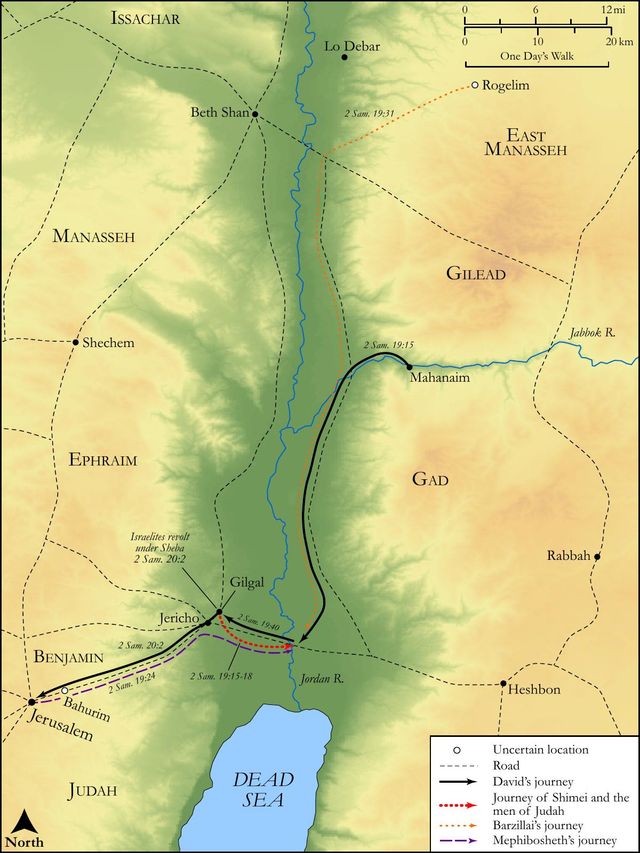
See on the biblical-era maps

Study this verse
Public-domain commentary
Matthew Henry
From his Commentary on the Whole Bible. Henry comments on passages, not single verses — this entry covers 2 Samuel 19:1–8. His two-level outline is real structure in the source text, so it is rendered as structure.
Soon after the messengers had brought the news of the defeat and death of Absalom to the court of Mahanaim, Joab and his victorious army followed, to grace the king's triumphs and receive his further orders. Now here we are told,
I.What a damp and disappointment it was to them to find the king in tears for Absalom's death, which they construed as a token of displeasure against them for what they had done, whereas they expected him to have met them with joy and thanks for their good services: It was told Joab, v. 1 The report of it ran through the army (Sa2 19:2), how the king was grieved for his son. The people will take particular notice what their princes say and do. The more eyes we have upon us, and the greater our influence is, the more need we have to speak and act wisely and to govern our passions strictly. When they came to the city they found the king in close mourning, Sa2 19:4. He covered his face, and would not so much as look up, nor take any notice of the generals when they attended him. It could not but surprise them to find, 1. How the king proclaimed his passion, of which he ought to have been ashamed, and which he would have striven to smother and conceal if he had consulted either his reputation for courage, which was lessened by his mean submission to the tyranny of so absurd a passion, or his interest in the people, which would be prejudiced by his discountenancing what was done in zeal for his honour and the public safety. Yet see how he avows his grief: He cries with a loud voice, O my son Absalom! "My servants have all come home safe, but where is my son? He is dead; and, dying in sin, I fear he is lost for ever. I cannot now say, I shall go to him, for my soul shall not be gathered with such sinners; what shall be done for thee, O Absalom! my son, my son!" 2. How he prolonged his passion, even till the army had come up to him, which must be some time after he received the first intelligence. If he had contented himself with giving vent to his passion for an hour or two when he first heard the news, it would have been excusable, but to continue it thus for so bad a son as Absalom, like Jacob for so good a son as Joseph, with a resolution to go to the grave mourning and to stain his triumphs with his tears, was very unwise and very unworthy. Now see how ill this was taken by the people. They were loth to blame the king, for whatever he did used to please them (Sa2 3:36), but they took it as a great mortification to them. Their victory was turned into mourning, Sa2 19:2. They stole into the city as men ashamed, Sa2 19:3. In compliment to their sovereign, they would not rejoice in that which they perceived so afflictive to him, and yet they could not but be uneasy that they were thus obliged to conceal their joy. Superiors ought not to put such hardships as these on their inferiors.
II.How plainly and vehemently Joab reproved David for this indiscreet management of himself in this critical juncture.
David never more needed the hearts of his subjects than now, nor was ever more concerned to secure his interest in their affections; and therefore whatever tended to disoblige them now was the most impolitic thing he could do, and the greatest wrong imaginable to his friends that adhered to him. Joab therefore censures him, Sa2 19:5-7. He speaks a great deal of reason, but not with the respect and deference which he owed to his prince. Is is fit to say to a king, Thou art wicked? A plain case may be fairly pleaded with those that are above us, and they may be reproved for what they do amiss, but it must not be done with rudeness and insolence. David did indeed need to be roused and alarmed; and Joab thought it no time to dally with him. If superiors do that which is foolish, they must neither think it strange nor take it ill if their inferiors tell them of it, perhaps too bluntly.
1.Joab magnifies the services of David's soldiers: "This day they have saved thy life, and therefore deserve to be taken notice of, and have reason to resent it if they be not." It is implied that Absalom, whom he honoured with his tears, sought his ruin and the ruin of his family, while those whom by his tears he puts a slight upon were such as preserved from ruin him and all that was dear to him. Great mischiefs have arisen to princes from the contempt of great merits.
2.He aggravates the discouragement David had given them: "Thou hast shamed their faces; for, while they have shown such a value for thy life, thou hast shown no value for theirs, but preferrest a spoiled wicked youth, a false traitor to his king and country, whom we are happily rid of, before all thy wise counsellors, brave commanders, and loyal subjects. What can be more absurd than to love thy enemies and hate thy friends?" 3. He advises him to present himself immediately at the head of his troops, to smile upon them, welcome them home, congratulate their success, and return them thanks for their services. Even those that may be commanded yet expect to be thanked when they do well, and ought to be. 4. He threatens him with another rebellion if he would not do this, intimating that rather than serve so ungrateful a prince he himself would head a revolt from him, and then (so confident is Joab of his own interest in the people) "there will not tarry with thee one man. If I go, they will go. Thou hast now nothing to mourn for: but, if thou persist, I will give thee something to mourn for (as Josephus expresses it) with a true and more bitter mourning."
III.How prudently and mildly David took the reproof and counsel given him, Sa2 19:8.
He shook off his grief, anointed his head, and washed his face, that he might not appear unto men to mourn, and then made his appearance in public in the gate, which was as the guild-hall of the city. Hither the people flocked to him to congratulate his and their safety, and all was well. Note, When we are convinced of a fault, we must amend, though we are told of it by our inferiors, and indecently, or in heat and passion.
Continue studying 2 Samuel 19:7 across the web’s major study libraries — every link below opens this exact verse, chapter, or book on the destination site.
Read & Compare
 BibleGatewayThis verse in more than 200 translations and 70 languages.
 Bible.comThe YouVersion reader — hundreds of translations, reading plans, and highlights.
 ESV.orgCrossway's official English Standard Version reader.
 NET BibleThe NET translation with 60,000+ translators' notes on every rendering decision.
 STEP BibleTyndale House's free study tool — original text, vocabulary, and scholarly resources.
 BibliaLogos Bible Software's free web reader.
 USCCBThe New American Bible (Revised Edition) with the U.S. bishops' study notes.
Commentaries
 BibleHub CommentariesDozens of classic commentaries on this verse, gathered on one page.
 StudyLightMore than 100 commentary sets — the largest collection on the web.
 BibleRefPlain-English commentary on what this verse means, verse by verse.
 Enduring WordDavid Guzik's free commentary on this chapter, widely used by Bible teachers.
 Bible Study ToolsVerse commentary alongside Greek and Hebrew study aids.
Original Language & Research
- BibleHub InterlinearThe verse word by word — original language, transliteration, and English.
- BibleHub LexiconEvery word's original-language definition and Strong's entry.
 Blue Letter BibleDeep-study tools — Strong's numbers, concordance, and word studies.
 SefariaThe Hebrew text with Rashi and centuries of Jewish commentary.
Sermons, Hymns & Audio


TrulyRandomVerse is not affiliated with these sites and doesn’t control their content. They’re linked because they’re genuinely useful.
Summary
Second Samuel 19:7 marks a pivotal moment in the aftermath of Absalom's rebellion, where King David's military commander, Joab, confronts the king's debilitating grief. David's excessive mourning over his rebellious son, even after a decisive victory that preserved his throne, had severely demoralized his loyal army. Joab's stern ultimatum forces David to set aside personal sorrow and fulfill his royal duty to acknowledge and encourage his victorious soldiers, thereby averting a potentially catastrophic defection and ensuring the stability of his kingdom and the continuity of his divinely appointed reign.
Context
ShowHideLiterary Context
This verse serves as the dramatic climax of Joab's forceful intervention with King David, immediately following the crushing defeat of Absalom's rebellion. Instead of celebrating the preservation of his kingdom and dynasty, David was consumed by profound grief for his deceased son, Absalom, who had sought to usurp his throne and even kill him. This sorrow led David to withdraw, refusing to acknowledge the valor and sacrifice of his loyal soldiers who had fought for him and risked their lives. The preceding verses (2 Samuel 19:1-6) vividly describe the army's shame and demoralization, as they had "stolen away" into the city like those ashamed of their victory. Joab, recognizing the imminent danger of the army's complete desertion and the unraveling of David's reign, directly confronts the king. His words in this verse are the decisive push that compels David to re-engage with his royal responsibilities and avert utter disaster.
Historical & Cultural Context
In ancient Israel, the king's public persona and actions were intrinsically linked to the morale and stability of the nation. A military victory was typically celebrated with public rejoicing, acknowledging divine favor and the bravery of the warriors. David's profound and public grief for Absalom, a rebel who had sought to kill him and overthrow his kingdom, was not only culturally inappropriate but deeply insulting to his loyal army. It implied that their victory was a cause for sorrow, not celebration, and that their lives, sacrificed for the king, were less valuable than the life of his enemy son. Furthermore, the loyalty of the army was paramount for maintaining power in a volatile political landscape marked by tribal divisions and potential uprisings. A king who failed to honor his troops risked widespread discontent, mutiny, or desertion, which could lead to his downfall, as seen in Absalom's revolt, when the hearts of the men of Israel went after him. Joab's bluntness, though shocking and seemingly insubordinate, was born of a military commander's pragmatic understanding of the immediate and dire consequences of David's emotional paralysis, prioritizing the kingdom's survival over courtly etiquette.
Key Themes
ShowHideThe passage powerfully illustrates several major themes central to the narrative of David's reign and biblical leadership. Firstly, it highlights Leadership Responsibility, emphasizing that true leadership demands prioritizing the welfare and morale of one's followers, even amidst deep personal sorrow. David's personal grief, while understandable on a human level, was threatening his kingdom's stability and the loyalty of his people, demonstrating the tension between private emotion and public duty for a monarch. Secondly, it underscores the Consequences of Neglect, as Joab's stark warning—"there will not tarry one with thee this night"—underscores the severe repercussions of a leader failing to acknowledge and appreciate those who serve them. Such neglect can lead to complete abandonment, as foreshadowed by the earlier fragmentation of David's kingdom during Absalom's rebellion. Thirdly, the scene exemplifies the necessity of Blunt Truth for the Greater Good. Joab's approach was harsh but necessary; sometimes, difficult and uncomfortable truths must be spoken to those in authority to avert catastrophe, even if it means risking personal disfavor, as seen in the prophetic tradition where figures like Nathan confronted David in 2 Samuel 12. Finally, it explores the theme of Balancing Grief and Duty, forcing David to confront the tension between his understandable private sorrow and his inescapable public responsibility as king, a challenge faced by leaders throughout biblical history.
Exposition and Analysis
ShowHideKey Word Analysis
ShowHideA primitive root meaning "to rise," "to stand up," or "to establish." In this context, it functions as an imperative, a direct command for David to physically get up from his posture of mourning and, by extension, to mentally and spiritually re-engage with his royal duties. It signifies a call to immediate action, a departure from passivity and lamentation, and a return to active, decisive leadership.
This is a significant Hebrew idiom literally meaning "speak to the heart." The verb dabar (H1696) means "to speak" or "to arrange," while leb (H3820) refers to "the heart," encompassing feelings, will, and intellect. Together, they imply speaking kindly, reassuringly, consolingly, and with genuine appreciation. It's not merely about uttering words, but about conveying heartfelt gratitude, restoring a sense of worth, recognition, and belonging to the soldiers, thereby healing their wounded morale and affirming their value.
A primitive root meaning "to seven oneself," which implies making a solemn oath, often invoking divine witness. Joab's declaration, "I swear by the LORD" (H3068, Yᵉhôvâh), elevates his warning from a mere threat to a divinely attested certainty. It underscores the absolute gravity and certainty of the consequence if David fails to act, invoking God's name to lend ultimate authority and weight to his ultimatum, making it an unbreakable pledge.
Verse Breakdown
ShowHide"Now therefore arise, go forth, and speak comfortably unto thy servants:"
Joab's opening is a series of urgent, direct imperatives, signaling the immediate and critical nature of the situation. "Arise" (קוּם, qum) demands a physical and symbolic shift from David's prostrate grief. "Go forth" (יָצָא, yatsa') commands him to leave his private chambers and appear publicly before his army. "Speak comfortably unto thy servants" (דַּבֵּר עַל־לֵב, dabber al-lev) is the core of the command, urging David to offer words of genuine appreciation, comfort, and affirmation to his demoralized troops, directly addressing their wounded morale and profound sense of neglect.
"for I swear by the LORD, if thou go not forth, there will not tarry one with thee this night:"
This clause presents the dire consequence of inaction, underscored by Joab's solemn oath "by the LORD" (יְהֹוָה, Yᵉhôvâh). It is a stark, absolute prediction: if David does not immediately engage with his army, they will all abandon him by nightfall. The phrase "not tarry one" (לִין אִישׁ, lun ish) emphasizes the complete and utter desertion, highlighting the immediacy and severity of the crisis and the extreme fragility of loyalty when leadership is perceived as ungrateful or indifferent.
"and that will be worse unto thee than all the evil that befell thee from thy youth until now."
This is the ultimate threat, a hyperbole designed to shock David into immediate action. Joab asserts that the complete desertion of his army would be a catastrophe far exceeding any previous hardship David had endured—including his persecution by Saul, the loss of his family at Ziklag, or even Absalom's rebellion itself. It implies not just the loss of his throne and kingdom, but the complete and utter collapse of his life's work and legacy, leaving him utterly alone, vulnerable, and without any hope of recovery.
Literary Devices
ShowHideThe passage employs several potent Literary Devices to convey the urgency and gravity of Joab's message and to compel King David to action. The most prominent is the Ultimatum, delivered directly and without equivocation, leaving David with no alternative but immediate action. This is powerfully reinforced by Hyperbole in Joab's declaration that the consequence of inaction would be "worse unto thee than all the evil that befell thee from thy youth until now." This exaggeration is not meant to be taken literally, but to emphasize the extreme peril David faced, designed to shock him out of his stupor and underscore the catastrophic implications of his continued inaction. The phrase "speak comfortably unto thy servants" is a beautiful Idiom (דַּבֵּר עַל־לֵב, dabber al-lev), literally "speak to the heart," which conveys the profound need for genuine, heartfelt communication that goes beyond mere words to restore morale and connection. Finally, the entire speech functions as a Rhetorical Confrontation, where Joab, though a subordinate, assumes a prophetic-like authority to challenge the king for the good of the kingdom, using a blend of logical consequence and emotional appeal to compel David to fulfill his royal responsibilities.
Theological and Thematic Connections
ShowHideThis pivotal moment in David's reign offers profound theological insights into the nature of leadership, divine appointment, and human fallibility. While David was a man "after God's own heart" (1 Samuel 13:14), his personal grief here threatened to derail God's purposes for his kingdom. Joab's intervention, though harsh, served as a divine instrument, a necessary "hard truth" to recall David to his God-given duty. It underscores that even divinely chosen leaders are not immune to human weakness and require wise, courageous counsel to remain faithful to their calling. The passage implicitly affirms that God's kingdom is advanced not just through a leader's piety, but also through their practical, compassionate engagement with those they lead, reflecting God's own care for His people.
Reflection and Application
ShowHideThe narrative of 2 Samuel 19:7 serves as a timeless reminder that leadership, whether in a family, a church, a workplace, or a nation, is not merely about position or power, but fundamentally about service and responsibility to those entrusted to one's care. David's failure to acknowledge his loyal army, consumed by his personal sorrow, illustrates the critical need for leaders to manage their personal struggles in a way that does not compromise their public duties. It challenges us to consider how our own emotional states might impact our ability to lead, serve, and appreciate those around us. This passage calls us to cultivate a posture of gratitude, to proactively recognize and affirm the efforts of others, and to understand that genuine appreciation is a cornerstone of strong relationships and effective community. Furthermore, it highlights the importance of having trusted advisors who possess the courage to speak difficult truths, even when uncomfortable, for the greater good of the collective.
Questions for Reflection
ShowHideFAQ
ShowHideWhy was Joab so harsh with King David?
ShowHideJoab's harshness stemmed from a desperate and pragmatic understanding of the immediate and dire threat to David's kingdom. David's excessive mourning for Absalom, a rebel who sought his life, was deeply demoralizing to the loyal army who had just risked everything to save David's throne. They felt unappreciated and shamed for their victory. Joab recognized that if David did not immediately re-engage with his troops and acknowledge their sacrifice, the army would likely desert him, leading to the complete collapse of his reign. His bluntness, though disrespectful by normal courtly standards, was a necessary shock to awaken David to his royal responsibilities and avert a catastrophic outcome, demonstrating a fierce loyalty to David's kingship and the welfare of Israel.
Was David wrong to grieve for Absalom?
ShowHideDavid's grief for his son, Absalom, was a natural human emotion, and in itself, not inherently wrong. The Bible often portrays David as a man of deep emotions, capable of profound sorrow, as seen in his lament over Saul and Jonathan in 2 Samuel 1. However, the problem arose from the excessive and public nature of his grief, particularly in the context of a hard-won victory against Absalom's rebellion. His mourning overshadowed the celebration of his loyal army's sacrifice and the preservation of his kingdom. It sent a message that he valued his rebellious son's life more than the lives of his loyal soldiers. While personal grief is valid, a king's public duties often require him to set aside private emotions for the welfare of his people. David's failure to balance his personal sorrow with his public responsibility jeopardized the loyalty of his army and the stability of his reign, highlighting a common tension for those in leadership.
What does "speak comfortably unto thy servants" truly mean?
ShowHideThe phrase "speak comfortably unto thy servants" uses a beautiful Hebrew idiom, דַּבֵּר עַל־לֵב (dabber al-lev), which literally means "speak to the heart." It signifies far more than just saying kind words. It means to speak in a way that is reassuring, consoling, and genuinely appreciative, touching the deepest part of a person's being. For the soldiers, it meant David needed to affirm their worth, acknowledge their sacrifice, and restore their morale by showing them that their efforts were valued and that he, their king, truly cared for them. It was a call for heartfelt communication that would heal their wounded spirits and re-establish their loyalty, a principle of effective and compassionate leadership applicable in all contexts.
Christ-Centered Fulfillment
ShowHideThe dramatic confrontation in 2 Samuel 19:7, where Joab compels David to rise from his grief and attend to his people, powerfully foreshadows the perfect leadership and compassionate care of Jesus Christ. David, despite being a "man after God's own heart," was a flawed earthly king, prone to personal weakness that could jeopardize his kingdom. His temporary failure to "speak comfortably" to his servants, consumed by his own sorrow, highlights the limitations of even the best human leaders. In stark contrast, Jesus, the true King, never prioritizes His own comfort or grief over the needs of His people. He is the Good Shepherd who always "goes forth" to seek and save the lost, laying down His life for His sheep (John 10:11). He never neglects His "servants" but continually "speaks comfortably" to our hearts, offering true rest to the weary and heavy-laden (Matthew 11:28-30). Unlike David, who needed Joab's harsh intervention, Christ perfectly balances divine authority with profound empathy, understanding our weaknesses as one who was tempted in every way, yet without sin (Hebrews 4:15-16). His ultimate act of self-sacrifice on the cross demonstrates a love and commitment to His followers that transcends any earthly king's duty, ensuring that not one of His own will ever "tarry" or be abandoned, for He promises to be with us always, even to the end of the age (Matthew 28:20), a fulfillment of God's perfect, unwavering covenant love.