


1 Samuel 30:28
Bible text: King James Version (1769 Blayney text) · Public domain
Bible text: Berean Standard Bible · Public domain
Bible text: American Standard Version (1901) · Public domain
Bible text: World English Bible, Messianic edition · Public domain
Bible text: Geneva Bible (1599) · Public domain
Bible text: Young's Literal Translation · Public domain
- וְלַאֲשֶׁרve·la·'a·Sherand for [those] whoH834Conj-w ¦ Prep-l ¦ RelParticle Relativeוְandלַforאֲשֶׁר[those] who
- בַּעֲרֹעֵרba·'a·ro·'Er[were] in AroerH6177Prep-b ¦ N-properNoun Proper Locationבַּ[were] inעֲרֹעֵרAroer
- וְלַאֲשֶׁרve·la·'a·Sherand for [those] whoH834Conj-w ¦ Prep-l ¦ RelParticle Relativeוְandלַforאֲשֶׁר[those] who
- בְּשִׂפְמוֹתbe·sif·Mot[were] in SiphmothH8224Prep-b ¦ N-properNoun Proper Locationבְּ[were] inשִׂפְמוֹתSiphmoth
- וְלַאֲשֶׁרve·la·'a·Sherand for [those] whoH834Conj-w ¦ Prep-l ¦ RelParticle Relativeוְandלַforאֲשֶׁר[those] who
- בְּאֶשְׁתְּמֹעַbe·'esh·te·Mo·a'[were] in EshtemoaH851Prep-b ¦ N-properNoun Proper Locationבְּ[were] inאֶשְׁתְּמֹעַEshtemoa
English is a literal word-by-word gloss of the Hebrew, not the KJV's wording. Why?
This is the original text the KJV's translators worked from — each Hebrew word with its own literal English meaning in this verse, prepared by scholars at Tyndale House, Cambridge. The KJV translates whole sentences, not word by word, so its wording differs: one Hebrew word can become several English words, and the KJV may choose “the LORD” where the gloss reads “Yahweh”. Both are faithful — they answer different questions. For the KJV's own rendering, switch to the KJV text.
Details
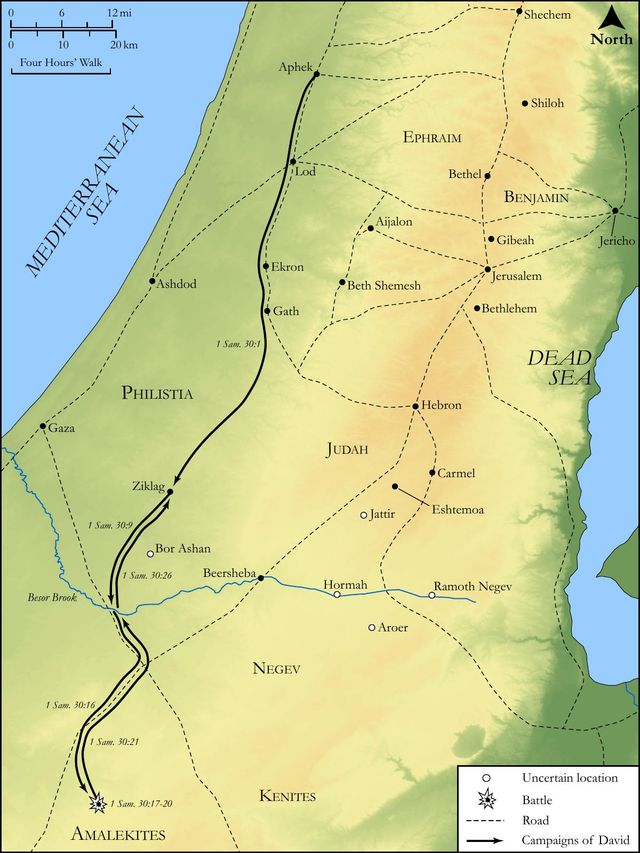
See on the biblical-era map
Study this verse
Public-domain commentary
Matthew Henry
From his Commentary on the Whole Bible. Henry comments on passages, not single verses — this entry covers 1 Samuel 30:21–31. His four-level outline is real structure in the source text, so it is rendered as structure.
We have here an account of the distribution of the spoil which as taken from the Amalekites. When the Amalekites had carried away a rich booty from the land of Judah and the Philistines they spent it in sensuality, in eating, and drinking, and making merry with it; but David disposed of the spoil taken after another manner, as one that knew that justice and charity must govern us in the use we make of whatever we have in this world. What God gives us he designs we should do good with, not serve our lusts with. In the distribution of the spoil,
I.David was just and kind to those who abode by the stuff.
They came forth to meet the conquerors, and to congratulate them on this success, though they could not contribute to it (Sa1 30:21); for we should rejoice in a good work done, though Providence had laid us aside and rendered us incapable of lending a hand to it. David received their address very kindly, and was so far from upbraiding them with their weakness that he showed himself solicitous concerning them. He saluted them; he asked them of peace (so the word is), enquired how they did, because he had left them faint and not well; or wished them peace, bade them be of good cheer, they should lose nothing by staying behind; for of this they seemed afraid, as perhaps David saw by their countenances.
1.There were those that opposed their coming in to share in the spoil; some of David's soldiers, probably the same that spoke of stoning him, spoke now of defrauding their brethren; they are called wicked men and men of Belial, Sa1 30:22. Let not the best of men think it strange if they have those attending them that are very bad and they cannot prevail to make them better. We may suppose that David had instructed his soldiers, and prayed with them, and yet there were many among them that were wicked men and men of Belial, often terrified with the apprehensions of death and yet wicked men still and men of Belial. These made a motion that the 200 men who abode by the stuff should only have their wives and children given them, but none of their goods. Well might they be called wicked men; for this bespeaks them,
(1.)Very covetous themselves and greedy of gain; for hereby the more would fall to their share. Awhile ago they would gladly have given half their own to recover the other half, yet now that they have all their own they are not content unless they can have their brethren's too; so soon do men forget their low estate. All seek their own, and too often more than their own.
(2.)Very barbarous to their brethren; for, to give them their wives and children, and not their estates, was to give them the mouths without the meat. What joy could they have of their families if they had nothing to maintain them with? Was this to do as they would be done by? Those are men of Belial indeed who delight in putting hardships upon their brethren, and care not who is starved, so they may be fed to the full.
2.David would by no means admit this, but ordered that those who tarried behind should come in for an equal share in the spoils with those that went to the battle, Sa1 30:23, Sa1 30:24. This he did,
(1.)In gratitude to God. The spoil we have is that which God has given us; we have it from him, and therefore must use it under his direction as good stewards. Let this check us when we are tempted to misapply that which God has entrusted us with of this world's goods. "Nay, I must not do so with that which God has given me, not serve Satan and a base lust with those things which are not only the creatures of his power, but the gifts of his bounty. God has recompensed us by delivering the company that came against us into our hand, let not us then wrong our brethren. God has been kind to us in preserving us and giving us victory, let not us be unkind to them." God's mercy to us should make us merciful to one another.
(2.)In justice to them. It was true they tarried behind; but,
[1.]It was not for want of good-will to the cause or to their brethren, but because they had not strength to keep up with them. It was not their fault, but their infelicity; and therefore they ought not to suffer for it.
[2.]Though they tarried behind now, they had formerly engaged many times in battle and done their part as well as the best of their brethren, and their former services must be considered now that there was something to enjoy.
[3.]Even now they did good service, for they abode by the stuff, to guard that which somebody must take care of, else that might have fallen into the hands of some other enemy. Every post of service is not alike a post of honour, yet those that are in any way serviceable to the common interest, though in a meaner station, ought to share in the common advantages, as in the natural body every member has its use and therefore has its share of the nourishment. First, Thus David overruled the wicked men, and men of Belial, with reason, but with a great deal of mildness; for the force of reason is sufficient, without the force of passion. He calls them his brethren, Sa1 30:23. Superiors often lose their authority by haughtiness, but seldom by courtesy and condescension. Secondly, Thus he settled the matter for the time to come, made it a statute of his kingdom (a statute of distributions, primo Davidis - in the first year of David's reign), an ordinance of war (Sa1 30:25), that as his part is that goes down to the battle, and hazards his life in the high places of the field, so shall his be that guards the carriages. Abraham returned the spoils of Sodom to the right owners, and quitted his title to them jure belli - derived from the laws of war. If we help others to recover their right, we must not think that this alienates the property and makes it ours. God appointed that the spoil of Midian should be divided between the soldiers and the whole congregation, Num 31:27. The case here was somewhat different, but governed by the same general rule - that we are members one of another. The disciples, at first, had all things common, and we should still be ready to distribute, willing to communicate, Ti1 6:18. When kings of armies did flee apace, she that tarried at home did divide the spoil, Psa 68:12.
II.David was generous and kind to all his friends.
When he had given every one his own with interest there was a considerable overplus, which David, as general, had the disposal of; probably the spoil of the tents of the Amalekites consisted much in plate and jewels (Jdg 8:24, Jdg 8:26), and these, because he thought they would but make his own soldiers proud and effeminate, he thought fit to make presents of to his friends, even the elders of Judah, Sa1 30:26. Several places are here named to which he sent of these presents, all of them in or near the tribe of Judah. The first place named is Bethel, which signifies the house of God; that place shall be first served for its name's sake; or perhaps it means not the city so called, but the place where the ark was, which was therefore the house of God. Thither David sent the first and best, to those that attended there, for his sake who is the first and best. Hebron is named last (Sa1 30:31), probably because thither he sent the residuum, which was the largest share, having an eye upon that place as fittest for his head-quarters, Sa2 2:1. In David's sending these presents observe,
1.His generosity. He aimed not to enrich himself, but to serve his country; and therefore God afterwards enriched him, and set him to rule the country he had served. It becomes gracious souls to be generous. There is that scatters, and yet increases.
2.His gratitude. He sent presents to all the places where he and his men were wont to haunt (Sa1 30:31), that is, to all that he had received kindness from, that had sheltered him and sent him intelligence or provisions. Note, Honesty, as well as honour, obliges us to requite the favours that have been done us, or at least to make a real acknowledgment of them as far as is in the power of our hand.
3.His piety. He calls his present a blessing; for no present we give to our friends will be a comfort to them but as it is made so by the blessing of God: it intimates that his prayers for them accompanied his present. He also sent it out of the spoil of the enemies of the Lord (so he calls them, not his enemies), that they might rejoice in the victory for the Lord's sake, and might join with him in thanksgivings for it.
4.His policy. He sent these presents among his countrymen to engage them to be ready to appear for him upon his accession to the throne, which he now saw at hand. A man's gift maketh room for him. He was fit to be a king who thus showed the bounty and liberality of a king. Munificence recommends a man more than magnificence. The Ziphites had none of his presents, nor the men of Keilah; and thus he showed that, though he was such a saint as not to revenge affronts, yet he was not such a fool as not to take notice of them.
Continue studying 1 Samuel 30:28 across the web’s major study libraries — every link below opens this exact verse, chapter, or book on the destination site.
Read & Compare
 BibleGatewayThis verse in more than 200 translations and 70 languages.
 Bible.comThe YouVersion reader — hundreds of translations, reading plans, and highlights.
 ESV.orgCrossway's official English Standard Version reader.
 NET BibleThe NET translation with 60,000+ translators' notes on every rendering decision.
 STEP BibleTyndale House's free study tool — original text, vocabulary, and scholarly resources.
 BibliaLogos Bible Software's free web reader.
 USCCBThe New American Bible (Revised Edition) with the U.S. bishops' study notes.
Commentaries
 BibleHub CommentariesDozens of classic commentaries on this verse, gathered on one page.
 StudyLightMore than 100 commentary sets — the largest collection on the web.
 BibleRefPlain-English commentary on what this verse means, verse by verse.
 Enduring WordDavid Guzik's free commentary on this chapter, widely used by Bible teachers.
 Bible Study ToolsVerse commentary alongside Greek and Hebrew study aids.
Original Language & Research
- BibleHub InterlinearThe verse word by word — original language, transliteration, and English.
- BibleHub LexiconEvery word's original-language definition and Strong's entry.
 Blue Letter BibleDeep-study tools — Strong's numbers, concordance, and word studies.
 SefariaThe Hebrew text with Rashi and centuries of Jewish commentary.
Sermons, Hymns & Audio


TrulyRandomVerse is not affiliated with these sites and doesn’t control their content. They’re linked because they’re genuinely useful.
Summary
This verse meticulously records David's strategic and generous distribution of the recovered spoils from the Amalekites to specific towns in Judah. Following his decisive victory at Ziklag, this act served not only as an expression of profound gratitude to those who had supported him but also as a shrewd exercise in political foresight, building crucial goodwill and alliances among the elders of Judah. It powerfully demonstrates David's burgeoning leadership and his faithful stewardship over the abundant resources divinely provided, marking a significant transition from a fugitive leader to a unifying figure, thereby laying essential groundwork for his eventual kingship over all Israel.
Context
ShowHideLiterary Context
This verse is situated within the immediate aftermath of David's triumphant recovery of everything the Amalekites had plundered from Ziklag, including his wives and the families of his men. After returning to a devastated Ziklag, David, having inquired of the Lord, pursued the raiders and, by divine grace, recovered all that was taken. The narrative then shifts dramatically from the intensity of pursuit and battle to the deliberate and strategic distribution of the vast spoil. Before this verse, David had already established a foundational principle of shared reward, declaring that those who guarded the supplies should receive an equal share with those who went to battle (1 Samuel 30:24). Verses 26-31 then meticulously list the specific towns to which David sent a portion of the spoil, highlighting his widespread generosity and astute political acumen.
Historical & Cultural Context
At this point in the narrative, David was still operating as a fugitive from King Saul, albeit with a rapidly growing band of loyal followers and an established reputation as a mighty warrior. His residence in Ziklag, granted by the Philistine king Achish, placed him in a precarious but strategically useful position, allowing him to operate on the fringes of Judah. In Israel, the distribution of war spoils was far more than a mere act of reward; it was a significant political and social gesture. It unequivocally demonstrated a leader's power, generosity, and, crucially, his ability to provide for and protect his people. Sending gifts to elders and key towns was a common and effective practice to secure loyalty, build vital alliances, and solidify a burgeoning power base. The towns listed—Aroer, Siphmoth, and Eshtemoa—were likely located in the southern part of Judah, possibly within the Negev or the southern hill country. These areas may have offered refuge, supplies, or at least safe passage to David and his men during their arduous years as fugitives, making them natural and strategic recipients of his gratitude and outreach. As Saul's tumultuous reign was nearing its prophesied end, David's calculated actions here were instrumental in paving the way for his eventual acceptance and anointing as king by the tribes of Judah.
Key Themes
ShowHideDavid's actions in this chapter, particularly the systematic distribution of spoil, powerfully underscore several major themes. First, Gratitude and Generosity are profoundly prominent, as David acknowledges God's direct hand in the miraculous victory and extends blessing to others. This reflects a spirit of open-handedness, rooted in the understanding that all provision and success ultimately come from God. Second, Strategic Leadership and Political Wisdom are abundantly evident; David was not merely being altruistic but was also shrewdly building goodwill and strengthening crucial alliances within Judah. By sending gifts to these specific towns, he was demonstrating his capacity for unifying leadership and securing a broad support base among the elders of Judah, which would prove absolutely vital for his future kingship. This was a calculated and forward-thinking move to solidify his position as Saul's reign waned, as explicitly seen in his sending gifts "to the elders of Judah, even to his friends" (1 Samuel 30:26). Third, the theme of Divine Provision and Stewardship is highlighted with striking clarity. The recovered spoil was a direct and undeniable result of God's intervention and blessing in battle, and David, as a wise and faithful leader, understood he was a steward of these resources, called to use them to bless others and further God's overarching purposes, which inherently included the establishment of his own righteous rule. Finally, the principle of Community and Shared Blessing is reinforced, as David extended the blessing of victory beyond just the warriors who fought, reflecting a broader, inclusive principle of shared reward within the community, including even those who stayed behind to guard the supplies (1 Samuel 30:24).
Exposition and Analysis
ShowHideKey Word Analysis
ShowHideThis name, derived from a root possibly meaning "nudity of situation" or "juniper tree," refers to one of several places in biblical geography. In this context, it most likely designates a town in the Negev region of southern Judah. Its inclusion suggests David's extensive reach to communities on the southern fringes of the tribal territory, acknowledging those who may have provided him with safe passage or supplies during his fugitive years, and solidifying their allegiance.
This feminine plural name, whose precise meaning is obscure, refers to a place in Palestine, generally believed to be located in the southern hill country of Judah. Its mention here underscores the breadth of David's strategic outreach, ensuring that his generosity and influence touched various parts of the region, not solely the most prominent centers, thereby cultivating widespread support.
Meaning "obedience" or "I will make myself heard," Eshtemoa was a significant Levitical city located in the hill country of Judah, explicitly listed among the cities designated for the sons of Aaron in Joshua 21:14. As a center of religious and potentially judicial authority, David's decision to send gifts to such a city was particularly strategic, securing the favor of influential religious leaders and communities, thereby bolstering his legitimacy and support base.
Verse Breakdown
ShowHide"And to [them] which [were] in Aroer"
This phrase initiates a deliberate and widespread distribution of the recovered spoil, highlighting David's intention to extend his gratitude and influence broadly. The inclusion of Aroer, a town likely situated in the southern Negev, underscores David's concern for communities on the periphery of Judah, perhaps those who had offered him refuge or sustenance during his years as a fugitive. This act signifies his emerging role as a leader who acknowledges and rewards loyalty across his sphere of influence.
"and to [them] which [were] in Siphmoth"
Continuing the methodical pattern, David's gift to Siphmoth further emphasizes the extensive reach of his generosity. Although its exact location is debated, its inclusion signifies David's meticulous approach to building a robust network of support. By ensuring that various regions within Judah felt his favor, he was actively cultivating allegiance and acknowledging their potential role in his future kingship.
"and to [them] which [were] in Eshtemoa"
The final town listed in this specific verse, Eshtemoa, held particular significance as a Levitical city, indicating its religious and intellectual prominence. David's decision to send gifts to such a vital center underscores his profound political acumen. By blessing this community, he would have gained favor not only with its inhabitants but potentially with the wider religious establishment, thereby solidifying his standing and legitimacy among influential groups within Judah in preparation for his eventual reign.
Literary Devices
ShowHideThe primary literary device employed in 1 Samuel 30:28, and indeed throughout the broader passage of 1 Samuel 30:26-31, is Listing or Cataloguing. This technique involves the systematic enumeration of a series of items, in this case, the specific towns that received a portion of the spoil. The cumulative effect of this detailed list is to powerfully emphasize the extensive, deliberate, and comprehensive nature of David's generosity and strategic outreach. It underscores the breadth of his burgeoning influence and the meticulousness with which he cultivated crucial alliances across Judah. Furthermore, the subtle Repetition of the phrase "and to them which were in" (or similar constructions in the broader list of towns) creates a rhythmic emphasis, reinforcing the systematic and widespread distribution. This repetition highlights David's comprehensive effort to acknowledge and reward those who had supported him, demonstrating his emerging and unifying role as a leader. Finally, the Strategic Naming of these particular towns, ranging from the geographical fringes of the territory to significant Levitical centers, subtly communicates David's profound political wisdom and foresight, showcasing his ability to build a broad and diverse base of support essential for his imminent kingship.
Theological and Thematic Connections
ShowHideDavid's act of distributing the spoil is deeply rooted in profound theological principles of divine provision, faithful stewardship, and the very nature of blessing. The overwhelming victory over the Amalekites was clearly and unequivocally attributed to God's direct intervention and miraculous power, making the recovered spoil a tangible manifestation of God's boundless generosity and unwavering faithfulness to David. David, in turn, acts as a wise and exemplary steward, understanding implicitly that these abundant resources are not solely for his personal gain or the exclusive benefit of his immediate fighting force, but are rather to be used to bless others and further God's overarching purposes. This echoes the timeless biblical truth that all we possess is, in fact, a gracious gift from God, and we are therefore called to manage it in a way that profoundly honors Him and genuinely benefits His people. David's open-handed generosity also beautifully reflects God's own character as the ultimate and most generous giver, who blesses His children abundantly beyond measure. By sharing the spoil, David extends the blessing of victory and demonstrates a foundational kingdom principle of shared prosperity, mutual support, and collective well-being, thereby laying the groundwork for a righteous rule founded on justice, equity, and generosity.
Reflection and Application
ShowHideDavid's post-victory actions in 1 Samuel 30:28 offer profound and actionable lessons for contemporary believers seeking to live out their faith in practical ways. First, they serve as a powerful reminder to always acknowledge God's sovereign hand in our successes, victories, and blessings. Just as David recognized that the recovered spoil was a direct result of divine intervention, we too must cultivate a deep and abiding spirit of gratitude, remembering that "every good gift and every perfect gift is from above" (James 1:17). Second, David's exemplary conduct calls us to practice radical and intentional generosity with the resources, talents, and opportunities God has graciously entrusted to us. Our blessings are never solely for personal consumption or accumulation but are fundamentally meant to be shared, especially with those who have supported us, are in need, or can benefit from our faithful stewardship. This open-handed generosity actively builds community, strengthens vital relationships, and powerfully extends God's kingdom influence. Third, David's strategic wisdom in building alliances teaches us the enduring importance of investing deeply in relationships and fostering genuine goodwill within our families, communities, churches, and even professionally. Simple acts of kindness, thoughtful support, and sincere gratitude can forge lasting bonds and create a robust network of mutual encouragement and shared purpose. Finally, we are called to be wise and faithful stewards of all that God provides—not merely financial resources, but also our time, abilities, influence, and spiritual gifts—using them not just for personal gain, but for the profound benefit of others and for purposes that align directly with God's divine will and the advancement of His eternal kingdom.
Questions for Reflection
ShowHideFAQ
ShowHideWhy did David send gifts to these specific towns, and not others?
ShowHideDavid's decision to send gifts to specific towns like Aroer, Siphmoth, and Eshtemoa was a multifaceted act rooted in profound gratitude, astute strategic political wisdom, and the practical realities of his situation. These towns were likely located in southern Judah, possibly within the Negev or the southern hill country, regions where David and his men had probably found crucial refuge, essential supplies, or at least safe passage during their arduous years as fugitives from King Saul. Sending gifts was thus an act of profound gratitude for any past support or kindness they had rendered. More significantly, it was a shrewd and calculated political maneuver. In Israel, distributing spoils to key cities and their influential elders was a recognized and highly effective way to build vital alliances, secure unwavering loyalty, and powerfully demonstrate a leader's ability to provide for and protect his people. As King Saul's tumultuous reign was nearing its end, David was actively and intelligently laying the groundwork for his future kingship over Judah. By blessing these specific communities, especially a prominent Levitical city like Eshtemoa, David was strategically solidifying his support base among the elders and influential figures of Judah, thereby paving the way for his eventual anointing as king in Hebron (2 Samuel 2:4).
Christ-Centered Fulfillment
ShowHideDavid's act of distributing the spoils in 1 Samuel 30:28, born out of a divinely granted victory and exercised with remarkable strategic generosity, beautifully foreshadows the ultimate generosity and unparalleled strategic wisdom of Jesus Christ. David, as a type of Christ, received a material spoil from his earthly victory and distributed it to build an earthly kingdom and secure human loyalty. Christ, the true and infinitely greater David, achieved the ultimate victory over sin, death, and the devil through His sacrificial crucifixion and glorious resurrection (Colossians 2:15). From this unparalleled triumph, He did not distribute mere earthly spoils but poured out an abundance of spiritual blessings and divine gifts upon His people. Just as David shared his victory's benefits with those who supported him and those in need, Christ, upon His ascension to heaven, "led captivity captive, and gave gifts unto men" (Ephesians 4:8). He sovereignly distributes the indwelling Holy Spirit, diverse spiritual gifts, and the very righteousness of God to all who believe, not based on their merit, but solely on His boundless grace and immeasurable love (Romans 5:17). David's generosity was limited to physical resources and a specific geographical region; Christ's generosity is infinite, providing eternal life and inexhaustible spiritual riches to all nations, building an eternal kingdom where every believer is a grateful recipient of His immeasurable grace (John 3:16). He is the ultimate and perfect steward, who, though eternally rich, for our sakes became poor, that we through His poverty might become spiritually rich beyond measure (2 Corinthians 8:9).