


Joshua 21:14
Bible text: King James Version (1769 Blayney text) · Public domain
Bible text: American Standard Version (1901) · Public domain
Bible text: World English Bible, Messianic edition · Public domain
Bible text: Geneva Bible (1599) · Public domain
Bible text: Young's Literal Translation · Public domain
- וְאֶתve·'Etand <obj.>H853Conj-w ¦ DirObjMParticle Object Indicatorוְandאֶת<obj.>
- יַתִּרya·TirJattirH3492N-properNoun Proper Location
- וְאֶתve·'Etand <obj.>H853Conj-w ¦ DirObjMParticle Object Indicatorוְandאֶת<obj.>
- מִגְרָשֶׁהָmig·ra·She·haits pasture landsH4054N-mpc ¦ 3fsNoun Plural Masculine Constructמִגְרָשֶׁpasture landsהָits
- וְאֶתve·'Etand <obj.>H853Conj-w ¦ DirObjMParticle Object Indicatorוְandאֶת<obj.>
- אֶשְׁתְּמֹעַ'esh·te·Mo·a'EshtemoaH851N-properNoun Proper Location
- וְאֶתve·'Etand <obj.>H853Conj-w ¦ DirObjMParticle Object Indicatorוְandאֶת<obj.>
- מִגְרָשֶׁהָmig·ra·She·haits pasture landsH4054N-mpc ¦ 3fsNoun Plural Masculine Constructמִגְרָשֶׁpasture landsהָits
English is a literal word-by-word gloss of the Hebrew, not the KJV's wording. Why?
This is the original text the KJV's translators worked from — each Hebrew word with its own literal English meaning in this verse, prepared by scholars at Tyndale House, Cambridge. The KJV translates whole sentences, not word by word, so its wording differs: one Hebrew word can become several English words, and the KJV may choose “the LORD” where the gloss reads “Yahweh”. Both are faithful — they answer different questions. For the KJV's own rendering, switch to the KJV text.
Details
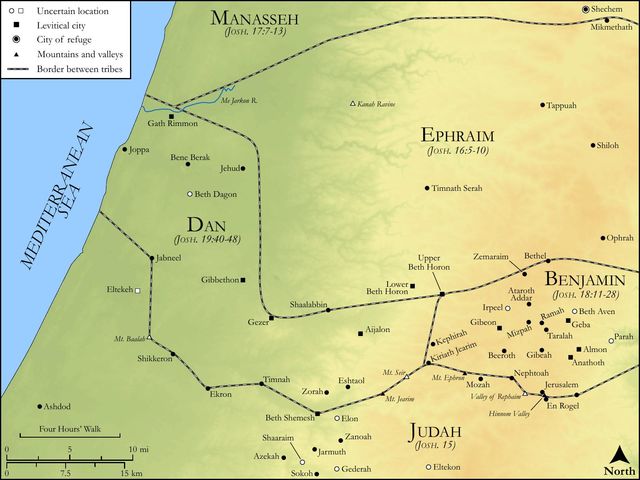
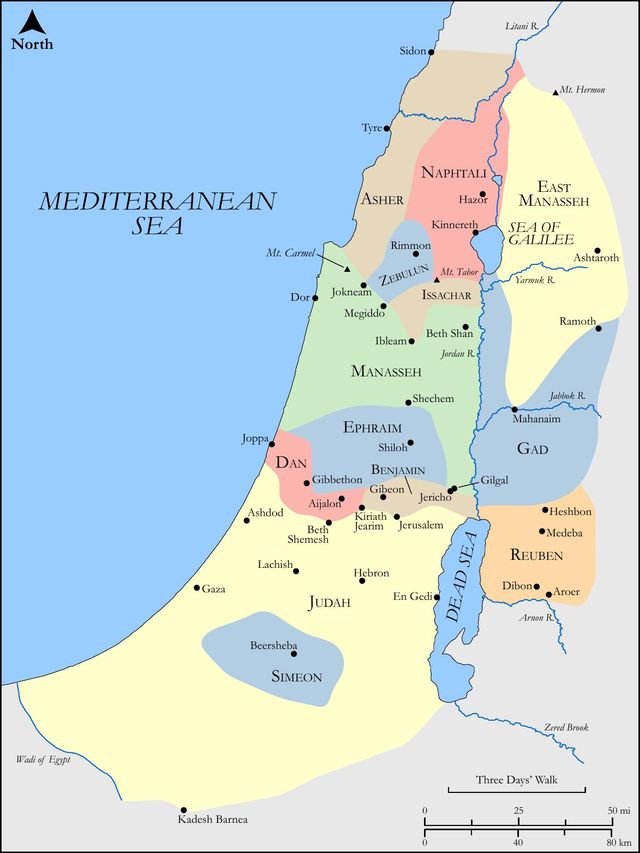
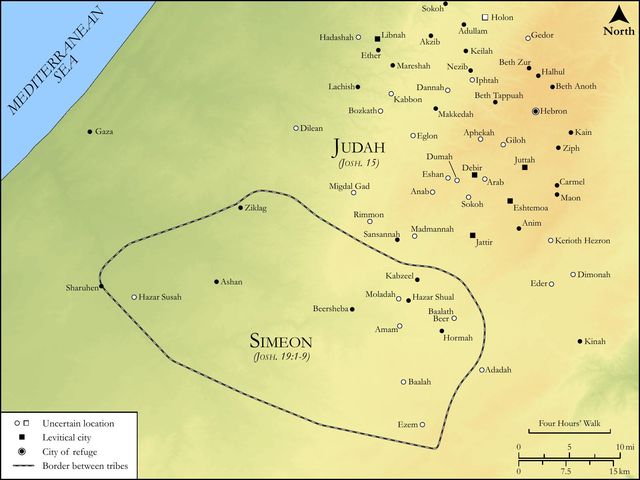
See on the biblical-era maps
Study this verse
Public-domain commentary
Matthew Henry
From his Commentary on the Whole Bible. Henry comments on passages, not single verses — this entry covers Joshua 21:9–42. His two-level outline is real structure in the source text, so it is rendered as structure.
We have here a particular account of the cities which were given to the children of Levi out of the several tribes, not only to be occupied and inhabited by them, as tenants to the several tribes in which they lay - no, their interest in them was not dependent and precarious, but to be owned and possessed by them as lords and proprietors, and as having the same title to them that the rest of the tribes had to their cities or lands, as appears by the law which preserved the house in the Levites' cities from being alienated any longer than till the year of jubilee, Lev 25:32, Lev 25:33. Yet it is probable that the Levites having only the cities and suburbs, while the land about pertained to the tribes in which they lay, those of that tribe, for the convenience of occupying that land, might commonly rent houses of the Levites, as they could spare them in their cities, and so live among them as their tenants. Several things may be observed in this account, besides what was observed in the law concerning it, Num. 35.
I.That the Levites were dispersed into all the tribes, and not suffered to live all together in any one part of the country.
This would find them all with work, and employ them all for the good of others; for ministers, of all people, must neither be idle nor live to themselves or to one another only. Christ left his twelve disciples together in a body, but left orders that they should in due time disperse themselves, that they might preach the gospel to every creature. The mixing of the Levites thus with the other tribes would be an obligation upon them to walk circumspectly, and as became their sacred function, and to avoid every thing that might disgrace it. Had they lived all together, they would have been tempted to wink at one another's faults, and to excuse one another when they did amiss; but by this means they were made to see the eyes of all Israel upon them, and therefore saw it their concern to walk so as that their ministry might in nothing be blamed nor their high character suffer by their ill carriage.
II.That every tribe of Israel was adorned and enriched with its share of Levites' cities in proportion to its compass, even those that lay most remote. They were all God's people, and therefore they all had Levites among them.
1.To show kindness to, as God appointed them, Deu 12:19; Deu 14:29. They were God's receivers, to whom the people might give their grateful acknowledgments of God's goodness, as the occasion and disposition were.
2.To receive advice and instruction from; when they could not go up to the tabernacle, to consult those who attended there, they might go to a Levites' city, and be taught the good knowledge of the Lord. Thus God set up a candle in every room of his house, to give light to all his family; as those that attended the altar kept the charge of the Lord, to see that no divine appointment was neglected there, so those that were scattered in the country had their charge too, which was to see that no idolatrous superstitious usages were introduced at a distance and to watch for the souls of God's Israel. Thus did God graciously provide for the keeping up of religion among them, and that they might have the word nigh them; yet, blessed be God, we, under the gospel, have it yet nigher, not only Levites in every county, but Levites in every parish, whose office it is still to teach the people knowledge, and to go before them in the things of God.
III.That there were thirteen cities, and those some of the best, appointed for the priests, the sons of Aaron, Jos 21:19.
Aaron left but two sons, Eleazar and Ithamar, yet his family was now so much increased, and it was foreseen that it would in process of time grow so numerous, as to replenish all these cities, though a considerable number must of necessity be resident wherever the ark and the altar were. We read in both Testaments of such numbers of priests that we may suppose none of all the families of Israel that came out of Egypt increased afterwards so much as that of Aaron did; and the promise afterwards to the house of Aaron is, God shall increase you more and more, you and your children, Psa 115:12, Psa 115:14. He will raise up a seed to serve him.
IV.That some of the Levites' cities were afterwards famous upon other accounts.
Hebron was the city in which David began his reign, and in Manhanaim, another Levites' city (Jos 21:38), he lay, and had his headquarters when he fled from Absalom. The first Israelite that ever wore the title of king (namely, Abimelech, the son of Gideon) reigned in Shechem, another Levites' city, Jos 21:21.
V.That the number of them in all was more than of most of the tribes, except Judah, though the tribe of Levi was one of the least of the tribes, to show how liberal God is, and his people should be, to his ministers; yet the disproportion will not appear so great as at first it seems, if we consider that the Levites had cities only with their suburbs to dwell in, but the rest of the tribes, besides their cities (and those perhaps were many more than are named in the account of their lot), had many unwalled towns and villages which they inhabited, besides country houses.
Upon the whole, it appears that effectual care was taken that the Levites should live both comfortably and usefully: and those, whether ministers or others, for whom Providence has done well, must look upon themselves as obliged thereby to do good, and, according as their capacity and opportunity are, to serve their generation.
Continue studying Joshua 21:14 across the web’s major study libraries — every link below opens this exact verse, chapter, or book on the destination site.
Read & Compare
 BibleGatewayThis verse in more than 200 translations and 70 languages.
 Bible.comThe YouVersion reader — hundreds of translations, reading plans, and highlights.
 ESV.orgCrossway's official English Standard Version reader.
 NET BibleThe NET translation with 60,000+ translators' notes on every rendering decision.
 STEP BibleTyndale House's free study tool — original text, vocabulary, and scholarly resources.
 BibliaLogos Bible Software's free web reader.
 USCCBThe New American Bible (Revised Edition) with the U.S. bishops' study notes.
Commentaries
 BibleHub CommentariesDozens of classic commentaries on this verse, gathered on one page.
 StudyLightMore than 100 commentary sets — the largest collection on the web.
 BibleRefPlain-English commentary on what this verse means, verse by verse.
 Enduring WordDavid Guzik's free commentary on this chapter, widely used by Bible teachers.
 Bible Study ToolsVerse commentary alongside Greek and Hebrew study aids.
Original Language & Research
- BibleHub InterlinearThe verse word by word — original language, transliteration, and English.
- BibleHub LexiconEvery word's original-language definition and Strong's entry.
 Blue Letter BibleDeep-study tools — Strong's numbers, concordance, and word studies.
 SefariaThe Hebrew text with Rashi and centuries of Jewish commentary.
Sermons, Hymns & Audio


TrulyRandomVerse is not affiliated with these sites and doesn’t control their content. They’re linked because they’re genuinely useful.
Summary
Joshua 21:14 meticulously records the allocation of Jattir and Eshtemoa, along with their surrounding pasturelands, to the Levites. This specific detail within the broader account of Israel's land distribution powerfully underscores God's unwavering faithfulness in fulfilling His covenant promises, His precise and comprehensive provision for those consecrated to His service, and the strategic placement of the Levites throughout the land to ensure spiritual instruction and access to divine law for all tribes.
Context
ShowHideLiterary Context
Joshua 21 serves as the climactic conclusion to the detailed land distribution narrative that commenced in Joshua 13. Following the successful conquest of Canaan and the division of territory among the twelve tribes by lot, this chapter meticulously enumerates the forty-eight cities, complete with their surrounding pasturelands, specifically designated for the tribe of Levi. Unlike the other tribes, who received contiguous territorial inheritances, the Levites were set apart for priestly and spiritual service and thus received scattered cities from the portions of the other tribes, as explicitly commanded by God in Numbers 35:1-8. Joshua 21:14 specifically names two cities from the territory of Judah, continuing the precise enumeration that demonstrates the thoroughness with which God's commands were executed and His promises fulfilled.
Historical & Cultural Context
The Levites occupied a unique and indispensable position within ancient Israelite society. They were divinely consecrated for the service of the Tabernacle and, later, the Temple, bearing primary responsibility for priestly duties, teaching the Mosaic Law, and administering justice. Because "the Lord God of Israel was their inheritance" (Joshua 13:33), they were not granted a tribal land inheritance for agricultural purposes like the other tribes. Instead, God commanded that they be provided with cities to reside in, along with "suburbs" (pasturelands) for their livestock, ensuring their practical livelihood. This strategic arrangement allowed the Levites to live dispersed among all the tribes, thereby facilitating their crucial role as spiritual guides and instructors across the entire nation, preventing the centralization of religious authority and ensuring widespread access to God's law and worship.
Key Themes
ShowHideThis verse, embedded within the broader narrative of Joshua 21, powerfully illustrates several foundational themes. First, it highlights Divine Faithfulness, demonstrating God's meticulous fulfillment of every intricate detail of His promises, extending even to the specific cities allocated to the Levites. This echoes the profound declaration found in Joshua 21:45 that "not one word of all the good promises that the Lord had made to the house of Israel had failed; all came to pass." Second, it underscores Divine Order and Provision, showcasing God's precise and comprehensive care for His people, particularly those dedicated to His sacred service. The explicit provision of pasturelands ("suburbs") alongside the cities underscores His attention to their practical and material needs. Finally, it reinforces The Strategic Role of the Levites, whose scattered distribution throughout Israel was absolutely crucial for their function as spiritual educators, ensuring that the knowledge of God and His Law permeated all corners of the land, thereby fostering national unity under God's covenant.
Exposition and Analysis
ShowHideKey Word Analysis
ShowHideA city in Palestine, specifically located in the hill country of Judah, and designated as one of the cities assigned to the Levites (specifically the sons of Aaron, the Kohathites). The name, derived from a root meaning "redundant" or "remaining," perhaps alludes to its status as one of the cities "left over" or designated for the Levites from the tribal allotments. Its specific mention underscores the meticulous detail of God's provision and the historical reality of the land distribution.
A place in Palestine, also situated in the hill country of Judah, and designated as a Levitical city. Its name is derived from a root meaning "to hear" or "obedience," possibly reflecting a characteristic of the place or its inhabitants, or perhaps hinting at the Levites' role in teaching obedience to God's Law. The explicit naming of Eshtemoa further emphasizes the precise and comprehensive nature of God's fulfillment of His covenant promises in the land allocation.
The Hebrew term migrâsh (plural migrashim) refers specifically to the open country or pasturelands surrounding the Levitical cities, where flocks could be driven for grazing. This was not merely an "outskirt" but a designated area for sustenance. Derived from a root meaning "to cast out" or "drive away," it aptly describes land where livestock were driven. Since the Levites were not allotted agricultural land, these migrashim were vital for their livelihood, ensuring they had the necessary means to support themselves and their animals. This detail underscores God's meticulous and comprehensive provision for those consecrated to His service, allowing them to focus on their sacred duties.
Verse Breakdown
ShowHide"And Jattir with her suburbs"
This clause identifies the first of two specific cities mentioned in this verse that were given to the Levites. "Jattir" signifies a tangible, identifiable location within the territory of Judah. The phrase "with her suburbs" is critical, indicating that along with the city itself, the surrounding pasturelands (migrashim) were also allocated. This provision was vital for the Levites, whose sustenance came not from agricultural land but from their livestock, which required grazing areas. It underscores the precise and practical nature of God's provision for their unique calling.
"and Eshtemoa with her suburbs"
This second clause follows the exact pattern of the first, listing another specific city, "Eshtemoa," also located in Judah, and explicitly stating the inclusion of its "suburbs." The repetition reinforces the consistent pattern of allocation for all Levite cities. It emphasizes the thoroughness of the land distribution and God's detailed care, ensuring that each Levite city came with the necessary adjacent lands to support the Levites' livelihood and allow them to fulfill their divinely appointed roles without material hindrance.
Literary Devices
ShowHideThe verse employs Enumeration as part of a larger, systematic cataloging of the cities given to the Levites within Joshua 21. This precise listing underscores the meticulous fulfillment of God's promises and the orderly nature of the divine plan. The Repetition of the phrase "with her suburbs" after each city's name is a significant literary feature. This reiteration serves to emphasize the comprehensive nature of the provision, highlighting that not only were cities given, but also the essential pasturelands for the Levites' livelihood. This reinforces God's attention to detail and His complete care for those dedicated to His service, ensuring their practical needs were met. The naming of specific cities like Jattir and Eshtemoa also functions as a form of Specificity, grounding the divine promise in concrete, geographical realities, thereby enhancing the narrative's credibility and demonstrating the tangible outcome of God's faithfulness.
Theological and Thematic Connections
ShowHideJoshua 21:14, though seemingly a minor detail in a lengthy list, powerfully illustrates God's unwavering faithfulness and meticulous provision for His people, particularly those consecrated for His service. The precise allocation of cities and their essential pasturelands to the Levites demonstrates that God's promises are not vague generalities but specific, detailed commitments that He fulfills with absolute precision. This divine care for the Levites, who had no land inheritance but were sustained by the Lord Himself, serves as a profound theological statement about God's commitment to those who dedicate their lives to Him. It underscores that true spiritual service is always met with divine sustenance, ensuring that those called to ministry can focus on their sacred duties without being consumed by worldly anxieties. This verse, therefore, is a testament to God's orderly nature and His comprehensive care for His covenant people and His divine plan for their spiritual well-being.
Reflection and Application
ShowHideThe meticulous detail of Joshua 21:14, listing specific cities and their suburbs for the Levites, offers profound lessons for contemporary believers. It reminds us that God is a God of order, precision, and unwavering faithfulness, fulfilling His promises down to the smallest detail. Just as He meticulously provided for the Levites, ensuring their livelihood so they could focus on their spiritual duties, He continues to care for and provide for those who dedicate their lives to His service today, whether in full-time ministry or in their daily vocations. This verse also highlights the importance of strategic placement and distributed spiritual influence. The Levites were scattered among all the tribes, not concentrated in one area, to ensure that God's law and worship were accessible throughout the nation. Similarly, believers today are called to be "salt and light" in their diverse communities, as Jesus taught in Matthew 5:13-16, bringing the knowledge of God and the transforming power of the Gospel to every sphere of society. It challenges us to consider how we can support and encourage those in spiritual leadership, recognizing that their ability to serve effectively is often tied to the practical provision and spiritual support they receive from the wider body of Christ. Ultimately, this verse calls us to trust in God's comprehensive provision and to faithfully steward the callings and resources He entrusts to us, knowing that His detailed care extends to every aspect of our lives and His kingdom work.
Questions for Reflection
ShowHideFAQ
ShowHideWhy did the Levites receive cities instead of a continuous tribal territory like the other tribes?
ShowHideThe Levites did not receive a continuous territorial inheritance because they were set apart by God for sacred service. Their "inheritance" was the Lord Himself, as stated in Numbers 18:20 and Deuteronomy 10:9. Their primary role was to minister to God and to teach His law to all the tribes of Israel. To facilitate this, God commanded that they be given forty-eight cities, along with their surrounding pasturelands, scattered throughout the territories of the other tribes. This strategic distribution ensured that spiritual instruction, priestly service, and access to God's law were available to all Israelites, preventing a centralized religious authority and promoting widespread spiritual access across the nation.
What was the specific purpose of the "suburbs" mentioned alongside the cities like Jattir and Eshtemoa?
ShowHideThe "suburbs" (Hebrew: migrashim) were not merely the outskirts of the cities but specifically designated common pasturelands surrounding the Levitical cities. Their purpose was to provide grazing areas for the Levites' livestock. Since the Levites did not receive agricultural land for farming, their livelihood often depended on their animals. This provision of migrashim was a crucial aspect of God's comprehensive care, ensuring that the Levites had the necessary means of sustenance. This allowed them to dedicate themselves fully to their sacred duties without being burdened by the need to cultivate land, demonstrating God's meticulous attention to the practical needs of those serving Him.
Christ-Centered Fulfillment
ShowHideThe meticulous provision for the Levites in Joshua 21:14, ensuring their sustenance and strategic placement, finds its ultimate fulfillment in Jesus Christ. The Levites, as mediators, teachers of the Law, and priests, served as vital foreshadows of the perfect and ultimate High Priest, Jesus Christ, who is our true spiritual inheritance. Just as the Levites had no earthly land inheritance but the Lord was their portion, believers in Christ find their true and eternal inheritance not in earthly possessions but in Christ Himself, who is "all in all" as declared in Colossians 3:11. Jesus, the Lamb of God, made the ultimate and sufficient sacrifice, establishing a new covenant where all believers are made "a royal priesthood" (1 Peter 2:9), no longer dependent on a specific tribe for mediation. Furthermore, the scattering of the Levites throughout Israel to bring the knowledge of God's law finds its profound parallel in Christ's commission to His disciples: to "go and make disciples of all nations" (Matthew 28:19). The church, as the body of Christ, is strategically placed throughout the world, empowered by the Holy Spirit, to be His witnesses and to spread the good news of the Gospel, fulfilling the spiritual purpose that the Levites' distribution prefigured. Thus, the detailed provision for the Levites points to God's perfect provision for His people through Christ, and the Levites' dispersed ministry foreshadows the global mission of the church, empowered by the Spirit, to bring the knowledge of God to every corner of the earth, echoing the promise that the earth will be "filled with the knowledge of the glory of the Lord as the waters cover the sea" (Habakkuk 2:14).