


1 Samuel 20:38
Bible text: King James Version (1769 Blayney text) · Public domain
Bible text: Berean Standard Bible · Public domain
Bible text: American Standard Version (1901) · Public domain
Bible text: World English Bible, Messianic edition · Public domain
Bible text: Geneva Bible (1599) · Public domain
Bible text: Young's Literal Translation · Public domain
- וַיִּקְרָאvai·yik·Ra'and he called outH7121Conj-w ¦ V-Qal-ConsecImperf-3msVerb Qal Consecutive Imperfect 3rd Singular Masculineוַandיִּקְרָאhe called out
- יְהוֹנָתָןye·ho·na·TanJonathanH3083N-proper-mNoun Proper Masculine
- אַחֲרֵי'a·cha·ReiafterH310Adj-mpcAdjective Numerical Plural Masculine Construct
- הַנַּעַרha·Na·'arthe ladH5288Art ¦ N-msNoun Singular Masculine Absoluteהַtheנַּעַרlad
- מְהֵרָהme·he·RahquicklyH4120AdvAdverb
- חוּשָׁהChu·shahmake haste !H2363V-Qal-Imp-2ms ¦ SfxVerb Qal Imperative 2nd Singular Masculineחוּשָׁmake hasteה!
- אַל'almay notH408NegParticle Negative
- תַּעֲמֹדta·'a·Modyou delayH5975V-Qal-Imperf-2msVerb Qal Imperfect 2nd Singular Masculine
- וַיְלַקֵּטvay·la·Ketand he picked upH3950Conj-w ¦ V-Piel-ConsecImperf-3msVerb Piel Consecutive Imperfect 3rd Singular Masculineוַandיְלַקֵּטhe picked up
- נַעַרNa·'ar[the] lad ofH5288N-mscNoun Singular Masculine Construct
- יְהוֹנָתָןye·ho·na·TanJonathanH3083N-proper-mNoun Proper Masculine
- אֶת'et<obj.>H853DirObjMParticle Object Indicator
- הַחִצִּיםha·che·tzithe arrowsH2671Art ¦ N-mpNoun Plural Masculine Absoluteהַtheחִצִּיםarrows
- וַיָּבֹאvai·ya·Vo'and he cameH935Conj-w ¦ V-Qal-ConsecImperf-3msVerb Qal Consecutive Imperfect 3rd Singular Masculineוַandיָּבֹאhe came
- אֶל'eltoH413PrepPreposition
- אֲדֹנָיו'a·do·Navhis master<s>H113N-mpc ¦ 3msNoun Plural Masculine Constructאֲדֹנָיmaster<s>וhis
English is a literal word-by-word gloss of the Hebrew, not the KJV's wording. Why?
This is the original text the KJV's translators worked from — each Hebrew word with its own literal English meaning in this verse, prepared by scholars at Tyndale House, Cambridge. The KJV translates whole sentences, not word by word, so its wording differs: one Hebrew word can become several English words, and the KJV may choose “the LORD” where the gloss reads “Yahweh”. Both are faithful — they answer different questions. For the KJV's own rendering, switch to the KJV text.
Details
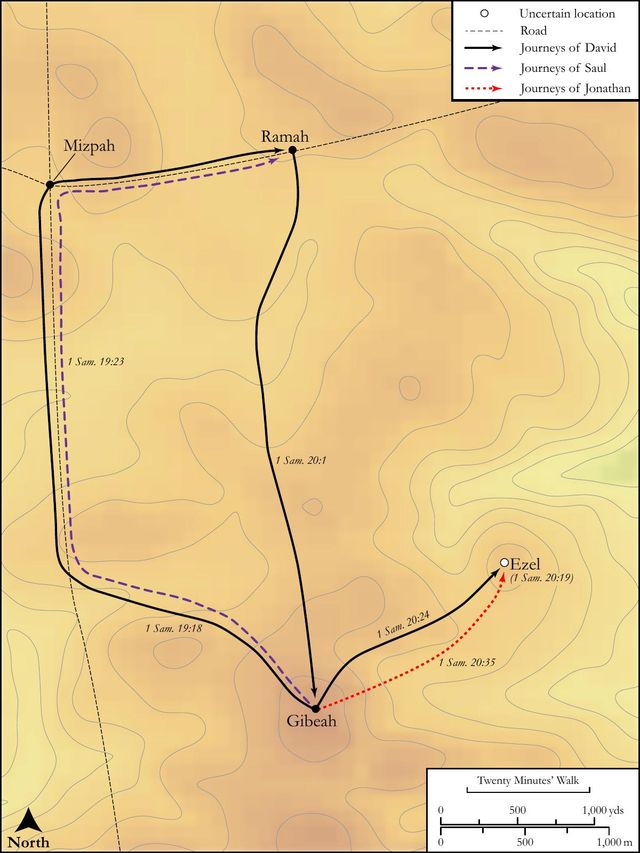
See on the biblical-era map
Study this verse
Public-domain commentary
Matthew Henry
From his Commentary on the Whole Bible. Henry comments on passages, not single verses — this entry covers 1 Samuel 20:35–42.
Here is, 1. Jonathan's faithful performance of his promise to give David notice of the success of his dangerous experiment. He went at the time and to the place appointed (Sa1 20:35), within sight of which he knew David lay hid, sent his footboy to fetch his arrows, which he would shoot at random (Sa1 20:36), and gave David the fatal signal by shooting an arrow beyond the lad (Sa1 20:37): Is not the arrow beyond thee? That word [beyond] David knew the meaning of better than the lad. Jonathan dismissed the lad, who knew nothing of the matter, and, finding the coast clear and no danger of a discovery, he presumed upon one minute's personal conversation with David after he had bidden him flee for his life. 2. The most sorrowful parting of these two friends, who, for aught that appears, never came together again but once, and that was by stealth in a wood, Sa1 23:16. (1.) David addressed himself to Jonathan with the reverence of a servant rather than the freedom of a friend: He fell on his face to the ground, and bowed himself three times, as one deeply sensible of his obligations to him for the good services he had done him. (2.) They took leave of each other with the greatest affection imaginable, with kisses and tears; they wept on each other's neck till David exceeded, Sa1 20:41. The separation of two such faithful friends was equally grievous to them both, but David's case was the more deplorable; for, when Jonathan was returning to his family and friends, David was leaving all his comforts, even those of God's sanctuary, and therefore his grief exceeded Jonathan's, or perhaps it was because his temper was more tender and his passions were stronger. (3.) They referred themselves to the covenant of friendship that was between them, both of them comforting themselves with this in this mournful separation: "We have sworn both of us in the name of the Lord, for ourselves and our heirs, that we and they will be faithful and kind to each other from generation to generation." Thus, while we are at home in the body and absent from the Lord, this is our comfort, that he has made with us an everlasting covenant.
Continue studying 1 Samuel 20:38 across the web’s major study libraries — every link below opens this exact verse, chapter, or book on the destination site.
Read & Compare
 BibleGatewayThis verse in more than 200 translations and 70 languages.
 Bible.comThe YouVersion reader — hundreds of translations, reading plans, and highlights.
 ESV.orgCrossway's official English Standard Version reader.
 NET BibleThe NET translation with 60,000+ translators' notes on every rendering decision.
 STEP BibleTyndale House's free study tool — original text, vocabulary, and scholarly resources.
 BibliaLogos Bible Software's free web reader.
 USCCBThe New American Bible (Revised Edition) with the U.S. bishops' study notes.
Commentaries
 BibleHub CommentariesDozens of classic commentaries on this verse, gathered on one page.
 StudyLightMore than 100 commentary sets — the largest collection on the web.
 BibleRefPlain-English commentary on what this verse means, verse by verse.
 Enduring WordDavid Guzik's free commentary on this chapter, widely used by Bible teachers.
 Bible Study ToolsVerse commentary alongside Greek and Hebrew study aids.
Original Language & Research
- BibleHub InterlinearThe verse word by word — original language, transliteration, and English.
- BibleHub LexiconEvery word's original-language definition and Strong's entry.
 Blue Letter BibleDeep-study tools — Strong's numbers, concordance, and word studies.
 SefariaThe Hebrew text with Rashi and centuries of Jewish commentary.
Sermons, Hymns & Audio


TrulyRandomVerse is not affiliated with these sites and doesn’t control their content. They’re linked because they’re genuinely useful.
Summary
1 Samuel 20:38 culminates the elaborate, life-saving signal orchestrated by Jonathan to warn David of King Saul's unwavering and murderous intent. This urgent, coded message—"Make speed, haste, stay not"—serves as the definitive confirmation of David's extreme peril, compelling his immediate and permanent flight from Saul's court, thereby marking a critical turning point in David's life as a fugitive and initiating the next phase of God's sovereign plan for the future king of Israel.
Context
ShowHideLiterary Context
This verse represents the dramatic climax and execution of Jonathan's perilous plan to ascertain and communicate King Saul's true intentions toward David. Following their deep covenant of friendship and loyalty established in 1 Samuel 18:1-4, David and Jonathan devised a secret test. David was to absent himself from Saul's new moon feast. Jonathan would then observe Saul's reaction; if Saul inquired about David's absence with anger, it would confirm his hostility. The pre-arranged signal involved Jonathan shooting arrows and sending a lad to retrieve them. If Jonathan called out to the lad, "Look, the arrows are beyond you," it meant David must flee, for "the Lord has sent you away" (1 Samuel 20:22). The preceding verses detail Saul's furious outburst against Jonathan, confirming his intent to kill David and even Jonathan for his loyalty to David (1 Samuel 20:30-34). Thus, 1 Samuel 20:38 is the precise moment the final, life-saving signal is delivered, bringing the tension of the preceding narrative to a head and initiating David's long period of exile.
Historical & Cultural Context
The narrative unfolds in ancient Israel during the tumultuous period of the transition from a tribal confederacy to a monarchy, specifically during the reign of Saul, Israel's first king. Kingship in this era was often characterized by dynastic ambitions, political intrigue, and the elimination of rivals. Saul, having been rejected by God as king (1 Samuel 15:23), was increasingly paranoid and prone to fits of rage, especially towards David, whom he perceived as a threat to his throne and dynasty. Covenants, like the one between David and Jonathan, were sacred bonds of loyalty, often involving mutual protection and care for descendants. The use of coded signals and messengers was a common and necessary practice in a world without modern communication, particularly when dealing with sensitive and dangerous political matters where direct communication could be intercepted or betray intent. Jonathan's actions reflect extraordinary moral courage, choosing loyalty to God's anointed and his friend over allegiance to his own father and his potential claim to the throne.
Key Themes
ShowHideThis verse powerfully encapsulates several overarching themes of the book of 1 Samuel. Firstly, it highlights Loyalty and Friendship, showcasing Jonathan's unparalleled devotion to David, a bond that transcends familial and political obligations. Jonathan's self-sacrificial love and willingness to risk his own life and royal succession for David's safety is a profound example of true friendship, as seen in their initial covenant in 1 Samuel 20:16. Secondly, it underscores the theme of Imminent Danger and Escape, marking the definitive beginning of David's life as a fugitive, constantly on the run from Saul's relentless pursuit, a reality that dominates the subsequent chapters (e.g., 1 Samuel 21:1). Thirdly, while not explicitly stated in this verse, the entire episode is permeated by the theme of Divine Providence and Protection. God's hand is clearly at work, using Jonathan as an instrument to protect His chosen king, David, ensuring the fulfillment of His promises despite human opposition and malice. Finally, the use of Clandestine Communication emphasizes the need for wisdom, discretion, and strategic planning in navigating treacherous circumstances, demonstrating how God can use human ingenuity to achieve His purposes.
Exposition and Analysis
ShowHideKey Word Analysis
ShowHideThis primitive root means "to call out to," "to address by name," or "to proclaim." In this context, it signifies Jonathan raising his voice to ensure the lad (and by extension, David) heard the crucial message from a distance. This public "cry" for the lad to retrieve the arrows cleverly masked the private, life-saving signal intended for David, demonstrating Jonathan's cunning and the desperate measures required.
This feminine noun, used adverbially, means "promptly," "hastily," or "swiftly." The imperative "Make speed" conveys an extreme sense of urgency and immediacy. It's not merely a suggestion to hurry, but an emphatic, non-negotiable directive for rapid action, underscoring the life-or-death nature of David's situation, leaving no room for hesitation or delay.
This primitive root means "to stand," "to cease," "to dwell," or "to tarry." Used in the negative imperative ("stay not"), it forms a strong command meaning "do not stand," "do not delay," or "do not linger." It reinforces the absolute necessity of immediate departure and continuous flight. Combined with "Make speed, haste," it forms a powerful and unambiguous command for David to flee without looking back, emphasizing the grave danger of remaining in the vicinity.
Verse Breakdown
ShowHide"And Jonathan cried after the lad"
This clause sets the scene for the execution of the pre-arranged signal. Jonathan, positioned at a distance from David (who was hidden nearby), calls out to the young boy retrieving the arrows. The act of "crying after" implies a raised voice, necessary for the lad to hear, but also serving to make the action seem like a normal part of an archery practice, thus maintaining the secrecy of the true message.
"Make speed, haste, stay not"
This is the heart of the message, the pre-arranged code that David understood. Jonathan's words, ostensibly directed at the lad to hurry with the arrows, were in fact the urgent, definitive warning to David. The emphatic repetition ("make speed, haste") and the direct negative command ("stay not") confirmed that Saul's intentions were indeed hostile and that David's life was in immediate peril, requiring his swift and continuous flight from the area. This was the signal that meant, "the arrows are beyond you," indicating danger.
"And Jonathan's lad gathered up the arrows, and came to his master"
This final clause describes the unwitting completion of the physical act. The lad, unaware of the profound significance of Jonathan's words, simply obeys the command to collect the arrows and return them. This action effectively concludes Jonathan's part in the immediate warning, allowing David to understand the message and begin his escape, while the lad remains oblivious to the life-or-death drama unfolding around him.
Literary Devices
ShowHideThe passage employs several potent literary devices to heighten its impact. Irony is prominent, as the lad is an unwitting participant in a life-or-death communication, completely oblivious to the true meaning of Jonathan's urgent commands. Jonathan's public "crying" to the lad serves as a private, coded message for David, creating a layer of dramatic tension and suspense. The repetition of "Make speed, haste" functions as a form of emphasis, underscoring the extreme urgency of David's situation and the immediate need for flight. The symbolism of the arrows is also significant; they are not merely projectiles but instruments of communication, signifying both danger (by being shot "beyond" the lad) and the means of David's escape. This scene also serves as powerful foreshadowing, signaling the beginning of David's long and arduous period as a fugitive, a central theme for the remainder of 1 Samuel.
Theological and Thematic Connections
ShowHideThis pivotal moment in 1 Samuel 20:38 is rich with theological implications, demonstrating God's sovereign hand at work even amidst human treachery and danger. Jonathan's extraordinary loyalty and self-sacrifice for David are not merely acts of human friendship but are divinely orchestrated to protect God's chosen king. Despite Saul's relentless pursuit and the seemingly insurmountable odds, God consistently provides means of escape and protection for David, ensuring His plan for the Davidic dynasty will come to fruition. This episode underscores that God often works through human relationships and clever strategies, even in the face of intense opposition, to preserve His purposes and His people. It reminds us that even when life forces us into unexpected and difficult paths, God is present, guiding, and protecting, often through the faithfulness of others.
Reflection and Application
ShowHideThe urgent command "Make speed, haste, stay not" from Jonathan to David carries profound lessons for believers today. It calls us to consider the value of true, self-sacrificial friendship, modeled by Jonathan, who prioritized David's life over his own familial loyalty and potential claim to the throne. Such friendships are rare and precious, offering support and even warnings when we are in danger. More broadly, this passage reminds us of the importance of spiritual discernment and heeding urgent warnings, whether from trusted friends, the Holy Spirit, or the Word of God. Just as David had to immediately and decisively respond to Jonathan's signal, we too are called to "make speed, haste, stay not" when God reveals dangers, calls us to repentance, or directs us to flee from sin or harmful situations. This may involve difficult decisions, forced changes, or stepping into the unknown, but the narrative assures us that even in moments of peril and forced exile, God is sovereignly at work, guiding our steps and protecting His purposes for our lives, ultimately leading us to a place of His blessing and fulfillment.
Questions for Reflection
ShowHideFAQ
ShowHideWhy did Jonathan use a coded signal instead of telling David directly?
ShowHideJonathan used a coded signal to protect David from Saul's escalating paranoia and murderous intent, and to protect himself from being implicated. Saul was surrounded by servants and spies, and any direct, open communication about his hostile plans would have been immediately reported to the king, jeopardizing both Jonathan and David. The pre-arranged code, involving the seemingly innocent act of shooting arrows and calling to a lad, allowed Jonathan to convey a life-or-death message to David without arousing suspicion from those who might be listening or observing. This discretion was a matter of survival, as seen in 1 Samuel 20:19-23.
What was the significance of the arrows being shot "beyond" the lad?
ShowHideThe direction of the arrows was the crucial element of the coded message. Jonathan and David had agreed that if Jonathan shot the arrows short of the lad, it would mean "there is peace for you" (1 Samuel 20:21). However, if he shot them "beyond" the lad, as he did in 1 Samuel 20:38, it was the definitive signal of extreme danger, meaning "the Lord has sent you away" (1 Samuel 20:22). This indicated that Saul's anger was unyielding, his intent to kill David was firm, and David must flee immediately and permanently.
Christ-Centered Fulfillment
ShowHideThe deeply moving narrative of Jonathan's self-sacrificial love and urgent warning to David in 1 Samuel 20:38 powerfully foreshadows the ultimate love and salvation offered by Jesus Christ. Jonathan, the son of the reigning king, willingly relinquished his own claim to the throne and risked his life to protect David, God's chosen king. This selfless act of friendship, described by David as "love for me was wonderful, passing the love of women" (2 Samuel 1:26), points to Christ, the true King's Son, who willingly laid down His divine prerogatives and His very life, not for a friend, but for His enemies, to secure their eternal salvation (Romans 5:8). Just as Jonathan's urgent cry warned David of mortal danger and provided a way of escape, so too does Christ, through the Gospel, issue an urgent call to "make speed, haste, stay not" from the path of sin and eternal death. His warning is not a coded message but a clear, compassionate invitation to repent and believe (Mark 1:15), offering Himself as the ultimate refuge and the secure path to life. David's subsequent journey as a fugitive, protected by God's providence, ultimately leading to his enthronement, also mirrors Christ's path through suffering and rejection to His glorious resurrection and ascension, where He now reigns as King of kings (Philippians 2:8-11). Jonathan's love for David is a beautiful, albeit imperfect, earthly echo of the boundless, saving love of our Lord Jesus Christ.