


1 Samuel 20:37
Bible text: King James Version (1769 Blayney text) · Public domain
Bible text: King James Version with Strong's numbers · Public domain
Bible text: Berean Standard Bible · Public domain
Bible text: American Standard Version (1901) · Public domain
Bible text: World English Bible, Messianic edition · Public domain
Bible text: Geneva Bible (1599) · Public domain
Bible text: Young's Literal Translation · Public domain
- וַיָּבֹאvai·ya·Vo'and he cameH935Conj-w ¦ V-Qal-ConsecImperf-3msVerb Qal Consecutive Imperfect 3rd Singular Masculineוַandיָּבֹאhe came
- הַנַּעַרha·Na·'arthe ladH5288Art ¦ N-msNoun Singular Masculine Absoluteהַtheנַּעַרlad
- עַד'adtoH5704PrepPreposition
- מְקוֹםme·Kom[the] place ofH4725N-mscNoun Singular Masculine Construct
- הַחֵצִיha·Che·tzithe arrowH2678Art ¦ N-msNoun Singular Masculine Absoluteהַtheחֵצִיarrow
- אֲשֶׁר'a·SherwhichH834RelParticle Relative
- יָרָהya·Rahhe had shotH3384V-Qal-Perf-3msVerb Qal Perfect 3rd Singular Masculine
- יְהוֹנָתָןye·ho·na·TanJonathanH3083N-proper-mNoun Proper Masculine
- וַיִּקְרָאvai·yik·Ra'and he called outH7121Conj-w ¦ V-Qal-ConsecImperf-3msVerb Qal Consecutive Imperfect 3rd Singular Masculineוַandיִּקְרָאhe called out
- יְהוֹנָתָןye·ho·na·TanJonathanH3083N-proper-mNoun Proper Masculine
- אַחֲרֵי'a·cha·ReiafterH310Adj-mpcAdjective Numerical Plural Masculine Construct
- הַנַּעַרha·Na·'arthe ladH5288Art ¦ N-msNoun Singular Masculine Absoluteהַtheנַּעַרlad
- וַיֹּאמֶרvai·Yo·merand he saidH559Conj-w ¦ V-Qal-ConsecImperf-3msVerb Qal Consecutive Imperfect 3rd Singular Masculineוַandיֹּאמֶרhe said
- הֲלוֹאha·Lo'¿ notH3808Interrog ¦ NegParticle Negativeהֲ¿לוֹאnot
- הַחֵצִיha·Che·tzi[is] the arrowH2678Art ¦ N-msNoun Singular Masculine Absoluteהַ[is] theחֵצִיarrow
- מִמְּךָmi·me·Khafrom youH4480Prep ¦ 2msPrepositionמִמְּfromךָyou
- וָהָלְאָהva·Hal·'ahand beyondH1973Conj-w ¦ AdvAdverbוָandהָלְאָהbeyond
English is a literal word-by-word gloss of the Hebrew, not the KJV's wording. Why?
This is the original text the KJV's translators worked from — each Hebrew word with its own literal English meaning in this verse, prepared by scholars at Tyndale House, Cambridge. The KJV translates whole sentences, not word by word, so its wording differs: one Hebrew word can become several English words, and the KJV may choose “the LORD” where the gloss reads “Yahweh”. Both are faithful — they answer different questions. For the KJV's own rendering, switch to the KJV text.
Details
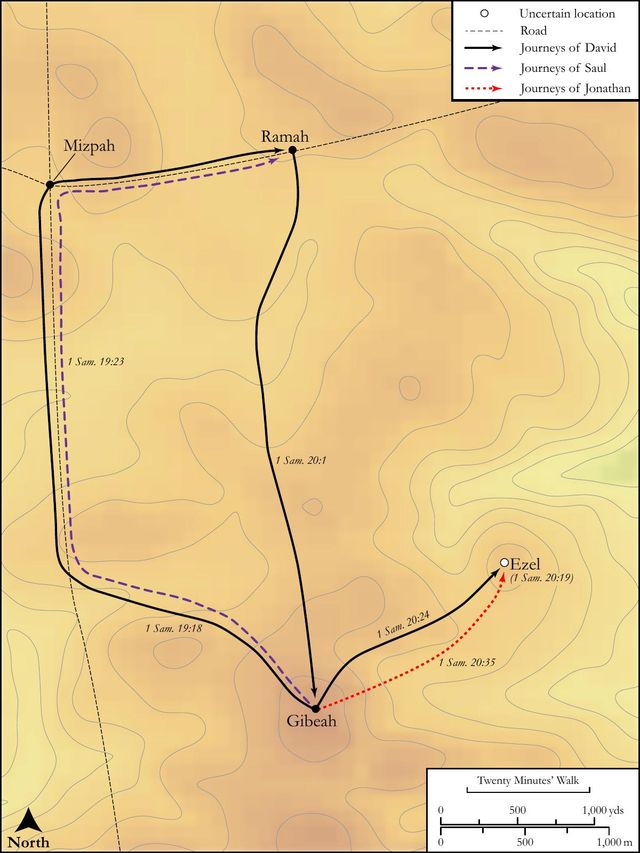
See on the biblical-era map
Study this verse
Public-domain commentary
Matthew Henry
From his Commentary on the Whole Bible. Henry comments on passages, not single verses — this entry covers 1 Samuel 20:35–42.
Here is, 1. Jonathan's faithful performance of his promise to give David notice of the success of his dangerous experiment. He went at the time and to the place appointed (Sa1 20:35), within sight of which he knew David lay hid, sent his footboy to fetch his arrows, which he would shoot at random (Sa1 20:36), and gave David the fatal signal by shooting an arrow beyond the lad (Sa1 20:37): Is not the arrow beyond thee? That word [beyond] David knew the meaning of better than the lad. Jonathan dismissed the lad, who knew nothing of the matter, and, finding the coast clear and no danger of a discovery, he presumed upon one minute's personal conversation with David after he had bidden him flee for his life. 2. The most sorrowful parting of these two friends, who, for aught that appears, never came together again but once, and that was by stealth in a wood, Sa1 23:16. (1.) David addressed himself to Jonathan with the reverence of a servant rather than the freedom of a friend: He fell on his face to the ground, and bowed himself three times, as one deeply sensible of his obligations to him for the good services he had done him. (2.) They took leave of each other with the greatest affection imaginable, with kisses and tears; they wept on each other's neck till David exceeded, Sa1 20:41. The separation of two such faithful friends was equally grievous to them both, but David's case was the more deplorable; for, when Jonathan was returning to his family and friends, David was leaving all his comforts, even those of God's sanctuary, and therefore his grief exceeded Jonathan's, or perhaps it was because his temper was more tender and his passions were stronger. (3.) They referred themselves to the covenant of friendship that was between them, both of them comforting themselves with this in this mournful separation: "We have sworn both of us in the name of the Lord, for ourselves and our heirs, that we and they will be faithful and kind to each other from generation to generation." Thus, while we are at home in the body and absent from the Lord, this is our comfort, that he has made with us an everlasting covenant.
Continue studying 1 Samuel 20:37 across the web’s major study libraries — every link below opens this exact verse, chapter, or book on the destination site.
Read & Compare
 BibleGatewayThis verse in more than 200 translations and 70 languages.
 Bible.comThe YouVersion reader — hundreds of translations, reading plans, and highlights.
 ESV.orgCrossway's official English Standard Version reader.
 NET BibleThe NET translation with 60,000+ translators' notes on every rendering decision.
 STEP BibleTyndale House's free study tool — original text, vocabulary, and scholarly resources.
 BibliaLogos Bible Software's free web reader.
 USCCBThe New American Bible (Revised Edition) with the U.S. bishops' study notes.
Commentaries
 BibleHub CommentariesDozens of classic commentaries on this verse, gathered on one page.
 StudyLightMore than 100 commentary sets — the largest collection on the web.
 BibleRefPlain-English commentary on what this verse means, verse by verse.
 Enduring WordDavid Guzik's free commentary on this chapter, widely used by Bible teachers.
 Bible Study ToolsVerse commentary alongside Greek and Hebrew study aids.
Original Language & Research
- BibleHub InterlinearThe verse word by word — original language, transliteration, and English.
- BibleHub LexiconEvery word's original-language definition and Strong's entry.
 Blue Letter BibleDeep-study tools — Strong's numbers, concordance, and word studies.
 SefariaThe Hebrew text with Rashi and centuries of Jewish commentary.
Sermons, Hymns & Audio


TrulyRandomVerse is not affiliated with these sites and doesn’t control their content. They’re linked because they’re genuinely useful.
Summary
1 Samuel 20:37 captures the critical moment when Jonathan, son of King Saul, executes a pre-arranged signal to covertly inform his dear friend David of King Saul's murderous intentions. By crying out to his young servant that the arrow he had shot was "beyond" him, Jonathan communicated to David, who was hiding nearby, that Saul was indeed seeking his life and that he must flee immediately. This seemingly innocuous act of retrieving an arrow served as a life-or-death message, confirming the irreversible break between Saul and David and marking a pivotal turning point in David's journey toward kingship and his subsequent period of exile.
Context
ShowHideLiterary Context
This verse serves as the dramatic climax of Jonathan's elaborate plan to ascertain his father Saul's true disposition towards David, a plan meticulously detailed throughout 1 Samuel 20. Following Saul's escalating attempts on David's life, including a javelin throw (e.g., 1 Samuel 19:9-10), Jonathan, despite being the heir to the throne, forged a deep covenant of loyalty with David (1 Samuel 20:12-17). The specific arrow signal, with its coded messages for safety or danger, was carefully pre-arranged in 1 Samuel 20:20-22. Jonathan's public display of archery and his precise cry to the lad in verse 37 directly fulfills this pre-arranged code, leading immediately to David's tearful departure and the poignant farewell between the two friends in 1 Samuel 20:41-42.
Historical & Cultural Context
The narrative unfolds within the turbulent early monarchy of Israel, a period characterized by the consolidation of royal power and often fraught with political intrigue and violence. Kings like Saul wielded absolute authority, and their paranoia, as vividly seen in Saul's escalating jealousy and irrational hatred of David, could lead to swift and brutal consequences for perceived rivals. Loyalty within the royal court was paramount, yet Jonathan's profound loyalty to David transcended familial and political ties, reflecting a deeper covenantal bond that prioritized God's will over personal ambition. The use of archery as a means of communication was highly practical in an era without modern technology, allowing for discrete, long-distance signaling. Such covert methods were essential for survival in a court rife with spies and suspicion, highlighting the extreme high stakes for both David and Jonathan.
Key Themes
ShowHideThe passage powerfully illustrates the theme of unwavering loyalty and covenantal friendship, as Jonathan risks his own life and succession to protect David, whom he recognized as God's anointed (1 Samuel 20:13). Another prominent theme is covert communication and the necessity of deception for survival, as the elaborate arrow signal underscores the extreme danger David faced and the ingenuity required to navigate Saul's irrational wrath. This moment also highlights the theme of imminent danger and divine protection, as David's life hangs in the balance, yet God sovereignly orchestrates his escape through Jonathan's faithfulness, preserving His chosen king for future reign. The narrative also subtly explores the tragedy of Saul's spiritual decline, contrasting his escalating madness with Jonathan's righteous and selfless character.
Exposition and Analysis
ShowHideKey Word Analysis
ShowHideThis verb (H7121) signifies more than a casual shout; it implies a deliberate, urgent, and often public proclamation or call. In this context, Jonathan's "crying" out to the lad is a calculated act designed to be heard by the boy and, crucially, by David (who is hiding), but not understood by any potential eavesdroppers. It conveys the immediacy and importance of the message, even if its true meaning remains hidden from the unsuspecting lad and any of Saul's agents.
The use of a "lad" (H5288) or young boy is significant. A naʻar was typically a youth, often a servant or attendant, whose presence would not arouse suspicion. His innocence and lack of understanding regarding the true meaning of the signal made him an ideal, unwitting messenger, ensuring the secrecy and security of Jonathan's life-saving communication to David. His role underscores the necessity of the covert operation.
This adverb (H1973) denotes "to the distance," "far away," "henceforth," or "yonder." In the context of the pre-arranged signal (1 Samuel 20:21-22), Jonathan's declaration that the arrow is "beyond thee" (i.e., further away than the lad's position) was the coded message for extreme danger. It indicated that Saul's intentions were unequivocally hostile and that David must flee immediately, contrasting sharply with the signal for safety ("on this side of you," meaning the arrow was closer).
Verse Breakdown
ShowHide"And when the lad was come to the place of the arrow which Jonathan had shot,"
This clause sets the scene for the execution of the signal. The lad's innocent act of retrieving the arrow provides the natural, unsuspecting cover for Jonathan's coded message. It highlights the precision of Jonathan's plan, ensuring the lad was in the correct position relative to the arrow for the message to be delivered accurately and discreetly, without drawing suspicion from any observers.
"Jonathan cried after the lad, and said,"
This describes Jonathan's immediate and purposeful action. His "crying" out is not a casual remark but a deliberate, audible communication designed to carry the coded message. The public nature of the call, directed at the lad, cleverly masks its true, life-or-death significance for David, who is listening intently and anxiously from his hiding place, awaiting the pre-arranged sign.
"[Is] not the arrow beyond thee?"
This is the core of the coded message. On the surface, it's a simple question about the arrow's location, seemingly an instruction for the lad. However, for David, it was the pre-arranged signal confirming Saul's murderous intent. The phrase "beyond thee" conveyed that danger was indeed present and that David must immediately depart, marking the definitive and heartbreaking end of his time in Saul's court and the beginning of his fugitive years.
Literary Devices
ShowHideThe passage employs several potent literary devices. Symbolism is central, with the arrow serving as a multifaceted symbol: it is a tool for sport, a means of communication, and, most critically, a symbol of fate and impending danger for David. Its precise location determines David's very survival. Dramatic Irony pervades the scene, as the unsuspecting lad is entirely unaware of the profound, life-altering message he is unwittingly helping to convey, and Saul (and any of his spies) would also be oblivious to the true meaning of Jonathan's seemingly innocuous words. This creates palpable tension for the knowing reader. Furthermore, the event serves as Foreshadowing, signaling the inevitable and complete break between David and Saul, David's subsequent flight and period of exile, and ultimately, Saul's downfall and David's ascent to the throne. The entire interaction is a testament to the Covenant Language of deep, loyal friendship between Jonathan and David, a bond that transcends familial and political loyalties, demonstrating a commitment akin to a sacred oath.
Theological and Thematic Connections
ShowHideThis pivotal moment in 1 Samuel 20:37 powerfully illustrates God's sovereign hand in protecting His anointed and guiding His purposes, even amidst human treachery and danger. Jonathan's extraordinary loyalty to David, defying his own father and risking his inheritance, serves as a profound example of true friendship and covenant faithfulness, reflecting a divine quality of steadfast love (Hebrew: hesed). It reminds us that God often works through human relationships and courageous acts of obedience to preserve His chosen instruments. The need for covert communication underscores the reality of spiritual warfare and the cunning required to navigate hostile environments, while God's providence ensures that His plans for David's kingship will not be thwarted by Saul's malice. This scene is a testament to God's faithfulness to His promises, even when circumstances seem dire.
Reflection and Application
ShowHideThe scene of Jonathan's coded message to David offers rich lessons for contemporary believers. It calls us to reflect on the profound value of true, loyal friendships, those rare bonds where individuals are willing to sacrifice for one another, even at great personal cost. Such friendships are a divine gift, often serving as channels of God's protection and provision in times of adversity. Moreover, David's attentiveness to Jonathan's signal teaches us the importance of discerning warnings in our own lives—whether from wise counsel, providential circumstances, or the quiet leading of the Holy Spirit. We are called to be vigilant, to listen for the "signals" that might guide us away from danger or toward God's intended path. Ultimately, this passage encourages us to trust in God's sovereign providence, knowing that even in moments of extreme peril and human cunning, He is actively at work, orchestrating events to fulfill His purposes and protect His people. It challenges us to cultivate courage and faithfulness, like Jonathan, to act righteously even when it demands personal sacrifice, embodying the selfless love that Christ exemplifies.
Questions for Reflection
ShowHideFAQ
ShowHideWhy didn't Jonathan just tell David directly that Saul wanted to kill him?
ShowHideJonathan could not tell David directly because Saul's court was likely filled with spies and loyalists who would report any suspicious activity. Saul's paranoia was extreme, and any direct communication between Jonathan and David about Saul's intentions would have put both their lives at immediate risk. The elaborate arrow signal was a necessary and ingenious method of covert communication, allowing Jonathan to convey a life-or-death message without alerting Saul or his agents to their secret alliance and David's hiding place. It was a matter of survival for both men, as any open defiance of Saul's will could have led to their swift execution.
What was the significance of the arrow being "beyond" the lad, as opposed to another location?
ShowHideJonathan and David had a pre-arranged code, as described in 1 Samuel 20:21-22. If Jonathan shot the arrows and told the lad, "Look, the arrows are on this side of you," it would mean "Go in peace, for there is no danger." However, by crying out, "Is not the arrow beyond thee?" (meaning the arrow had gone further than the lad's position), it was the agreed-upon signal that Saul indeed intended to kill David, and David must flee immediately. The precise spatial relationship of the arrow to the lad conveyed the critical, life-saving information, ensuring David understood the severity of the situation without a single word being spoken that could betray their secret.
How does this event impact David's future and the broader narrative of 1 Samuel?
ShowHideThis event is a decisive turning point in David's life and the narrative of 1 Samuel. It definitively confirms Saul's unyielding hostility and murderous intent towards David, forcing David into a prolonged period of exile and flight from Saul's relentless pursuit. This period of being a fugitive, though fraught with hardship, served to forge David's character, gather loyal followers, and prepare him for future kingship by teaching him reliance on God alone. It also solidified the profound covenantal friendship between David and Jonathan, a bond that remained unbroken until Jonathan's death (2 Samuel 1:26). Ultimately, this event ensures David's survival, paving the way for God's promise of his eventual reign over Israel and demonstrating God's faithfulness in preserving His chosen one against all odds.
Christ-Centered Fulfillment
ShowHideThe extraordinary loyalty and self-sacrificial love demonstrated by Jonathan in 1 Samuel 20:37, where he risks his own life and royal inheritance to save his friend David, powerfully foreshadows the ultimate friendship and covenant faithfulness found in Jesus Christ. Just as Jonathan acted as a faithful intercessor and protector for David, so too does Christ intercede for us (Romans 8:34) and protect us from the ultimate enemy, sin and death. Jonathan's willingness to lay down his life for his friend (John 15:13) finds its perfect fulfillment in Jesus, who, while we were still sinners, died for us (Romans 5:8). The coded message of danger, "Is not the arrow beyond thee?", can be seen as a shadow of the ultimate "signal" of judgment for sin that was borne by Christ on the cross. He took the "arrow" of God's wrath "beyond" us, absorbing the full penalty so that we might find safety and eternal life (2 Corinthians 5:21). Like David, who was God's anointed and protected through trials, Jesus, the true Anointed One, faced betrayal and persecution, yet was ultimately preserved by God for His redemptive purpose (Hebrews 4:15). Christ is the faithful friend who never abandons us, the ultimate covenant keeper whose love secures our salvation forever, demonstrating a love far surpassing Jonathan's.