


1 Samuel 20:36
Bible text: King James Version (1769 Blayney text) · Public domain
Bible text: Berean Standard Bible · Public domain
Bible text: American Standard Version (1901) · Public domain
Bible text: World English Bible, Messianic edition · Public domain
Bible text: Geneva Bible (1599) · Public domain
Bible text: Young's Literal Translation · Public domain
- וַיֹּאמֶרvai·Yo·merand he saidH559Conj-w ¦ V-Qal-ConsecImperf-3msVerb Qal Consecutive Imperfect 3rd Singular Masculineוַandיֹּאמֶרhe said
- לְנַעֲרוֹle·na·'a·Roto his ladH5288Prep-l ¦ N-msc ¦ 3msNoun Singular Masculine Constructלְtoנַעֲרladוֹhis
- רֻץRutzrunH7323V-Qal-Imp-2msVerb Qal Imperative 2nd Singular Masculine
- מְצָאme·Tza'findH4672V-Qal-Imp-2msVerb Qal Imperative 2nd Singular Masculine
- נָאna'pleaseH4994PrtParticle Interjection
- אֶת'et<obj.>H853DirObjMParticle Object Indicator
- הַחִצִּיםha·chi·Tzimthe arrowsH2671Art ¦ N-mpNoun Plural Masculine Absoluteהַtheחִצִּיםarrows
- אֲשֶׁר'a·SherwhichH834RelParticle Relative
- אָנֹכִי'a·no·KhiIH595Pro-1csPronoun Personal 1st Singular common gender
- מוֹרֶהmo·Reh[am] about to shootH3384V-Hiphil-Prtcpl-msVerb Hiphil Participle Singular Masculine Absolute
- הַנַּעַרha·Na·'arthe ladH5288Art ¦ N-msNoun Singular Masculine Absoluteהַtheנַּעַרlad
- רָץRatzhe ranH7323V-Qal-Perf-3msVerb Qal Perfect 3rd Singular Masculine
- וְהוּאve·hu'and heH1931Conj-w ¦ Pro-3msPronoun Personal 3rd Singular Masculineוְandהוּאhe
- יָרָהya·Rahhe shotH3384V-Qal-Perf-3msVerb Qal Perfect 3rd Singular Masculine
- הַחֵצִיha·Che·tzithe arrowH2678Art ¦ N-msNoun Singular Masculine Absoluteהַtheחֵצִיarrow
- לְהַעֲבִרוֹle·ha·'a·vi·Roto make [it] pass beyond himH5674Prep-l ¦ V-Hiphil-Inf ¦ 3msVerb Hiphil Infinitive Constructלְtoהַעֲבִרmake [it] pass beyondוֹhim
English is a literal word-by-word gloss of the Hebrew, not the KJV's wording. Why?
This is the original text the KJV's translators worked from — each Hebrew word with its own literal English meaning in this verse, prepared by scholars at Tyndale House, Cambridge. The KJV translates whole sentences, not word by word, so its wording differs: one Hebrew word can become several English words, and the KJV may choose “the LORD” where the gloss reads “Yahweh”. Both are faithful — they answer different questions. For the KJV's own rendering, switch to the KJV text.
Details
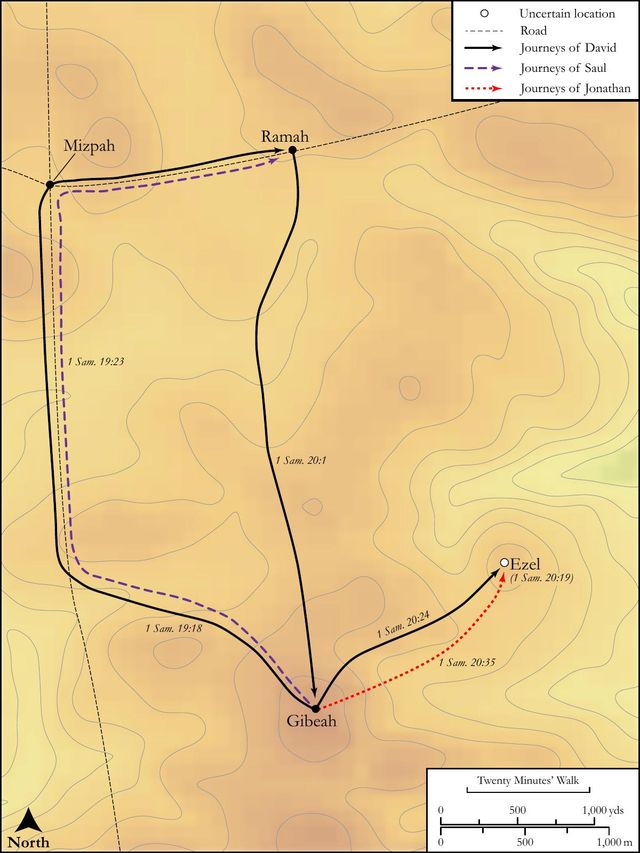
See on the biblical-era map
Study this verse
Public-domain commentary
Matthew Henry
From his Commentary on the Whole Bible. Henry comments on passages, not single verses — this entry covers 1 Samuel 20:35–42.
Here is, 1. Jonathan's faithful performance of his promise to give David notice of the success of his dangerous experiment. He went at the time and to the place appointed (Sa1 20:35), within sight of which he knew David lay hid, sent his footboy to fetch his arrows, which he would shoot at random (Sa1 20:36), and gave David the fatal signal by shooting an arrow beyond the lad (Sa1 20:37): Is not the arrow beyond thee? That word [beyond] David knew the meaning of better than the lad. Jonathan dismissed the lad, who knew nothing of the matter, and, finding the coast clear and no danger of a discovery, he presumed upon one minute's personal conversation with David after he had bidden him flee for his life. 2. The most sorrowful parting of these two friends, who, for aught that appears, never came together again but once, and that was by stealth in a wood, Sa1 23:16. (1.) David addressed himself to Jonathan with the reverence of a servant rather than the freedom of a friend: He fell on his face to the ground, and bowed himself three times, as one deeply sensible of his obligations to him for the good services he had done him. (2.) They took leave of each other with the greatest affection imaginable, with kisses and tears; they wept on each other's neck till David exceeded, Sa1 20:41. The separation of two such faithful friends was equally grievous to them both, but David's case was the more deplorable; for, when Jonathan was returning to his family and friends, David was leaving all his comforts, even those of God's sanctuary, and therefore his grief exceeded Jonathan's, or perhaps it was because his temper was more tender and his passions were stronger. (3.) They referred themselves to the covenant of friendship that was between them, both of them comforting themselves with this in this mournful separation: "We have sworn both of us in the name of the Lord, for ourselves and our heirs, that we and they will be faithful and kind to each other from generation to generation." Thus, while we are at home in the body and absent from the Lord, this is our comfort, that he has made with us an everlasting covenant.
Historical interpretation
Historical reception
1 surviving comment on this verse from the historical church.
The boy Jonathan collected the arrows, etc. The humble discipleship of the pious learned the deeds in order, learned also the sayings of the teachers, and attributed all praise to the Church; or, as we expounded above, he saw the disciples of Christ, whether still vigorous with life or already snatched by death, widely dispersed from Jerusalem, from where the word of the Lord had gone out, and recognized that all should be gathered into one heavenly Jerusalem; yet he could not know the divine secret, that salvation was to be given to the nations through repentance. For only those greater in the Lord, to whom it is said; But I have called you friends, because all that I have heard from my Father, I have made known to you (John 15), and he himself, strong in hand, and desired by all nations, knew this secret thing.
Continue studying 1 Samuel 20:36 across the web’s major study libraries — every link below opens this exact verse, chapter, or book on the destination site.
Read & Compare
 BibleGatewayThis verse in more than 200 translations and 70 languages.
 Bible.comThe YouVersion reader — hundreds of translations, reading plans, and highlights.
 ESV.orgCrossway's official English Standard Version reader.
 NET BibleThe NET translation with 60,000+ translators' notes on every rendering decision.
 STEP BibleTyndale House's free study tool — original text, vocabulary, and scholarly resources.
 BibliaLogos Bible Software's free web reader.
 USCCBThe New American Bible (Revised Edition) with the U.S. bishops' study notes.
Commentaries
 BibleHub CommentariesDozens of classic commentaries on this verse, gathered on one page.
 StudyLightMore than 100 commentary sets — the largest collection on the web.
 BibleRefPlain-English commentary on what this verse means, verse by verse.
 Enduring WordDavid Guzik's free commentary on this chapter, widely used by Bible teachers.
 Bible Study ToolsVerse commentary alongside Greek and Hebrew study aids.
Original Language & Research
- BibleHub InterlinearThe verse word by word — original language, transliteration, and English.
- BibleHub LexiconEvery word's original-language definition and Strong's entry.
 Blue Letter BibleDeep-study tools — Strong's numbers, concordance, and word studies.
 SefariaThe Hebrew text with Rashi and centuries of Jewish commentary.
Sermons, Hymns & Audio


TrulyRandomVerse is not affiliated with these sites and doesn’t control their content. They’re linked because they’re genuinely useful.
Summary
1 Samuel 20:36 vividly portrays the execution of Jonathan's pre-arranged, coded signal to David, confirming King Saul's unyielding intent to kill David. This seemingly innocuous act of shooting an arrow "beyond" his servant boy served as a dire, non-verbal warning, compelling David to flee for his life and solidifying the profound, self-sacrificial bond between the two friends in the face of escalating royal paranoia and danger.
Context
ShowHideLiterary Context
This verse represents the somber culmination of a meticulously planned secret communication system detailed in 1 Samuel 20. Following David's initial escape from Saul's murderous attempts in 1 Samuel 19, Jonathan, Saul's son, reaffirms his deep covenant loyalty to David, even at personal risk (1 Samuel 20:16-17). They devise an ingenious archery signal: if Jonathan shot arrows short of the boy sent to retrieve them, it meant safety; if he shot them "beyond" the boy, it signaled extreme danger and David's immediate need to flee (1 Samuel 20:21-22). The preceding verses describe Jonathan's desperate, yet futile, attempts to intercede for David with Saul during the new moon feast, which only provoked Saul's violent rage and explicit declaration of his murderous intent toward David (1 Samuel 20:30-34). Thus, 1 Samuel 20:36 is the solemn, pre-determined confirmation of David's peril, bringing the chapter's intense tension to a definitive, sorrowful resolution and setting the stage for David's life as a fugitive.
Historical & Cultural Context
The narrative unfolds within the volatile political landscape of early Israelite monarchy, where the concept of royal succession was often contested and King Saul's behavior became increasingly erratic and paranoid. Saul's jealousy over David's military successes and popularity (1 Samuel 18:7-8) directly threatened his dynastic aspirations for Jonathan. Covenants, such as the profound bond between David and Jonathan, were foundational and sacred agreements in Israel, frequently involving solemn oaths and reciprocal obligations that transcended familial ties. The use of a "lad" (Hebrew: na'ar) as a servant or attendant was common in royal and noble households, and his unwitting participation in this covert operation underscores the extreme secrecy necessitated by Saul's pervasive suspicion and surveillance. Archery was a vital skill for both warfare and hunting in ancient Israel, making it a natural, yet ingeniously repurposed, medium for this clandestine communication.
Key Themes
ShowHideThis pivotal verse encapsulates several profound themes central to the book of Samuel. Foremost is Unwavering Loyalty and Friendship, exemplified by Jonathan's profound devotion to David, which transcended his own potential claim to the throne and risked his father's violent wrath. Their bond reflects a selfless, covenantal love that mirrors the highest ideals of biblical friendship (Proverbs 18:24). Another significant theme is Strategic Communication under Oppression, as the elaborate arrow signal highlights the ingenuity and caution required to convey vital information when operating under the tyrannical gaze of a paranoid king. The act of shooting the arrow "beyond him" also signifies Imminent Danger and Divine Providence. It is the undeniable sign that David's life is in severe peril, marking the definitive break between David and Saul's court and initiating David's long period as a fugitive. Yet, within this danger, there is an implicit theme of God's protective hand, working through Jonathan's faithfulness to preserve David, the chosen king, for his future role. This moment also tragically highlights the Decline of Saul's Reign, as his unchecked jealousy and paranoia alienate his most loyal subjects and even his own son, ultimately leading to his downfall.
Exposition and Analysis
ShowHideKey Word Analysis
ShowHideThis term refers to a boy or young servant, typically from infancy to adolescence, often implying an active attendant. In this context, the naʻar is an innocent, unwitting participant in the highly sensitive communication between David and Jonathan. His presence provides a plausible public facade for Jonathan's archery practice, allowing the secret signal to appear as a mundane activity, thereby preserving the clandestine nature of the message and protecting both David and Jonathan from Saul's pervasive suspicion.
This primitive root properly means "to flow as water" or "to rain," but transitively, it means "to lay or throw (especially an arrow, i.e., to shoot)." Jonathan's act of shooting is deliberate and purposeful, not merely practice. It is the precise execution of a pre-arranged signal. The trajectory of the arrow, determined by this act of shooting, is the message itself, highlighting Jonathan's careful and intentional fulfillment of his solemn promise to David.
This primitive root means "to cross over," used widely of any transition, literal or figurative. In the phrase "beyond him" (מֵעֵבֶר לוֹ, me'ever lo), the root ʻâbar signifies passing over or going past a point. This is the crucial spatial indicator that carries the weight of the entire message. As per their agreement in 1 Samuel 20:22, this specific trajectory unequivocally signaled extreme danger from Saul, necessitating David's immediate flight. The arrow's position relative to the lad is the definitive, non-verbal declaration of Saul's murderous intent.
Verse Breakdown
ShowHide"And he said unto his lad, Run, find out now the arrows which I shoot."
Jonathan's initial command to his servant establishes the public pretense of a routine archery practice. This instruction is a necessary part of the elaborate deception, ensuring that the lad will run out into the field to retrieve arrows, thus setting up the conditions for the coded message to be delivered without arousing suspicion. It underscores Jonathan's meticulous planning and his need to maintain absolute secrecy in the face of King Saul's pervasive threat and paranoia.
"[And] as the lad ran, he shot an arrow beyond him."
This clause describes the decisive action that conveys the dire message. As the unsuspecting lad runs to retrieve the first arrows, Jonathan intentionally shoots another arrow far past him. This specific trajectory—"beyond him"—is the pre-arranged, unambiguous signal that David's life is in immediate and grave danger from King Saul. It is the moment of definitive confirmation, a silent but profoundly powerful declaration that David must flee at once. The simplicity of the action belies the immense weight of its meaning and the profound sorrow it must have caused Jonathan, who was effectively bidding farewell to his dearest friend.
Literary Devices
ShowHideThe passage masterfully employs several literary devices to heighten its dramatic and emotional impact. Symbolism is central, as the arrows transcend their literal function as projectiles to become a sophisticated, life-or-death communication system. The trajectory of the arrow "beyond him" becomes a potent symbol of danger, the necessity of immediate flight, and the tragic rupture between David and Saul's court. Dramatic Irony pervades the scene, as the lad remains completely oblivious to the true, grave meaning of Jonathan's actions, while David (hidden nearby) and the audience are fully aware of the dire message being conveyed. This creates a palpable sense of tension and pathos. The scene also serves as powerful Foreshadowing, signaling the beginning of David's long and arduous period as a fugitive, hunted by Saul, and the eventual, sorrowful separation of David and Jonathan. Finally, the succinctness of the description, focusing on the single, decisive action, effectively builds Suspense to a quiet yet devastating climax, delivering the grim news with a sense of finality.
Theological and Thematic Connections
ShowHideThe profound loyalty and self-sacrifice displayed by Jonathan in 1 Samuel 20:36 resonate deeply with broader biblical themes of covenant faithfulness and the nature of true friendship. Jonathan's willingness to risk his own life and potential succession for David, the divinely anointed king, foreshadows the unwavering faithfulness that God demonstrates toward His chosen ones, even in the face of human treachery and opposition. This act of warning, born out of deep love, serves as a poignant reminder of how God often works through human relationships to provide protection, guidance, and deliverance in times of peril. It underscores the spiritual value of having trusted allies who are willing to stand with us, even when it costs them greatly, reflecting a love that mirrors God's own protective and providential care for His people.
Reflection and Application
ShowHideThe scene in 1 Samuel 20:36 offers profound insights for contemporary life, particularly regarding the nature of genuine relationships and the challenges of navigating difficult circumstances. Jonathan's self-sacrificial love for David challenges us to examine the depth of our own friendships: are we willing to prioritize the well-being and safety of others, even when it demands personal cost or risk? This passage also highlights the importance of clear, albeit sometimes coded, communication in high-stakes situations, reminding us to be discerning and strategic in how we convey vital information, especially when facing opposition or potential harm. Spiritually, we can reflect on how God, through His providence, often uses human instruments—trusted friends, wise mentors, or even unexpected "signals" through circumstances—to warn us of spiritual dangers or guide us through perilous seasons. Just as Jonathan's arrow was a clear sign for David, we are called to be attentive to the warnings and guidance God provides, whether through His Word, the counsel of godly individuals, or the promptings of the Holy Spirit, enabling us to flee from sin and pursue righteousness and safety in Him.
Questions for Reflection
ShowHideFAQ
ShowHideWhy didn't Jonathan just tell David directly that Saul wanted to kill him?
ShowHideJonathan and David were operating under extreme duress and secrecy due to King Saul's intense paranoia and pervasive surveillance. Saul was not only seeking to kill David but was also deeply suspicious of Jonathan's loyalty, as evidenced by his violent outburst and accusations in 1 Samuel 20:30-34. A direct verbal warning would have been too risky, potentially exposing both David and Jonathan to immediate danger from Saul's guards or spies. The elaborate arrow signal was a pre-arranged, non-verbal code designed to convey a life-or-death message without attracting suspicion, allowing David to escape undetected and preserving Jonathan's ability to remain at court, at least for a time.
What was the significance of shooting the arrow "beyond" the lad, as opposed to short of him?
ShowHideThe significance lay entirely in the pre-arranged code established between David and Jonathan, meticulously detailed in 1 Samuel 20:21-22. If Jonathan shot the arrows short of the lad, it was the signal for "all clear," meaning David could safely return. However, if he shot them "beyond" the lad, it was the definitive, unambiguous signal for extreme danger, indicating that "the Lord has sent you away," meaning David must flee immediately and not return. This specific trajectory was the critical, agreed-upon differentiator that communicated the dire outcome of Jonathan's investigation into Saul's murderous intentions.
How does this event relate to the broader narrative of David's rise to kingship?
ShowHide1 Samuel 20:36 marks a crucial and irreversible turning point in David's life and the broader narrative of the book of Samuel. It signifies the definitive break between David and King Saul's court, initiating David's long and arduous period as a fugitive, hunted by Saul across the wilderness of Judah (1 Samuel 21-31). This forced exile, though fraught with hardship and danger, became a crucible for David's character, where he developed essential leadership skills, gathered loyal followers, and learned to depend entirely on God's providence and protection. It also sets the stage for Saul's eventual downfall and David's eventual, divinely appointed ascent to the throne of Israel, fulfilling the prophecy of Samuel (1 Samuel 16:1-13).
Christ-Centered Fulfillment
ShowHideThe profound self-sacrificial love and the life-saving warning displayed by Jonathan in 1 Samuel 20:36 find their ultimate and perfect fulfillment in Jesus Christ. Jonathan, the king's son, willingly relinquished his own claim to the throne and risked his life to warn and save David, the anointed future king. This mirrors Christ, the eternal Son of God, who "though he was in the form of God, did not count equality with God a thing to be grasped, but emptied himself, by taking the form of a servant" (Philippians 2:6-7). Jesus, our faithful friend and covenant keeper, did not merely send a warning signal from a distance, but Himself became the ultimate sacrifice, laying down His life for His friends (John 15:13) and indeed for His enemies (Romans 5:8). He is the true "Good Shepherd" who "lays down his life for the sheep" (John 10:11). Just as Jonathan's arrow signaled danger and the urgent need for David to flee to safety, Christ's death and resurrection serve as the ultimate warning against the danger of sin and eternal judgment, and simultaneously, the gracious invitation to flee to Him for eternal refuge and salvation. He delivers us from the "power of him who had the power of death, that is, the devil" (Hebrews 2:14-15), providing not just a temporary escape, but everlasting life and a secure dwelling in His presence.