


1 Samuel 20:39
Bible text: King James Version (1769 Blayney text) · Public domain
Bible text: Berean Standard Bible · Public domain
Bible text: American Standard Version (1901) · Public domain
Bible text: World English Bible, Messianic edition · Public domain
Bible text: Geneva Bible (1599) · Public domain
Bible text: Young's Literal Translation · Public domain
- וְהַנַּעַרve·ha·Na·'arand the ladH5288Conj-w ¦ Art ¦ N-msNoun Singular Masculine Absoluteוְandהַtheנַּעַרlad
- לֹאlo'notH3808NegParticle Negative
- יָדַעya·Da'he knewH3045V-Qal-Perf-3msVerb Qal Perfect 3rd Singular Masculine
- מְאוּמָהme·'U·mahanythingH3972N-fsNoun Singular Feminine Absolute
- אַךְ'akhonlyH389AdvAdverb
- יְהוֹנָתָןye·ho·na·TanJonathanH3083N-proper-mNoun Proper Masculine
- וְדָוִדve·da·Vidand DavidH1732Conj-w ¦ N-proper-mNoun Proper MasculineוְandדָוִדDavid
- יָדְעוּya·de·'Uthey knewH3045V-Qal-Perf-3cpVerb Qal Perfect 3rd Plural common gender
- אֶת'et<obj.>H853DirObjMParticle Object Indicator
- הַדָּבָרha·da·Varthe matterH1697Art ¦ N-msNoun Singular Masculine Absoluteהַtheדָּבָרmatter
English is a literal word-by-word gloss of the Hebrew, not the KJV's wording. Why?
This is the original text the KJV's translators worked from — each Hebrew word with its own literal English meaning in this verse, prepared by scholars at Tyndale House, Cambridge. The KJV translates whole sentences, not word by word, so its wording differs: one Hebrew word can become several English words, and the KJV may choose “the LORD” where the gloss reads “Yahweh”. Both are faithful — they answer different questions. For the KJV's own rendering, switch to the KJV text.
Details
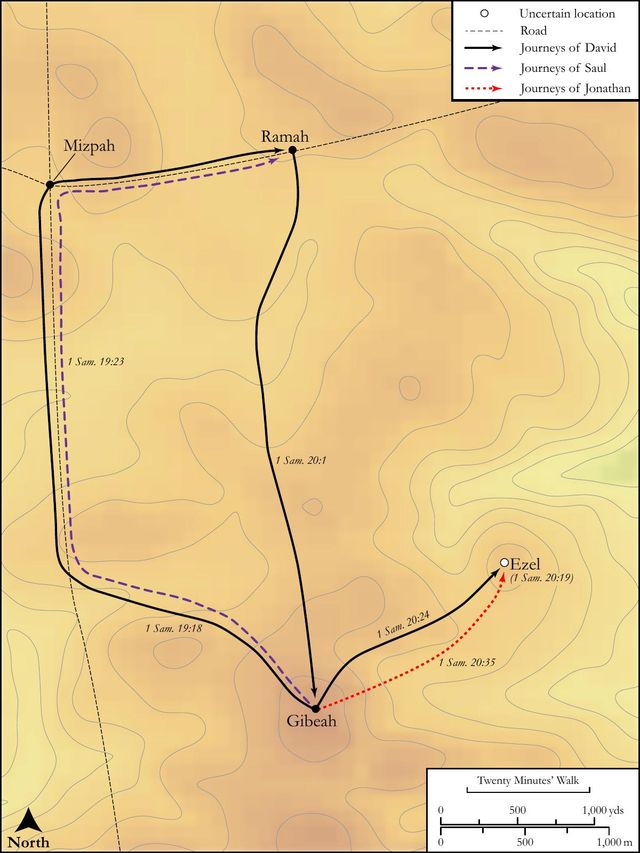
See on the biblical-era map
Study this verse
Public-domain commentary
Matthew Henry
From his Commentary on the Whole Bible. Henry comments on passages, not single verses — this entry covers 1 Samuel 20:35–42.
Here is, 1. Jonathan's faithful performance of his promise to give David notice of the success of his dangerous experiment. He went at the time and to the place appointed (Sa1 20:35), within sight of which he knew David lay hid, sent his footboy to fetch his arrows, which he would shoot at random (Sa1 20:36), and gave David the fatal signal by shooting an arrow beyond the lad (Sa1 20:37): Is not the arrow beyond thee? That word [beyond] David knew the meaning of better than the lad. Jonathan dismissed the lad, who knew nothing of the matter, and, finding the coast clear and no danger of a discovery, he presumed upon one minute's personal conversation with David after he had bidden him flee for his life. 2. The most sorrowful parting of these two friends, who, for aught that appears, never came together again but once, and that was by stealth in a wood, Sa1 23:16. (1.) David addressed himself to Jonathan with the reverence of a servant rather than the freedom of a friend: He fell on his face to the ground, and bowed himself three times, as one deeply sensible of his obligations to him for the good services he had done him. (2.) They took leave of each other with the greatest affection imaginable, with kisses and tears; they wept on each other's neck till David exceeded, Sa1 20:41. The separation of two such faithful friends was equally grievous to them both, but David's case was the more deplorable; for, when Jonathan was returning to his family and friends, David was leaving all his comforts, even those of God's sanctuary, and therefore his grief exceeded Jonathan's, or perhaps it was because his temper was more tender and his passions were stronger. (3.) They referred themselves to the covenant of friendship that was between them, both of them comforting themselves with this in this mournful separation: "We have sworn both of us in the name of the Lord, for ourselves and our heirs, that we and they will be faithful and kind to each other from generation to generation." Thus, while we are at home in the body and absent from the Lord, this is our comfort, that he has made with us an everlasting covenant.
Continue studying 1 Samuel 20:39 across the web’s major study libraries — every link below opens this exact verse, chapter, or book on the destination site.
Read & Compare
 BibleGatewayThis verse in more than 200 translations and 70 languages.
 Bible.comThe YouVersion reader — hundreds of translations, reading plans, and highlights.
 ESV.orgCrossway's official English Standard Version reader.
 NET BibleThe NET translation with 60,000+ translators' notes on every rendering decision.
 STEP BibleTyndale House's free study tool — original text, vocabulary, and scholarly resources.
 BibliaLogos Bible Software's free web reader.
 USCCBThe New American Bible (Revised Edition) with the U.S. bishops' study notes.
Commentaries
 BibleHub CommentariesDozens of classic commentaries on this verse, gathered on one page.
 StudyLightMore than 100 commentary sets — the largest collection on the web.
 BibleRefPlain-English commentary on what this verse means, verse by verse.
 Enduring WordDavid Guzik's free commentary on this chapter, widely used by Bible teachers.
 Bible Study ToolsVerse commentary alongside Greek and Hebrew study aids.
Original Language & Research
- BibleHub InterlinearThe verse word by word — original language, transliteration, and English.
- BibleHub LexiconEvery word's original-language definition and Strong's entry.
 Blue Letter BibleDeep-study tools — Strong's numbers, concordance, and word studies.
 SefariaThe Hebrew text with Rashi and centuries of Jewish commentary.
Sermons, Hymns & Audio


TrulyRandomVerse is not affiliated with these sites and doesn’t control their content. They’re linked because they’re genuinely useful.
Summary
1 Samuel 20:39 succinctly captures the profound and perilous secret shared between Jonathan and David, a pivotal moment in David's flight from King Saul's escalating jealousy. This verse critically highlights the absolute necessity of the young servant's ignorance for the successful execution of Jonathan's elaborate plan to warn David, underscoring the deep trust, unwavering loyalty, and strategic discretion employed by the two friends in the face of imminent danger. It encapsulates the tension of a hidden communication, known only to those whose lives hung in the balance, serving as a testament to the intricate ways God's providence operates to protect His anointed.
Context
ShowHideLiterary Context
This verse is deeply embedded within the emotionally charged narrative of Jonathan's steadfast loyalty to David, set against the backdrop of King Saul's increasingly irrational paranoia and repeated attempts to assassinate David. Following Saul's violent outbursts and direct assaults on David's life, as vividly depicted in 1 Samuel 19:9-10, Jonathan, Saul's own son, enters into a solemn covenant with David, pledging his protection and ensuring his safety (detailed in 1 Samuel 20:1-17). The specific, intricate plan involving the shooting of arrows and the use of a lad is meticulously devised and articulated by Jonathan in 1 Samuel 20:20-22, designed to convey a life-or-death message without arousing the suspicion of Saul's court. The immediate preceding verses, 1 Samuel 20:35-38, describe the tense execution of this very plan, where Jonathan goes out with the lad to perform the seemingly innocent archery practice. Verse 39 then serves as a crucial explanatory aside, emphasizing the absolute secrecy that undergirds the entire operation, confirming that only the two principal actors understood the true, dire gravity of the seemingly innocuous game.
Historical & Cultural Context
The setting for this dramatic encounter is the nascent monarchy of Israel, a period characterized by evolving tribal loyalties, the consolidation of national identity, and the complex, often treacherous, dynamics of power within a royal court. Kings in this era wielded absolute authority, and any perceived dissent or threat to their rule was typically met with swift and brutal reprisal. Saul's intense jealousy of David, exacerbated by the people's adoration and the prophetic pronouncements regarding David's future kingship, fostered a highly volatile and dangerous environment. Covenants, such as the one forged between David and Jonathan (1 Samuel 18:3), were profoundly binding agreements, often sealed with solemn oaths before God, and were considered sacrosanct. The widespread use of a "lad" or servant was a common societal norm; such individuals were typically young, uninitiated, and expected to carry out their master's bidding without necessarily comprehending the broader implications of their tasks. This cultural expectation of a subordinate's ignorance made the arrow signal a remarkably plausible and inconspicuous means of communication, cleverly leveraging the lad's expected lack of understanding to maintain critical secrecy in a life-threatening situation.
Key Themes
ShowHideThis verse powerfully contributes to several overarching themes woven throughout the book of 1 Samuel. Secrecy and Discretion are paramount, as the lad's unawareness is the linchpin of Jonathan's intricate plan, ensuring that the critical message of Saul's deadly intent reaches David undetected. This highlights the profound wisdom and cunning required to navigate treacherous circumstances. Unwavering Loyalty and Self-Sacrificial Friendship are profoundly displayed in Jonathan's actions; he risks his own life, his inheritance as heir to the throne, and his relationship with his father to protect David. This demonstrates a love that transcends political ambition and familial ties, a bond further affirmed when Jonathan strengthens David's hand in God in 1 Samuel 23:16-18. Finally, while not explicitly stated, the success of this secret communication subtly points to Divine Providence. God, who had sovereignly chosen David to be the next king (as revealed in 1 Samuel 16:1-13), is actively at work, using human ingenuity and devoted relationships to protect His anointed one and advance His sovereign plan, even amidst the chaos and conflict of human affairs.
Exposition and Analysis
ShowHideKey Word Analysis
ShowHideThis Hebrew term refers to a young man, typically a servant or attendant, often without significant status or independent knowledge. In this context, the lad's youth and subordinate position are absolutely crucial. He functions merely as an instrument in Jonathan's hands, performing a task without comprehending its true, life-or-death significance. His ignorance is not a flaw but a deliberate and necessary component of the plan's success, ensuring no unintended betrayal or leakage of vital information.
The verb "knew" appears twice in this verse, creating a powerful contrast. In its first instance, "knew not any thing," it denotes a complete lack of awareness or understanding on the part of the lad. He performed his duty mechanically, without grasping the underlying "matter." In its second instance, "Jonathan and David knew the matter," it signifies a deep, shared understanding and full comprehension of the perilous reality. This knowledge is not merely intellectual but existential, binding them in a dangerous secret and a common purpose.
This versatile Hebrew word can mean "word," "thing," "affair," or "cause." Here, it refers to the true nature of Jonathan's arrow signal—not a simple game of archery, but a coded message about Saul's murderous intent and David's immediate need to flee. It encompasses the entire clandestine operation, the grave danger, and the profound implications for David's life and future. The "matter" is the secret, the conspiracy, and the very fabric of their desperate attempt to save David.
Verse Breakdown
ShowHide"But the lad knew not any thing:"
This clause immediately establishes the critical element of secrecy that underpins Jonathan's elaborate plan. The "lad," Jonathan's young attendant, was entirely oblivious to the true, life-saving purpose of the archery exercise. He perceived it merely as a routine task of retrieving arrows. This profound lack of knowledge was not accidental but a deliberate and essential component of Jonathan's strategy. His innocence and ignorance ensured that he could not unwittingly betray the secret to King Saul's watchful eyes or ears, thereby safeguarding the integrity of the coded message and, ultimately, David's life.
"only Jonathan and David knew the matter."
This second clause provides a stark and powerful contrast, clarifying the exclusive nature of the shared knowledge. Only the two principal actors, Jonathan and David, were privy to the "matter," which was the grave reality of Saul's murderous intent and the life-or-death significance of the arrow signal. This shared secret underscores the profound depth of their bond, their absolute mutual trust, and the perilous situation they faced. Their knowledge was not just intellectual understanding, but a deep, personal comprehension of the existential stakes involved, binding them together in a desperate conspiracy for survival and the fulfillment of God's plan.
Literary Devices
ShowHideThe verse effectively employs Contrast as its primary literary device, sharply setting the complete ignorance of the lad against the full, shared knowledge of Jonathan and David. This stark juxtaposition powerfully highlights the critical nature of the secret and the immense danger inherent in its potential revelation. The scene also subtly utilizes Foreshadowing, as the necessity of such elaborate secrecy and David's subsequent flight from Saul's relentless pursuit foreshadows the long and arduous period of his life as a fugitive, constantly evading capture. Furthermore, there is a potent element of Dramatic Irony at play: the audience is fully aware of the life-or-death message being conveyed through a seemingly innocent game, while the lad, a character within the scene, remains completely oblivious. This creates significant tension and underscores the perilous stakes for both David and Jonathan. The arrows themselves function as a powerful Symbol of communication, transformed from simple projectiles into a coded language of warning, deliverance, and escape.
Theological and Thematic Connections
ShowHide1 Samuel 20:39 profoundly illustrates the intricate and often hidden ways in which God's providence operates, frequently through human relationships and strategic discretion, to protect His chosen instruments. While the immediate focus is on Jonathan and David's unwavering loyalty and clever ingenuity, the underlying theological truth is that God is sovereignly orchestrating events to preserve David, His anointed king, from the wrath of Saul. This verse reminds us that God does not always intervene with overt miracles but can work powerfully through the hidden acts of faithful friends, the wisdom of careful planning, and even the unwitting participation of others. It speaks to the value of discernment in dangerous times, the necessity of trusted confidantes, and the profound assurance that God's purposes for His people will ultimately prevail, even when circumstances appear dire and require clandestine measures.
Reflection and Application
ShowHideThe clandestine communication in 1 Samuel 20:39 offers profound and enduring lessons for believers today. It underscores the invaluable nature of deep, covenantal relationships built on trust and unwavering loyalty, reminding us to cultivate friendships where we can be truly known, supported, and even protected, especially in times of adversity. Just as Jonathan risked everything—his life, his inheritance, and his relationship with his father—for David, we are called to be faithful friends who stand by one another, offering practical help, unwavering support, and prayer. Furthermore, the verse highlights the wisdom of discretion; not all information needs to be shared, and there are indeed times when strategic silence or carefully coded communication is necessary for protection, for the success of a mission, or to prevent harm to ourselves or others. This calls us to prayerful discernment, asking God for wisdom in knowing when to speak and when to remain silent, and how to communicate effectively in sensitive situations. Ultimately, this passage powerfully reassures us of God's active and sovereign involvement in our lives. Even in the most complex and dangerous situations, God can orchestrate events through human means, using loyal friends, clever strategies, and even the unwitting actions of others, to protect His children and advance His divine purposes. We are invited to trust His sovereign hand, even when His working is hidden from plain sight or unfolds through seemingly ordinary circumstances.
Questions for Reflection
ShowHideFAQ
ShowHideWhy was the lad's ignorance so important to Jonathan's plan?
ShowHideThe lad's complete ignorance was absolutely critical because it preserved the secrecy and integrity of Jonathan's plan to warn David. If the lad had understood the true, life-or-death meaning of the arrow signal, he could have inadvertently betrayed the secret to King Saul or his numerous spies. In a royal court filled with intrigue, paranoia, and the king's murderous intent, any hint of a conspiracy against the king, even an accidental one, could have led to immediate capture or death for David, and severe consequences, potentially even execution, for Jonathan. By keeping the lad entirely in the dark, Jonathan ensured that the communication was entirely private and secure between himself and David, making the seemingly innocent act of retrieving arrows an undetectable, life-saving message.
What does this verse tell us about Jonathan's character?
ShowHideThis verse, in conjunction with the surrounding narrative in 1 Samuel 20, profoundly reveals Jonathan's extraordinary character. It highlights his unwavering loyalty to David, even at immense personal cost. Jonathan, the king's son and heir apparent, knowingly defied his father's murderous will to protect David, whom he recognized as God's chosen successor. His actions demonstrate remarkable courage, selflessness, and a deep, covenantal love that prioritized David's life and God's plan over his own royal ambitions or personal safety. Jonathan's wisdom and strategic thinking are also evident in devising such an intricate and discreet plan to communicate with David, showcasing his intelligence and foresight in a dangerous situation. His character stands as a powerful example of faithful friendship and obedience to a higher calling, even when it meant profound personal sacrifice and risking everything.
How does this event fit into the larger narrative of David's rise to power?
ShowHideThis event is a crucial and definitive turning point in the larger narrative of David's rise to power. It marks the irreversible end of David's time in Saul's court and the definitive beginning of his life as a fugitive. Jonathan's warning, facilitated by the absolute secrecy emphasized in this verse, directly leads to David's escape from Saul's immediate and deadly reach. This subsequent period of flight and hardship, though incredibly challenging, served several divine purposes: it further humbled David, refined his character, demonstrated God's constant and miraculous protection over His anointed, and solidified his leadership among a growing band of loyal followers (as seen in 1 Samuel 22:1-2). It also powerfully underscores the divine hand in David's destiny, as God uses Jonathan's selfless loyalty and human ingenuity to preserve the life of His anointed one, ensuring that the path to the throne, though arduous and circuitous, would ultimately be fulfilled according to His sovereign and perfect plan.
Christ-Centered Fulfillment
ShowHideThe profound loyalty and self-sacrificial love displayed by Jonathan for David in 1 Samuel 20:39 powerfully foreshadow the ultimate love of Christ for humanity. David, the anointed king who is rejected and relentlessly pursued by the reigning monarch, serves as a vivid type of Christ, who was also rejected by His own people and faced relentless opposition and a murderous plot. Jonathan's willingness to risk his inheritance and his very life to save David, communicating a hidden message of deliverance, echoes Jesus's profound willingness to lay down His life for His friends (as stated in John 15:13). Christ, the true Son of the Father, did not cling to His divine prerogatives but emptied Himself, taking the form of a servant, even to the point of death on a cross, for our salvation (see Philippians 2:5-8). The "matter" known only to Jonathan and David can be seen as a shadow of the "mystery" of the gospel, a divine plan of redemption once hidden but now gloriously revealed in Christ, a truth known only to those who have been given eyes to see and ears to hear (Colossians 1:26-27). Just as David was protected by a loyal friend and a secret, divinely orchestrated plan, believers are protected by Christ's unfailing love and the eternal divine plan of redemption, a plan fully known and perfectly executed by the One who calls us friends, even while we were still sinners (as in Romans 5:8).