


1 Samuel 10:13
Bible text: King James Version (1769 Blayney text) · Public domain
Bible text: King James Version with Strong's numbers · Public domain
Bible text: Berean Standard Bible · Public domain
Bible text: American Standard Version (1901) · Public domain
Bible text: World English Bible, Messianic edition · Public domain
Bible text: Geneva Bible (1599) · Public domain
Bible text: Young's Literal Translation · Public domain
- וַיְכַלvay·Khaland he finishedH3615Conj-w ¦ V-Piel-ConsecImperf-3msVerb Piel Consecutive Imperfect 3rd Singular Masculineוַandיְכַלhe finished
- מֵהִתְנַבּוֹתme·hit·na·Botfrom prophesyingH5012Prep-m ¦ V-Hithpael-InfVerb Hithpael Infinitive Constructמֵfromהִתְנַבּוֹתprophesying
- וַיָּבֹאvai·ya·Vo'and he cameH935Conj-w ¦ V-Qal-ConsecImperf-3msVerb Qal Consecutive Imperfect 3rd Singular Masculineוַandיָּבֹאhe came
- הַבָּמָהha·ba·Mahthe high placeH1116Art ¦ N-fsNoun Singular Feminine Absoluteהַtheבָּמָהhigh place
English is a literal word-by-word gloss of the Hebrew, not the KJV's wording. Why?
This is the original text the KJV's translators worked from — each Hebrew word with its own literal English meaning in this verse, prepared by scholars at Tyndale House, Cambridge. The KJV translates whole sentences, not word by word, so its wording differs: one Hebrew word can become several English words, and the KJV may choose “the LORD” where the gloss reads “Yahweh”. Both are faithful — they answer different questions. For the KJV's own rendering, switch to the KJV text.
Details
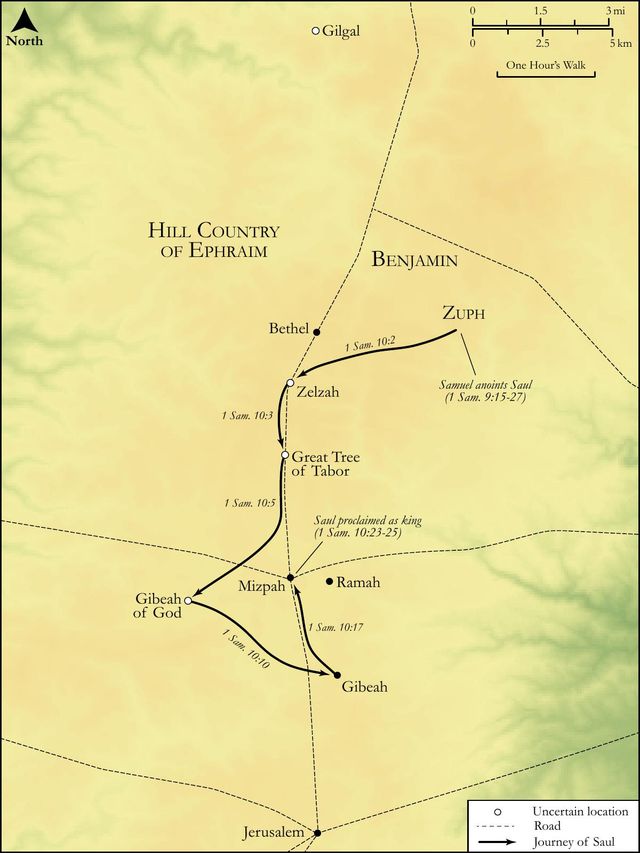
See on the biblical-era map
Study this verse
Public-domain commentary
Matthew Henry
From his Commentary on the Whole Bible. Henry comments on passages, not single verses — this entry covers 1 Samuel 10:9–16. His four-level outline is real structure in the source text, so it is rendered as structure.
Saul has now taken his leave of Samuel, much amazed, we may well suppose, at what has been done to him, almost ready to question whether he be awake or no, and whether it be not all a dream. Now here we are told,
I.What occurred by the way, Sa1 10:9.
Those signs which Samuel had given him came to pass very punctually; but that which gave him the greatest satisfaction of all was this, he found immediately that God had given him another heart. A new fire was kindled in his breast, such as he had never before been acquainted with: seeking the asses is quite out of his mind, and he thinks of nothing but fighting the Philistines, redressing the grievances of Israel, making laws, administering justice, and providing for the public safety; these are the things that now fill his head. He finds himself raised to such a pitch of boldness and bravery as he never thought he should be conscious of. He has no longer the heart of a husbandman, which is low, and mean, and narrow, and concerned only about his corn and cattle; but the heart of a statesman, a general, a prince. Whom God calls to any service he will make fit for it. If he advance to another station, he will give another heart, to those who sincerely desire to serve him with their power.
II.What occurred when he came near home.
They came to the hill (Sa1 10:10), that is, to Gibeah, or Geba, which signifies a hill, and so the Chaldee here takes it as a proper name; he met with the prophets as Samuel had told him, and the Spirit of God came upon him, strongly and suddenly (so the word signifies), but not so as to rest and abide upon him. It came on so as to go off quickly. However, for the present, it had a strange effect upon him; for he immediately joined with the prophets in their devotion, and that with as much decorum and as great a transport of affection as any of them: He prophesied among them. Now,
1.His prophesying was publicly taken notice of, Sa1 10:11, Sa1 10:12. He was now among his acquaintance, who, when they saw him among the prophets, called one another to come and see a strange sight. This would prepare them to accept him as a king, though one of themselves, when they had seen how God had advanced him to the honour of a prophet. The seventy elders prophesied before they were made judges, Num 11:25. Now,
(1.)They all wondered to see Saul among the prophets: What is this that has come to the son of Kish? Though this school of the prophets was near his father's house, yet he had never associated with them, nor shown them any respect, perhaps had sometimes spoken slightly of them; and now to see him prophesying among them was a surprise to them, as it was long after when his namesake, in the New Testament, preached that gospel which he had before persecuted, Act 9:21. Where God gives another heart it will soon show itself.
(2.)One of them, that was wiser than the rest, asked, "Who is their father, or instructor? Is is not God? Are they not all taught of him? Do they not all owe their gifts to him? And is he limited? Cannot he make Saul a prophet, as well as any of them, if he please?" Or, "Is not Samuel their father?" Under God, he was so; and Saul had now lately been with him, which, by his servant, he might know. No marvel for him to prophesy who lay last night under Samuel's roof.
(3.)It became a proverb, commonly used in Israel, when they would express their wonder at a bad man's either becoming good, or at least being found in good company, Is Saul among the prophets? Note, Saul among the prophets is a wonder to a proverb. Let not the worst be despaired of, yet let not an external show of devotion, and a sudden change for the present, be too much relied on; for Saul among the prophets was Saul still.
2.His being anointed was kept private. When he had done prophesying,
(1.)It should seem he uttered all his words before the Lord, and recommended the affair to his favour, for he went straight to the high place (Sa1 10:13), to give God thanks for his mercies to him and to pray for the continuance of those mercies. But,
(2.)He industriously concealed from his relations what had passed. His uncle, who met with him either at the high place or as soon as he came home, examined him, Sa1 10:14. Saul owned, for his servant knew it, that they had been with Samuel, and that he told them the asses were found, but said not a word of the kingdom, Sa1 10:14, Sa1 10:15. This was an instance,
[1.]Of his humility. Many a one would have been so elated with this surprising elevation as to proclaim it upon the house-top. But Saul, though he might please himself with it in his own breast, did not pride himself in it among his neighbours. The heirs of the kingdom of glory are well enough pleased that the world knows them not, Jo1 3:1.
[2.]Of his prudence. Had he been forward to proclaim it, he would have been envied, and he knew not what difficulty that might have created him. Samuel had communicated it to him as a secret, and he knows how to keep counsel. Thus it appears that he had another heart, a heart fit for government.
[3.]Of his dependence upon God. He does not go about to make an interest for himself, but leaves it to God to carry on his own work by Samuel, and, for his own part, sits still, to see how the matter will fall.
Historical interpretation
Historical reception
1 surviving comment on this verse from the historical church.
But he ceased to prophesy, etc. However, Jesus ceased to be considered a prophet, and began to be believed as Almighty God, of whom Isaiah to the pursuing peoples said: "Therefore desist from man, whose breath is in his nostrils, for he is considered on high" (Isa. II).
Continue studying 1 Samuel 10:13 across the web’s major study libraries — every link below opens this exact verse, chapter, or book on the destination site.
Read & Compare
 BibleGatewayThis verse in more than 200 translations and 70 languages.
 Bible.comThe YouVersion reader — hundreds of translations, reading plans, and highlights.
 ESV.orgCrossway's official English Standard Version reader.
 NET BibleThe NET translation with 60,000+ translators' notes on every rendering decision.
 STEP BibleTyndale House's free study tool — original text, vocabulary, and scholarly resources.
 BibliaLogos Bible Software's free web reader.
 USCCBThe New American Bible (Revised Edition) with the U.S. bishops' study notes.
Commentaries
 BibleHub CommentariesDozens of classic commentaries on this verse, gathered on one page.
 StudyLightMore than 100 commentary sets — the largest collection on the web.
 BibleRefPlain-English commentary on what this verse means, verse by verse.
 Enduring WordDavid Guzik's free commentary on this chapter, widely used by Bible teachers.
 Bible Study ToolsVerse commentary alongside Greek and Hebrew study aids.
Original Language & Research
- BibleHub InterlinearThe verse word by word — original language, transliteration, and English.
- BibleHub LexiconEvery word's original-language definition and Strong's entry.
 Blue Letter BibleDeep-study tools — Strong's numbers, concordance, and word studies.
 SefariaThe Hebrew text with Rashi and centuries of Jewish commentary.
Sermons, Hymns & Audio


TrulyRandomVerse is not affiliated with these sites and doesn’t control their content. They’re linked because they’re genuinely useful.
Summary
1 Samuel 10:13 marks the culmination of a divinely orchestrated spiritual transformation for Saul, immediately following his anointing as Israel's first king. This verse describes the conclusion of an ecstatic prophetic encounter, where the Spirit of the Lord powerfully came upon him, enabling him to prophesy among a company of prophets. It signifies a pivotal transition from this intense, Spirit-filled experience to a specific, recognized location—the "high place"—which served as a legitimate site for worship and communal gathering in early Israel, underscoring the public validation of God's hand upon His chosen leader.
Context
ShowHideLiterary Context
This verse is strategically positioned as the narrative climax of the signs given to Saul by Samuel following his private anointing. In 1 Samuel 10:1-8, Samuel had provided three specific signs to confirm God's anointing, the third being that Saul would encounter a company of prophets and "the Spirit of the LORD will come upon thee, and thou shalt prophesy with them, and thou shalt be turned into another man" (1 Samuel 10:6). 1 Samuel 10:9-12 vividly recount the fulfillment of this prophecy: God indeed gave Saul a new heart, he met the prophets, and the Spirit of God powerfully rushed upon him, causing him to prophesy. This astonishing display led bystanders to exclaim, "Is Saul also among the prophets?" (1 Samuel 10:11). Therefore, 1 Samuel 10:13 serves as the narrative conclusion to this specific prophetic episode, indicating that the intense, Spirit-filled experience had concluded, and Saul proceeded to a known location, likely the very "high place" from which the prophets had descended. This sequence firmly establishes the divine validation of Saul's kingship.
Historical & Cultural Context
The period of the Judges and early monarchy in Israel, preceding the construction of the Jerusalem Temple, featured a less centralized and more localized form of worship. "High places" (Hebrew: bâmâh) were common elevated sites, often natural hills or constructed mounds, used for various religious rituals, sacrifices, and communal gatherings. While later biblical texts, particularly during the reforms of kings like Hezekiah and Josiah (2 Kings 23), would condemn high places due to their eventual association with idolatry and syncretistic worship, in Saul's era, they were frequently legitimate, albeit informal, centers of Israelite worship and prophetic activity. The prophets themselves were a recognized group, often operating in companies, whose role involved speaking under divine inspiration, not exclusively foretelling the future, but delivering God's message, offering praise, or engaging in ecstatic worship. Saul's participation in such an ecstatic prophetic display was a public, undeniable sign of divine endorsement for his kingship, demonstrating that God's Spirit was indeed upon him, equipping him for his new role.
Key Themes
ShowHideThis verse contributes significantly to several overarching themes in the book of 1 Samuel and the broader biblical narrative. Firstly, it powerfully illustrates Divine Empowerment and Calling, showcasing how God equips those He chooses for specific tasks, even an unlikely candidate like Saul, who initially expressed humility and inadequacy (1 Samuel 9:21). The Spirit's coming upon Saul was a tangible manifestation of God's anointing, a necessary enablement for leading Israel. Secondly, it underscores the theme of Transformation, as Saul was "turned into another man" (1 Samuel 10:6), signifying a new capacity and spiritual readiness for leadership. This initial transformation, though powerful, tragically foreshadows the later trajectory of Saul's reign, where his spiritual receptivity would wane, and the Spirit of the Lord would depart from him (1 Samuel 16:14). Lastly, the mention of the "High Place" introduces the complex theme of worship practices in early Israel, highlighting the decentralized nature of religious life before the Temple's construction and setting the stage for later theological debates about proper worship locations and the dangers of syncretism.
Exposition and Analysis
ShowHideKey Word Analysis
ShowHideFrom an unused root meaning "to be high," this primitive root signifies "to end," whether intransitively (to cease, be finished, perish) or transitively (to complete, prepare, consume). In this context, it denotes the completion or cessation of Saul's prophetic activity, indicating that the intense, Spirit-filled experience had reached its conclusion. It emphasizes the finite nature of this particular divine encounter.
A primitive root meaning "to prophesy," which involves speaking or singing by inspiration, whether in prediction or simple discourse. It describes the act of being a mouthpiece for God, often characterized by ecstatic utterance, praise, or the declaration of God's message. Here, it signifies a supernatural endowment of the Spirit upon Saul, confirming his divine appointment and equipping him for his new role as king.
From an unused root meaning "to be high," this noun refers to an elevation, height, or raised place. It designates an elevated location, either natural or man-made, commonly used for religious worship and sacrifice in ancient Israel. In this early period, such sites were often legitimate centers of spiritual activity, and Saul's movement to this location suggests a return to a known spiritual or communal gathering point, perhaps where the company of prophets resided or regularly met.
Verse Breakdown
ShowHide"And when he had made an end of prophesying"
This clause marks a definitive conclusion to a significant spiritual event. The verb "made an end" (כָּלָה, kâlâh') conveys finality, indicating that the intense, Spirit-filled prophetic experience Saul underwent had reached its cessation. This was not a permanent state of ecstatic utterance but a specific, powerful manifestation of the Spirit for a particular purpose—the confirmation of his anointing and transformation into "another man." It highlights the episodic nature of the Spirit's anointing in the Old Testament, often for specific tasks or moments.
"he came to the high place"
This phrase describes Saul's physical movement to a particular geographical location immediately following his spiritual encounter. The "high place" was likely the very site from which the company of prophets had descended, suggesting it was a known spiritual hub or a place of communal gathering associated with the prophetic community. His arrival there signifies a transition from the immediate, overwhelming spiritual experience to a more settled, perhaps reflective, state, or a return to a place of community and established worship.
Literary Devices
ShowHideThe verse primarily employs Narrative Transition and Symbolism. The opening phrase, "And when he had made an end of prophesying," functions as a clear Narrative Transition, signaling the conclusion of the dramatic, Spirit-filled episode and propelling the story forward. This transition emphasizes the episodic nature of the Spirit's anointing in the Old Testament, which often occurred for specific tasks or moments rather than as a continuous state. Furthermore, the act of "prophesying" itself is deeply Symbolic of divine empowerment and endorsement, serving as a visible and undeniable sign to all that God's hand was upon Saul, validating his kingship. The "high place" also carries Symbolic weight, representing a locus of spiritual activity and communal gathering, a place where the sacred and communal life intersected in early Israel. Its mention helps ground the supernatural event within the tangible, geographical realities of the time, while also subtly foreshadowing later theological developments regarding centralized worship.
Theological and Thematic Connections
ShowHide1 Samuel 10:13 profoundly illustrates the Old Testament pattern of divine empowerment for chosen leaders, where God's Spirit would "come upon" individuals to equip them for specific tasks. Saul's prophetic experience served as a public validation of his anointing, demonstrating that his kingship was not merely a human choice but a divine appointment. This initial outpouring of the Spirit highlights God's faithfulness in preparing His servants, providing the necessary spiritual enablement for their callings. The verse also implicitly contrasts the temporary and often ecstatic nature of the Spirit's work in the Old Testament with the later, permanent indwelling of the Holy Spirit in New Testament believers. The "high place" itself, while legitimate here, serves as a theological marker of Israel's journey towards centralized, pure worship, foreshadowing later reforms that would condemn such decentralized sites in favor of the Temple in Jerusalem.
Reflection and Application
ShowHideThis verse offers profound insights for believers today, demonstrating God's sovereign hand in equipping individuals for His purposes. Just as God equipped Saul for the immense task of leading Israel, He continues to empower and transform those He calls into service, whether in formal ministry or the daily vocations of life. Saul's experience reminds us that divine enablement is not always a permanent state of ecstatic feeling, but often a specific gifting for a particular season, task, or challenge. We are called to be open to the Spirit's leading and empowering, trusting that God will provide what is needed for the work He has set before us. Furthermore, the transition from prophesying to the "high place" suggests the importance of returning to places of spiritual community and reflection after intense spiritual encounters, integrating our experiences into our ongoing walk with God. It challenges us to consider where we go, physically and spiritually, after significant moments of divine encounter, and how we process and apply those experiences to live more faithfully.
Questions for Reflection
ShowHideFAQ
ShowHideWhat exactly does "prophesying" mean in this context for Saul?
ShowHideIn this specific context of 1 Samuel 10:13, "prophesying" (Hebrew: nâbâ') does not primarily mean foretelling the future. Instead, it refers to speaking or acting under the direct, powerful inspiration of God's Spirit, often involving ecstatic praise, spontaneous worship, or inspired utterance. It was a visible and public sign of God's Spirit resting upon an individual, confirming His presence and anointing. For Saul, it was a profound demonstration of divine empowerment, validating his appointment as king and showing that he was indeed "turned into another man" (1 Samuel 10:6), equipped by God for his new leadership role.
Was the "high place" a good or bad place for Saul to go?
ShowHideIn Saul's time, "high places" (Hebrew: bâmâh) were generally legitimate, though decentralized, sites for Israelite worship and sacrifice. Before the construction of the Temple in Jerusalem, it was common for people to worship God at various elevated locations, and the prophets themselves often gathered at such sites. Therefore, for Saul to go to the high place after prophesying was not inherently negative; it was likely a recognized spiritual gathering point or a place associated with the prophetic community. However, it is crucial to note that later in Israel's history, after the Law was more fully established and especially after the Temple was built as the singular place of worship, high places often became associated with idolatry and syncretistic worship. Consequently, biblical writers would condemn them and call for their destruction (e.g., 1 Kings 15:14; 2 Kings 23). This verse reflects an earlier, more fluid period of Israelite worship practices.
Christ-Centered Fulfillment
ShowHideWhile Saul's anointing and temporary Spirit-empowerment for kingship were significant, they ultimately point to the superior and eternal kingship of Jesus Christ. Saul's transformation was powerful but ultimately incomplete and fleeting, as his reign was tragically marked by disobedience and a departure from God's Spirit (1 Samuel 16:14). In stark contrast, Jesus is the King whose anointing by the Spirit is eternal, perfect, and without measure (John 3:34). The "prophesying" of Saul, a temporary manifestation of the Spirit for a specific purpose, foreshadows the permanent indwelling of the Holy Spirit in all believers through Christ, making them temples of the Holy Spirit (1 Corinthians 6:19). The "high place," a physical location for worship in the Old Testament, is superseded by Christ Himself, who is the ultimate access to God, our great High Priest who has passed through the heavens (Hebrews 4:14). Through Him, we are not merely transformed for a temporary task, but are continually being transformed into His image from one degree of glory to another by the Spirit of the Lord (2 Corinthians 3:18), becoming a royal priesthood and a holy nation, called to declare His praises (1 Peter 2:9). Jesus is the fulfillment of all Old Testament patterns of anointing, Spirit-empowerment, and true worship, establishing a new covenant where God's presence is not confined to a "high place" but indwells His people.