


1 Samuel 10:14
Bible text: King James Version (1769 Blayney text) · Public domain
Bible text: King James Version with Strong's numbers · Public domain
Bible text: Berean Standard Bible · Public domain
Bible text: American Standard Version (1901) · Public domain
Bible text: World English Bible, Messianic edition · Public domain
Bible text: Geneva Bible (1599) · Public domain
Bible text: Young's Literal Translation · Public domain
- וַיֹּאמֶרvai·yo·Merand he saidH559Conj-w ¦ V-Qal-ConsecImperf-3msVerb Qal Consecutive Imperfect 3rd Singular Masculineוַandיֹּאמֶרhe said
- דּוֹדDod[the] uncle ofH1730N-mscNoun Singular Masculine Construct
- שָׁאוּלsha·'UlSaulH7586N-proper-mNoun Proper Masculine
- אֵלָיו'e·Lavto himH413Prep ¦ 3msPrepositionאֵלָיtoוhim
- וְאֶלve·'eland toH413Conj-w ¦ PrepPrepositionוְandאֶלto
- נַעֲרוֹna·'a·Rohis servantH5288N-msc ¦ 3msNoun Singular Masculine Constructנַעֲרservantוֹhis
- אָן'anwhere?H575InterrogParticle Interrogative
- הֲלַכְתֶּםha·lakh·Temdid you goH1980V-Qal-Perf-2mpVerb Qal Perfect 2nd Plural Masculine
- וַיֹּאמֶרvai·Yo·merand he saidH559Conj-w ¦ V-Qal-ConsecImperf-3msVerb Qal Consecutive Imperfect 3rd Singular Masculineוַandיֹּאמֶרhe said
- לְבַקֵּשׁle·va·Keshto seekH1245Prep-l ¦ V-Piel-InfVerb Piel Infinitive Constructלְtoבַקֵּשׁseek
- אֶת'et<obj.>H853DirObjMParticle Object Indicator
- הָאֲתֹנוֹתha·'a·to·Notthe she-assesH860Art ¦ N-fpNoun Plural Feminine Absoluteהָtheאֲתֹנוֹתshe-asses
- וַנִּרְאֶהva·nir·'Ehand we sawH7200Conj-w ¦ V-Qal-ConsecImperf-1cpVerb Qal Consecutive Imperfect 1st Plural common genderוַandנִּרְאֶהwe saw
- כִיkhithatH3588PrtParticle Conditional
- אַיִן'A·yinthere notH369N-msNoun Singular Masculine Absolute
- וַנָּבוֹאva·na·Vo'and we wentH935Conj-w ¦ V-Qal-ConsecImperf-1cpVerb Qal Consecutive Imperfect 1st Plural common genderוַandנָּבוֹאwe went
- אֶל'eltoH413PrepPreposition
- שְׁמוּאֵלshe·mu·'ElSamuelH8050N-proper-mNoun Proper Masculine
English is a literal word-by-word gloss of the Hebrew, not the KJV's wording. Why?
This is the original text the KJV's translators worked from — each Hebrew word with its own literal English meaning in this verse, prepared by scholars at Tyndale House, Cambridge. The KJV translates whole sentences, not word by word, so its wording differs: one Hebrew word can become several English words, and the KJV may choose “the LORD” where the gloss reads “Yahweh”. Both are faithful — they answer different questions. For the KJV's own rendering, switch to the KJV text.
Details
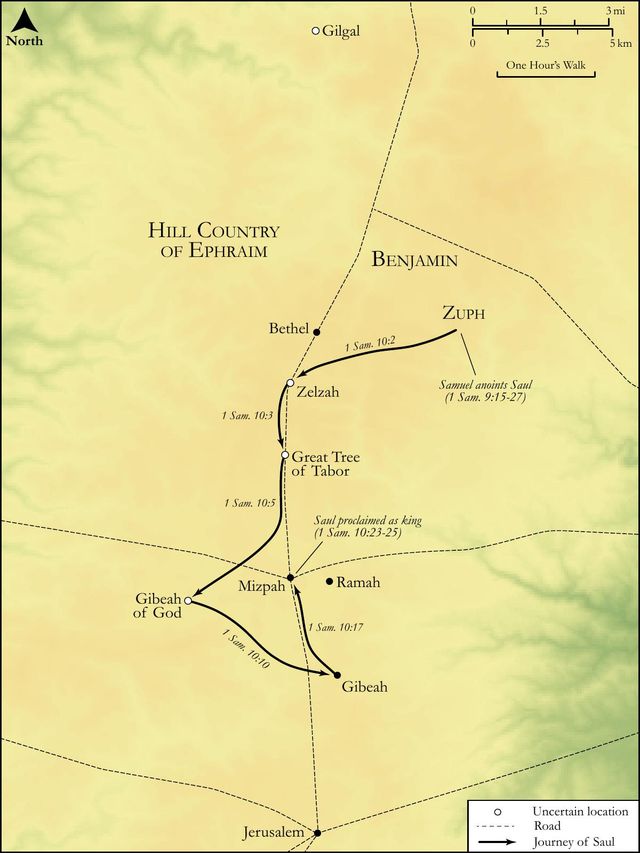
See on the biblical-era map
Study this verse
Public-domain commentary
Matthew Henry
From his Commentary on the Whole Bible. Henry comments on passages, not single verses — this entry covers 1 Samuel 10:9–16. His four-level outline is real structure in the source text, so it is rendered as structure.
Saul has now taken his leave of Samuel, much amazed, we may well suppose, at what has been done to him, almost ready to question whether he be awake or no, and whether it be not all a dream. Now here we are told,
I.What occurred by the way, Sa1 10:9.
Those signs which Samuel had given him came to pass very punctually; but that which gave him the greatest satisfaction of all was this, he found immediately that God had given him another heart. A new fire was kindled in his breast, such as he had never before been acquainted with: seeking the asses is quite out of his mind, and he thinks of nothing but fighting the Philistines, redressing the grievances of Israel, making laws, administering justice, and providing for the public safety; these are the things that now fill his head. He finds himself raised to such a pitch of boldness and bravery as he never thought he should be conscious of. He has no longer the heart of a husbandman, which is low, and mean, and narrow, and concerned only about his corn and cattle; but the heart of a statesman, a general, a prince. Whom God calls to any service he will make fit for it. If he advance to another station, he will give another heart, to those who sincerely desire to serve him with their power.
II.What occurred when he came near home.
They came to the hill (Sa1 10:10), that is, to Gibeah, or Geba, which signifies a hill, and so the Chaldee here takes it as a proper name; he met with the prophets as Samuel had told him, and the Spirit of God came upon him, strongly and suddenly (so the word signifies), but not so as to rest and abide upon him. It came on so as to go off quickly. However, for the present, it had a strange effect upon him; for he immediately joined with the prophets in their devotion, and that with as much decorum and as great a transport of affection as any of them: He prophesied among them. Now,
1.His prophesying was publicly taken notice of, Sa1 10:11, Sa1 10:12. He was now among his acquaintance, who, when they saw him among the prophets, called one another to come and see a strange sight. This would prepare them to accept him as a king, though one of themselves, when they had seen how God had advanced him to the honour of a prophet. The seventy elders prophesied before they were made judges, Num 11:25. Now,
(1.)They all wondered to see Saul among the prophets: What is this that has come to the son of Kish? Though this school of the prophets was near his father's house, yet he had never associated with them, nor shown them any respect, perhaps had sometimes spoken slightly of them; and now to see him prophesying among them was a surprise to them, as it was long after when his namesake, in the New Testament, preached that gospel which he had before persecuted, Act 9:21. Where God gives another heart it will soon show itself.
(2.)One of them, that was wiser than the rest, asked, "Who is their father, or instructor? Is is not God? Are they not all taught of him? Do they not all owe their gifts to him? And is he limited? Cannot he make Saul a prophet, as well as any of them, if he please?" Or, "Is not Samuel their father?" Under God, he was so; and Saul had now lately been with him, which, by his servant, he might know. No marvel for him to prophesy who lay last night under Samuel's roof.
(3.)It became a proverb, commonly used in Israel, when they would express their wonder at a bad man's either becoming good, or at least being found in good company, Is Saul among the prophets? Note, Saul among the prophets is a wonder to a proverb. Let not the worst be despaired of, yet let not an external show of devotion, and a sudden change for the present, be too much relied on; for Saul among the prophets was Saul still.
2.His being anointed was kept private. When he had done prophesying,
(1.)It should seem he uttered all his words before the Lord, and recommended the affair to his favour, for he went straight to the high place (Sa1 10:13), to give God thanks for his mercies to him and to pray for the continuance of those mercies. But,
(2.)He industriously concealed from his relations what had passed. His uncle, who met with him either at the high place or as soon as he came home, examined him, Sa1 10:14. Saul owned, for his servant knew it, that they had been with Samuel, and that he told them the asses were found, but said not a word of the kingdom, Sa1 10:14, Sa1 10:15. This was an instance,
[1.]Of his humility. Many a one would have been so elated with this surprising elevation as to proclaim it upon the house-top. But Saul, though he might please himself with it in his own breast, did not pride himself in it among his neighbours. The heirs of the kingdom of glory are well enough pleased that the world knows them not, Jo1 3:1.
[2.]Of his prudence. Had he been forward to proclaim it, he would have been envied, and he knew not what difficulty that might have created him. Samuel had communicated it to him as a secret, and he knows how to keep counsel. Thus it appears that he had another heart, a heart fit for government.
[3.]Of his dependence upon God. He does not go about to make an interest for himself, but leaves it to God to carry on his own work by Samuel, and, for his own part, sits still, to see how the matter will fall.
Historical interpretation
Historical reception
1 surviving comment on this verse from the historical church.
And Saul’s uncle said to him: Tell me, etc. Saul’s uncle who speaks with him here is understood to be Ner, the father of Abner, who was the son of Abiel or Saul. Therefore, the relatives and brothers of the Lord, who were seeking what testimony John had given of him but not yet believing in him, as John the Evangelist testifies; the Lord himself responded, teaching that the entrance of the heavenly kingdom was proclaimed to those repenting by his precursor and promised; but he delayed saying that he was the God and Lord preached by that same precursor, and that he was to be proclaimed king to all nations unsparing and proud. Thus far we have briefly traversed the allegorical exposition of the anointing of Saul concerning the Lord. But also tropologically, that is, according to the rules of moral understanding, each of us keeps simple thoughts and those refreshed by the word of God to bear the burdens of fraternal necessity within the enclosures of our hearts, as if pasturing donkeys prepared for daily work, which namely, the most healthful devotion of thoughts, having been slipped away by some temptation as is usual at the moment, having escaped from watchfulness, broken with the reins of continence, to pursue external and secular things, it is necessary to recall wandering minds with all instant attention and to hasten to return them to the inner manger of heavenly fodder. And because we are not sufficient to do anything of ourselves, as from ourselves, having received the gifts of obedience and humility, let us ascend to hear the word of God, and being raised by his modest consolations, let us acquire that which our weakness could not achieve. And indeed it will come, with the help of divine grace, that not only do we recover the interrupted watchfulness of the mind, but also being enriched with the interest of a more perfect gift, we may begin to hope for the joys of the heavenly kingdom; indeed leading devoted people of God in charity, joy, peace, patience, long-suffering, goodness, kindness, faith, modesty, continence, and the other fruits of the Spirit, we may be anointed with the oil of heavenly grace as prince over this inheritance of the Lord; and also to kiss with the prophetic mouth, that is, to receive in our manner the exhortatory admonitions of the holy Scripture, by which the hearts of either ourselves or our neighbors may be comforted.
Continue studying 1 Samuel 10:14 across the web’s major study libraries — every link below opens this exact verse, chapter, or book on the destination site.
Read & Compare
 BibleGatewayThis verse in more than 200 translations and 70 languages.
 Bible.comThe YouVersion reader — hundreds of translations, reading plans, and highlights.
 ESV.orgCrossway's official English Standard Version reader.
 NET BibleThe NET translation with 60,000+ translators' notes on every rendering decision.
 STEP BibleTyndale House's free study tool — original text, vocabulary, and scholarly resources.
 BibliaLogos Bible Software's free web reader.
 USCCBThe New American Bible (Revised Edition) with the U.S. bishops' study notes.
Commentaries
 BibleHub CommentariesDozens of classic commentaries on this verse, gathered on one page.
 StudyLightMore than 100 commentary sets — the largest collection on the web.
 BibleRefPlain-English commentary on what this verse means, verse by verse.
 Enduring WordDavid Guzik's free commentary on this chapter, widely used by Bible teachers.
 Bible Study ToolsVerse commentary alongside Greek and Hebrew study aids.
Original Language & Research
- BibleHub InterlinearThe verse word by word — original language, transliteration, and English.
- BibleHub LexiconEvery word's original-language definition and Strong's entry.
 Blue Letter BibleDeep-study tools — Strong's numbers, concordance, and word studies.
 SefariaThe Hebrew text with Rashi and centuries of Jewish commentary.
Sermons, Hymns & Audio


TrulyRandomVerse is not affiliated with these sites and doesn’t control their content. They’re linked because they’re genuinely useful.
Summary
1 Samuel 10:14 captures a delicate moment as Saul returns from his secret anointing, encountering his uncle who inquires about his prolonged absence. Saul's response, while factually accurate regarding the search for lost donkeys and the visit to Samuel, strategically omits the profound divine encounter and his anointing as Israel's first king. This brief exchange serves as an initial revelation of Saul's character, highlighting themes of discretion, humility, and the tension between a private divine call and its public manifestation according to God's perfect timing.
Context
ShowHideLiterary Context
This verse immediately follows a series of momentous events for Saul, detailed in 1 Samuel 10:1-13. Samuel, acting on divine instruction, privately anointed Saul as prince over God's inheritance. This anointing was accompanied by three prophetic signs, all of which miraculously came to pass, confirming God's Spirit was indeed upon Saul and validating his divine selection. Having been dispatched by his father Kish to locate lost donkeys, Saul's journey unexpectedly led him to Samuel, where his destiny was revealed. The entire anointing process was clandestine, known only to Samuel, Saul, and perhaps his servant. Upon their return, the uncle's natural inquiry provides a narrative bridge, bringing Saul back into his familial sphere before the momentous public assembly at Mizpah, where his kingship would be publicly proclaimed by Samuel, as recorded in 1 Samuel 10:17-24. This transitional verse thus sets the stage for the public revelation of God's chosen king.
Historical & Cultural Context
The period of 1 Samuel marks a pivotal transition in ancient Israelite history, moving from a decentralized tribal confederacy under the leadership of judges to a centralized monarchy. This shift was largely driven by the people's insistent demand for a king "like all the nations" (1 Samuel 8:5), a request that, while displeasing to God, He ultimately granted. Prophets like Samuel held immense spiritual and political authority, serving as God's direct spokesmen, mediating divine will, and anointing leaders. Within the patriarchal family structure of ancient Israel, an uncle's inquiry about a family member's whereabouts and activities was not only natural but expected, reflecting communal responsibility and concern for family affairs. The initial search for lost donkeys, a seemingly mundane and common task, underscores a recurring biblical motif: God often uses ordinary circumstances and humble beginnings to initiate His extraordinary plans and reveal His chosen instruments.
Key Themes
ShowHideThis verse subtly introduces and reinforces several key themes that will profoundly shape Saul's narrative and the broader biblical story. The overarching theme of Divine Election is paramount, emphasizing that Saul's kingship is God's sovereign choice, not a result of human merit or ambition. Saul's partial disclosure highlights the theme of Discretion and Divine Timing, suggesting that not all divine revelations are meant for immediate public consumption; there is a wisdom in waiting for God's appointed moment for truths to be fully unveiled. This initial reticence can be interpreted as a nascent Humility on Saul's part, or perhaps a strategic understanding that the public proclamation of his kingship was Samuel's prerogative and not yet due. Furthermore, the verse establishes a powerful Contrast between the mundane task of seeking lost animals and the profound spiritual reality of being divinely anointed as king, illustrating God's remarkable ability to work through the ordinary to achieve the extraordinary.
Exposition and Analysis
ShowHideKey Word Analysis
ShowHideThis term (H1730) specifically refers to a father's brother. The relationship implies a degree of familial authority, concern, and interest, making the uncle's inquiry about Saul's whereabouts a natural and legitimate expression of familial responsibility. The text later identifies this uncle as Ner, the father of Abner, who would become Saul's commander (1 Samuel 14:50), indicating a close and influential family tie. The root meaning of dôwd ("to boil, i.e., to love") also subtly hints at the affection and close bond within the family unit.
This verb (H1245) signifies "to search out," often implying a diligent and intentional effort. While used here in the literal sense of searching for lost animals, bâqash frequently carries a deeper theological meaning in scripture, referring to seeking God, His will, or His presence (e.g., seeking the Lord with all one's heart). Here, it underscores the initial, seemingly mundane purpose of Saul's journey, which paradoxically led him to the most significant encounter of his life.
This particle (H369) denotes a "non-entity" or "not existing." Its use here emphasizes the complete failure of Saul and his servant to locate the lost donkeys, despite their diligent search. This lack of success in their original mission becomes the very catalyst for their detour to Samuel, highlighting how God often uses human limitations or failures to redirect paths toward His divine purposes.
Verse Breakdown
ShowHide"And Saul's uncle said unto him and to his servant, Whither went ye?"
This opening clause establishes the setting of Saul's return home and the immediate familial inquiry. The uncle's question is direct, practical, and reflects a natural concern for their prolonged absence and the outcome of their mission. The inclusion of "his servant" indicates that the servant was a witness to the journey's events, though perhaps not fully comprehending the spiritual significance of the anointing. This question sets the stage for Saul's carefully crafted response.
"And he said, To seek the asses:"
Saul's initial reply is straightforward and entirely truthful, addressing the original, stated purpose of their departure. This part of his answer aligns perfectly with his family's understanding of why he left, confirming that he had indeed been engaged in the expected task. It provides a foundation of truth upon which his subsequent, more selective disclosure is built.
"and when we saw that [they were] no where, we came to Samuel."
This is the pivotal part of Saul's answer, where he provides a partial truth. He acknowledges the failure to find the donkeys and their subsequent visit to Samuel. However, he deliberately and strategically omits any mention of the divine encounter, the anointing as king, or the prophetic signs that confirmed his calling. This omission is not a lie but a calculated silence, likely driven by discretion, humility, or an understanding that the public revelation of his kingship was not yet his to announce, but rather Samuel's prerogative and God's timing.
Literary Devices
ShowHideThe verse employs several subtle yet significant Literary Devices. There is a clear Contrast established between the mundane, earthly task of searching for lost donkeys and the momentous, divine appointment of kingship. This highlights God's ability to work through ordinary circumstances to achieve extraordinary ends. Irony is present in the fact that a search for animals, which ultimately proved fruitless, leads directly to the finding of a king for Israel. Saul's partial disclosure serves as a subtle Foreshadowing of his later struggles with complete obedience and transparency, though in this initial instance, his discretion appears to be a positive and wise trait. The simple, direct Dialogue between Saul and his uncle efficiently moves the narrative forward while simultaneously revealing key aspects of Saul's character and the unfolding divine plan.
Theological and Thematic Connections
ShowHideThis brief interaction in 1 Samuel 10:14 underscores the profound theological truth that God's plans often unfold in ways that are initially hidden or revealed incrementally. Saul's discretion in not immediately divulging his anointing reflects a recognition that divine revelation has its proper timing and method of public declaration. It teaches us about the wisdom of waiting on God's appointed time for certain truths to be made known, rather than rushing to proclaim them prematurely. This private anointing, followed by a period of silence before public proclamation, emphasizes that true authority and calling come from God, not from human boasting or self-promotion. It also highlights God's sovereignty in choosing and preparing His leaders, often through unexpected and humble means, demonstrating that His ways are higher than our ways.
Reflection and Application
ShowHideSaul's measured response to his uncle offers valuable insights for believers today, reminding us that not every significant experience or divine calling is meant for immediate public disclosure. There are times for profound discretion, for quietly processing God's work in our lives, and for patiently waiting for His timing to reveal His purposes more broadly. This can be a sign of genuine humility, profound wisdom, and a deep trust that God will bring to light what He intends, when He intends, without our premature intervention. Furthermore, the narrative encourages us to recognize God's hand in the seemingly mundane tasks and ordinary circumstances of our lives. Just as searching for lost donkeys led Saul to his destiny, our everyday responsibilities, even the most tedious, can be the very pathways through which God guides us to profound encounters with His will and prepares us for greater service. We are called to be faithful in the small things, knowing that God often uses them to unfold His grand designs, shaping us for His sovereign purposes.
Questions for Reflection
ShowHideFAQ
ShowHideWas Saul being dishonest by not telling his uncle about the anointing?
ShowHideSaul's response was an omission rather than an outright lie. He truthfully stated that he was seeking the asses and then went to Samuel. What he omitted was the most significant part of his visit: his anointing as king. In this context, his omission appears to be an act of strategic discretion rather than deception. Samuel himself had just privately anointed Saul and given him specific instructions, including prophetic signs, but had not yet publicly presented him as king to Israel. The public proclamation of Saul's kingship would come shortly thereafter at Mizpah, initiated by Samuel (1 Samuel 10:24). Saul's silence likely stemmed from humility, awe at the divine encounter, or a recognition that the timing for public revelation was not yet his to control. It was not uncommon in biblical narratives for significant divine acts or identities to be kept hidden until God's appointed time.
Why did God choose Saul through such an ordinary event like searching for lost donkeys?
ShowHideGod frequently uses ordinary circumstances and humble beginnings to demonstrate His sovereignty and to highlight that His choice is based on His divine purpose, not on human grandeur or worldly qualifications. The search for lost donkeys was a common, relatable task, yet it became the unexpected catalyst for Saul's encounter with Samuel and his anointing as king. This pattern is seen throughout scripture: Moses was called while tending sheep (Exodus 3:1-2), David was called from tending his father's flock (1 Samuel 16:11-13), and many of Jesus' disciples were called from their fishing boats (Matthew 4:18-22). This emphasizes that God's power and wisdom are manifested not in human might or pretense, but often through the humble and overlooked, demonstrating that "God has chosen the foolish things of the world to shame the wise" (1 Corinthians 1:27).
Christ-Centered Fulfillment
ShowHideThe narrative of Saul's hidden anointing and subsequent public revelation finds a profound Christ-centered fulfillment. Just as Saul was privately chosen and anointed before his public manifestation as king, Jesus, the ultimate King of Israel, also experienced a period of hiddenness and gradual revelation. Though born King of the Jews (Matthew 2:2), His early life was spent in obscurity in Nazareth, far from the centers of power. His divine identity and messianic kingship were not immediately proclaimed to all, but revealed progressively through His ministry, miracles, and teachings, often with a call for discretion (Mark 1:44). He came not in the expected earthly pomp of a conquering monarch, but in profound humility, embodying the servant king who would suffer before reigning (Philippians 2:7-8). His kingdom was "not of this world" (John 18:36), and its full nature was often conveyed through parables, like the hidden treasure (Matthew 13:44), understood only by those given insight. Ultimately, like Saul, whose kingship was publicly confirmed, Christ's true identity and reign will be fully and undeniably revealed at His glorious second coming, when He returns as the King of kings and Lord of lords (Revelation 19:11-16), fulfilling the hidden anointing of God's eternal plan.