


1 Samuel 10:15
Bible text: King James Version (1769 Blayney text) · Public domain
Bible text: Berean Standard Bible · Public domain
Bible text: American Standard Version (1901) · Public domain
Bible text: World English Bible, Messianic edition · Public domain
Bible text: Geneva Bible (1599) · Public domain
Bible text: Young's Literal Translation · Public domain
- וַיֹּאמֶרvai·Yo·merand he saidH559Conj-w ¦ V-Qal-ConsecImperf-3msVerb Qal Consecutive Imperfect 3rd Singular Masculineוַandיֹּאמֶרhe said
- דּוֹדDod[the] uncle ofH1730N-mscNoun Singular Masculine Construct
- שָׁאוּלsha·'UlSaulH7586N-proper-mNoun Proper Masculine
- הַגִּידָהha·gi·dahtell !H5046V-Hiphil-Imp-2ms ¦ SfxVerb Hiphil Imperative 2nd Singular Masculineהַגִּידָtellה!
- נָּאna'pleaseH4994PrtParticle Interjection
- לִיLito <the> mePrep-l ¦ 1csSuffix Personal 1st Singular common genderלִto <the>יme
- מָהmahwhat?H4100InterrogPronoun Interrogative
- אָמַר'a·Mardid he sayH559V-Qal-Perf-3msVerb Qal Perfect 3rd Singular Masculine
- לָכֶםla·Khemto <the> youPrep-l ¦ 2mpSuffix Personal 2nd Plural Masculineלָto <the>כֶםyou
- שְׁמוּאֵלshe·mu·'ElSamuelH8050N-proper-mNoun Proper Masculine
English is a literal word-by-word gloss of the Hebrew, not the KJV's wording. Why?
This is the original text the KJV's translators worked from — each Hebrew word with its own literal English meaning in this verse, prepared by scholars at Tyndale House, Cambridge. The KJV translates whole sentences, not word by word, so its wording differs: one Hebrew word can become several English words, and the KJV may choose “the LORD” where the gloss reads “Yahweh”. Both are faithful — they answer different questions. For the KJV's own rendering, switch to the KJV text.
Details
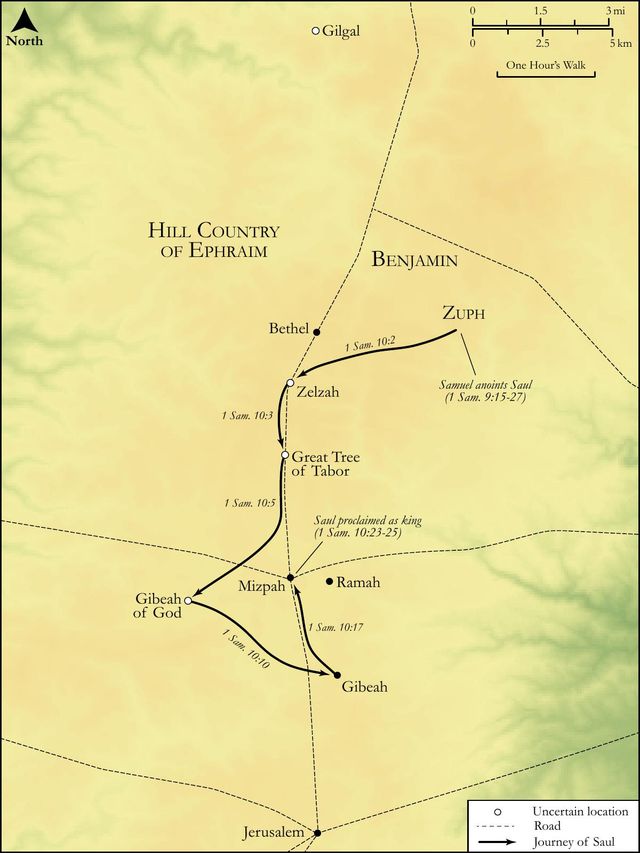
See on the biblical-era map
Study this verse
Public-domain commentary
Matthew Henry
From his Commentary on the Whole Bible. Henry comments on passages, not single verses — this entry covers 1 Samuel 10:9–16. His four-level outline is real structure in the source text, so it is rendered as structure.
Saul has now taken his leave of Samuel, much amazed, we may well suppose, at what has been done to him, almost ready to question whether he be awake or no, and whether it be not all a dream. Now here we are told,
I.What occurred by the way, Sa1 10:9.
Those signs which Samuel had given him came to pass very punctually; but that which gave him the greatest satisfaction of all was this, he found immediately that God had given him another heart. A new fire was kindled in his breast, such as he had never before been acquainted with: seeking the asses is quite out of his mind, and he thinks of nothing but fighting the Philistines, redressing the grievances of Israel, making laws, administering justice, and providing for the public safety; these are the things that now fill his head. He finds himself raised to such a pitch of boldness and bravery as he never thought he should be conscious of. He has no longer the heart of a husbandman, which is low, and mean, and narrow, and concerned only about his corn and cattle; but the heart of a statesman, a general, a prince. Whom God calls to any service he will make fit for it. If he advance to another station, he will give another heart, to those who sincerely desire to serve him with their power.
II.What occurred when he came near home.
They came to the hill (Sa1 10:10), that is, to Gibeah, or Geba, which signifies a hill, and so the Chaldee here takes it as a proper name; he met with the prophets as Samuel had told him, and the Spirit of God came upon him, strongly and suddenly (so the word signifies), but not so as to rest and abide upon him. It came on so as to go off quickly. However, for the present, it had a strange effect upon him; for he immediately joined with the prophets in their devotion, and that with as much decorum and as great a transport of affection as any of them: He prophesied among them. Now,
1.His prophesying was publicly taken notice of, Sa1 10:11, Sa1 10:12. He was now among his acquaintance, who, when they saw him among the prophets, called one another to come and see a strange sight. This would prepare them to accept him as a king, though one of themselves, when they had seen how God had advanced him to the honour of a prophet. The seventy elders prophesied before they were made judges, Num 11:25. Now,
(1.)They all wondered to see Saul among the prophets: What is this that has come to the son of Kish? Though this school of the prophets was near his father's house, yet he had never associated with them, nor shown them any respect, perhaps had sometimes spoken slightly of them; and now to see him prophesying among them was a surprise to them, as it was long after when his namesake, in the New Testament, preached that gospel which he had before persecuted, Act 9:21. Where God gives another heart it will soon show itself.
(2.)One of them, that was wiser than the rest, asked, "Who is their father, or instructor? Is is not God? Are they not all taught of him? Do they not all owe their gifts to him? And is he limited? Cannot he make Saul a prophet, as well as any of them, if he please?" Or, "Is not Samuel their father?" Under God, he was so; and Saul had now lately been with him, which, by his servant, he might know. No marvel for him to prophesy who lay last night under Samuel's roof.
(3.)It became a proverb, commonly used in Israel, when they would express their wonder at a bad man's either becoming good, or at least being found in good company, Is Saul among the prophets? Note, Saul among the prophets is a wonder to a proverb. Let not the worst be despaired of, yet let not an external show of devotion, and a sudden change for the present, be too much relied on; for Saul among the prophets was Saul still.
2.His being anointed was kept private. When he had done prophesying,
(1.)It should seem he uttered all his words before the Lord, and recommended the affair to his favour, for he went straight to the high place (Sa1 10:13), to give God thanks for his mercies to him and to pray for the continuance of those mercies. But,
(2.)He industriously concealed from his relations what had passed. His uncle, who met with him either at the high place or as soon as he came home, examined him, Sa1 10:14. Saul owned, for his servant knew it, that they had been with Samuel, and that he told them the asses were found, but said not a word of the kingdom, Sa1 10:14, Sa1 10:15. This was an instance,
[1.]Of his humility. Many a one would have been so elated with this surprising elevation as to proclaim it upon the house-top. But Saul, though he might please himself with it in his own breast, did not pride himself in it among his neighbours. The heirs of the kingdom of glory are well enough pleased that the world knows them not, Jo1 3:1.
[2.]Of his prudence. Had he been forward to proclaim it, he would have been envied, and he knew not what difficulty that might have created him. Samuel had communicated it to him as a secret, and he knows how to keep counsel. Thus it appears that he had another heart, a heart fit for government.
[3.]Of his dependence upon God. He does not go about to make an interest for himself, but leaves it to God to carry on his own work by Samuel, and, for his own part, sits still, to see how the matter will fall.
Continue studying 1 Samuel 10:15 across the web’s major study libraries — every link below opens this exact verse, chapter, or book on the destination site.
Read & Compare
 BibleGatewayThis verse in more than 200 translations and 70 languages.
 Bible.comThe YouVersion reader — hundreds of translations, reading plans, and highlights.
 ESV.orgCrossway's official English Standard Version reader.
 NET BibleThe NET translation with 60,000+ translators' notes on every rendering decision.
 STEP BibleTyndale House's free study tool — original text, vocabulary, and scholarly resources.
 BibliaLogos Bible Software's free web reader.
 USCCBThe New American Bible (Revised Edition) with the U.S. bishops' study notes.
Commentaries
 BibleHub CommentariesDozens of classic commentaries on this verse, gathered on one page.
 StudyLightMore than 100 commentary sets — the largest collection on the web.
 BibleRefPlain-English commentary on what this verse means, verse by verse.
 Enduring WordDavid Guzik's free commentary on this chapter, widely used by Bible teachers.
 Bible Study ToolsVerse commentary alongside Greek and Hebrew study aids.
Original Language & Research
- BibleHub InterlinearThe verse word by word — original language, transliteration, and English.
- BibleHub LexiconEvery word's original-language definition and Strong's entry.
 Blue Letter BibleDeep-study tools — Strong's numbers, concordance, and word studies.
 SefariaThe Hebrew text with Rashi and centuries of Jewish commentary.
Sermons, Hymns & Audio


TrulyRandomVerse is not affiliated with these sites and doesn’t control their content. They’re linked because they’re genuinely useful.
Summary
1 Samuel 10:15 captures a moment of subtle tension and testing as Saul returns from his private anointing by Samuel. His uncle, Ner, approaches with a direct and earnest inquiry, seeking to understand the specifics of Saul's encounter with the revered prophet. This seemingly innocuous question serves as an immediate test of Saul's discretion and obedience to Samuel's prior instruction to keep the matter of the kingdom private, highlighting the delicate balance between divine revelation and human curiosity in the unfolding narrative of Israel's monarchy.
Context
ShowHideLiterary Context
This verse is strategically placed immediately after Samuel's private anointing of Saul as king, detailed in 1 Samuel 10:1. Following the anointing, Samuel provided Saul with a series of confirming signs and explicit instructions, including a command not to reveal the matter of the kingdom to anyone (1 Samuel 10:7 and 1 Samuel 10:8). As Saul returns home, his family, particularly his uncle, naturally inquires about his journey and the purpose of his visit with Samuel. This direct question in 1 Samuel 10:15 immediately sets up a test of Saul's obedience and discretion, which is then partially revealed in his response in 1 Samuel 10:16, where he withholds the most significant part of Samuel's message.
Historical & Cultural Context
The setting of 1 Samuel marks a pivotal transition in Israelite history, moving from a decentralized tribal confederacy under judges to a centralized monarchy. Samuel, as the last judge and a highly respected prophet, held unparalleled spiritual and political authority, making any encounter with him of immense significance. In ancient Israelite society, familial bonds were exceptionally strong, and it was customary for close relatives, such as an uncle, to inquire about a family member's journey, especially one involving a figure as prominent as Samuel. The uncle mentioned here is Ner, the father of Abner, who would later become a crucial military commander in Saul's reign (1 Samuel 14:50). The anointing of a king was often a sacred, initially private act, reflecting God's sovereign choice and the importance of divine timing before public acclamation.
Key Themes
ShowHideThis brief verse subtly contributes to several overarching themes prevalent in 1 Samuel. Firstly, it underscores the theme of divine appointment and the mystery of God's plans, as God's chosen leader is initially revealed in a private, intimate setting before any public manifestation. Secondly, it immediately introduces the theme of obedience and discretion, as Saul is put to an immediate test regarding his adherence to Samuel's instruction to keep the anointing private. This early demonstration of discretion, though partial, contrasts sharply with Saul's later struggles with obedience, particularly concerning God's explicit commands, which ultimately led to his rejection as king (e.g., 1 Samuel 15). Finally, the uncle's question reflects the universal theme of human curiosity and the natural desire to understand significant encounters, especially with a prophet like Samuel, who was renowned for delivering divine messages (1 Samuel 3:19-20).
Exposition and Analysis
ShowHideKey Word Analysis
ShowHideThis refers to the individual who has just been privately anointed as king. The name, derived from a root meaning "asked," is significant as Saul was "asked for" by the people as their king, though God had already chosen him. The mention of his name here grounds the narrative in his personal journey and the unfolding of his destiny.
This term denotes a father's brother, emphasizing the close familial relationship between Saul and Ner. The use of "uncle" highlights the intimate and familiar context of the inquiry, suggesting a natural level of trust and expectation within their cultural setting. This familial connection makes the question both natural and expected, setting the stage for Saul's response.
This primitive root is used with great latitude, meaning "to say," "speak," or "utter." In this context, it describes the uncle's direct verbal inquiry, initiating the dialogue. The repetition of this verb (used for both the uncle's question and Samuel's prior words) underscores the importance of spoken communication and the transmission of information in this narrative moment.
This primitive root means "to front," "stand boldly out opposite," and by implication, "to manifest" or "to announce." Here, it is an imperative, a direct command from the uncle to Saul to reveal the information. It signifies a demand for full disclosure, placing Saul in a position where he must decide what to reveal and what to withhold, directly testing his obedience to Samuel's instructions.
Verse Breakdown
ShowHide"And Saul's uncle said"
This opening clause establishes the speaker and the immediate context of the interaction. The familial relationship between Saul and his uncle (Ner, father of Abner) sets a personal and intimate tone for the conversation, making the ensuing inquiry a natural progression within the family dynamic. It underscores that this is not a public interrogation but a private family discussion.
"Tell me, I pray thee"
This phrase constitutes a direct, yet polite, request for information. The inclusion of "I pray thee" (a particle of entreaty or politeness) softens the imperative "Tell me," indicating a respectful but earnest desire for a full disclosure from Saul. It conveys the uncle's genuine curiosity and perhaps a sense of urgency or importance regarding Saul's recent encounter.
"what Samuel said unto you"
This is the core of the uncle's inquiry, specifically targeting the content of Samuel's message to Saul. It reveals that the uncle's interest extends beyond a mere casual inquiry about the journey; he wants to know the prophetic word, recognizing Samuel's esteemed role as a divine messenger. This precise question immediately sets up the test of Saul's obedience to Samuel's instruction to keep the anointing secret.
Literary Devices
ShowHideThe verse employs several subtle Literary Devices. Dialogue is the primary device, presenting a direct interaction that propels the immediate narrative forward and highlights the personal nature of the exchange. The uncle's question serves as a moment of Foreshadowing, hinting at the ongoing tension between private divine revelation and public knowledge that will characterize Saul's early reign. It also Foreshadows Saul's initial discretion, which stands in stark contrast to his later, more significant failures in obedience and trust. There is a subtle Irony present, as the uncle asks about Samuel's words, completely unaware that the most significant part of the message—Saul's anointing as king—is being deliberately withheld. This highlights the divine secrecy surrounding God's plans and the human inability to fully grasp them until the appointed time, emphasizing God's sovereign control over the revelation of His will.
Theological and Thematic Connections
ShowHideThis verse, though concise, powerfully illustrates the delicate balance between divine revelation and human responsibility, particularly concerning the timing and scope of disclosure. God's plans often unfold in stages, involving periods of private preparation and testing before public manifestation. Saul's initial discretion here, choosing to withhold the most significant part of Samuel's message, is a testament to his early obedience and discernment. It demonstrates that a true calling often requires a season of quiet faithfulness and trust in God's perfect timing, rather than immediate public declaration. This moment underscores the profound principle that not every truth, even a divinely revealed one, is for immediate public consumption; wisdom and discernment are required in its handling. This serves as an early, crucial test of Saul's character, establishing a benchmark against which his subsequent actions of impatience, presumption, and disobedience will be measured throughout his reign.
Reflection and Application
ShowHide1 Samuel 10:15 invites us to deeply consider the importance of discretion, obedience, and discerning God's timing in our own lives, especially when we believe God has entrusted us with a unique calling, a sensitive truth, or a personal revelation. Just as Saul was instructed to keep the matter of the kingdom private for a season, there are moments when God calls us to quiet faithfulness, to wait for His perfect timing before revealing His full plan or sharing certain insights with others. This passage challenges us to reflect on our immediate responses when pressed for information, particularly concerning spiritual matters or personal divine encounters. Do we yield to the natural human inclination for immediate disclosure, or do we maintain a spirit of patient obedience, trusting God's sovereign wisdom in the unfolding of His purposes? Saul's initial discretion here is commendable, serving as a powerful reminder that early faithfulness, even in seemingly small acts of obedience and self-control, lays a crucial foundation for enduring a greater calling and stewarding divine truth. It prompts us to ask ourselves if we are trustworthy stewards of the "secrets" God may reveal to us, whether they pertain to personal revelations, aspects of His kingdom work, or sensitive truths about others.
Questions for Reflection
ShowHideFAQ
ShowHideWho was Saul's uncle mentioned in this verse?
ShowHideSaul's uncle was Ner, who was the father of Abner. Abner later became a prominent figure in Saul's reign, serving as the commander of his army (see 1 Samuel 14:50). This close familial connection highlights the intimate context of the inquiry and the natural curiosity within a close family unit regarding significant events.
Why did the uncle specifically ask what Samuel said, rather than just about the journey in general?
ShowHideThe uncle's specific focus on "what Samuel said" underscores Samuel's immense reputation and authority as a prophet in Israel. People understood that an encounter with Samuel was not merely a casual meeting but often involved a divine message or significant pronouncement. The uncle likely sensed the importance of the meeting, perhaps even suspecting it went beyond the lost donkeys, and was genuinely curious about any prophetic word Saul might have received. This also sets up the immediate test of Saul's obedience to Samuel's instruction to keep the matter of the kingship private (see 1 Samuel 10:7).
What was Saul supposed to do according to Samuel's instructions regarding the anointing?
ShowHideSamuel had explicitly instructed Saul not to reveal the matter of the kingdom to anyone (see 1 Samuel 10:7-8). This was part of God's sovereign plan for a gradual revelation of Saul's kingship, allowing for a period of private confirmation and preparation before his public acclamation. Saul's response in the following verse, 1 Samuel 10:16, demonstrates his initial adherence to this command, as he deliberately omits mentioning the kingship to his uncle, only speaking of the donkeys.
Christ-Centered Fulfillment
ShowHideWhile 1 Samuel 10:15 describes Saul's initial discretion regarding his anointing, it subtly points forward to the perfect obedience and divine timing exemplified in Jesus Christ. Saul, though initially obedient, would later fail significantly in his discretion and obedience, ultimately losing his kingdom due to presumption and impatience (1 Samuel 13:8-14). In stark contrast, Jesus perfectly embodied the principle of divine timing and revelation. Throughout His earthly ministry, Jesus often commanded His disciples and those He healed to keep His identity as the Messiah secret, a concept known as the "Messianic Secret" (e.g., Matthew 16:20, Mark 8:30). This was not due to fear or a lack of authority, but because His kingdom was "not of this world" (John 18:36), and the full revelation of His kingship required His atoning death and resurrection. Jesus's entire life was marked by perfect obedience to the Father's will, even to the point of death on a cross (Philippians 2:8), demonstrating the ultimate fulfillment of discretion, submission to divine timing, and unwavering faithfulness. Unlike Saul, who struggled with the weight of his calling and succumbed to human pressures, Christ perfectly fulfilled His divine mission, revealing God's kingdom according to the Father's perfect plan and timing, bringing about eternal salvation.