


1 Samuel 10:16
Bible text: King James Version (1769 Blayney text) · Public domain
Bible text: King James Version with Strong's numbers · Public domain
Bible text: Berean Standard Bible · Public domain
Bible text: American Standard Version (1901) · Public domain
Bible text: World English Bible, Messianic edition · Public domain
Bible text: Geneva Bible (1599) · Public domain
Bible text: Young's Literal Translation · Public domain
- וַיֹּאמֶרvai·Yo·merand he saidH559Conj-w ¦ V-Qal-ConsecImperf-3msVerb Qal Consecutive Imperfect 3rd Singular Masculineוַandיֹּאמֶרhe said
- שָׁאוּלsha·'UlSaulH7586N-proper-mNoun Proper Masculine
- אֶל'eltoH413PrepPreposition
- דּוֹדוֹdo·Dohis uncleH1730N-msc ¦ 3msNoun Singular Masculine Constructדּוֹדuncleוֹhis
- הַגֵּדha·Gedcertainly <to tell>H5046V-Hiphil-InfAbsVerb Hiphil Infinitive Absolute
- הִגִּידhi·Gidhe toldH5046V-Hiphil-Perf-3msVerb Hiphil Perfect 3rd Singular Masculine
- לָנוּLa·nuto <the> usPrep-l ¦ 1cpSuffix Personal 1st Plural common genderלָto <the>נוּus
- כִּיkithatH3588PrtParticle Conditional
- נִמְצְאוּnim·tze·'Uthey had been foundH4672V-Niphal-Perf-3cpVerb Niphal Perfect 3rd Plural common gender
- הָאֲתֹנוֹתha·'a·to·Notthe she-assesH860Art ¦ N-fpNoun Plural Feminine Absoluteהָtheאֲתֹנוֹתshe-asses
- וְאֶתve·'Etand <obj.>H853Conj-w ¦ DirObjMParticle Object Indicatorוְandאֶת<obj.>
- דְּבַרde·Var[the] word ofH1697N-mscNoun Singular Masculine Construct
- הַמְּלוּכָהha·me·lu·Khahthe kingshipH4410Art ¦ N-fsNoun Singular Feminine Absoluteהַtheמְּלוּכָהkingship
- לֹאlo'notH3808NegParticle Negative
- הִגִּידhi·Gidhe toldH5046V-Hiphil-Perf-3msVerb Hiphil Perfect 3rd Singular Masculine
- לוֹloto <the> himPrep-l ¦ 3msSuffix Personal 3rd Singular Masculineלto <the>וֹhim
- אֲשֶׁר'a·SherwhichH834RelParticle Relative
- אָמַר'a·Marhe had saidH559V-Qal-Perf-3msVerb Qal Perfect 3rd Singular Masculine
- שְׁמוּאֵלshe·mu·'ElSamuelH8050N-proper-mNoun Proper Masculine
English is a literal word-by-word gloss of the Hebrew, not the KJV's wording. Why?
This is the original text the KJV's translators worked from — each Hebrew word with its own literal English meaning in this verse, prepared by scholars at Tyndale House, Cambridge. The KJV translates whole sentences, not word by word, so its wording differs: one Hebrew word can become several English words, and the KJV may choose “the LORD” where the gloss reads “Yahweh”. Both are faithful — they answer different questions. For the KJV's own rendering, switch to the KJV text.
Details
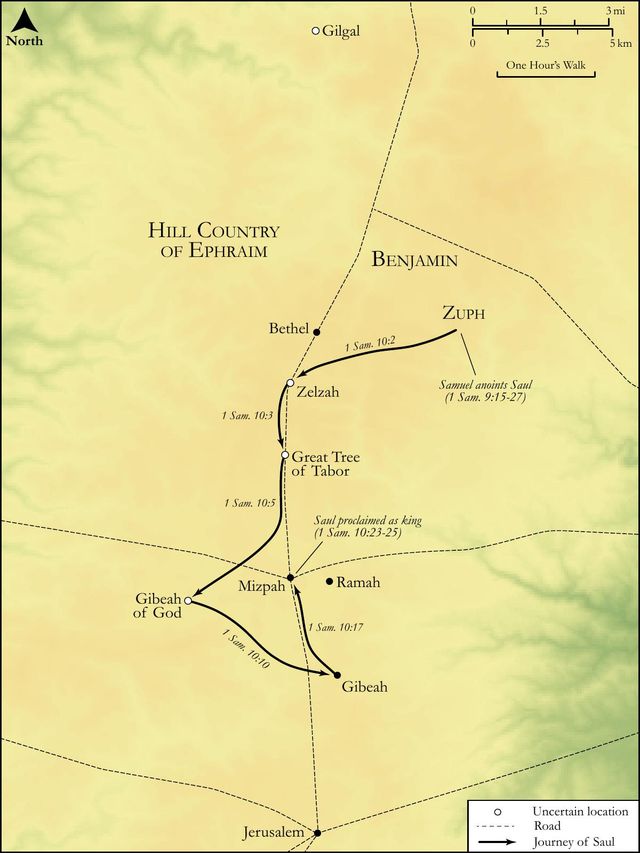
See on the biblical-era map
Study this verse
Public-domain commentary
Matthew Henry
From his Commentary on the Whole Bible. Henry comments on passages, not single verses — this entry covers 1 Samuel 10:9–16. His four-level outline is real structure in the source text, so it is rendered as structure.
Saul has now taken his leave of Samuel, much amazed, we may well suppose, at what has been done to him, almost ready to question whether he be awake or no, and whether it be not all a dream. Now here we are told,
I.What occurred by the way, Sa1 10:9.
Those signs which Samuel had given him came to pass very punctually; but that which gave him the greatest satisfaction of all was this, he found immediately that God had given him another heart. A new fire was kindled in his breast, such as he had never before been acquainted with: seeking the asses is quite out of his mind, and he thinks of nothing but fighting the Philistines, redressing the grievances of Israel, making laws, administering justice, and providing for the public safety; these are the things that now fill his head. He finds himself raised to such a pitch of boldness and bravery as he never thought he should be conscious of. He has no longer the heart of a husbandman, which is low, and mean, and narrow, and concerned only about his corn and cattle; but the heart of a statesman, a general, a prince. Whom God calls to any service he will make fit for it. If he advance to another station, he will give another heart, to those who sincerely desire to serve him with their power.
II.What occurred when he came near home.
They came to the hill (Sa1 10:10), that is, to Gibeah, or Geba, which signifies a hill, and so the Chaldee here takes it as a proper name; he met with the prophets as Samuel had told him, and the Spirit of God came upon him, strongly and suddenly (so the word signifies), but not so as to rest and abide upon him. It came on so as to go off quickly. However, for the present, it had a strange effect upon him; for he immediately joined with the prophets in their devotion, and that with as much decorum and as great a transport of affection as any of them: He prophesied among them. Now,
1.His prophesying was publicly taken notice of, Sa1 10:11, Sa1 10:12. He was now among his acquaintance, who, when they saw him among the prophets, called one another to come and see a strange sight. This would prepare them to accept him as a king, though one of themselves, when they had seen how God had advanced him to the honour of a prophet. The seventy elders prophesied before they were made judges, Num 11:25. Now,
(1.)They all wondered to see Saul among the prophets: What is this that has come to the son of Kish? Though this school of the prophets was near his father's house, yet he had never associated with them, nor shown them any respect, perhaps had sometimes spoken slightly of them; and now to see him prophesying among them was a surprise to them, as it was long after when his namesake, in the New Testament, preached that gospel which he had before persecuted, Act 9:21. Where God gives another heart it will soon show itself.
(2.)One of them, that was wiser than the rest, asked, "Who is their father, or instructor? Is is not God? Are they not all taught of him? Do they not all owe their gifts to him? And is he limited? Cannot he make Saul a prophet, as well as any of them, if he please?" Or, "Is not Samuel their father?" Under God, he was so; and Saul had now lately been with him, which, by his servant, he might know. No marvel for him to prophesy who lay last night under Samuel's roof.
(3.)It became a proverb, commonly used in Israel, when they would express their wonder at a bad man's either becoming good, or at least being found in good company, Is Saul among the prophets? Note, Saul among the prophets is a wonder to a proverb. Let not the worst be despaired of, yet let not an external show of devotion, and a sudden change for the present, be too much relied on; for Saul among the prophets was Saul still.
2.His being anointed was kept private. When he had done prophesying,
(1.)It should seem he uttered all his words before the Lord, and recommended the affair to his favour, for he went straight to the high place (Sa1 10:13), to give God thanks for his mercies to him and to pray for the continuance of those mercies. But,
(2.)He industriously concealed from his relations what had passed. His uncle, who met with him either at the high place or as soon as he came home, examined him, Sa1 10:14. Saul owned, for his servant knew it, that they had been with Samuel, and that he told them the asses were found, but said not a word of the kingdom, Sa1 10:14, Sa1 10:15. This was an instance,
[1.]Of his humility. Many a one would have been so elated with this surprising elevation as to proclaim it upon the house-top. But Saul, though he might please himself with it in his own breast, did not pride himself in it among his neighbours. The heirs of the kingdom of glory are well enough pleased that the world knows them not, Jo1 3:1.
[2.]Of his prudence. Had he been forward to proclaim it, he would have been envied, and he knew not what difficulty that might have created him. Samuel had communicated it to him as a secret, and he knows how to keep counsel. Thus it appears that he had another heart, a heart fit for government.
[3.]Of his dependence upon God. He does not go about to make an interest for himself, but leaves it to God to carry on his own work by Samuel, and, for his own part, sits still, to see how the matter will fall.
Continue studying 1 Samuel 10:16 across the web’s major study libraries — every link below opens this exact verse, chapter, or book on the destination site.
Read & Compare
 BibleGatewayThis verse in more than 200 translations and 70 languages.
 Bible.comThe YouVersion reader — hundreds of translations, reading plans, and highlights.
 ESV.orgCrossway's official English Standard Version reader.
 NET BibleThe NET translation with 60,000+ translators' notes on every rendering decision.
 STEP BibleTyndale House's free study tool — original text, vocabulary, and scholarly resources.
 BibliaLogos Bible Software's free web reader.
 USCCBThe New American Bible (Revised Edition) with the U.S. bishops' study notes.
Commentaries
 BibleHub CommentariesDozens of classic commentaries on this verse, gathered on one page.
 StudyLightMore than 100 commentary sets — the largest collection on the web.
 BibleRefPlain-English commentary on what this verse means, verse by verse.
 Enduring WordDavid Guzik's free commentary on this chapter, widely used by Bible teachers.
 Bible Study ToolsVerse commentary alongside Greek and Hebrew study aids.
Original Language & Research
- BibleHub InterlinearThe verse word by word — original language, transliteration, and English.
- BibleHub LexiconEvery word's original-language definition and Strong's entry.
 Blue Letter BibleDeep-study tools — Strong's numbers, concordance, and word studies.
 SefariaThe Hebrew text with Rashi and centuries of Jewish commentary.
Sermons, Hymns & Audio


TrulyRandomVerse is not affiliated with these sites and doesn’t control their content. They’re linked because they’re genuinely useful.
Summary
1 Samuel 10:16 provides a crucial early insight into the character of Saul following his private anointing as Israel's first king by the prophet Samuel. The verse reveals Saul's remarkable discretion, as he readily shares the trivial news of his father's lost donkeys being found, yet deliberately conceals the momentous revelation of his divine appointment to kingship. This act of silence speaks volumes about his initial humility, prudence, or perhaps the overwhelming awe he felt regarding the immense responsibility that had just been placed upon him, setting a significant tone for the nascent stages of his reign.
Context
ShowHideLiterary Context
This verse is strategically placed within the pivotal narrative of Israel's transition from a judgeship to a monarchy. Immediately preceding this conversation, Saul, while on a seemingly mundane search for his father Kish's lost donkeys, was providentially led to Samuel, the revered prophet. In a private, divinely orchestrated encounter, Samuel, acting under God's direct instruction, anointed Saul with oil and declared him to be the future ruler over God's inheritance. This sacred anointing was powerfully corroborated by three specific prophetic signs that Saul experienced precisely as predicted, unequivocally confirming the divine origin of his calling and the authenticity of Samuel's message (1 Samuel 10:2-7). Upon his return home, his uncle, a prominent familial figure, naturally inquired about his extended absence and the details of his encounter with Samuel. Saul's selective disclosure in this verse directly precedes the momentous public assembly at Mizpah, where the selection of Israel's first king would be formally revealed through lots (1 Samuel 10:17-24), thereby underscoring the tension and progression from private divine appointment to public manifestation.
Historical & Cultural Context
The period chronicled in 1 Samuel marks a profound paradigm shift in Israelite history, moving from a decentralized tribal confederacy governed by charismatic judges to a centralized monarchy. This monumental transition was largely precipitated by the people's insistent demand for a king "like all the nations" (1 Samuel 8:5), a request that initially displeased Samuel but was ultimately sanctioned by God as a concession to their will. Within this cultural milieu, prophets like Samuel wielded immense spiritual and political influence as God's designated spokesmen, often playing a critical role in anointing kings and conveying divine messages. Familial ties were paramount in ancient Israelite society, making it entirely natural and expected for an uncle to inquire about a nephew's prolonged absence and significant encounters. The act of anointing with oil was a deeply symbolic and customary practice for consecrating individuals for sacred office—whether priests, prophets, or kings—signifying divine empowerment and setting them apart for a specific purpose. Saul's initial anointing was intentionally private, emphasizing that his authority derived directly from God's sovereign choice, rather than from popular acclaim or human election, a crucial theological foundation for the nascent Israelite monarchy.
Key Themes
ShowHideThis verse powerfully contributes to several overarching themes woven throughout the book of 1 Samuel. Firstly, it illuminates Saul's Initial Character, portraying him as discreet, seemingly humble, and certainly prudent in handling such momentous news. This early portrayal stands in stark contrast to his later displays of impulsiveness, disobedience, and pride, thereby subtly foreshadowing the tragic trajectory of his reign and eventual downfall. Secondly, it underscores the profound theme of Divine Sovereignty and Timing. God's meticulously crafted plans often unfold in stages, with periods of private preparation preceding public revelation. Saul's anointing was a secret divine act, demonstrating that God frequently works behind the scenes, preparing individuals and circumstances, before making His will known to the broader populace. The public confirmation of his kingship would come later at Mizpah (1 Samuel 10:17). Thirdly, the verse subtly touches upon the Burden and Weight of Leadership. Saul's silence might not only stem from humility but also from an early, perhaps subconscious, recognition of the immense responsibility, inherent challenges, and potential isolation that accompany leading a nation under God's covenant, especially one that had previously resisted the idea of a human king. This subtle acknowledgment of the kingship's gravity sets the stage for the complex and often tumultuous relationship between Saul, Samuel, and God throughout the remainder of the book.
Exposition and Analysis
ShowHideKey Word Analysis
ShowHideThis noun, from the root meaning "to speak," carries a broad semantic range, encompassing "word," "thing," "affair," or "business." In this context, "the matter of the kingdom" (דְּבַר הַמְּלוּכָה, dᵉbar hammᵉlûwkâh) refers to the weighty affair or subject of kingship itself. Saul's deliberate omission of this "matter" highlights its profound significance compared to the triviality of the lost donkeys. It signifies not just a word spoken, but the entire reality and implications of the royal office.
This feminine noun specifically denotes "kingship," "royal power," or "realm." It encapsulates the entire concept of monarchy, including its inherent authority, responsibilities, and divine mandate. The fact that Samuel "spake" of this "matter of the kingdom" to Saul signifies the weighty, divinely ordained nature of Saul's calling. Saul's deliberate omission of this word, mᵉlûwkâh, from his conversation with his uncle underscores the profound and perhaps overwhelming significance he attached to it, contrasting it sharply with the mundane "matter" of the lost donkeys.
This primitive root means "to front," "to stand boldly out opposite," and by implication, "to manifest" or "to announce." When Saul states, "He told us plainly that the asses were found," he emphasizes the unequivocal, clear, and unambiguous nature of Samuel's message regarding the mundane matter. This choice of word highlights the stark contrast with the unstated, yet infinitely more significant, "matter of the kingdom," which Samuel had spoken of with equal clarity but which Saul chose to keep un-manifested or un-announced to his uncle.
Verse Breakdown
ShowHide"And Saul said unto his uncle,"
This opening clause immediately establishes the familial and intimate setting of the conversation. Saul's uncle, a natural figure of authority and curiosity within the family structure, would have been expected to inquire about Saul's prolonged absence and his encounter with the renowned prophet Samuel. This sets the stage for Saul's selective disclosure.
"He told us plainly that the asses were found."
Saul's immediate response addresses the ostensible and socially acceptable purpose of his journey—the recovery of his father's lost donkeys. The use of "plainly" (נָגַד, nâgad) emphasizes the clear, direct, and unambiguous nature of Samuel's message regarding this mundane matter. This part of the revelation is straightforward, easily digestible, and poses no immediate challenge or profound implication for the family or the broader community. It is the expected, practical, and non-controversial answer.
"But of the matter of the kingdom, whereof Samuel spake, he told him not."
This is the pivotal and most revealing clause of the verse, highlighting Saul's profound discretion and self-restraint. Despite Samuel having spoken clearly and definitively about the kingship, Saul deliberately withheld this monumental information from his uncle. This act of silence is highly significant, suggesting a complex interplay of motivations: it could stem from a genuine sense of humility, feeling unworthy or overwhelmed by such a monumental calling; prudence, wisely waiting for God's appointed public timing; or even awe, being too stunned by the divine revelation to articulate it casually. This omission creates dramatic tension, underscoring the vast difference in significance between the trivial matter of found donkeys and the divinely appointed, nation-altering kingship.
Literary Devices
ShowHideThe verse employs several potent literary devices to convey its profound meaning. Most prominent is Contrast, which is masterfully used to juxtapose the mundane task of finding lost donkeys against the monumental, divinely ordained revelation of kingship. This stark opposition highlights Saul's selective disclosure and the vastly different weights he assigns to each piece of information. The act of Silence itself functions as a powerful narrative device, revealing more about Saul's inner state and strategic thinking than any words might have. His deliberate omission of the "matter of the kingdom" speaks volumes about his initial character, whether it be humility, awe, or a nascent sense of the immense responsibility. This also serves as a subtle Foreshadowing of Saul's complex and ultimately tragic character development; his initial discretion and apparent humility here stand in poignant contrast to the pride, impulsiveness, and disobedience that would increasingly define his reign, leading to his eventual downfall. Furthermore, there is a degree of Irony in the situation: the trivial matter is openly discussed and emphasized as "plainly" told, while the divinely ordained, nation-altering news is kept hidden, emphasizing the private, sacred nature of God's initial work in Saul's life.
Theological and Thematic Connections
ShowHide1 Samuel 10:16 offers a compelling theological insight into the nature of divine calling and human response. Saul's discretion teaches us that not all truths, even divinely revealed ones, are meant for immediate public consumption. There is a profound wisdom in discerning the appropriate time and context for revelation, a principle rooted in God's own sovereign timing. God often works in private, preparing individuals and circumstances, before publicly manifesting His plans. Saul's initial humility and measured response, however fleeting in his overall narrative, underscore the importance of processing significant divine appointments with sobriety, patience, and dependence on God's leading, rather than immediate self-promotion or premature announcement. This narrative invites reflection on the tension between personal conviction and public declaration, emphasizing that true authority and divine purpose often begin in quiet, consecrated moments of personal encounter with God.
Reflection and Application
ShowHideSaul's initial discretion in 1 Samuel 10:16 provides a powerful and enduring lesson for believers today regarding the wisdom of timing and the virtue of humility in the face of divine calling. In an age characterized by instant communication, pervasive social media, and the constant urge to publicize every personal achievement or significant event, Saul's decision to withhold the most momentous news of his life stands out as a counter-cultural act. This is not about deception, but about profound prudence—recognizing that some revelations are meant to be nurtured in the quiet, sacred space between God and the individual, awaiting God's perfect timing for public manifestation. It challenges us to consider whether we are quick to claim credit, announce our "kingship" (our gifts, callings, or successes), or prematurely broadcast God's work in our lives before He has fully prepared the way or the audience. True humility often manifests not in self-deprecation, but in a sober assessment of one's role, a patient trust in God's unfolding plan, and a willingness to wait for His appointed moment. This verse encourages us to cultivate a spirit of discernment, understanding that there is indeed "a time to keep silence, and a time to speak" (Ecclesiastes 3:7), especially when it pertains to the sacred and often sensitive work of God in our lives and in the world.
Questions for Reflection
ShowHideFAQ
ShowHideWhy did Saul choose not to tell his uncle about the kingdom?
ShowHideSaul's decision to withhold the news of his anointing as king was likely multifaceted and deeply strategic. Primarily, it suggests an initial sense of humility and profound awe in the face of such an immense, divinely ordained responsibility. He may have felt overwhelmed or even unworthy, a sentiment echoed later when he hid among the baggage before his public presentation at Mizpah (1 Samuel 10:22). Secondly, it demonstrates remarkable prudence; Saul understood that the private anointing was a preparatory step, and the public revelation of his kingship would come at God's appointed time and through Samuel's public declaration, not through his own premature announcement. This discretion allowed God's plan to unfold without human interference, undue pressure, or the potential for immediate, unmanaged public reaction.
What does this verse tell us about Saul's character at this early stage?
ShowHideAt this early point in the narrative, 1 Samuel 10:16 portrays Saul as a man of significant discretion, humility, and perhaps a nascent awareness of the immense burden of leadership. His ability to keep such a momentous secret suggests a level of self-control, thoughtfulness, and a capacity for strategic silence. This initial portrayal stands in stark contrast to the pride, impulsiveness, and disobedience that would increasingly characterize his later reign, ultimately leading to his rejection by God. The verse highlights a promising beginning, hinting at the potential for a wise and God-fearing king, a potential that, tragically, would not be fully realized due to his subsequent failures.
Is it always good to keep secrets, especially about God's work?
ShowHideThe principle highlighted here is not about keeping "secrets" in a deceptive or manipulative sense, but about exercising "discretion" and "prudence" in the timing of revelation. The Bible teaches that there is "a time to keep silence, and a time to speak" (Ecclesiastes 3:7). God often prepares individuals privately before revealing His plans publicly. For instance, Jesus frequently commanded those He healed or His disciples to keep His identity or miracles quiet for a time (e.g., Mark 1:44, Mark 8:30). Similarly, after his dramatic conversion, Paul spent time in Arabia before beginning his public ministry (Galatians 1:17). Saul's discretion here reflects a recognition of divine timing and the need for God to orchestrate the public unveiling of His will, rather than an act of concealment for personal gain.
Christ-Centered Fulfillment
ShowHideWhile Saul's anointing as Israel's first king marks a pivotal moment in the nation's history, his initial discretion in 1 Samuel 10:16 ultimately foreshadows the perfect King, Jesus Christ, in profound and redemptive ways. Saul's kingship, though divinely appointed, was earthly, temporary, and tragically flawed, leading to his eventual downfall. In stark contrast, Jesus' kingdom is not merely of this world (John 18:36), but is eternal, perfectly righteous, and spiritually transformative. Like Saul, Jesus often exercised divine discretion, commanding those He healed or His disciples not to reveal His identity as the Messiah for a time, a phenomenon known as the "Messianic secret" (Mark 8:30). This was not due to unworthiness, but to ensure that His mission, culminating in His sacrificial death and glorious resurrection, was fully understood as the true path to His spiritual kingdom, not a political one that would incite premature rebellion against Rome. Jesus' anointing was not with oil, but with the Holy Spirit for His prophetic, priestly, and kingly offices (Luke 4:18-19). His true authority and kingship were not publicly declared at the outset of His ministry, but were progressively revealed, ultimately confirmed through His resurrection and ascension, where He was given "all authority in heaven and on earth" (Matthew 28:18). Saul's initial humility, however fleeting, points to the perfect and enduring humility of Christ, who, "though he was in the form of God, did not count equality with God a thing to be grasped, but emptied himself, by taking the form of a servant" (Philippians 2:6-7). Ultimately, Saul's human failure as king underscores the desperate need for the perfect, eternal King, Jesus, whose kingdom will have no end (Luke 1:33), and who perfectly embodies the wisdom, discretion, and divine power necessary to reign forever in righteousness and truth.