


1 Kings 16:21
Bible text: King James Version (1769 Blayney text) · Public domain
Bible text: King James Version with Strong's numbers · Public domain
Bible text: Berean Standard Bible · Public domain
Bible text: American Standard Version (1901) · Public domain
Bible text: World English Bible, Messianic edition · Public domain
Bible text: Geneva Bible (1599) · Public domain
Bible text: Young's Literal Translation · Public domain
- אָז'azthenH227AdvAdverb
- יֵחָלֵקye·cha·Lekit was dividedH2505V-Niphal-Imperf-3msVerb Niphal Imperfect 3rd Singular Masculine
- הָעָםha·'Amthe peopleH5971Art ¦ N-msNoun Singular Masculine Absoluteהָtheעָםpeople
- יִשְׂרָאֵלYis·ra·'ElIsraelH3478N-properNoun Proper Location
- לַחֵצִיla·Che·tziinto the halfH2677Prep-l ¦ N-msNoun Singular Masculine Absoluteלַinto theחֵצִיhalf
- חֲצִיcha·Tzi<the> half ofH2677N-mscNoun Singular Masculine Construct
- הָעָםha·'Amthe peopleH5971Art ¦ N-msNoun Singular Masculine Absoluteהָtheעָםpeople
- הָיָהHa·yahit wasH1961V-Qal-Perf-3msVerb Qal Perfect 3rd Singular Masculine
- אַחֲרֵי'a·cha·ReibehindH310Adj-mpcAdjective Numerical Plural Masculine Construct
- תִבְנִיtiv·NiTibniH8402N-proper-mNoun Proper Masculine
- בֶןven[the] son ofH1121N-mscNoun Singular Masculine Construct
- גִּינַתgi·NatGinathH1527N-proper-mNoun Proper Masculine
- לְהַמְלִיכוֹle·ham·li·Khoto make king himH4427Prep-l ¦ V-Hiphil-Inf ¦ 3msVerb Hiphil Infinitive Constructלְtoהַמְלִיכmake kingוֹhim
- וְהַחֲצִיve·ha·cha·Tziand <the> halfH2677Conj-w ¦ Art ¦ N-msNoun Singular Masculine Absoluteוְandהַ<the>חֲצִיhalf
- אַחֲרֵי'a·cha·Rei[was] behindH310Adj-mpcAdjective Numerical Plural Masculine Construct
- עָמְרִי'a·me·RiOmriH6018N-proper-mNoun Proper Masculine
English is a literal word-by-word gloss of the Hebrew, not the KJV's wording. Why?
This is the original text the KJV's translators worked from — each Hebrew word with its own literal English meaning in this verse, prepared by scholars at Tyndale House, Cambridge. The KJV translates whole sentences, not word by word, so its wording differs: one Hebrew word can become several English words, and the KJV may choose “the LORD” where the gloss reads “Yahweh”. Both are faithful — they answer different questions. For the KJV's own rendering, switch to the KJV text.
Details
See on the biblical-era maps
Study this verse
Public-domain commentary
Matthew Henry
From his Commentary on the Whole Bible. Henry comments on passages, not single verses — this entry covers 1 Kings 16:15–28. His two-level outline is real structure in the source text, so it is rendered as structure.
Solomon observes (Pro 28:2) that for the transgression of a land many were the princes thereof (so it was here in Israel), but by a man of understanding the state thereof shall be prolonged - so it was with Judah at the same time under Asa. When men forsake God they are out of the way of rest and establishment. Zimri, and Tibni, and Omri, are here striving for the crown. Proud aspiring men ruin one another, and involve others in the ruin. These confusions end in the settlement of Omri; we must therefore take him along with us through this part of the story.
I.How he was chosen, as the Roman emperors often were, by the army in the field, now encamped before Gibbethon.
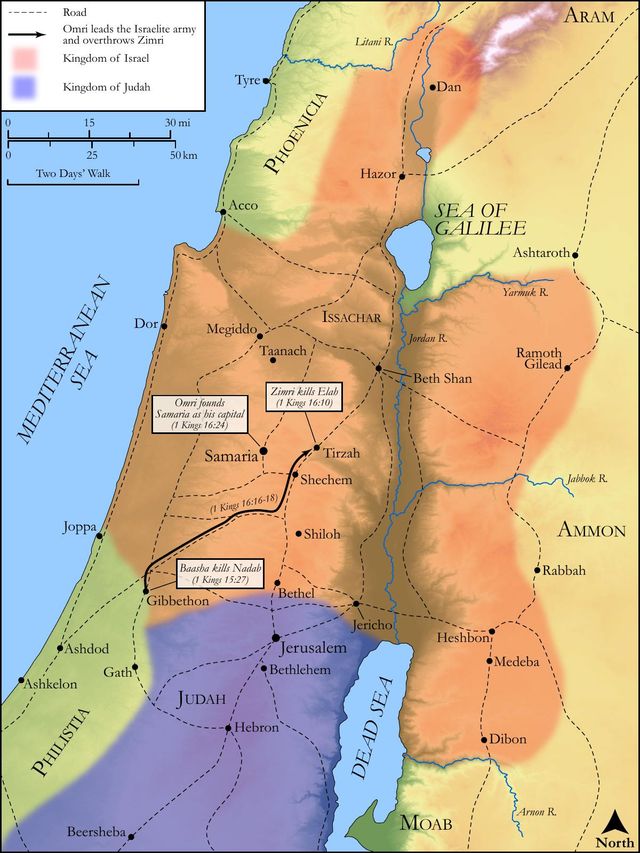
Notice was soon brought thither that Zimri had slain their king (Kg1 16:16) and set up himself in Tirzah, the royal city, whereupon they chose Omri king in the camp, that they might without delay avenge the death of Elah upon Zimri. Though he was idle and intemperate, yet he was their king, and they would not tamely submit to his murderer, nor let the treason go unpunished. They did not attempt to avenge the death of Nadab upon Baasha, perhaps because the house of Baasha had ruled with more gentleness than the house of Jeroboam; but Zimri shall feel the resentments of the provoked army. The siege of Gibbethon is quitted (Philistines are sure to gain when Israelites quarrel) and Zimri is prosecuted.
II.How he conquered Zimri, who is said to have reigned seven days (Kg1 16:15), so long before Omri was proclaimed king and himself proclaimed traitor; but we may suppose it was a longer time before he died, for he continued long enough to show his inclination to the way of Jeroboam, and to make himself obnoxious to the justice of God by supporting his idolatry, Kg1 16:19. Tirzah was a beautiful city, but not fortified, so that Omri soon made himself master of it (Kg1 16:17), forced Zimri into the palace, which being unable to defend, and yet unwilling to surrender, he burnt, and himself in it, Kg1 16:18. Unwilling that his rival should ever enjoy that sumptuous palace, he burnt it; and fearing that if he fell into the hands of the army, either alive or dead, he should be ignominiously treated, he burnt himself in it. See what desperate practices men's wickedness sometimes brings them to, and how it hurries them into their own ruin; see the disposition of incendiaries, who set palaces and kingdoms on fire, though they are themselves in danger of perishing in the flame.
III.How he struggled with Tibni, and at length got clear of him:
Half of the people followed this Tibni (Kg1 16:21), probably those who were in Zimri's interest, with whom others joined, who would not have a king chosen in the camp (lest he should rule by the sword and a standing army), but in a convention of the states. The contest between these two lasted some years, and, it is likely, cost a great deal of blood on both sides, for it was in the twenty-seventh year of Asa that Omri was first elected (Kg1 16:15) and thence the twelve years of his reign are to be dated; but it was not till the thirty-first year of Asa that he began to reign without a rival; then Tibni died, it is likely in battle, and Omri reigned, Kg1 16:22. Sir Walter Raleigh, in his History of the World (2.19.6), enquires here why it was that in all these confusions and revolutions of the kingdom of Israel they never thought of returning to the house of David, and uniting themselves again to Judah, for then it was better with them than now; and he thinks the reason was because the kings of Judah assumed a more absolute, arbitrary, and despotic power than the kings of Israel. It was the heaviness of the yoke that they complained of when they first revolted from the house of David, and the dread of that made them ever after averse to it, and attached to kings of their own, who ruled more by law and the rules of a limited monarchy.
IV.How he reigned when he was at length settled on the throne.
1.He made himself famous by building Samaria, which, ever after, was the royal city of the kings of Israel (the palace at Tirzah being burnt), and in process of time grew so considerable that it gave name to the middle part of Canaan (which lay between Galilee on the north and Judea on the south) and to the inhabitants of that country, who were called Samaritans. He bought the ground for two talents of silver, somewhat more than 700l. of our money, for a talent was 353l. 11s. 10 1/2d. Perhaps Shemer, who sold him the ground, let him have it considerably the cheaper upon condition that the city should be called after his name, for otherwise it would have borne the name of the purchaser; it was called Samaria, or Shemeren (as it is in the Hebrew), from Shemer, the former owner, Kg1 16:24. The kings of Israel changed their royal seats, Shechem first, then Tirzah, now Samaria; but the kings of Judah were constant to Jerusalem, the city of God. Those that cleave to the Lord fix, but those that leave him ever wander.
2.He made himself infamous by his wickedness; for he did worse than all that were before him, Kg1 16:25. Though he was brought to the throne with much difficulty, and Providence had remarkably favoured him in his advancement, yet he was more profane, or more superstitious, and a greater persecutor, than either of the houses of Jeroboam or Baasha. He went further than they had done in establishing iniquity by a law, and forcing his subjects to comply with him in it; for we read of the statutes of Omri, the keeping of which made Israel a desolation, Mic 6:16. Jeroboam caused Israel to sin by temptation, example, and allurement; but Omri did it by compulsion.
V.How he ended his reign, Kg1 16:27, Kg1 16:28.
He was in some repute for the might which he showed. Many a bad man has been a stout man. He died in his bed, as did Jeroboam and Baasha themselves; but, like them, left it to his posterity to fill up the measure, and then pay off the scores, of his iniquity.
Continue studying 1 Kings 16:21 across the web’s major study libraries — every link below opens this exact verse, chapter, or book on the destination site.
Read & Compare
 BibleGatewayThis verse in more than 200 translations and 70 languages.
 Bible.comThe YouVersion reader — hundreds of translations, reading plans, and highlights.
 ESV.orgCrossway's official English Standard Version reader.
 NET BibleThe NET translation with 60,000+ translators' notes on every rendering decision.
 STEP BibleTyndale House's free study tool — original text, vocabulary, and scholarly resources.
 BibliaLogos Bible Software's free web reader.
 USCCBThe New American Bible (Revised Edition) with the U.S. bishops' study notes.
Commentaries
 BibleHub CommentariesDozens of classic commentaries on this verse, gathered on one page.
 StudyLightMore than 100 commentary sets — the largest collection on the web.
 BibleRefPlain-English commentary on what this verse means, verse by verse.
 Enduring WordDavid Guzik's free commentary on this chapter, widely used by Bible teachers.
 Bible Study ToolsVerse commentary alongside Greek and Hebrew study aids.
Original Language & Research
- BibleHub InterlinearThe verse word by word — original language, transliteration, and English.
- BibleHub LexiconEvery word's original-language definition and Strong's entry.
 Blue Letter BibleDeep-study tools — Strong's numbers, concordance, and word studies.
 SefariaThe Hebrew text with Rashi and centuries of Jewish commentary.
Sermons, Hymns & Audio


TrulyRandomVerse is not affiliated with these sites and doesn’t control their content. They’re linked because they’re genuinely useful.
Summary
First Kings 16:21 delineates a critical juncture in the northern kingdom of Israel, immediately succeeding the brief and tumultuous reign of Zimri, where the nation fractured into two distinct and opposing factions. Rather than uniting under a single leader, half of the people pledged allegiance to Tibni, while the other half followed Omri. This verse starkly illustrates the profound political instability and deep-seated disunity plaguing Israel during this era, setting the stage for an intense civil conflict over the throne.
Context
ShowHideLiterary Context
This verse is situated at a critical juncture in the book of 1 Kings, following the dramatic and ignominious end of Zimri's seven-day reign, where he perished in the burning palace in Tirzah, fulfilling the prophecy against the house of Baasha, as recounted in 1 Kings 16:18. The immediate narrative flow transitions from the demise of one short-lived monarch to the emergence of a power vacuum, which the people of Israel fail to fill with a unified choice. Instead, the narrative immediately introduces a direct schism, highlighting the ongoing cycle of instability and violence that characterizes the northern kingdom's succession of kings, contrasting sharply with the more stable (though not perfect) Davidic line in Judah. The subsequent verses detail the ensuing civil war and Omri's eventual triumph over Tibni, as seen in 1 Kings 16:22.
Historical & Cultural Context
The period described in 1 Kings 16 is one of intense political turmoil and moral decline in Israel. Since the division of the united monarchy after Solomon's death, detailed in 1 Kings 12, the northern kingdom had experienced a rapid succession of dynasties, often established through violent coups rather than orderly succession. Kings like Jeroboam, Nadab, Baasha, Elah, Zimri, and now Tibni and Omri, illustrate a pattern of regicide and instability. The people's inability to unite behind a single leader reflects not only the ambition of rival claimants but also a deeper societal breakdown and lack of cohesive national identity rooted in faithfulness to Yahweh. The capital, Tirzah, had just been destroyed, further contributing to the chaos and the need for a new, stable center of power, which Omri would later establish in Samaria, as recorded in 1 Kings 16:24.
Key Themes
ShowHideThe division described in 1 Kings 16:21 powerfully underscores several pervasive themes in the book of Kings. Political Instability is paramount, as the verse explicitly details the fracturing of the kingdom into rival factions, a direct consequence of Israel's persistent idolatry and disobedience to the Mosaic covenant. This disunity is a recurring motif, contrasting with the ideal of a unified people under God's chosen king. Disunity and Factionalism are highlighted as destructive forces, preventing national cohesion and inviting further internal conflict, demonstrating the dangers of a kingdom divided against itself. Furthermore, the verse introduces the theme of Human Ambition and Power Struggles, as Tibni and Omri vie for control, illustrating how the pursuit of earthly power often overrides the welfare of the nation and God's divine order. This struggle ultimately sets the stage for the rise of the Omride dynasty, which, despite its political strength, would lead Israel into deeper spiritual apostasy, particularly under Ahab and Jezebel, as narrated in 1 Kings 16:30-33.
Exposition and Analysis
ShowHideKey Word Analysis
ShowHideThe Hebrew verb חָלַק (châlaq, H2505) signifies "to apportion, separate, or divide." Its application here underscores a decisive and fundamental schism within the Israelite populace, indicating not merely a disagreement but a profound partitioning into two distinct and opposing entities. This choice of word highlights the severity of the internal rupture, emphasizing a complete and deliberate splitting that would inevitably lead to open conflict and civil war.
The Hebrew noun עַם (ʻam, H5971) denotes "a people, a congregated unit, or a nation." In this context, "the people of Israel" refers specifically to the northern kingdom's populace, emphasizing that the division was not confined to a few leaders but permeated the entire national body. This collective term highlights the widespread nature of the crisis and the deep societal rift, indicating a national failure to maintain unity and consensus.
The phrase "followed" is derived from the Hebrew verb הָיָה (hâyâh, H1961), meaning "to be, become, or come to pass," combined with the preposition אַחַר (ʼachar, H310), signifying "after." Together, they convey the active sense of allegiance, loyalty, and deliberate alignment with a specific leader or cause. It implies a conscious decision by segments of the population to support either Tibni or Omri, indicating a committed endorsement of their respective claims to the throne, which would inevitably lead to direct confrontation.
Verse Breakdown
ShowHide"Then were the people of Israel divided into two parts:"
This opening clause immediately establishes the central conflict and the dire state of the nation. The power vacuum left by Zimri's death did not lead to consensus but to a stark polarization. The "people of Israel" here refers specifically to the northern kingdom, indicating a national crisis of leadership and unity. The division into "two parts" is absolute, setting the stage for an inevitable civil war.
"half of the people followed Tibni the son of Ginath, to make him king;"
This clause identifies the first faction and its chosen leader, Tibni, whose lineage is given as "the son of Ginath." The phrase "to make him king" clarifies the explicit purpose of this faction's allegiance: to install Tibni on the throne, indicating a direct challenge to any other claimant and a clear statement of political intent.
"and half followed Omri."
This final clause introduces the opposing faction and its leader, Omri. The parallel structure ("half of the people followed... and half followed") underscores the symmetrical nature of the division and the direct rivalry. Omri, as the commander of the army, represented a powerful military contender for the throne, setting up an unavoidable clash with Tibni's potentially more civilian-backed claim.
Literary Devices
ShowHideThe verse employs several literary devices to convey the depth of Israel's crisis. Antithesis is clearly evident in the stark contrast between the two halves of the people, each pledging allegiance to a different leader. This creates a sense of immediate conflict and opposition, highlighting the fractured state of the nation. Parallelism is used effectively through the repetition of the phrase "half of the people followed," which emphasizes the symmetrical and direct nature of the factions, underscoring the profound national schism. Furthermore, the verse serves as Foreshadowing, hinting at the intense civil war that is about to unfold and the eventual triumph of Omri, who would go on to establish a significant, albeit wicked, dynasty in Israel. The simple, direct language used to describe such a profound national division underscores the severity and immediacy of the political upheaval.
Theological and Thematic Connections
ShowHideThe division of Israel into two factions in 1 Kings 16:21 serves as a potent theological commentary on the consequences of a nation's departure from God's covenant and its pursuit of its own ways. This internal strife is not merely a political accident but a manifestation of deeper spiritual disunity and moral decay. When a people reject the divine order and fail to seek God's guidance in leadership, they become susceptible to the destructive forces of human ambition, factionalism, and internal conflict. The inability to unite under a single, God-ordained authority reflects a broader spiritual fragmentation, where self-interest and power struggles eclipse the collective good and divine purpose. This narrative warns against the perils of disunity, illustrating how it weakens a nation and makes it vulnerable to both internal collapse and external threats, ultimately hindering its ability to fulfill its divine calling.
Reflection and Application
ShowHideThe account of Israel's division into two warring factions offers a timeless and sobering lesson for all communities, whether national, ecclesiastical, or familial. It vividly illustrates the destructive power of disunity, highlighting how internal strife can cripple an entity from within, making it vulnerable and ineffective. When personal ambition, partisan loyalties, or a lack of shared vision override the pursuit of common good and divine principles, the result is often fragmentation, conflict, and a deviation from purpose. This passage challenges us to examine the sources of division in our own lives and communities, urging us to prioritize unity, humility, and a shared commitment to God's will above personal preferences or power struggles. True strength and flourishing are found not in fractured allegiances but in harmonious cooperation, guided by wisdom and a spirit of reconciliation, always seeking the peace that comes from God and acknowledging His supreme authority.
Questions for Reflection
ShowHideFAQ
ShowHideWhat was the immediate cause of the division described in 1 Kings 16:21?
ShowHideThe immediate cause was the power vacuum created by the dramatic and sudden death of King Zimri, who had reigned for only seven days before burning himself to death in the royal palace in Tirzah, as recorded in 1 Kings 16:18. Instead of a clear successor emerging, the people of Israel were unable to agree on a single king, leading to a direct split in allegiance between Tibni and Omri.
Who were Tibni and Omri, and what were their backgrounds?
ShowHideTibni the son of Ginath was one of the two rival claimants to the throne of Israel. The text does not provide extensive details about his background beyond his father's name, suggesting he may have represented a more civilian or popular choice. Omri, on the other hand, is explicitly identified as the commander of the army in 1 Kings 16:16. His military leadership likely gave him a significant advantage in the ensuing power struggle, which he ultimately won, as confirmed in 1 Kings 16:22.
How long did this period of division and civil war last?
ShowHideThe civil war between Tibni and Omri lasted for approximately four years. While 1 Kings 16:21-22 describes the initial split and Omri's eventual victory, the timeline is inferred from Omri's reign commencing in the 31st year of Asa of Judah, and Tibni's death being mentioned within that context. This suggests a period of contested rule before Omri's sole reign fully began, marking a tumultuous transition for the northern kingdom.
Christ-Centered Fulfillment
ShowHideThe political fragmentation and bitter civil strife depicted in 1 Kings 16:21 stand in stark contrast to the perfect unity and ultimate kingship found in Jesus Christ. While Israel was torn by human ambition and divided allegiances, the New Testament presents Jesus as the true and undisputed King, not chosen by factions but appointed by God Himself, as He declared to Pilate, "For this purpose I was born and for this purpose I have come into the world—to bear witness to the truth," in John 18:37. His kingdom is "not of this world" (John 18:36), transcending earthly power struggles and offering a spiritual unity that no human ruler could provide. Unlike the divided people who followed Tibni or Omri, believers are called to a singular allegiance to Christ, who prayed for the perfect unity of His followers, "that they may all be one, just as you, Father, are in me, and I in you, that they also may be in us, so that the world may believe that you have sent me," as recorded in John 17:21. In Him, the dividing wall of hostility is broken down (Ephesians 2:14), and His body, the Church, is called to be a unified expression of His reign, where there is "one Lord, one faith, one baptism" (Ephesians 4:5). Thus, the chaos of 1 Kings 16:21 powerfully foreshadows the desperate need for a King who brings not division, but eternal peace and perfect, unifying rule.