


1 Kings 14:2
Bible text: King James Version (1769 Blayney text) · Public domain
Bible text: King James Version with Strong's numbers · Public domain
Bible text: Berean Standard Bible · Public domain
Bible text: American Standard Version (1901) · Public domain
Bible text: World English Bible, Messianic edition · Public domain
Bible text: Geneva Bible (1599) · Public domain
Bible text: Young's Literal Translation · Public domain
- וַיֹּאמֶרvai·Yo·merand he saidH559Conj-w ¦ V-Qal-ConsecImperf-3msVerb Qal Consecutive Imperfect 3rd Singular Masculineוַandיֹּאמֶרhe said
- יָרָבְעָםya·ra·ve·'AmJeroboamH3379N-proper-mNoun Proper Masculine
- לְאִשְׁתּוֹle·'ish·Toto his wifeH802Prep-l ¦ N-fsc ¦ 3msNoun Singular Feminine Constructלְtoאִשְׁתּwifeוֹhis
- קוּמִיKu·miariseH6965V-Qal-Imp-2fsVerb Qal Imperative 2nd Singular Feminine
- נָאna'pleaseH4994PrtParticle Interjection
- וְהִשְׁתַּנִּיתve·hish·ta·Nitand you will disguise yourselfH8138Conj-w ¦ V-Hithpael-ConsecPerf-2fsVerb Hithpael Consecutive Perfect 2nd Singular Feminineוְandהִשְׁתַּנִּיתyou will disguise yourself
- וְלֹאve·Lo'and notH3808Conj-w ¦ NegParticle Negativeוְandלֹאnot
- יֵדְעוּye·de·'Upeople will knowH3045V-Qal-Imperf-3mpVerb Qal Imperfect 3rd Plural Masculine
- כִּיkithatH3588PrtParticle Conditional
- אַתְּ'a·tiyouH859Pro-2fsPronoun Personal 2nd Singular Feminine
- אֵשֶׁת'E·shet[are] [the] wife ofH802N-fscNoun Singular Feminine Construct
- יָרָבְעָםya·ra·ve·'AmJeroboamH3379N-proper-mNoun Proper Masculine
- וְהָלַכְתְּve·ha·Lakhtand you will goH1980Conj-w ¦ V-Qal-ConsecPerf-2fsVerb Qal Consecutive Perfect 2nd Singular Feminineוְandהָלַכְתְּyou will go
- שִׁלֹהshi·LohShilohH7887N-properNoun Proper Location
- הִנֵּהhi·nehthere!H2009PrtParticle Interjection
- שָׁםsham[is] thereH8033AdvAdverb
- אֲחִיָּה'a·chi·YahAhijahH281N-proper-mNoun Proper Masculine
- הַנָּבִיאha·na·Vi'the prophetH5030Art ¦ N-msNoun Singular Masculine Absoluteהַtheנָּבִיאprophet
- הוּאhu'heH1931Pro-3msPronoun Personal 3rd Singular Masculine
- דִבֶּרdi·Berhe spokeH1696V-Piel-Perf-3msVerb Piel Perfect 3rd Singular Masculine
- עָלַי'a·Laion meH5921Prep ¦ 1csPrepositionעָלַonיme
- לְמֶלֶךְle·Me·lekhto kingH4428Prep-l ¦ N-msNoun Singular Masculine Absoluteלְtoמֶלֶךְking
- עַל'aloverH5921PrepPreposition
- הָעָםha·'Amthe peopleH5971Art ¦ N-msNoun Singular Masculine Absoluteהָtheעָםpeople
- הַזֶּהha·Zeh<the> thisH2088Art ¦ PrtParticle Demonstrativeהַ<the>זֶּהthis
English is a literal word-by-word gloss of the Hebrew, not the KJV's wording. Why?
This is the original text the KJV's translators worked from — each Hebrew word with its own literal English meaning in this verse, prepared by scholars at Tyndale House, Cambridge. The KJV translates whole sentences, not word by word, so its wording differs: one Hebrew word can become several English words, and the KJV may choose “the LORD” where the gloss reads “Yahweh”. Both are faithful — they answer different questions. For the KJV's own rendering, switch to the KJV text.
Details
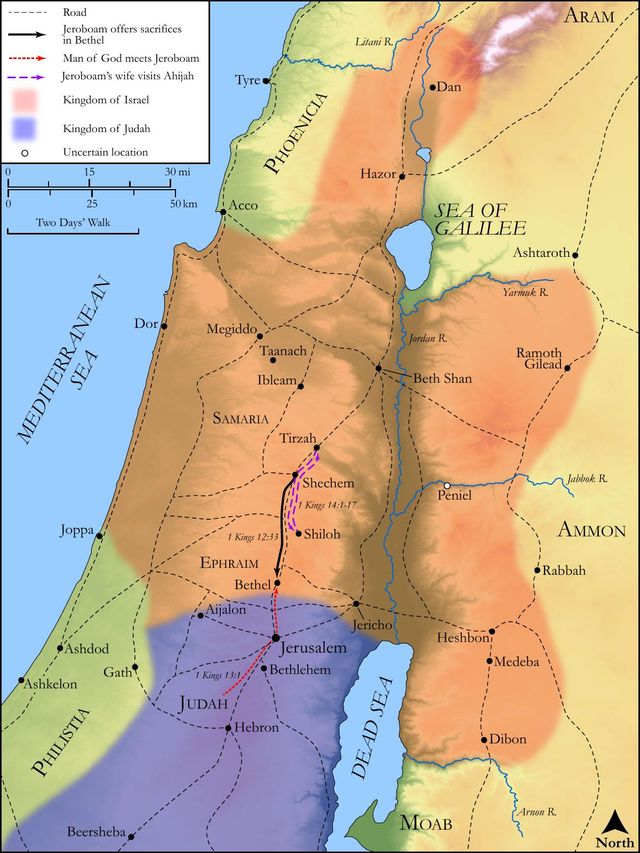
See on the biblical-era maps


Study this verse
Public-domain commentary
Matthew Henry
From his Commentary on the Whole Bible. Henry comments on passages, not single verses — this entry covers 1 Kings 14:1–6. His three-level outline is real structure in the source text, so it is rendered as structure.
How Jeroboam persisted in his contempt of God and religion we read in the close of the foregoing chapter. Here we are told how God proceeded in his controversy with him; for when God judges he will overcome, and sinners shall either bend or break before him.
I.His child fell sick, Kg1 14:1.
It is probable that he was his eldest son, and heir-apparent to the crown; for at his death all the kingdom went into mourning for him, ch. 13. His dignity as a prince, his age as a young prince, and his interest in heaven as a pious prince, could not exempt him from sickness, dangerous sickness. Let none be secure of the continuance of their health, but improve it, while it continues, for the best purposes. Lord, behold, he whom thou lovest, thy favourite, he whom Israel loves, their darling, is sick. At that time, when Jeroboam prostituted the profaned the priesthood (Kg1 13:33), his child sickened. When sickness comes into our families we should enquire whether there be not some particular sin harboured in our houses, which the affliction is sent to convince us of and reclaim us from.
II.He sent his wife in disguise to enquire of Ahijah the prophet what should become of the child, Kg1 14:2, Kg1 14:3.
The sickness of his child touched him in a tender part. The withering of this branch of the family would, perhaps, be as sore an affliction to him as the withering of that branch of his body, Kg1 13:4. Such is the force of natural affection; our children are ourselves but once removed. Now,
1.Jeroboam's great desire, under this affliction, is to know what shall become of the child, whether he will live or die.
(1.)It would have been more prudent if he had desired to know what means they should use for the recovery of the child, what they should give him, and what they should do to him; but by this instance, and those of Ahaziah (Kg2 1:2) and Benhadad (Kg2 8:8), it should seem they had then such a foolish notion of fatality as took them off from all use of means; for, if they were sure the patient would live, they thought means needless; if he would die, they thought them useless; not considering that duty is ours, events are God's, and that he that ordained the end ordained the means. Why should a prophet be desired to show that which a little time will show?
(2.)It would have been more pious if he had desired to know wherefore God contended with him, had begged the prophet's prayers, and cast away his idols from him; then the child might have been restored to him, as his hand was. But most people would rather be told their fortune than their faults or their duty.
2.That he might know the child's doom, he sent to Ahijah the prophet, who lived obscurely and neglected in Shiloh, blind through age, yet still blest with the visions of the Almighty, which need not bodily eyes, but are rather favoured by the want of them, the eyes of the mind being then most intent and least diverted. Jeroboam sent not to him for advice about the setting up of his calves, or the consecrating of his priests, but had recourse to him in his distress, when the gods he served could give him no relief. Lord, in trouble have those visited thee who before slighted thee. Some have by sickness been reminded of their forgotten ministers and praying friends. He sent to Ahijah, because he had told him he should be king, Kg1 13:2. "He was once the messenger of good tidings, surely he will be so again." Those that by sin disqualify themselves for comfort, and yet expect their ministers, because they are good men, should speak peace and comfort to them, greatly wrong both themselves and their ministers.
3.He sent his wife to enquire of the prophet, because she could best put the question without naming names, or making any other description than this, "Sir, I have a son ill; will he recover or not?" The heart of her husband safely trusted in her that she would be faithful both in delivering the message and bringing him the answer; and it seems there were none of all his counsellors in whom he could repose such a confidence; otherwise the sick child could very ill spare her, for mothers are the best nurses, and it would have been much fitter for her to have staid at home to tend him than go to Shiloh to enquire what would become of him. If she go, she must be incognito - in disguise, must change her dress, cover her face, and go by another name, not only to conceal herself from her own court and the country through which she passed (as if it were below her quality to go upon such an errand, and what she had reason to be ashamed of, as Nicodemus that came to Jesus by night, whereas it is no disparagement to the greatest to attend God's prophets), but also to conceal herself from the prophet himself, that he might only answer her question concerning her son, and not enter upon the unpleasing subject of her husband's defection. Thus some people love to prescribe to their ministers, limit them to smooth things, and care not for having the whole counsel of God declared to them, lest it prove to prophesy no good concerning them, but evil. But what a strange notion had Jeroboam of God's prophet when he believed that he could and would certainly tell what would become of the child, and yet either could not or would not discover who was the mother! Could he see into the thick darkness of futurity, and yet not see through the thin veil of this disguise? Did Jeroboam think the God of Israel like his calves, just what he pleased? Be not deceived, God is not mocked.
III.God gave Ahijah notice of the approach of Jeroboam's wife, and that she came in disguise, and full instructions what to say to her (Kg1 14:5), which enabled him, as she came in at the door, to call her by her name, to her great surprise, and so to discover to all about him who she was (Kg1 14:6): Come in, thou wife of Jeroboam, why feignest thou thyself to be another? He had no regard,
1.To her rank. She was a queen, but what was that to him, who had a message to deliver to her immediately from God, before whom all the children of men stand upon the same level? Nor,
2.To her present. It was usual for those who consulted prophets to bring them tokens of respect, which they accepted, and yet were no hirelings. She brought him a handsome country present (Kg1 14:3), but he did not think himself obliged by that to give her any finer language than the nature of her message required. Nor,
3.To her industrious concealment of herself. It is a piece of civility not to take notice of those who desire not to be taken notice of; but the prophet was no courtier, nor gave flattering titles; plain dealing is best, and she shall know, at the first word, what she has to trust to: I am sent to thee with heavy tidings. Note, Those who think by their disguises to hide themselves from God will be wretchedly confounded when they find themselves disappointed in the day of discovery. Sinners now appear in the garb of saints, and are taken to be such; but how will they blush and tremble when they find themselves stripped of their false colours, and are called by their own name: "Go out, thou treacherous false-hearted hypocrite. I never knew thee. Why feignest thou thyself to be another?" Tidings of a portion with hypocrites will be heavy tidings. God will judge men according to what they are, not according to what they seem.
Historical interpretation
Historical reception
1 surviving comment on this verse from the historical church.
“At that time Abijah son of Jeroboam fell sick,” and [the king], being worried for the health of his son, sent his wife to the prophet Ahijah because he was confident that through the prayers of that holy man he would obtain from God, whom he had repudiated, the healing of his son. And he did not want the queen to appear [before the prophet] without a present against the custom of the ancestors. Therefore “she took ten loaves of bread,” that is, ten soldiers’ biscuits, “a jar of honey and dry fruits”: the Greek text has staphylas, that is, grapes, instead of dry fruits. He did not want her to offer a regal present, lest she might appear in her real nature.
Continue studying 1 Kings 14:2 across the web’s major study libraries — every link below opens this exact verse, chapter, or book on the destination site.
Read & Compare
 BibleGatewayThis verse in more than 200 translations and 70 languages.
 Bible.comThe YouVersion reader — hundreds of translations, reading plans, and highlights.
 ESV.orgCrossway's official English Standard Version reader.
 NET BibleThe NET translation with 60,000+ translators' notes on every rendering decision.
 STEP BibleTyndale House's free study tool — original text, vocabulary, and scholarly resources.
 BibliaLogos Bible Software's free web reader.
 USCCBThe New American Bible (Revised Edition) with the U.S. bishops' study notes.
Commentaries
 BibleHub CommentariesDozens of classic commentaries on this verse, gathered on one page.
 StudyLightMore than 100 commentary sets — the largest collection on the web.
 BibleRefPlain-English commentary on what this verse means, verse by verse.
 Enduring WordDavid Guzik's free commentary on this chapter, widely used by Bible teachers.
 Bible Study ToolsVerse commentary alongside Greek and Hebrew study aids.
Original Language & Research
- BibleHub InterlinearThe verse word by word — original language, transliteration, and English.
- BibleHub LexiconEvery word's original-language definition and Strong's entry.
 Blue Letter BibleDeep-study tools — Strong's numbers, concordance, and word studies.
 SefariaThe Hebrew text with Rashi and centuries of Jewish commentary.
Sermons, Hymns & Audio


TrulyRandomVerse is not affiliated with these sites and doesn’t control their content. They’re linked because they’re genuinely useful.
Summary
1 Kings 14:2 presents King Jeroboam's desperate and deceptive maneuver to consult the prophet Ahijah regarding his critically ill son, Abijah. Despite having flagrantly led the northern kingdom of Israel into widespread idolatry by establishing golden calves, Jeroboam paradoxically acknowledges Ahijah's legitimate prophetic authority, recalling the very prophecy that elevated him to kingship. His instruction for his wife to disguise herself reveals a profound hypocrisy and a futile attempt to manipulate divine counsel by concealing his identity and the true, rebellious state of his heart.
Context
ShowHideLiterary Context
This verse serves as the narrative's immediate pivot point following the establishment of Jeroboam's apostate reign. Chapters 1 Kings 11-12 detail Jeroboam's divine appointment through Ahijah, his subsequent rejection of God's covenant, and his strategic, yet sinful, establishment of alternative worship centers at Dan and Bethel, complete with golden calves, to prevent his people from returning to Jerusalem. Chapter 1 Kings 13 recounts a dramatic prophetic confrontation at Bethel, where an unnamed man of God from Judah denounces Jeroboam's idolatrous altar and practices, even causing Jeroboam's hand to wither temporarily. The illness of Jeroboam's son, Abijah, immediately preceding this verse, acts as the catalyst for the king's hypocritical appeal to the very prophet whose God he has defied, setting the stage for the unfolding divine judgment against his house in the subsequent verses of 1 Kings 14.
Historical & Cultural Context
Jeroboam I, reigning over the newly formed northern kingdom of Israel (c. 931-910 BC), implemented a deliberate political and religious strategy to solidify his power by establishing cultic centers in Dan and Bethel. This act directly contravened the Mosaic Law's prohibition against idolatry and centralized worship in Jerusalem, aiming to prevent his subjects from maintaining allegiance to the southern kingdom of Judah. Prophets like Ahijah were central figures in ancient Israel, serving as God's direct spokespersons, often challenging kings and calling the nation to covenant faithfulness. Despite his deep apostasy, Jeroboam's turning to Ahijah in a personal crisis reflects a common practice among the kings of that day, who consulted diviners or prophets for insight into future events or solutions to problems, even if they generally disregarded the deity's broader commands. The act of disguise, as instructed by Jeroboam, was also a known practice to avoid recognition, typically for clandestine or deceptive purposes.
Key Themes
ShowHideThis verse powerfully contributes to several overarching themes within 1 Kings. Firstly, it highlights the theme of hypocrisy and deception, as Jeroboam, despite leading his nation into idolatry, seeks genuine divine counsel under false pretenses. His attempt to hide his wife's identity underscores his desire to avoid the prophet's direct condemnation for his widespread rebellion against the God who had promised him a lasting dynasty if he obeyed (1 Kings 11:38). Secondly, it emphasizes the theme of God's unwavering sovereignty and prophetic authority. Even amidst Israel's spiritual decline, God continues to speak through His prophets, and even rebellious kings like Jeroboam acknowledge this authority, however reluctantly, especially in times of personal crisis. This stands in stark contrast to Jeroboam's earlier disregard for divine commands, vividly seen in his establishment of the golden calves (1 Kings 12:28-30). Lastly, the verse foreshadows the inevitable consequences of disobedience. Jeroboam's actions have set a course for divine judgment, and his desperate, deceptive plea to Ahijah will not avert the severe pronouncements against his house and the kingdom of Israel that follow in the chapter (1 Kings 14:7-16).
Exposition and Analysis
ShowHideKey Word Analysis
ShowHideThis verb (H8138) means "to fold, duplicate, transmute, alter, change, or disguise." In this context, it denotes a deliberate and active effort to conceal one's true identity, not merely a change of clothing. Jeroboam instructs his wife to become unrecognizable as the queen, indicating a calculated attempt to manipulate the prophetic encounter or to avoid the prophet's immediate, unvarnished condemnation that would surely come if his identity were known. This word highlights Jeroboam's strategic and deceptive intent, aiming to circumvent divine knowledge or judgment through human artifice.
This verb (H3045) signifies "to know, perceive, acknowledge, or be recognized." Here, it refers to being identified or discovered. Jeroboam's instruction "that thou be not known" underscores his fear of exposure—his fear that his true spiritual state, as the king who had led Israel into apostasy, would be revealed and would influence the prophetic word. This stands in stark contrast to God's omniscience, who knows all things, including Jeroboam's heart and intentions, regardless of human attempts at concealment.
Verse Breakdown
ShowHide"And Jeroboam said to his wife, Arise, I pray thee"
This opening sets the scene for a private, urgent, and highly significant conversation. The phrase "Arise, I pray thee" (קוּם־נָא, qûm-nāʾ) is a common Hebrew idiom conveying a polite but firm and immediate command. It signals the initiation of a crucial, albeit deceptive, mission driven by the king's personal crisis—the grave illness of his son, Abijah.
"and disguise thyself, that thou be not known to be the wife of Jeroboam"
This clause reveals the core of Jeroboam's deception. He fears that his identity, specifically as the king who has led the northern kingdom into widespread idolatry, will prejudice the prophet Ahijah's message or provoke a direct, unfavorable prophecy. His attempt to hide his wife's royal status is a futile effort to control the divine message, demonstrating his profound spiritual blindness and hypocrisy.
"and get thee to Shiloh: behold, there [is] Ahijah the prophet, which told me that [I should be] king over this people"
Jeroboam directs his wife to Shiloh, a historically significant religious site and now Ahijah's residence. The mention of Ahijah as "the prophet, which told me that I should be king" is deeply ironic. Jeroboam implicitly acknowledges Ahijah's legitimate prophetic authority and the divine origin of his own kingship, yet he has consistently defied the very God who established him. This highlights the king's selective faith—trusting God's word when it brought him power, but attempting to manipulate it when seeking a favorable outcome in a personal crisis, despite his ongoing rebellion.
Literary Devices
ShowHideThe passage employs several potent literary devices. Irony is paramount, as Jeroboam, the architect of Israel's apostasy, turns to a true prophet of Yahweh for help, implicitly acknowledging the prophet's genuine connection to the divine while simultaneously attempting to deceive him. This highlights the king's spiritual inconsistency and the futility of trying to outwit God. Foreshadowing is also evident; Jeroboam's deceptive act hints at the negative and severe judgment that Ahijah will soon pronounce, suggesting that his attempts at concealment will not avert God's decree. Furthermore, there is a strong contrast between Jeroboam's human efforts to hide and manipulate, and God's divine omniscience, which sees through all pretense. The narrative implicitly critiques Jeroboam's actions by showcasing the inevitable failure of human deception against divine knowledge.
Theological and Thematic Connections
ShowHideThis passage profoundly illustrates the human tendency to seek God's favor or intervention in times of crisis while simultaneously attempting to hide or justify ongoing sin. Jeroboam's actions expose the hypocrisy of those who desire divine blessings without genuine repentance or obedience. It underscores the truth that God cannot be deceived or manipulated; His knowledge is perfect, and His judgment is righteous. The narrative also reaffirms the consistent theme throughout the Old Testament that God raises up prophets as His spokespersons, and their word, whether of blessing or judgment, is ultimately God's own word, regardless of human attempts to circumvent it.
Reflection and Application
ShowHideJeroboam's desperate and deceptive act serves as a timeless warning against spiritual hypocrisy. It challenges us to examine our own hearts: do we seek God only when we are in trouble, hoping for a favorable outcome, while simultaneously clinging to our own ways or unconfessed sins? The passage reminds us that God sees beyond our outward appearances and knows our true intentions. We cannot "disguise" ourselves from Him. True reconciliation and peace with God come not from attempts to manipulate or hide, but from genuine repentance, humble confession, and a sincere commitment to obedience. Living authentically before God means acknowledging His omniscience and responding to His truth with integrity, trusting that His grace is sufficient for our confessed weaknesses, rather than attempting to conceal them.
Questions for Reflection
ShowHideFAQ
ShowHideWhy did Jeroboam want his wife to disguise herself?
ShowHideJeroboam wanted his wife to disguise herself to conceal her identity as the queen. He likely feared that if Ahijah knew she was the wife of the king who had led Israel into widespread idolatry, the prophet would deliver an unfavorable, perhaps even harsher, prophecy concerning their son's illness. Jeroboam sought to manipulate the encounter, perhaps hoping that an anonymous inquiry would yield a more palatable response, or simply to avoid the public shame and direct confrontation that revealing his identity would entail. He was trying to get a word from God without having to face the consequences of his actions or acknowledge his rebellion.
Did Jeroboam truly believe in Ahijah's prophetic authority, given his idolatry?
ShowHideYes, Jeroboam clearly believed in Ahijah's prophetic authority, at least in a pragmatic sense. The text explicitly states that Jeroboam remembered Ahijah as the one "which told me that I should be king over this people." This indicates a recognition of Ahijah's past accuracy and divine connection. His turning to Ahijah in a moment of personal crisis, despite his general apostasy, suggests that he still acknowledged Ahijah as a legitimate spokesperson for God. However, this belief was selective and self-serving, demonstrating a profound spiritual inconsistency where he would seek God's word for personal benefit while simultaneously defying God's commands for national policy (1 Kings 12:28-30).
Christ-Centered Fulfillment
ShowHideThe narrative of Jeroboam's deceptive plea to Ahijah finds its profound Christ-centered fulfillment in the person and work of Jesus. Jeroboam sought a word from a prophet while attempting to hide his true identity and the state of his rebellious heart, a futile exercise given God's omniscience. In stark contrast, Jesus Christ is the ultimate Prophet, Priest, and King, who came not in disguise but in full revelation of God's truth and grace. He is the one who perfectly knows the heart of humanity, yet He came to bear our sins, not to condemn us for them (John 3:17). Unlike Jeroboam, who tried to manipulate a divine encounter, Jesus willingly laid down His life, fully known and fully exposed, as the Lamb of God who takes away the sin of the world. His identity was never hidden, but rather fully proclaimed and demonstrated through His life, death, and resurrection, inviting all to come to Him openly and honestly, for He is the way, the truth, and the life. In Christ, there is no need for disguise or pretense, for He offers true reconciliation and forgiveness to those who approach Him in faith, knowing that He sees us fully and loves us unconditionally.