


1 Kings 10:24
Bible text: King James Version (1769 Blayney text) · Public domain
Bible text: Berean Standard Bible · Public domain
Bible text: American Standard Version (1901) · Public domain
Bible text: World English Bible, Messianic edition · Public domain
Bible text: Geneva Bible (1599) · Public domain
Bible text: Young's Literal Translation · Public domain
- וְכָלve·kholand allH3605Conj-w ¦ N-mscNoun Singular Masculine Constructוְandכָלall
- הָאָרֶץha·'A·retzthe earthH776Art ¦ N-fsNoun Singular Feminine Absoluteהָtheאָרֶץearth
- מְבַקְשִׁיםme·vak·Shim[were] seekingH1245V-Piel-Prtcpl-mpVerb Piel Participle Plural Masculine Absolute
- אֶת'et<obj.>H853DirObjMParticle Object Indicator
- פְּנֵיpe·Nei[the] face ofH6440N-mpcNoun Plural Masculine Construct
- שְׁלֹמֹהshe·lo·MohSolomonH8010N-proper-mNoun Proper Masculine
- לִשְׁמֹעַlish·Mo·a'to hearH8085Prep-l ¦ V-Qal-InfVerb Qal Infinitive Constructלִtoשְׁמֹעַhear
- אֶת'et<obj.>H853DirObjMParticle Object Indicator
- חָכְמָתוֹcha·khe·ma·Tohis wisdomH2451N-fsc ¦ 3msNoun Singular Feminine Constructחָכְמָתwisdomוֹhis
- אֲשֶׁר'a·SherwhichH834RelParticle Relative
- נָתַןna·Tanhe had putH5414V-Qal-Perf-3msVerb Qal Perfect 3rd Singular Masculine
- אֱלֹהִים'E·lo·HimGodH430N-mpNoun Plural Masculine Absolute
- בְּלִבּוֹbe·li·Boin his heartH3820Prep-b ¦ N-msc ¦ 3msNoun Singular Masculine Constructבְּinלִבּheartוֹhis
English is a literal word-by-word gloss of the Hebrew, not the KJV's wording. Why?
This is the original text the KJV's translators worked from — each Hebrew word with its own literal English meaning in this verse, prepared by scholars at Tyndale House, Cambridge. The KJV translates whole sentences, not word by word, so its wording differs: one Hebrew word can become several English words, and the KJV may choose “the LORD” where the gloss reads “Yahweh”. Both are faithful — they answer different questions. For the KJV's own rendering, switch to the KJV text.
Details
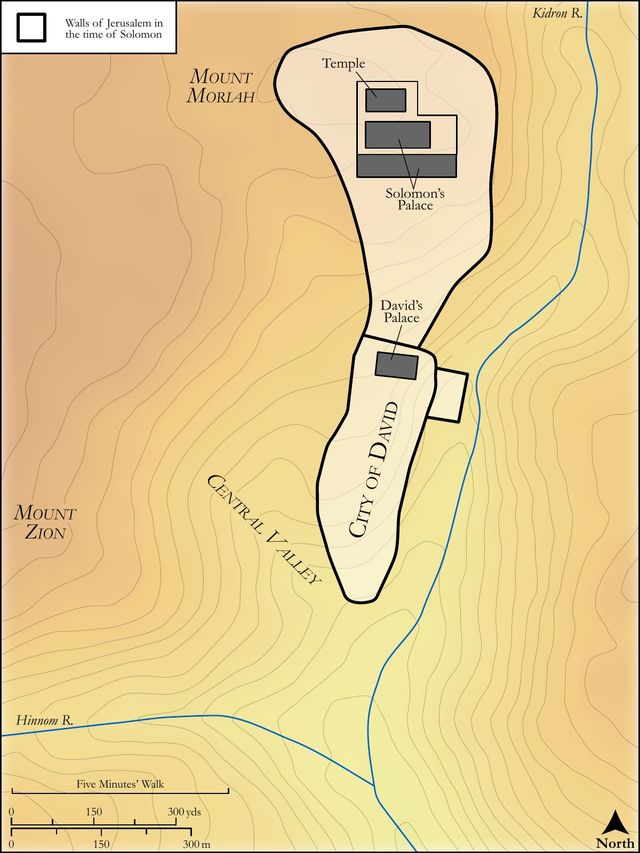
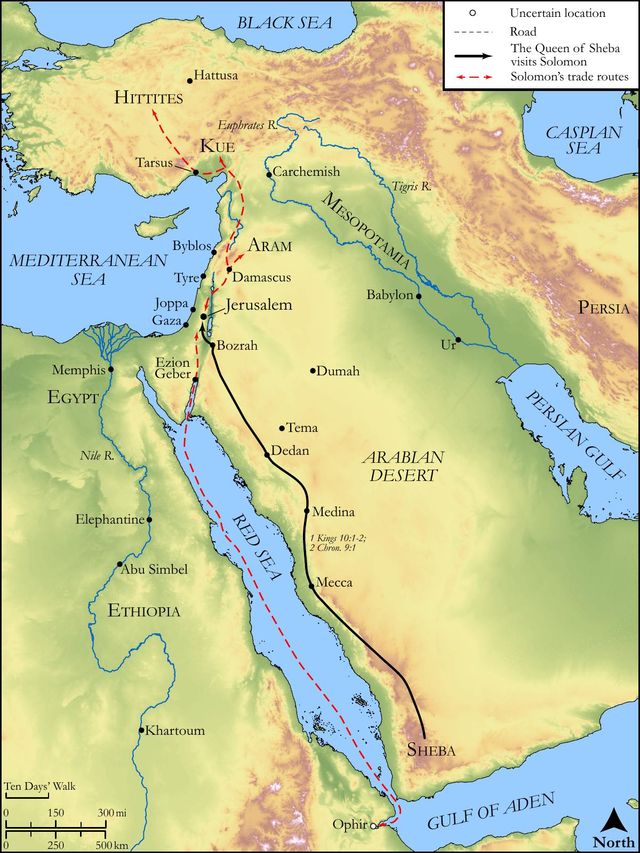
See on the biblical-era maps
Study this verse
Public-domain commentary
Matthew Henry
From his Commentary on the Whole Bible. Henry comments on passages, not single verses — this entry covers 1 Kings 10:14–29. His three-level outline is real structure in the source text, so it is rendered as structure.
We have here a further account of Solomon's prosperity.
I.How he increased his wealth.
Though he had much, he still coveted to have more, being willing to try the utmost the things of this world could do to make men happy.
1.Besides the gold that came from Ophir (Kg1 9:28), he brought so much into his country from other places that the whole amounted, every year, to 666 talents (Kg1 10:14), an ominous number, compare Rev 13:18, and Ezr 2:13.
2.He received a great deal in customs from the merchants, and in land-taxes from the countries his father had conquered and made tributaries to Israel, Kg1 10:15.
3.He was Hiram's partner in a Tharshish fleet, of and for Tyre, which imported once in three years, not only gold, and silver, and ivory, substantial goods and serviceable, but apes to play with and peacocks to please the eye with their feathers, Kg1 10:22. I wish this may not be an evidence that Solomon and his people, being overcharged with prosperity, by this time grew childish and wanton.
4.He had presents made him, every year, from the neighbouring princes and great men, to engage the continuance of his friendship, not so much because they feared him or were jealous of him as because they loved him and admired his wisdom, had often occasion to consult him as an oracle, and sent him these presents by way of recompence for his advice in politics, and (whether it became his grandeur and generosity or no we will not enquire) he took all that came, even garments and spices, horses and mules, Kg1 10:24, Kg1 10:25.
5.He traded to Egypt for horses and linen-yarn (or, as some read it, linen-cloth), the staple commodities of that country, and had his own merchants or factors whom he employed in this traffic and who were accountable to him, Kg1 10:28, Kg1 10:28. The custom to be paid to the king of Egypt for exported chariots and horses out of Egypt was very high, but (as bishop Patrick understands it) Solomon, having married his daughter, got him to compound for the customs, so that he could bring them up cheaper than his neighbours, which obliged them to buy them of him, which he was wise enough no doubt to make his advantage of. This puts an honour upon the trading part of a nation, and sets a tradesman not so much below a gentleman as some place him, that Solomon, one of the greatest men that ever was, thought it no disparagement to him to deal in trade. In all labour there is profit.
II.What use he made of his wealth.
He did not hoard it up in his coffers, that he might have it to look upon and leave behind him. He has, in his Ecclesiastes, so much exposed the folly of hoarding that we cannot suppose he would himself be guilty of it. No, God that had given him riches, and wealth, and honour, gave him also power to eat thereof, and to take his portion, Ecc 5:19.
1.He laid out his gold in fine things for himself, which he might the better be allowed to do when he had before laid out so much in fine things for the house of God.
(1.)He made 200 targets, and 300 shields, of beaten gold (Kg1 10:16, Kg1 10:17), not for service, but for state, to be carried before him when he appeared in pomp. With us, magistrates have swords and maces carried before them, as the Romans had their rods and axes, in token of their power to correct and punish the bad, to whom they are to be a terror. But Solomon had shields and targets carried before him, to signify that he took more pleasure in using his power for the defence and protection of the good, to whom he would be a praise. Magistrates are shields of the earth.
(2.)He made a stately throne, on which he sat, to give laws to his subjects, audience to ambassadors, and judgment upon appeals, Kg1 10:18-20. It was made of ivory, or elephants' teeth, which was very rich; and yet, as if he had so much gold that he knew not what to do with it, he overlaid that with gold, the best gold. Yet some think he did not cover the ivory all over, but here and there. He rolled it, flowered it, or inlaid it, with gold. The stays or arms of this stately chair were supported by the images of lions in gold; so were the steps and paces by which he went up to it, to be a memorandum to him of that courage and resolution wherewith he ought to execute judgment, not fearing the face of man. The righteous, in that post, is bold as a lion.
(3.)He made all his drinking vessels, and all the furniture of his table, even at his country seat, of pure gold, Kg1 10:21. He did not grudge himself what he had, but took the credit and comfort of it, such as it was. That is good that does us good.
2.He made it circulate among his subjects, so that the kingdom was as rich as the king; for he had no separate interests of his own to consult, but sought the welfare of his people. Those princes are not governed by Solomon's maxims who think it policy to keep their subjects poor. Solomon was herein a type of Christ, who is not only rich himself, but enriches all that are his. Solomon was instrumental to bring so much gold into the country, and disperse it, that silver was nothing accounted of, Kg1 10:21. There was such plenty of it in Jerusalem that it was as the stones; and cedars, that used to be great rarities, were as common as sycamore trees, Kg1 10:27. Such is the nature of worldly wealth, plenty of it makes it the less valuable; much more should the enjoyment of spiritual riches lessen our esteem of all earthly possessions. If gold in abundance would make silver to seem so despicable, shall not wisdom, and grace, and the foretastes of heaven, which are far better than gold, make earthly wealth seem much more despicable?
Lastly, Well, thus rich, thus great, was Solomon, and thus did he exceed all the kings of the earth, Kg1 10:23. Now let us remember, 1. That this was he who, when he was setting out in the world, did not ask for the wealth and honour of it, but asked for a wise and understanding heart. The more moderate our desires are towards earthly things the better qualified we are for the enjoyment of them and the more likely to have them. See, in Solomon's greatness, the performance of God's promise (Kg1 3:13), and let it encourage us to seek first the righteousness of God's kingdom. 2. That this was he who, having tasted all these enjoyments, wrote a whole book to show the vanity of all worldly things and the vexation of spirit that attends them, their insufficiency to make us happy and the folly of setting our hearts upon them, and to recommend to us the practice of serious godliness, as that which is the whole of man, and will do infinitely more towards the making of us easy and happy than all the wealth and power that he was master of, and which, through the grace of God, is within our reach, when the thousandth part of Solomon's greatness is a thousand times more than we can ever be so vain as to promise ourselves in this world.
Continue studying 1 Kings 10:24 across the web’s major study libraries — every link below opens this exact verse, chapter, or book on the destination site.
Read & Compare
 BibleGatewayThis verse in more than 200 translations and 70 languages.
 Bible.comThe YouVersion reader — hundreds of translations, reading plans, and highlights.
 ESV.orgCrossway's official English Standard Version reader.
 NET BibleThe NET translation with 60,000+ translators' notes on every rendering decision.
 STEP BibleTyndale House's free study tool — original text, vocabulary, and scholarly resources.
 BibliaLogos Bible Software's free web reader.
 USCCBThe New American Bible (Revised Edition) with the U.S. bishops' study notes.
Commentaries
 BibleHub CommentariesDozens of classic commentaries on this verse, gathered on one page.
 StudyLightMore than 100 commentary sets — the largest collection on the web.
 BibleRefPlain-English commentary on what this verse means, verse by verse.
 Enduring WordDavid Guzik's free commentary on this chapter, widely used by Bible teachers.
 Bible Study ToolsVerse commentary alongside Greek and Hebrew study aids.
Original Language & Research
- BibleHub InterlinearThe verse word by word — original language, transliteration, and English.
- BibleHub LexiconEvery word's original-language definition and Strong's entry.
 Blue Letter BibleDeep-study tools — Strong's numbers, concordance, and word studies.
 SefariaThe Hebrew text with Rashi and centuries of Jewish commentary.
Sermons, Hymns & Audio


TrulyRandomVerse is not affiliated with these sites and doesn’t control their content. They’re linked because they’re genuinely useful.
Summary
1 Kings 10:24 captures the zenith of King Solomon's global renown, underscoring that his extraordinary wisdom, which attracted people from across the known world, was a direct and profound divine endowment from God. This verse highlights the immense impact of God's blessing on a leader who prioritized seeking divine wisdom, resulting in unprecedented international recognition and a period of flourishing prosperity for Israel.
Context
ShowHideLiterary Context
This verse serves as a climactic summary statement within the detailed account of Solomon's reign, immediately following the elaborate description of the Queen of Sheba's visit in 1 Kings 10:1-13. Her arduous journey from the "ends of the earth" to test Solomon's wisdom and witness his opulent kingdom is presented as the primary example of "all the earth" seeking him out. The preceding verses in 1 Kings 10 meticulously detail his immense wealth, the splendor of his court, and the vastness of his kingdom, all of which are depicted as tangible manifestations of the divine wisdom that underpinned his rule. Thus, 1 Kings 10:24 acts as a profound theological conclusion, attributing the entirety of his success and fame directly to God's miraculous gift.
Historical & Cultural Context
Solomon's reign (c. 970-931 BC) represents a golden age for ancient Israel, marked by unparalleled peace, prosperity, and significant international influence. Strategically situated at the crossroads of major trade routes, Israel under Solomon became a prominent hub for commerce, diplomacy, and cultural exchange. In Israel, a king's wisdom was not merely an intellectual attribute but a vital component of effective governance, encompassing judicial discernment, strategic planning, and the ability to maintain societal order and prosperity. While kings often sought counsel from other wise rulers or sages, Solomon's reputation transcended typical diplomatic exchanges. The fact that individuals from distant lands were motivated solely by the desire to "hear his wisdom" indicates that his insight was considered a unique and exceptionally valuable commodity in that era, setting him apart from contemporary monarchs.
Key Themes
ShowHide1 Kings 10:24 powerfully reinforces several overarching themes within the book of 1 Kings and the broader Deuteronomistic History. Foremost is the theme of Divine Wisdom as the indispensable foundation of righteous and prosperous leadership. This wisdom is presented not as inherent genius but as a supernatural endowment, directly fulfilling God's promise to Solomon after his humble request for discernment to govern God's people (1 Kings 3:9-13). This underscores God's active involvement in the affairs of His chosen king. Another significant theme is Global Recognition and Blessing, demonstrating how God's favor on Israel and its king led to widespread international respect and influence, making Jerusalem a renowned center of learning and diplomacy. Lastly, the verse highlights the Value of Discernment, illustrating that people, even from distant lands, recognized and highly prized true understanding and sound judgment, willing to undertake arduous journeys simply to access it.
Exposition and Analysis
ShowHideKey Word Analysis
ShowHideThis verb (H1245) signifies an active and diligent pursuit, implying a deep desire and intentional effort to "search out" or "enquire" after something of great value. It suggests people were not merely curious but earnestly "seeking" and "requiring" Solomon's wisdom, undertaking significant journeys and expense to do so. This goes beyond casual interest, indicating a profound recognition of the worth of what Solomon possessed.
This term (H2451) refers to more than intellectual knowledge; it is "wisdom in a good sense," encompassing practical skill, discernment, sound judgment, and the ability to govern and live rightly. For Solomon, it included his extraordinary capacity for judicial decisions, strategic governance, and understanding of the natural world, all rooted in divine insight.
In ancient Hebrew thought, the "heart" (H3820) is not merely the seat of emotions but the core of one's being, encompassing the "intellect," "will," and moral character. When God "put wisdom in his heart," it signifies an internal, transformative gift that permeated Solomon's entire person, shaping his "mind," "understanding," and decisions at the deepest level. It was an intrinsic, central aspect of his identity, not just an external skill.
Verse Breakdown
ShowHide"And all the earth sought to Solomon"
This clause emphasizes the universal scope of Solomon's fame and influence. "All the earth" is a hyperbole signifying the known world or the vast extent of the surrounding nations, indicating that his reputation had spread far beyond the borders of Israel. The active verb "sought" (Hebrew bâqash) conveys a deliberate, earnest, and often arduous pursuit, not merely passive interest. People actively traveled to Jerusalem to engage with him.
"to hear his wisdom"
This phrase clarifies the primary motivation for people's journeys to Solomon. It was not primarily for trade, political alliance, or military aid, but specifically to gain access to his profound insight and understanding. This highlights the extraordinary value placed on wisdom among the nations, especially when embodied by a king. It suggests that Solomon's wisdom offered practical solutions, judicial clarity, and perhaps even spiritual insight that was unavailable elsewhere, making him a unique resource.
"which God had put in his heart"
This crucial concluding clause reveals the ultimate source of Solomon's unparalleled wisdom. It explicitly attributes his extraordinary gift not to his own intellect or education, but to a divine endowment. The phrase "put in his heart" signifies an internal, spiritual gift that became an integral part of his being, shaping his thoughts, decisions, and understanding. This divine origin elevates Solomon's wisdom beyond mere human genius, establishing it as a manifestation of God's favor and power.
Literary Devices
ShowHideThe verse employs several impactful literary devices to convey Solomon's unparalleled renown. The phrase "all the earth sought to Solomon" is a clear example of Hyperbole, emphasizing the widespread and unparalleled nature of Solomon's fame and influence, extending far beyond the literal geographical confines of the entire globe. This exaggeration effectively conveys the magnitude of his reputation. The verse also utilizes Metonymy or Synecdoche by using "earth" to represent the people and nations of the known world. Furthermore, the explicit statement that God "had put [wisdom] in his heart" functions as a powerful form of Divine Attribution, directly crediting God as the ultimate source of Solomon's extraordinary abilities, thereby elevating the narrative beyond a mere chronicle of human achievement to a profound testament of divine blessing and intervention.
Theological and Thematic Connections
ShowHide1 Kings 10:24 serves as a powerful testament to God's faithfulness in granting wisdom to those who seek Him, particularly for the purpose of righteous leadership. It underscores the Old Testament principle that true wisdom originates from God and is a divine gift that enables effective governance and brings honor not only to the individual but also to the nation. Solomon's reign, marked by this God-given wisdom, became a beacon of divine blessing and a demonstration of the benefits of a kingdom ordered by God's principles. This verse also foreshadows the ultimate source of all wisdom found in the person of Jesus Christ, who is greater than Solomon.
Reflection and Application
ShowHide1 Kings 10:24 offers profound lessons for believers today, reminding us that true wisdom is not merely intellectual accumulation or worldly cleverness but a divine gift, essential for navigating life's complexities and leading with integrity. Just as God endowed Solomon with the discernment needed to govern His people, He is willing to grant wisdom to all who humbly ask (James 1:5). This verse challenges us to prioritize seeking God's wisdom above worldly riches or fleeting fame, recognizing that it is the ultimate resource for sound judgment, effective decision-making, and living a life that honors Him. When God-given wisdom is applied, it has the power to impact not only our personal lives but also to influence our communities and spheres of influence for good, drawing others to the source of all truth and demonstrating the transformative power of a life guided by divine insight.
Questions for Reflection
ShowHideFAQ
ShowHideWas Solomon's wisdom entirely unique, or can believers today also receive such wisdom from God?
ShowHideWhile Solomon's wisdom was unique in its scope and application for ruling a kingdom, leading to international fame and prosperity, the principle of God granting wisdom to His people is not exclusive to him. The Bible teaches that God generously gives wisdom to all who ask in faith (James 1:5). However, the nature of the wisdom may differ; Solomon's was specifically for governing a nation and discerning complex judicial matters. For believers today, God's wisdom empowers us for righteous living, discerning His will, making sound decisions in our personal and professional lives, and effectively serving in our callings within the church and the world. It is a wisdom that guides us in practical righteousness and spiritual understanding, rooted in the fear of the Lord (Proverbs 9:10).
Christ-Centered Fulfillment
ShowHide1 Kings 10:24, with its depiction of "all the earth" seeking Solomon's wisdom, serves as a powerful Old Testament foreshadowing of the ultimate and perfect wisdom embodied in Jesus Christ. While Solomon's wisdom was a divine gift, enabling him to govern and bring a measure of peace and prosperity, it was ultimately limited and imperfect, as evidenced by his later moral failures and the eventual division of his kingdom. Jesus, however, is not merely a recipient of wisdom but the very incarnation of divine wisdom. In Him, "are hid all the treasures of wisdom and knowledge" (Colossians 2:3). The Queen of Sheba traveled a great distance to hear Solomon, but Jesus Himself declares that "a greater than Solomon is here" (Matthew 12:42), inviting all people, from every nation, to come to Him for eternal life and true understanding. His wisdom is not just for governance but for salvation, offering the path to reconciliation with God and eternal life, a wisdom that Solomon's reign could only dimly reflect.