


Ezra 2:13
- בְּנֵיbe·Nei[the] descendants ofH1121N-mpcNoun Plural Masculine Construct
- אֲדֹנִיקָם'a·Do·ni·KamAdonikamH140N-proper-mNoun Proper Masculine
- שֵׁשׁsheshsixH8337Adj-csAdjective Numerical Singular common gender Absolute
- מֵאוֹתme·'othundred<s>H3967Adj-fpAdjective Numerical Plural Feminine Absolute
- שִׁשִּׁיםshi·ShimsixtyH8346Adj-mpAdjective Numerical Plural Masculine Absolute
- וְשִׁשָּׁהve·shi·Shahand sixH8337Conj-w ¦ Adj-csAdjective Numerical Singular common gender Absoluteוְandשִׁשָּׁהsix
English is a literal word-by-word gloss of the Hebrew, not the KJV's wording. Why?
This is the original text the KJV's translators worked from — each Hebrew word with its own literal English meaning in this verse, prepared by scholars at Tyndale House, Cambridge. The KJV translates whole sentences, not word by word, so its wording differs: one Hebrew word can become several English words, and the KJV may choose “the LORD” where the gloss reads “Yahweh”. Both are faithful — they answer different questions. For the KJV's own rendering, switch to the KJV text.
Details
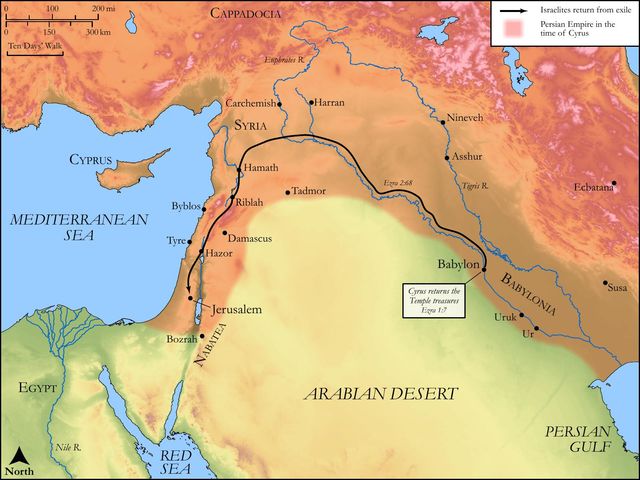
See on the biblical-era map
Study this verse
Public-domain commentary
Matthew Henry
From his Commentary on the Whole Bible. Henry comments on passages, not single verses — this entry covers Ezra 2:1–35.
We may observe here, 1. That an account was kept in writing of the families that came up out of captivity, and the numbers of each family. This was done for their honour, as part of their recompence for their faith and courage, their confidence in God and their affection to their own land, and to stir up others to follow their good example. Those that honour God he will thus honour. The names of all those Israelites indeed that accept the offer of deliverance by Christ shall be found, to their honour, in a more sacred record than this, even in the Lamb's book of life. The account that was kept of the families that came up from the captivity was intended also for the benefit of posterity, that they might know from whom they descended and to whom they were allied. 2. That they are called children of the province. Judah, which had been an illustrious kingdom, to which other kingdoms had been made provinces, subject to it and dependent on it, was now itself made a province, to receive laws and commissions from the king of Persia and to be accountable to him. See how sin diminishes and debases a nation, which righteousness would exalt. But by thus being made servants (as the patriarchs by being sojourners in a country which was theirs by promise) they were reminded of the better country, that is, the heavenly (Heb 11:16), a kingdom which cannot be moved, or changed into a province. 3. That they are said to come every one to his city, that is, the city appointed them, in which appointment an eye, no doubt, was had to their former settlement by Joshua; and to that, as near as might be, they returned: for it does not appear that any others, at least any that were able to oppose them, had possessed them in their absence. 4. That the leaders are first mentioned, v. 2. Zerubbabel and Jeshua were their Moses and Aaron, the former their chief prince, the latter their chief priest. Nehemiah and Mordecai are mentioned here; some think not the same with the famous men we afterwards meet with of those names: probably they were the same, but afterwards returned to court for the service of their country. 5. Some of these several families are named from the persons that were their ancestors, others from the places in which they had formerly resided; as with us many surnames are the proper names of persons, others of places. 6. Some little difference there is between the numbers of some of the families here and in Neh. 7, where this catalogue is repeated, which might arise from this, that some who had given in their names at first to come afterwards drew back - said, I go, Sir, but went not, which would lessen the number of the families they belonged to; others that declined, at first, afterwards repented and went, and so increased the number. 7. Here are two families that are called the children of Elam (one Ezr 2:7, another Ezr 2:31), and, which is strange, the number of both is the same, 1254. 8. The children of Adonikam, which signifies a high lord, were 666, just the number of the beast (Rev 13:18), which is there said to be the number of a man, which, Mr. Hugh Broughton thinks, has reference to this man. 9. The children of Bethlehem (Ezr 2:21) were but 123, though it was David's city; for Bethlehem was little among the thousands of Judah, yet there must the Messiah arise, Mic 5:2. 10. Anathoth had been a famous place in the tribe of Benjamin and yet here it numbered but 128 (v. 23), which is to be imputed to the divine curse which the men of Anathoth brought upon themselves by persecuting Jeremiah, who was of their city. Jer 11:21, Jer 11:23, There shall be no remnant of them, for I will bring evil upon the men of Anathoth. And see Isa 10:30, O poor Anathoth! Nothing brings ruin on a people sooner than persecution.
Continue studying Ezra 2:13 across the web’s major study libraries — every link below opens this exact verse, chapter, or book on the destination site.
Read & Compare
 BibleGatewayThis verse in more than 200 translations and 70 languages.
 Bible.comThe YouVersion reader — hundreds of translations, reading plans, and highlights.
 ESV.orgCrossway's official English Standard Version reader.
 NET BibleThe NET translation with 60,000+ translators' notes on every rendering decision.
 STEP BibleTyndale House's free study tool — original text, vocabulary, and scholarly resources.
 BibliaLogos Bible Software's free web reader.
 USCCBThe New American Bible (Revised Edition) with the U.S. bishops' study notes.
Commentaries
 BibleHub CommentariesDozens of classic commentaries on this verse, gathered on one page.
 StudyLightMore than 100 commentary sets — the largest collection on the web.
 BibleRefPlain-English commentary on what this verse means, verse by verse.
 Enduring WordDavid Guzik's free commentary on this chapter, widely used by Bible teachers.
 Bible Study ToolsVerse commentary alongside Greek and Hebrew study aids.
Original Language & Research
- BibleHub InterlinearThe verse word by word — original language, transliteration, and English.
- BibleHub LexiconEvery word's original-language definition and Strong's entry.
 Blue Letter BibleDeep-study tools — Strong's numbers, concordance, and word studies.
 SefariaThe Hebrew text with Rashi and centuries of Jewish commentary.
Sermons, Hymns & Audio


TrulyRandomVerse is not affiliated with these sites and doesn’t control their content. They’re linked because they’re genuinely useful.
Summary
Ezra 2:13 precisely records the number of descendants from the family of Adonikam who returned to Jerusalem from Babylonian exile, totaling "six hundred sixty and six." This verse is an integral part of a comprehensive census within Ezra chapter 2, which meticulously details the various families, their leaders, and the precise number of individuals participating in the initial wave of repatriation under Zerubbabel. It underscores the divine orchestration of restoration, the critical importance of lineage for re-establishing the post-exilic community, and the historical veracity of God's covenant faithfulness in bringing His people back to their land.
Context
ShowHideLiterary Context
Ezra 2:13 is embedded within a meticulous genealogical and numerical registry that constitutes the entirety of Ezra 2. This chapter immediately follows King Cyrus's monumental decree, which granted the exiled Jews permission to return to Jerusalem and rebuild the Temple (Ezra 1:1-4). The detailed listing of families, including the "children of Adonikam," serves as a foundational document for the re-establishment of the Judean community. This precise enumeration provided legitimacy for land claims, clarified eligibility for priestly and Levitical service, and powerfully demonstrated the fulfillment of God's prophetic promises regarding the return from exile. Thus, Ezra 2 functions as a vital bridge, connecting the divine decree and the practical, organized efforts of rebuilding the nation and its spiritual infrastructure.
Historical & Cultural Context
The return chronicled in Ezra 2 occurred around 538 BC, marking the end of nearly 70 years of Babylonian captivity, a period prophesied by Jeremiah (Jeremiah 29:10). The Persian Empire, having recently conquered Babylon under Cyrus the Great, implemented a unique and strategically brilliant policy of allowing conquered peoples to return to their homelands. For the Jewish exiles, this was not merely a political maneuver but a profound act of divine deliverance and a testament to God's sovereignty over world empires. Genealogies held immense importance in ancient Israelite society, functioning as legal and social documents to establish tribal identity, secure inheritance rights (especially to ancestral land), and confirm eligibility for sacred duties within the temple cult. The precise count of each family, such as that of Adonikam, was therefore essential for organizing the nascent community, allocating resources, and ensuring the proper re-establishment of worship according to the Mosaic Law.
Key Themes
ShowHideThe meticulous enumeration in Ezra 2, including the specific count of Adonikam's descendants, illuminates several pivotal themes central to the book of Ezra and the broader post-exilic narrative. Firstly, the theme of Restoration and Identity is paramount; the returning remnant, though small, was actively re-establishing their identity as God's covenant people in their ancestral land, emphasizing the enduring significance of their heritage (Isaiah 43:5-7). Secondly, Divine Faithfulness is powerfully demonstrated as God, through the decree of a foreign king, orchestrated the return of His people, thereby fulfilling His promises and asserting His sovereign control over human history (Ezra 1:1). Thirdly, the Meticulous Record-Keeping underscores the biblical emphasis on accuracy, order, and the divine intention behind every individual's role in God's redemptive plan. Finally, the specific number "six hundred sixty and six" in this context highlights the crucial theme of Contextual Interpretation, serving as a reminder that numbers in the Bible must always be understood within their immediate literary and historical framework, quite distinct from its symbolic usage in Revelation 13:18.
Exposition and Analysis
ShowHideKey Word Analysis
ShowHideFrom the root meaning "to build," this term signifies a son or descendant, emphasizing their role in building or continuing the family name and lineage. In Ezra 2:13, it highlights the generational continuity of the Adonikam family, underscoring the importance of family units in the re-establishment of the Israelite community after exile. The term encompasses a wide range of relationships, but here it clearly refers to the direct descendants comprising the returning family contingent.
This personal name, meaning "lord of rising" or "my Lord has stood up," carries a profound theological resonance within the context of the return from exile. The name itself can be seen as a quiet declaration of faith, acknowledging God's active intervention and sovereignty in raising up His people from their fallen state and bringing them back to their land. It suggests a recognition that the Lord is not passive but actively involved in the restoration and affairs of His covenant people.
This phrase provides a precise numerical count, representing the exact number of individuals from the family of Adonikam who participated in the initial wave of returnees from Babylonian exile. In the immediate context of Ezra 2, this number is purely literal and statistical, serving as a factual demographic detail within a comprehensive census. Its inclusion emphasizes the meticulous nature of the record-keeping, essential for administrative, genealogical, and religious purposes in organizing the newly re-established community.
Verse Breakdown
ShowHide"The children of Adonikam,"
This opening phrase precisely identifies a specific family unit among the many clans making the arduous journey back from Babylonian exile. The use of "children" (descendants) underscores the critical importance of lineage and family continuity in establishing identity, land rights, and social standing within the re-forming Israelite community. Adonikam's family was evidently a significant contingent, indicating their substantial contribution and presence among the first wave of returnees.
"six hundred sixty and six."
This concluding clause provides the exact numerical strength of the Adonikam family contingent. In the context of a detailed census, this precise figure serves as a vital piece of demographic data, contributing to the overall record of the repatriated community. The inclusion of such specific numbers throughout Ezra 2 highlights the meticulous nature of the biblical record-keeping, affirming the historical accuracy and practical organization required for the successful resettlement of the land and the rebuilding of Jerusalem and its institutions.
Literary Devices
ShowHideEzra 2:13, as an integral part of a larger census, primarily employs Enumeration and Genealogy as its core literary devices. The entire chapter is a meticulously detailed list, reflecting the administrative precision common in ancient Near Eastern documents, yet here it is imbued with profound theological significance. The Literal Reporting of names, numbers, and family units emphasizes the historical veracity of the return from exile, grounding the narrative in concrete reality. While seemingly dry, this precise accounting serves to solidify the identity of the returning community and their legitimate claim to their ancestral land and heritage. The repetitive formula "the children of [name], [number]" found throughout the chapter creates a rhythmic, almost liturgical effect, reinforcing the ordered and divinely orchestrated nature of the repatriation. This detailed list also functions as a powerful form of Confirmation, validating the identity, purpose, and divine blessing upon each returning group within the grand narrative of Israel's restoration.
Theological and Thematic Connections
ShowHideEzra 2:13, though a single line in a comprehensive list, profoundly illustrates God's meticulous care for His people and His unwavering faithfulness in fulfilling His promises. The very act of counting and listing each family, down to specific numbers, demonstrates that God's redemptive plan is not an abstract concept but intimately involves specific individuals and families. It underscores the enduring importance of identity and belonging within the covenant community, a theme that resonates throughout biblical history from Abraham to the early church. The return from Babylonian exile was a tangible manifestation of God's commitment to His covenant with Israel, meticulously re-establishing them in the land and setting the stage for the rebuilding of their spiritual and national life. This verse, therefore, speaks powerfully to the divine orchestration of history and the infinite value God places on every person within His grand, unfolding design.
Reflection and Application
ShowHideEzra 2:13, a seemingly mundane detail within a historical census, offers remarkably profound insights for contemporary believers. It serves as a powerful reminder that God is a God of order, precision, and intimate detail, deeply invested in the lives of individuals and the collective life of His community. Just as He meticulously orchestrated the return of specific families like Adonikam's, He remains intimately involved in the details of our personal lives and the life of His church today. This verse challenges us to value our spiritual heritage and identity in Christ, recognizing that we are part of a larger, divinely purposed family, a spiritual lineage that transcends earthly genealogies. Furthermore, the stark difference in interpreting the numerical value "666" between its literal use in Ezra and its symbolic use in Revelation serves as a critical hermeneutical lesson: it underscores the paramount importance of careful, contextual biblical interpretation, guarding us against anachronism, speculative readings, and imposing external meanings onto the text. Our faith is rooted in historical truth and divine revelation, and understanding Scripture accurately is foundational to living a faithful and discerning life.
Questions for Reflection
ShowHideFAQ
ShowHideIs the number "666" in Ezra 2:13 related to the "Mark of the Beast" in Revelation?
ShowHideNo, there is absolutely no direct relationship or symbolic connection between the number "666" in Ezra 2:13 and the "Mark of the Beast" found in Revelation 13:18. In Ezra, "six hundred sixty and six" is a purely literal, historical count of the individuals from the family of Adonikam who returned from Babylonian exile. It is a factual demographic detail within a comprehensive census, serving administrative and genealogical purposes. In stark contrast, the "666" in Revelation is highly symbolic, representing a specific entity, system, or principle of evil within an apocalyptic vision. To interpret the Ezra passage symbolically based on the Revelation passage would be an anachronism and a severe misapplication of sound hermeneutical principles, as the original audience of Ezra would have understood it purely as a numerical tally for historical record.
Why are such detailed lists important in the Bible, especially in books like Ezra?
ShowHideDetailed lists, genealogies, and censuses are profoundly important in biblical books like Ezra for several critical reasons. Firstly, they provide historical verification and accuracy, grounding the biblical narrative in real people, places, and events, thereby affirming its reliability. Secondly, they establish identity and lineage, which was vital in ancient Israel for tribal affiliation, land inheritance, and crucially, for eligibility for priestly or Levitical service within the temple system (Numbers 1:1-3). Thirdly, they powerfully demonstrate divine faithfulness by showing how God meticulously fulfills His promises, even to specific families and individuals, bringing them back from exile precisely as prophesied. Finally, these lists underscore the order and organization inherent in God's plan for His people, highlighting the practical steps involved in rebuilding a community and a nation after a period of desolation. Ultimately, these detailed records affirm that every individual and family has a significant place within God's overarching redemptive story.
Christ-Centered Fulfillment
ShowHideThe meticulous counting and restoration of the families in Ezra 2, including the children of Adonikam, serve as a profound earthly shadow pointing to the far greater and infinitely more comprehensive spiritual restoration found in Jesus Christ. While the return from Babylonian exile was a physical restoration to a specific land and a physical lineage, Christ offers a spiritual restoration that transcends all earthly boundaries, genealogies, and national identities. In Him, a new spiritual family is formed, composed of all who believe, regardless of their ethnic, social, or historical background (Galatians 3:28). The identity and belonging so earnestly sought through physical lineage in Ezra find their ultimate and eternal fulfillment in our identity as children of God through faith in Christ Jesus (John 1:12-13). The rebuilding of the physical temple in Jerusalem, which followed the census in Ezra, powerfully points to Christ Himself as the true and ultimate Temple, the very dwelling place of God among humanity, and to the church as His spiritual body, being built together into a holy dwelling for God by the Spirit (Ephesians 2:19-22). Just as God meticulously cared for each returning family, He meticulously orchestrated salvation through the perfect life, atoning death, and glorious resurrection of His Son, establishing a new and better covenant that brings eternal restoration, true belonging, and an everlasting inheritance to all who come to Him by faith (Hebrews 8:6).