


1 Corinthians 7:8
- ΛέγωLegōI sayG3004V-PAI-1SVerb Present Active Indicative 1st Singular
- δὲdenowG1161CONJConjunction
- τοῖςtoisto theG3588T-DPMDefinite article Dative Plural Masculine
- ἀγάμοιςagamoisunmarriedG22N-DPMNoun Dative Plural Masculine
- καὶkaiandG2532CONJConjunction
- ταῖςtaisto theG3588T-DPFDefinite article Dative Plural Feminine
- χήραιςchēraiswidowsG5503N-DPFNoun Dative Plural Feminine
- καλὸνkalongoodG2570A-NSNAdjective Nominative Singular Neuter
- αὐτοῖςautoisfor themG846P-DPMPersonal pronoun Dative Plural Masculine
- ἐστινestinit isG1510V-PAI-3SVerb Present Active Indicative 3rd Singular
- ἐὰνeanifG1437CONDConjunction
- μείνωσινmeinōsinthey shall remainG3306V-AAS-3PVerb Aorist Active Subjunctive 3rd Plural
- ὡςhōsasG5613PRTParticle or Disjunctive
- κἀγώkagōalso I. myselfG2532P-1NS + G2532=CONJ
English is a literal word-by-word gloss of the Greek, not the KJV's wording. Why?
This is the original text the KJV's translators worked from — each Greek word with its own literal English meaning in this verse, prepared by scholars at Tyndale House, Cambridge. The KJV translates whole sentences, not word by word, so its wording differs: one Greek word can become several English words, and the KJV may choose “charity” where the gloss reads “love”. Both are faithful — they answer different questions. For the KJV's own rendering, switch to the KJV text.
Details
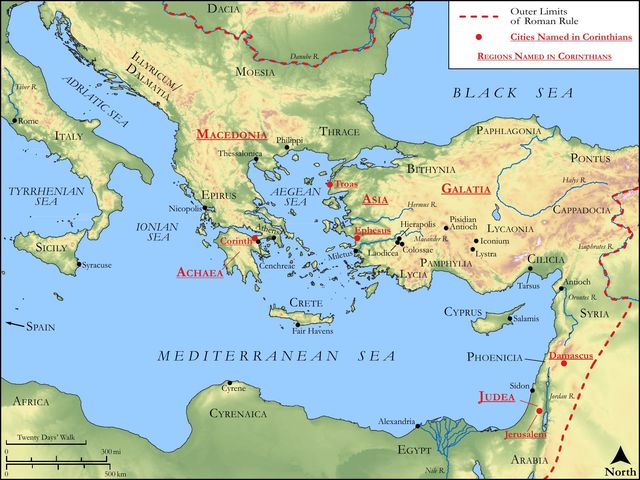
See on the biblical-era map

Study this verse
Public-domain commentary
Matthew Henry
From his Commentary on the Whole Bible. Henry comments on passages, not single verses — this entry covers 1 Corinthians 7:1–9.
The apostle comes now, as a faithful and skilful casuist, to answer some cases of conscience which the Corinthians had proposed to him. Those were things whereof they wrote to him, Co1 7:1. As the lips of ministers should keep knowledge, so the people should ask the law at their mouths. The apostle was as ready to resolve as they were to propose their doubts. In the former chapter, he warns them to avoid fornication; here he gives some directions about marriage, the remedy God had appointed for it. He tells them in general,
I.That it was good, in that juncture of time at least, to abstain from marriage altogether:
It is good for a man not to touch a woman (not to take her to wife), by good here not understanding what is so conformable to the mind and will of God as if to do otherwise were sin, an extreme into which many of the ancients have run in favour of celibacy and virginity. Should the apostle be understood in this sense, he would contradict much of the rest of his discourse. But it is good, that is, either abstracting from circumstances there are many things in which the state of celibacy has the advantage above the marriage state; or else at this juncture, by reason of the distress of the Christian church, it would be a convenience for Christians to keep themselves single, provided they have the gift of continency, and at the same time can keep themselves chaste. The expression also may carry in it an intimation that Christians must avoid all occasions of this sin, and flee all fleshly lusts, and incentives to them; must neither look on nor touch a woman, so as to provoke lustful inclinations. Yet,
II.He informs them that marriage, and the comforts and satisfactions of that state, are by divine wisdom prescribed for preventing fornication (Co1 7:2), Porneias - Fornications, all sorts of lawless lust. To avoid these, Let every man, says he, have his own wife, and every woman her own husband; that is, marry, and confine themselves to their own mates. And, when they are married, let each render the other due benevolence (Co1 7:3), consider the disposition and exigency of each other, and render conjugal duty, which is owing to each other. For, as the apostle argues (Co1 7:4), in the married state neither person has power over his own body, but has delivered it into the power of the other, the wife hers into the power of the husband, the husband his into the power of the wife. Note, Polygamy, or the marriage of more persons than one, as well as adultery, must be a breach of marriage-covenants, and a violation of the partner's rights. And therefore they should not defraud one another of the use of their bodies, nor any other of the comforts of the conjugal state, appointed of God for keeping the vessel in sanctification and honour, and preventing the lusts of uncleanness, except it be with mutual consent (Co1 7:5) and for a time only, while they employ themselves in some extraordinary duties of religion, or give themselves to fasting and prayer. Note, Seasons of deep humiliation require abstinence from lawful pleasures. But this separation between husband and wife must not be for a continuance, lest they expose themselves to Satan's temptations, by reason of their incontinence, or inability to contain. Note, Persons expose themselves to great danger by attempting to perform what is above their strength, and at the same time not bound upon them by any law of God. If they abstain from lawful enjoyments, they may be ensnared into unlawful ones. The remedies God hath provided against sinful inclinations are certainly best.
III.The apostle limits what he had said about every man's having his own wife, etc.
(Co1 7:2): I speak this by permission, not of command. He did not lay it as an injunction upon every man to marry without exception. Any man might marry. No law of God prohibited the thing. But, on the other hand, not law bound a man to marry so that he sinned if he did not; I mean, unless his circumstances required it for preventing the lust of uncleanness. It was a thing in which men, by the laws of God, were in a great measure left at liberty. And therefore Paul did not bind every man to marry, though every man had an allowance. No, he could wish all men were as himself (Co1 7:7), that is, single, and capable of living continently in that state. There were several conveniences in it, which at that season, if not at others, made it more eligible in itself. Note, It is a mark of true goodness to wish all men as happy as ourselves. But it did not answer the intentions of divine Providence as well for all men to have as much command of this appetite as Paul had. It was a gift vouchsafed to such persons as Infinite Wisdom thought proper: Every one hath his proper gift of God, one after this manner and another after that. Natural constitutions vary; and, where there may not be much difference in the constitution, different degrees of grace are vouchsafed, which may give some a greater victory over natural inclination than others. Note, The gifts of God, both in nature and grace, are variously distributed. Some have them after this manner and some after that. Paul could wish all men were as himself, but all men cannot receive such a saying, save those to whom it is given, Mat 19:11.
IV.He sums up his sense on this head (Co1 7:9, Co1 7:10):
I say therefore to the unmarried and widows, to those in a state of virginity or widowhood, It is good for them if they abide even as I. There are many conveniences, and especially at this juncture, in a single state, to render it preferable to a married one. It is convenient therefore that the unmarried abide as I, which plainly implies that Paul was at that time unmarried. But, if they cannot contain, let them marry; for it is better to marry than to burn. This is God's remedy for lust. The fire may be quenched by the means he has appointed. And marriage, with all its inconveniences, is much better than to burn with impure and lustful desires. Marriage is honourable in all; but it is a duty in those who cannot contain nor conquer those inclinations.
Historical interpretation
Two Centuries of Reception
3 surviving comments on this verse. Each one is dated, so this reads as a timeline rather than a list.
Select a marker to jump to its quote. Markers stagger vertically where authors wrote within a few decades of each other.
But when things lawful are (only) granted by way of indulgence, who hope for things unlawful? "To the unmarried" also, "and widows," he says, "It is good, by his example, to persevere" (in their present state); "but if they were too weak, to marry; because it is preferable to marry than to bum." With what fires, I pray you, is it preferable to "burn"-(the fires) of concupiscence, or (the fires) of penalty? Nay, but if fornication is pardonable, it will not be an object of concupiscence.
For, withal, when he has laid down the definitive rule with reference to "the widowed and the unwedded," that they are to "marry if they cannot contain," because "better it is to marry than to burn," he turns round to the other class, and says: "But to the wedded I make official declaration-not indeed I, but the Lord.
We must not understand these words to mean that widows are not unmarried because they once embraced the married state. Widows are unmarried, but not all unmarried are widows. That is why Paul makes a distinction here.
Continue studying 1 Corinthians 7:8 across the web’s major study libraries — every link below opens this exact verse, chapter, or book on the destination site.
Read & Compare
 BibleGatewayThis verse in more than 200 translations and 70 languages.
 Bible.comThe YouVersion reader — hundreds of translations, reading plans, and highlights.
 ESV.orgCrossway's official English Standard Version reader.
 NET BibleThe NET translation with 60,000+ translators' notes on every rendering decision.
 STEP BibleTyndale House's free study tool — original text, vocabulary, and scholarly resources.
 BibliaLogos Bible Software's free web reader.
 USCCBThe New American Bible (Revised Edition) with the U.S. bishops' study notes.
Commentaries
 BibleHub CommentariesDozens of classic commentaries on this verse, gathered on one page.
 StudyLightMore than 100 commentary sets — the largest collection on the web.
 BibleRefPlain-English commentary on what this verse means, verse by verse.
 Enduring WordDavid Guzik's free commentary on this chapter, widely used by Bible teachers.
 Bible Study ToolsVerse commentary alongside Greek and Hebrew study aids.
Original Language & Research
- BibleHub InterlinearThe verse word by word — original language, transliteration, and English.
- BibleHub LexiconEvery word's original-language definition and Strong's entry.
 Blue Letter BibleDeep-study tools — Strong's numbers, concordance, and word studies.
 CNTR CollationThe earliest Greek manuscripts of this verse, collated letter by letter.
Sermons, Hymns & Audio


TrulyRandomVerse is not affiliated with these sites and doesn’t control their content. They’re linked because they’re genuinely useful.
Summary
In 1 Corinthians 7:8, the Apostle Paul offers direct counsel to the unmarried and widows within the Corinthian church, advocating for the spiritual benefit of remaining single, mirroring his own personal state. This verse underscores Paul's conviction that for some, celibacy is not merely a lesser alternative to marriage but a commendable and advantageous path, enabling focused devotion and service to the Lord.
Context
ShowHideLiterary Context
This verse is an integral part of Paul's extensive discourse on marriage, celibacy, and sexual ethics, which spans the entirety of 1 Corinthians 7. Paul is responding to specific questions (implied by "Now concerning the things whereof ye wrote unto me" in 1 Corinthians 7:1) from the Corinthian believers regarding various aspects of Christian life, particularly how their faith should inform their marital status and sexual conduct. His advice flows from a general principle that marriage is good and appropriate for most, yet he then pivots to commend singleness for those who are able to embrace it, setting the stage for his subsequent arguments about undivided devotion to the Lord found later in the chapter, such as in 1 Corinthians 7:32-35.
Historical & Cultural Context
The city of Corinth was a bustling Roman port city renowned for its wealth, diverse population, and pervasive moral laxity, particularly sexual immorality. The temple of Aphrodite, with its cultic prostitution, was a prominent feature of the city's religious landscape. This environment posed significant challenges for early Christians striving to live a life of holiness. Paul's counsel in 1 Corinthians 7 must be understood against this backdrop, where believers needed clear guidance on how to navigate societal pressures and maintain purity. Furthermore, Paul often operated with a sense of eschatological urgency, perceiving a "present distress" (1 Corinthians 7:26) that made undivided devotion to the Lord particularly strategic for ministry and perseverance.
Key Themes
ShowHideThe primary themes emerging from 1 Corinthians 7 and to which this verse contributes significantly include the Commendation of Singleness. Paul explicitly states that it is "good" (Greek: kalon, meaning noble, excellent, or morally beautiful) for the unmarried and widows to remain in their current state, elevating singleness as a valid and honorable choice, not a lesser status. Another key theme is Paul's Personal Example, as he highlights his own celibacy with the phrase "even as I," presenting himself as a practical model of a life fully dedicated to God outside of marriage. This aligns with his earlier statement in 1 Corinthians 7:7 where he alludes to different spiritual gifts, implying singleness is one such gift. Finally, the broader context reveals the theme of Freedom for Undivided Devotion, as Paul argues that singleness can allow for greater focus on the Lord's service without the additional cares and distractions that can accompany marriage, as elaborated in 1 Corinthians 7:35.
Exposition and Analysis
ShowHideKey Word Analysis
ShowHideMeaning "unmarried." This term broadly refers to those not currently in a marital union, encompassing virgins, divorcees, or those who have never married. Paul uses it as a comprehensive category for individuals without a spouse.
Properly meaning "beautiful," but chiefly (figuratively) "good" (literally or morally), "valuable or virtuous." Paul's use of kalós here is a strong affirmation, indicating that remaining single is not merely permissible but is noble, excellent, and morally commendable in God's eyes, carrying inherent value and virtue.
Meaning "to stay (in a given place, state, relation or expectancy)." This word emphasizes the intentionality and stability of maintaining one's single status. It implies a settled decision to continue in that state, rather than merely a temporary condition.
Verse Breakdown
ShowHide"I say therefore to the unmarried and widows"
Paul, exercising his apostolic authority and pastoral care, directly addresses two specific groups within the Corinthian church: those who have never married or are divorced ("unmarried") and those whose spouses have died ("widows"). This direct address signals the particular relevance of his counsel to their unique circumstances. The inclusion of "therefore" (G1161, dé) links this advice to his preceding discussion on marriage, indicating a logical continuation of his thought.
"It is good for them"
This declarative statement conveys Paul's strong commendation. The Greek word kalós signifies that this state is not just acceptable but is inherently noble, excellent, and beneficial for these individuals. It presents singleness not as a deficiency but as a viable and even preferable option for some, carrying spiritual advantages.
"if they abide even as I."
This clause introduces a condition and a personal example. The "if" (G1437, eán) indicates that this "good" state is contingent upon their ability to remain single. Paul then offers himself ("even as I," G2504, kagṓ) as the living illustration of this commendable state, implying that his own celibacy allows him a particular freedom and focus in his service to the Lord. The phrase "abide" (G3306, ménō) underscores the idea of continuing or remaining in this single state.
Literary Devices
ShowHidePaul employs several literary devices in this concise verse. The most prominent is Apostolic Authority and Exhortation, evident in his direct opening, "I say therefore," which conveys his authoritative pastoral counsel to the Corinthian believers. This is immediately followed by Personal Example/Autobiographical Reference, as he points to his own life with the phrase "even as I." This serves as a powerful testament to the viability and spiritual fruitfulness of a single life, lending credibility and practical illustration to his teaching. Furthermore, the verse contains a Conditional Statement ("if they abide"), which highlights that while singleness is good, it is good for those who are able to maintain it, implying a spiritual gift or disposition. Finally, there is an element of Commendation and Affirmation through the use of "It is good," which elevates singleness from a mere default status to a divinely affirmed and valuable choice.
Theological and Thematic Connections
ShowHideThis verse profoundly shapes Christian theology regarding singleness, affirming it as a legitimate and honorable calling within the body of Christ, not merely a temporary state or a lesser alternative to marriage. Paul's counsel elevates celibacy as a path that can enable greater, undivided devotion to the Lord and His service, free from the inherent cares and distractions that accompany marital life. It challenges cultural norms, both ancient and modern, that often implicitly or explicitly devalue singleness, asserting its spiritual dignity and potential for profound kingdom impact. Theologically, it underscores the diversity of gifts and callings within the church, where every state, consecrated to God, can be a means of glorifying Him and advancing His purposes.
Reflection and Application
ShowHide1 Corinthians 7:8 offers profound encouragement and validation for single individuals and widows within the Christian community today. It affirms that singleness is not merely a temporary waiting period or a "second-best" option, but can be a divinely appointed and purposeful path, allowing for focused ministry, deeper spiritual growth, and a unique capacity for service. It reminds believers that one's marital status does not define their worth, their completeness, or their potential for impacting God's kingdom. Instead, the emphasis is on living out one's calling with wholehearted devotion to the Lord, whether one is married or single. For the church, this verse calls for a greater appreciation and intentional support for single members, recognizing their unique contributions and avoiding any societal or ecclesiastical pressures that might imply singleness is a deficiency rather than a potentially powerful means of spiritual flourishing and ministry.
Questions for Reflection
ShowHideFAQ
ShowHideDoes Paul's advice mean singleness is superior to marriage?
ShowHideNot necessarily. While Paul states it is "good" for the unmarried and widows to remain as he is, he does not universally declare singleness superior to marriage. In 1 Corinthians 7:2, he explicitly states that "to avoid fornication, let every man have his own wife, and let every woman have her own husband," indicating that marriage is a valid and necessary institution for many. Paul's emphasis in 1 Corinthians 7 is on the spiritual advantages that can accompany singleness, particularly the ability to offer undivided devotion to the Lord (1 Corinthians 7:32-35). He recognizes that both marriage and singleness are gifts from God, each with its own unique benefits and challenges, as he states in 1 Corinthians 7:7. The "goodness" of singleness is conditional on one's ability to "abide" in that state, suggesting it is a specific calling or gift for some, not a universal mandate.
Christ-Centered Fulfillment
ShowHideWhile 1 Corinthians 7:8 directly addresses the practicalities of marital status for believers, its deepest fulfillment is found in the person and work of Jesus Christ. Jesus Himself lived a life of perfect celibacy, demonstrating the ultimate model of undivided devotion to the Father's will and the advancement of His kingdom. His singleness was not a lack, but a complete consecration, allowing Him to fulfill His mission without earthly distractions, culminating in His atoning sacrifice. Furthermore, Jesus's teaching on "eunuchs for the kingdom of heaven" in Matthew 19:10-12 provides a profound theological basis for celibacy, linking it directly to radical discipleship and kingdom priorities. Ultimately, in Christ, our identity and worth are not defined by our marital status but by our union with Him. Whether married or single, the Christian life is meant to be a reflection of Christ's self-giving love and singular focus on God's glory, anticipating the eschatological reality where, in the resurrection, "they neither marry, nor are given in marriage, but are as the angels of God in heaven" (Matthew 22:30). Thus, Paul's counsel points believers to a life lived for Christ, a life that finds its ultimate purpose and satisfaction in Him, regardless of earthly circumstances.