


1 Chronicles 22:19
Bible text: King James Version (1769 Blayney text) · Public domain
Bible text: King James Version with Strong's numbers · Public domain
Bible text: Berean Standard Bible · Public domain
Bible text: American Standard Version (1901) · Public domain
Bible text: World English Bible, Messianic edition · Public domain
Bible text: Geneva Bible (1599) · Public domain
Bible text: Young's Literal Translation · Public domain
- עַתָּה'a·TahnowH6258AdvAdverb
- תְּנוּte·NusetH5414V-Qal-Imp-2mpVerb Qal Imperative 2nd Plural Masculine
- לְבַבְכֶםle·vav·Khemyour heartH3824N-msc ¦ 2mpNoun Singular Masculine Constructלְבַבְheartכֶםyour
- וְנַפְשְׁכֶםve·naf·she·Khemand your beingH5315Conj-w ¦ N-fsc ¦ 2mpNoun Singular Feminine Constructוְandנַפְשְׁbeingכֶםyour
- לִדְרוֹשׁlid·Ro·oshto seekH1875Prep-l ¦ V-Qal-InfVerb Qal Infinitive Constructלִtoדְרוֹשׁseek
- לַיהוָהla·Yah·weh<to> YahwehH3068Prep-l ¦ N-properNoun Proper Titleלַ<to>יהוָהYahweh
- אֱלֹהֵיכֶם'e·lo·hei·Khemyour GodH430N-mpc ¦ 2mpNoun Plural Masculine ConstructאֱלֹהֵיGodכֶםyour
- וְקוּמוּve·Ku·muand ariseH6965Conj-w ¦ V-Qal-Imp-2mpVerb Qal Imperative 2nd Plural Masculineוְandקוּמוּarise
- וּבְנוּu·ve·Nuand buildH1129Conj-w ¦ V-Qal-Imp-2mpVerb Qal Imperative 2nd Plural Masculineוּandבְנוּbuild
- אֶת'et<obj.>H853DirObjMParticle Object Indicator
- מִקְדַּשׁmik·Dash[the] sanctuary ofH4720N-mscNoun Singular Masculine Construct
- יְהוָהYah·wehYahwehH3068N-properNoun Proper Title
- הָאֱלֹהִיםha·'E·lo·Him<the> GodH430Art ¦ N-mpNoun Plural Masculine Absoluteהָ<the>אֱלֹהִיםGod
- לְהָבִיאle·ha·Vi'to bringH935Prep-l ¦ V-Hiphil-InfVerb Hiphil Infinitive Constructלְtoהָבִיאbring
- אֶת'et<obj.>H853DirObjMParticle Object Indicator
- אֲרוֹן'a·Ron[the] ark ofH727N-mscNoun Singular Masculine Construct
- בְּרִיתbe·rit[the] covenant ofH1285N-fscNoun Singular Feminine Construct
- יְהוָהYah·wehYahwehH3068N-properNoun Proper Title
- וּכְלֵיu·khe·Leiand [the] articles ofH3627Conj-w ¦ N-mpcNoun Plural Masculine Constructוּandכְלֵי[the] articles of
- קֹדֶשׁKo·desh<the> holiness ofH6944N-mscNoun Singular Masculine Construct
- הָאֱלֹהִיםha·'E·lo·Him<the> GodH430Art ¦ N-mpNoun Plural Masculine Absoluteהָ<the>אֱלֹהִיםGod
- לַבַּיִתla·Ba·yitto the houseH1004Prep-l ¦ N-msNoun Singular Masculine Absoluteלַto theבַּיִתhouse
- הַנִּבְנֶהha·niv·Nehthat will be builtH1129Art ¦ V-Niphal-Prtcpl-msVerb Niphal Participle Singular Masculine Absoluteהַthatנִּבְנֶהwill be built
- לְשֵׁםle·shemfor [the] name ofH8034Prep-l ¦ N-mscNoun Singular Masculine Constructלְforשֵׁם[the] name of
- יְהוָהYah·wehYahwehH3068N-properNoun Proper Title
English is a literal word-by-word gloss of the Hebrew, not the KJV's wording. Why?
This is the original text the KJV's translators worked from — each Hebrew word with its own literal English meaning in this verse, prepared by scholars at Tyndale House, Cambridge. The KJV translates whole sentences, not word by word, so its wording differs: one Hebrew word can become several English words, and the KJV may choose “the LORD” where the gloss reads “Yahweh”. Both are faithful — they answer different questions. For the KJV's own rendering, switch to the KJV text.
Details
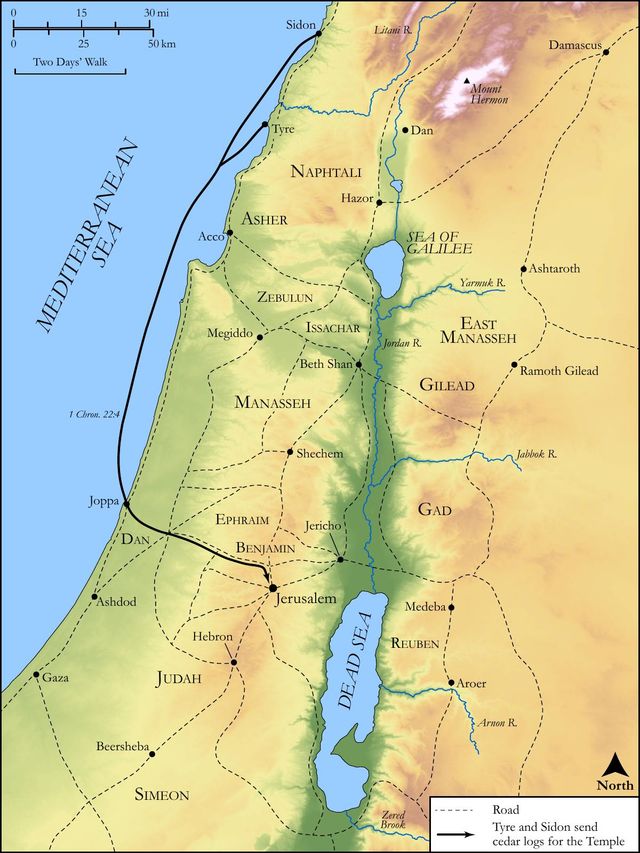
See on the biblical-era map
Study this verse
Public-domain commentary
Matthew Henry
From his Commentary on the Whole Bible. Henry comments on passages, not single verses — this entry covers 1 Chronicles 22:17–19.
David here engages the princes of Israel to assist Solomon in the great work he had to do, and every one to lend him a hand towards the carrying of it on. Those that are in the throne cannot do the good they would, unless those about the throne set in with them. David would therefore have the princes to advise Solomon and quicken him, and make the work as easy to him as they could, by promoting it every one in his place. 1. He shows them what obligations they lay under to be zealous in this matter, in gratitude to God for the great things he had done for them. He had given them victory, and rest, and a good land for an inheritance, Ch1 22:18. The more God has done for us the more we should study to do for him. 2. He presses that upon them which should make them zealous in it (Ch1 22:19): "Set your heart and soul to seek God, place your happiness in his favour, and keep your eye upon his glory. Seek him as your chief good and highest end, and this with your heart and soul. Make religion your choice and business; and then you will grudge no pains nor cost to promote the building of his sanctuary." Let but the heart be sincerely engaged for God, and the head and hand, the estate and interest, and all will be cheerfully employed for him.
Continue studying 1 Chronicles 22:19 across the web’s major study libraries — every link below opens this exact verse, chapter, or book on the destination site.
Read & Compare
 BibleGatewayThis verse in more than 200 translations and 70 languages.
 Bible.comThe YouVersion reader — hundreds of translations, reading plans, and highlights.
 ESV.orgCrossway's official English Standard Version reader.
 NET BibleThe NET translation with 60,000+ translators' notes on every rendering decision.
 STEP BibleTyndale House's free study tool — original text, vocabulary, and scholarly resources.
 BibliaLogos Bible Software's free web reader.
 USCCBThe New American Bible (Revised Edition) with the U.S. bishops' study notes.
Commentaries
 BibleHub CommentariesDozens of classic commentaries on this verse, gathered on one page.
 StudyLightMore than 100 commentary sets — the largest collection on the web.
 BibleRefPlain-English commentary on what this verse means, verse by verse.
 Enduring WordDavid Guzik's free commentary on this chapter, widely used by Bible teachers.
 Bible Study ToolsVerse commentary alongside Greek and Hebrew study aids.
Original Language & Research
- BibleHub InterlinearThe verse word by word — original language, transliteration, and English.
- BibleHub LexiconEvery word's original-language definition and Strong's entry.
 Blue Letter BibleDeep-study tools — Strong's numbers, concordance, and word studies.
 SefariaThe Hebrew text with Rashi and centuries of Jewish commentary.
Sermons, Hymns & Audio


TrulyRandomVerse is not affiliated with these sites and doesn’t control their content. They’re linked because they’re genuinely useful.
Summary
1 Chronicles 22:19 presents King David's profound and urgent exhortation to the leaders and people of Israel, challenging them to commit their entire being to seeking the Lord their God. This internal, spiritual dedication is posited as the indispensable foundation for the monumental external task of constructing the Temple. David articulates the ultimate purpose of this sacred undertaking: to establish a permanent and fitting dwelling place for the Ark of the Covenant and the holy vessels, thereby centralizing God's manifest presence and the nation's worship. The verse underscores that diligent, collective action, rooted in wholehearted devotion, is essential for fulfilling God's divine architectural and spiritual purposes.
Context
ShowHideLiterary Context
This pivotal verse is situated at a critical juncture in David's reign, as he prepares for the transition of leadership to his son Solomon and the commencement of the Temple construction. Having been divinely prohibited from building the Temple himself due to his military past (1 Chronicles 22:8 - God's Prohibition to David), David dedicates himself to meticulous preparation, amassing vast quantities of materials, skilled laborers, and financial resources. He then formally charges Solomon with the sacred duty of building the "house of the LORD" (1 Chronicles 22:6-16 - David's Charge to Solomon). However, David understands that this national endeavor requires more than just Solomon's leadership; it demands the unified commitment of the entire community. Therefore, in 1 Chronicles 22:17 - David's Charge to the Princes, he summons "all the princes of Israel" and extends the mandate to them, and by extension, to the whole nation. Verse 19 serves as the culmination of this charge, a direct appeal that emphasizes the spiritual prerequisite for the physical task, highlighting that the success of God's work is contingent upon both divine enablement and human obedience and wholehearted participation.
Historical & Cultural Context
The era of the united monarchy under David marked a significant transformation for Israel, moving from a loose tribal confederacy to a centralized kingdom with Jerusalem as its established capital. For centuries, the Ark of the Covenant, the tangible symbol of God's presence and covenant with His people, had resided in the portable Tabernacle, reflecting Israel's nomadic history. With the establishment of a settled kingdom, the desire for a permanent, magnificent Temple was a natural and significant development. In Israel, grand architectural projects like the house of God, whose pattern David gave to Solomon, were not merely buildings but central expressions of national identity, religious devotion, and royal power, often requiring immense national mobilization of resources, skilled craftsmanship, and communal labor. The Temple in Jerusalem would become the spiritual, political, and economic heart of the nation, a visible testament to God's dwelling among His people and the focal point for their covenant relationship, sacrifices, and worship. Its construction would signify Israel's stability and its unique relationship with the sovereign God.
Key Themes
ShowHide1 Chronicles 22:19 profoundly contributes to several overarching themes within the book of Chronicles and the broader biblical narrative. Firstly, it underscores the theme of Divine Sovereignty and Human Responsibility. While God initiates the plan for His dwelling and chooses His instruments, the actualization of His purposes requires diligent human effort and obedience. David's extensive preparations and subsequent charge exemplify this partnership. Secondly, the imperative to "set your heart and your soul to seek the LORD your God" highlights Wholehearted Devotion as the non-negotiable prerequisite for any sacred work. This resonates deeply with the foundational command of the Shema, to love God with all one's being, as articulated in Deuteronomy 6:5 - The Great Commandment. Thirdly, the ultimate goal of bringing the Ark into the sanctuary emphasizes the Centrality of God's Presence and Worship. The Temple was not an end in itself but a means to facilitate communion with God, making His dwelling among His people tangible. This theme of God desiring to dwell with humanity is foundational, stretching from the Tabernacle in Exodus 25:8 - God's Command to Build the Tabernacle to the New Covenant reality. Finally, David's role in faithfully preparing for a project he would not personally complete showcases the theme of Legacy and Continuity, where one generation lays the groundwork for the next to fulfill God's ongoing purposes.
Exposition and Analysis
ShowHideKey Word Analysis
ShowHideThis term refers to the innermost part of a person, encompassing not only emotions but also intellect, will, conscience, and moral character. To "set one's heart" signifies a deliberate, conscious, and resolute decision, involving one's entire inner being in focused intention and commitment. It is the seat of thought and purpose.
"soul" broadly denotes the totality of a living being—one's life-force, vitality, desires, and unique personality. When paired with "heart," as in this verse, it forms a comprehensive expression, emphasizing a complete, unreserved, and holistic dedication. To "set one's soul" means to commit one's very existence, energy, and life's essence to the task and to God.
Derived from the root qadash (to be holy, set apart), a "sanctuary" is a consecrated place or thing, specifically a holy place dedicated exclusively for God's presence and worship. It signifies a space distinct from the common, set apart for divine purposes, underscoring the holiness, reverence, and sacred nature required for the Temple and all associated activities.
Verse Breakdown
ShowHide"Now set your heart and your soul to seek the LORD your God;"
This opening clause serves as a profound spiritual injunction, demanding an internal, holistic, and unwavering commitment to God. Before any physical action, David calls for an intentional, deep-seated devotion. "Seeking" here implies not mere intellectual curiosity but an active, diligent pursuit of God's will, presence, and favor, engaging every faculty of one's being. This internal disposition is presented as the foundational prerequisite for all subsequent endeavors.
"arise therefore, and build ye the sanctuary of the LORD God,"
Following the spiritual directive, this clause issues a direct, urgent call to tangible action. The conjunction "therefore" establishes a clear logical consequence: the internal commitment to seeking God must naturally translate into outward, diligent effort. "Arise" signifies a transition from passivity or contemplation to active engagement, emphasizing the collective responsibility of the people in constructing God's holy dwelling place. It is a command for decisive, unified action.
"to bring the ark of the covenant of the LORD, and the holy vessels of God, into the house that is to be built to the name of the LORD."
This final clause articulates the ultimate, sacred purpose of the entire Temple construction project. The Temple was not merely a grand architectural feat but a consecrated space designed to house the Ark of the Covenant, symbolizing God's holy presence and His enduring covenant fidelity, and the various instruments of worship ("holy vessels"). Building "to the name of the LORD" signifies that the entire undertaking was for God's glory, honor, and the establishment of His manifest presence among His people, rather than for human prestige or a mere national monument.
Literary Devices
ShowHideThe verse employs several powerful Literary Devices to convey its message with compelling force and clarity. The predominant use of the Imperative Mood ("set," "arise," "build," "bring") creates a sense of urgency, authority, and direct command, underscoring the non-negotiable nature of David's charge and the immediate call to action. The phrase "heart and soul" functions as a Merism, a rhetorical device where two complementary parts are used to represent a complete whole. Here, it emphasizes the totality of a person's being—encompassing intellect, will, emotion, and vitality—demanding complete and unreserved devotion. Furthermore, the structure of the verse demonstrates a clear Logical Progression or Cause and Effect: the spiritual commitment ("set your heart and your soul to seek the LORD your God") is presented as the necessary precursor and motivation for the physical action ("arise therefore, and build"). This highlights the profound biblical principle that true, effective work for God must always flow from an internal, consecrated disposition. Finally, the "sanctuary," "Ark of the Covenant," and "holy vessels" are rich Symbols of God's presence, His covenant relationship with Israel, and the means by which His people were to draw near to Him in worship, imbuing the physical construction with profound spiritual significance.
Theological and Thematic Connections
ShowHideThis verse encapsulates a profound theological truth: genuine, effective service to God must always originate from a place of deep, internal devotion and spiritual readiness. The call to "set your heart and your soul to seek the LORD your God" establishes that an intimate, wholehearted relationship with the Divine is the indispensable foundation for any meaningful action in God's kingdom. This principle extends far beyond the specific context of Temple building, emphasizing that outward acts of piety, service, or religious observance are ultimately hollow without an accompanying, sincere, and unreserved commitment to God Himself. The ultimate purpose of the Temple, to house the Ark of the Covenant, reinforces the overarching biblical theme of God's desire to dwell among His people, providing a tangible space for communion, worship, and the manifestation of His glory. This physical dwelling, while magnificent, foreshadowed a more profound spiritual reality where God's presence is not confined to a building but indwells His people, transforming them into living temples.
Reflection and Application
ShowHideDavid's earnest charge in 1 Chronicles 22:19 offers timeless and profound principles for believers today, transcending the literal act of constructing a physical temple. The initial imperative to "set your heart and your soul to seek the LORD your God" serves as a powerful reminder that all authentic spiritual endeavor, all meaningful service, and all true growth must begin with an internal posture of wholehearted devotion and diligent pursuit of God's will and presence. Before we "build" anything—whether it's a ministry, a family, a career, or our personal character—our primary focus must be on cultivating an intimate, unreserved, and passionate relationship with God. This internal readiness then naturally propels us to "arise therefore, and build." Our faith is not passive; it demands active participation, diligent work, and the faithful deployment of our gifts, talents, and resources in service to God's kingdom. Just as the Temple was built to house God's manifest presence, our individual lives, our homes, and our gathered churches should be consecrated spaces where God's presence is welcomed, honored, and made manifest. We are called to be "temples" of the Holy Spirit, ensuring that our actions are not merely self-serving or for human acclaim, but are ultimately for "the name of the LORD," bringing His glory and transformative presence into a world that desperately needs Him.
Questions for Reflection
ShowHideFAQ
ShowHideWhy was David not allowed to build the Temple, but Solomon was?
ShowHideGod explicitly told David that he was a man of war and had shed much blood, making him unsuitable to build a house for God's name (1 Chronicles 22:8 - God's Prohibition to David). Instead, God chose Solomon, David's son, who would be a man of peace, to undertake this sacred task (1 Chronicles 22:9-10 - God's Promise to Solomon). This divine decision highlights God's sovereignty in choosing His instruments, His specific purposes for individuals, and the symbolic significance of the Temple as a place of peace and rest, a contrast to the era of conquest.
What is the significance of the "Ark of the Covenant" in this verse?
ShowHideThe Ark of the Covenant was the most sacred object in ancient Israel, symbolizing God's holy presence, His throne, and His covenant relationship with His people (Exodus 25:22 - God's Presence Above the Ark). Its placement within the Temple was the ultimate purpose of the building, signifying that the Temple was primarily a dwelling place for God among His people. It underscored that the Temple's grandeur was not for human glory or national pride, but for the glory and manifest presence of the LORD, making it the central point of divine-human encounter and worship.
Christ-Centered Fulfillment
ShowHideThe charge in 1 Chronicles 22:19 to "set your heart and your soul to seek the LORD" and "build ye the sanctuary" finds its ultimate fulfillment and deeper meaning in Jesus Christ. While the Old Testament Temple was a magnificent physical structure designed to house God's presence, it was always a shadow, a temporary dwelling pointing to a greater, eternal reality. Jesus Himself declared, "Destroy this temple, and in three days I will raise it up," speaking of the temple of His own body (John 2:19 - Jesus, the True Temple). Christ is the true and ultimate sanctuary, the very embodiment of God's presence dwelling among humanity (John 1:14 - The Word Became Flesh). Through His atoning sacrifice on the cross, the veil separating humanity from God's holy presence was torn from top to bottom (Matthew 27:51 - The Torn Veil), granting direct and confident access to the Father through His blood (Hebrews 10:19-22 - Access to God Through Christ). Furthermore, in Christ, believers are transformed into living stones, becoming a spiritual house, a holy priesthood, built upon the chief cornerstone, Jesus Christ Himself (1 Peter 2:5 - Living Stones and Ephesians 2:20-22 - Christ, the Cornerstone). The Old Testament call to "seek the LORD" is now fully realized in seeking Christ, who is the Way, the Truth, and the Life, and the only path to the Father (John 14:6 - Jesus, the Way, Truth, and Life). Our "building" today is the edification of His church, the body of Christ, and the cultivation of our individual lives as temples of the Holy Spirit, where God's presence truly dwells (1 Corinthians 6:19-20 - Your Body, a Temple of the Holy Spirit). Thus, the ultimate purpose of bringing the Ark (God's presence) into the "house" is fulfilled by the indwelling of the Holy Spirit in every believer and the corporate presence of Christ in His gathered people.