


Ruth 4:18
- וְאֵלֶּהve·'E·lehand theseH428Conj-w ¦ PrtParticle Demonstrativeוְandאֵלֶּהthese
- תּוֹלְדוֹתtol·Dot[are] [the] descendants ofH8435N-fpcNoun Plural Feminine Construct
- פָּרֶץPa·retzPerezH6557N-proper-mNoun Proper Masculine
- פֶּרֶץPe·retzPerezH6557N-proper-mNoun Proper Masculine
- הוֹלִידho·Lidhe fatheredH3205V-Hiphil-Perf-3msVerb Hiphil Perfect 3rd Singular Masculine
- אֶת'et<obj.>H853DirObjMParticle Object Indicator
- חֶצְרוֹןchetz·RonHezronH2696N-proper-mNoun Proper Masculine
English is a literal word-by-word gloss of the Hebrew, not the KJV's wording. Why?
This is the original text the KJV's translators worked from — each Hebrew word with its own literal English meaning in this verse, prepared by scholars at Tyndale House, Cambridge. The KJV translates whole sentences, not word by word, so its wording differs: one Hebrew word can become several English words, and the KJV may choose “the LORD” where the gloss reads “Yahweh”. Both are faithful — they answer different questions. For the KJV's own rendering, switch to the KJV text.
Details
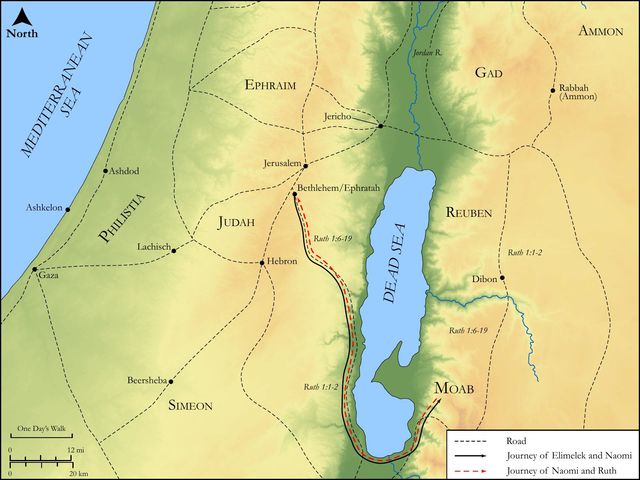
See on the biblical-era map
Study this verse
Public-domain commentary
Matthew Henry
From his Commentary on the Whole Bible. Henry comments on passages, not single verses — this entry covers Ruth 4:13–22. His three-level outline is real structure in the source text, so it is rendered as structure.
Here is, I. Ruth a wife. Boaz took her, with the usual solemnities, to his house, and she became his wife (Rut 4:13), all the city, no doubt, congratulating the preferment of a virtuous woman, purely for her virtues. We have reason to think that Orpah, who returned from Naomi to her people and her gods, was never half so well preferred as Ruth was. He that forsakes all for Christ shall find more than all with him; it shall be recompensed a hundred-fold in this present time. Now Orpah wished she had gone with Naomi too; but she, like the other kinsman, stood in her own light. Boaz had prayed that this pious proselyte might receive a full reward of her courage and constancy from the God of Israel, under whose wings she had come to trust; and now he became an instrument of that kindness, which was an answer to his prayer, and helped to make his own words good. Now she had the command of those servants with whom she had associated and of those fields in which she had gleaned. Thus sometimes God raiseth up the poor out of the dust, to set them with princes, Psa 113:7, Psa 113:8.
II.Ruth a mother:
The Lord gave her conception; for the fruit of the womb is his reward, Psa 127:3. It is one of the keys he hath in his hand; and he sometimes makes the barren woman that had been long so to be a joyful mother of children, Psa 113:9; Isa 54:1.
III.Ruth still a daughter-in-law, and the same that she always was, to Naomi, who was so far from being forgotten that she was a principal sharer in these new joys. The good women that were at the labour when this child was born congratulated Naomi upon it more than either Boaz or Ruth, because she was the match-maker, and it was the family of her husband that was hereby built up. See here, as before, what an air of devotion there was then even in the common expressions of civility among the Israelites. Prayer to God attended the birth of the child. What a pity it is that such pious language should either be disused among Christians or degenerate into a formality. "Blessed be the Lord that has sent thee this grandson," Rut 4:14, Rut 4:15.
1.Who was the preserver of the name of her family, and who, they hoped, would be famous, because his father was so.
2.Who would be hereafter dutiful and kind to her, so they hoped, because his mother was so. If he would but take after her, he would be a comfort to his aged grandmother, a restorer of her life, and, if there should be occasion, would have wherewithal to be the nourisher of her old age. It is a great comfort to those that are going into years to see any of those that descend from them growing up, that are likely, by the blessing of God, to be a stay and support to them, when the years come wherein they will need such, and of which they will say they have no pleasure in them. Observe, They say of Ruth that she loved Naomi, and therefore was better to her than seven sons. See how God in his providence sometimes makes up the want and loss of those relations from whom we expected most comfort in those from whom we expected least. The bonds of love prove stronger than those of nature, and there is a friend that sticks closer than a brother; so here there was a daughter-in-law better than an own child. See what wisdom and grace will do. Now here,
(1.)The child is named by the neighbours, Rut 4:17. The good women would have it called Obed, a servant, either in remembrance of the meanness and poverty of the mother or in prospect of his being hereafter a servant, and very serviceable, to his grandmother. It is no dishonour to those that are ever so well born to be servants to God, their friends, and their generation. The motto of the princes of Wales is Ich dien - I serve.
(2.)The child is nursed by the grandmother, that is, dry-nursed, when the mother had weaned him from the breast, Rut 4:16. She laid it in her bosom, in token of her tender affection to it and care of it. Grandmothers are often the most fond.
IV.Ruth is hereby brought in among the ancestors of David and Christ, which was the greatest honour.
The genealogy is here drawn from Pharez, through Boaz and Obed, to David, and so leads towards the Messiah, and therefore it is not an endless genealogy.
Continue studying Ruth 4:18 across the web’s major study libraries — every link below opens this exact verse, chapter, or book on the destination site.
Read & Compare
 BibleGatewayThis verse in more than 200 translations and 70 languages.
 Bible.comThe YouVersion reader — hundreds of translations, reading plans, and highlights.
 ESV.orgCrossway's official English Standard Version reader.
 NET BibleThe NET translation with 60,000+ translators' notes on every rendering decision.
 STEP BibleTyndale House's free study tool — original text, vocabulary, and scholarly resources.
 BibliaLogos Bible Software's free web reader.
 USCCBThe New American Bible (Revised Edition) with the U.S. bishops' study notes.
Commentaries
 BibleHub CommentariesDozens of classic commentaries on this verse, gathered on one page.
 StudyLightMore than 100 commentary sets — the largest collection on the web.
 BibleRefPlain-English commentary on what this verse means, verse by verse.
 Enduring WordDavid Guzik's free commentary on this chapter, widely used by Bible teachers.
 Bible Study ToolsVerse commentary alongside Greek and Hebrew study aids.
Original Language & Research
- BibleHub InterlinearThe verse word by word — original language, transliteration, and English.
- BibleHub LexiconEvery word's original-language definition and Strong's entry.
 Blue Letter BibleDeep-study tools — Strong's numbers, concordance, and word studies.
 SefariaThe Hebrew text with Rashi and centuries of Jewish commentary.
Sermons, Hymns & Audio


TrulyRandomVerse is not affiliated with these sites and doesn’t control their content. They’re linked because they’re genuinely useful.
Summary
Ruth 4:18 serves as a pivotal transition, concluding the intimate narrative of Ruth and Boaz by initiating a formal genealogy. This seemingly simple statement, "Now these [are] the generations of Pharez: Pharez begat Hezron," holds profound significance, acting as a crucial bridge. It connects the specific, personal events of Ruth's life to the grand sweep of biblical history, establishing the foundational lineage through which King David, and ultimately the Messiah, would descend, thereby underscoring God's meticulous and sovereign providence in salvation history.
Context
ShowHideLiterary Context
Following the joyous culmination of Ruth's story in Bethlehem—her marriage to Boaz, the birth of their son Obed, and the elders' pronouncement of blessing and hope for a lineage like that of Pharez and Judah, as recorded in Ruth 4:11-12—this verse dramatically shifts the narrative's focus. The preceding verses highlight the community's recognition of Ruth's pivotal role in restoring Naomi's line and securing an heir. Ruth 4:18 then broadens the scope from the immediate family unit to the overarching divine plan, demonstrating that these personal events were not isolated but intricately woven into the fabric of God's redemptive history. The book, often lauded for its themes of hesed (loyal love) and kinsman-redemption, culminates by revealing that these acts of faithfulness were divinely orchestrated steps towards the establishment of the Davidic monarchy.
Historical & Cultural Context
Genealogies held immense importance in ancient Israelite society, serving multiple critical functions. They established tribal identity, validated claims to land and inheritance, confirmed priestly or royal legitimacy, and preserved a people's collective memory and covenantal heritage. The period of the Judges, in which the Book of Ruth is set, was characterized by moral decline and political fragmentation, yet God was faithfully at work behind the scenes. The meticulous recording of this lineage, particularly one that includes a Moabitess (Ruth) and a son born from an irregular union (Pharez, from Judah and Tamar in Genesis 38), highlights God's sovereign ability to work through diverse and often unconventional circumstances to achieve His purposes. This genealogy provides a crucial link between the patriarchal era and the impending monarchy, signaling a new phase in Israel's history.
Key Themes
ShowHideThis concluding genealogy powerfully reinforces several core themes of the Book of Ruth and the broader biblical narrative. Firstly, it underscores Divine Sovereignty and Providence, demonstrating God's meticulous hand in guiding seemingly ordinary lives and events to fulfill His grand purposes. The seemingly chance encounter of Ruth and Boaz was part of a divine orchestration leading to the birth of Obed, who would become the grandfather of Israel's greatest king, David, as noted in Ruth 4:17. Secondly, the verse is central to the theme of Messianic Lineage. By tracing the line from Pharez to Hezron, the text begins the explicit connection to the future King David, concluding the book in Ruth 4:22, and, by extension, to the ultimate Messiah, Jesus Christ, whose New Testament genealogies prominently feature these very names, as seen in Matthew 1:3 and Luke 3:33. Lastly, it highlights Continuity and Fulfillment of God's covenant promises, showing how the narrative of Ruth seamlessly integrates into the larger tapestry of salvation history, linking the patriarchal promises to the future Davidic covenant and the coming of the Redeemer.
Exposition and Analysis
ShowHideKey Word Analysis
ShowHideThis noun (H8435) literally means "begettings," "descendants," or "account of descendants." It is a technical term frequently used in the Old Testament, especially in Genesis (e.g., "the generations of Noah," "the generations of Isaac"), to introduce a genealogical record or a family history. Its use here signals a formal and significant shift from narrative to a structured record of ancestry, emphasizing the continuity, legitimacy, and divine preservation of this specific family line. The term itself points to the unfolding of history through successive births, highlighting God's faithfulness in sustaining a chosen lineage.
The verb (H3205) means "to bear young," "to bring forth," or "to beget." In genealogical contexts, it signifies the act of procreation and the continuation of a family line. Its repetition throughout the subsequent verses of the genealogy (Ruth 4:19-22) emphasizes the unbroken chain of descent. This simple verb carries profound theological weight, as each "begetting" represents a step in God's sovereign plan to bring forth the promised seed, culminating in the Messiah. It underscores the organic, human process through which divine purposes are realized.
Verse Breakdown
ShowHide"Now these [are] the generations of Pharez:"
This opening clause acts as a formal heading, introducing the genealogical list that follows. The phrase "the generations of" (Hebrew: tôwlᵉdâh) signals a shift from the immediate narrative of Ruth and Boaz to a broader historical and theological context. By beginning with Pharez, the text immediately connects the lineage to Judah, one of the patriarchs, and specifically to the unconventional circumstances of Pharez's birth (from Judah and Tamar, Genesis 38). This inclusion sets a precedent for God working through unexpected and even scandalous means to accomplish His purposes, foreshadowing the later inclusion of other non-traditional figures in the Messianic line.
"Pharez begat Hezron,"
This second clause initiates the actual chain of descent. Pharez is identified as the progenitor, and Hezron as his immediate son in this specific lineage. This simple statement is foundational, establishing the first link in a chain that will ultimately lead to King David. The verb "begat" (Hebrew: yâlad) emphasizes the direct, biological continuity of the line, highlighting the unbroken succession of generations through whom God's promises are being faithfully preserved and advanced. This precise naming underscores the meticulous nature of biblical genealogies, which serve as historical anchors for theological claims.
Literary Devices
ShowHideThe primary literary device at play in Ruth 4:18, and indeed in the concluding verses of the book, is Genealogy. This is not merely a list of names but a structured literary form with significant theological implications. It serves as a Foreshadowing device, pointing forward to the Davidic monarchy and, ultimately, to the Messiah. By ending the Book of Ruth with a genealogy, the author uses a form of Framing or Inclusio, connecting the specific narrative of Ruth's redemption in Bethlehem to the larger historical arc of Israel's salvation. The seemingly domestic story is thus elevated to a crucial stage in God's unfolding plan. The Repetition of the verb "begat" throughout the subsequent verses (Ruth 4:19-22) reinforces the continuity and divine preservation of the lineage, emphasizing the unbroken chain of succession that leads to the fulfillment of God's promises.
Theological and Thematic Connections
ShowHideRuth 4:18 transcends its simple genealogical statement to become a profound theological declaration. It underscores God's meticulous and unwavering providence, demonstrating that even in periods of national disarray (the time of the Judges), God is actively working behind the scenes to fulfill His covenant promises. The inclusion of Pharez, born from a controversial union, and the subsequent inclusion of Ruth, a Moabitess, in this crucial lineage highlights God's expansive grace and His ability to use unexpected individuals and circumstances to advance His redemptive plan. This verse serves as a vital link, connecting the Abrahamic covenant's promise of a great nation and blessing to all families of the earth (Genesis 12:1-3) with the future Davidic covenant, which promised an eternal throne and kingdom (2 Samuel 7:12-16). It affirms that God's faithfulness is not dependent on human perfection but on His own sovereign will and steadfast love, meticulously guiding history towards its ultimate Christ-centered culmination.
Reflection and Application
ShowHideRuth 4:18, though a mere list of names, offers profound reassurance and practical application for believers today. It reminds us that God is deeply involved in the minutiae of human history, orchestrating events and lives, even those seemingly insignificant or ordinary, to accomplish His grand, eternal purposes. Our individual acts of faithfulness, kindness, and obedience, like Ruth's, are not lost in the vastness of time but are woven into God's larger narrative. This verse encourages us to trust in God's sovereign plan, even when we cannot see the full picture or understand how our present circumstances fit into His design. It teaches us that God works through both the expected and the unexpected, the prominent and the humble, to bring about His perfect will. Our lives, no matter how mundane they may seem, contribute to His ongoing story of redemption, ultimately leading to the glory of Christ and His kingdom.
Questions for Reflection
ShowHideFAQ
ShowHideWhy does the Book of Ruth, a narrative, conclude with a genealogy?
ShowHideThe Book of Ruth concludes with a genealogy to elevate its seemingly simple domestic story to a position of profound theological and historical significance. It demonstrates that the events concerning Ruth, Naomi, and Boaz were not isolated incidents but integral to God's overarching plan for Israel and humanity. By tracing the lineage from Pharez through Obed to David, the genealogy explicitly connects Ruth's story to the establishment of the Davidic monarchy, fulfilling the elders' blessing in Ruth 4:11-12. This ending transforms the book from a charming tale of loyalty into a crucial chapter in salvation history, highlighting God's providential hand in preparing the way for the coming of Israel's greatest king and, ultimately, the Messiah.
What is the significance of Pharez being the first name mentioned in this genealogy?
ShowHidePharez is significant because he is a son of Judah, born from the controversial union between Judah and Tamar, as recounted in Genesis 38. His inclusion as the starting point of this crucial lineage underscores several key themes. Firstly, it reiterates that God's redemptive plan often works through imperfect human circumstances and even scandalous origins. Secondly, it firmly roots the Davidic line within the tribe of Judah, fulfilling Jacob's prophecy that the scepter would not depart from Judah (Genesis 49:10). Pharez's presence at the head of the list reminds the reader that God's faithfulness transcends human failings and societal norms, meticulously guiding the lineage that would lead to both King David and Jesus Christ.
Christ-Centered Fulfillment
ShowHideRuth 4:18, by meticulously tracing the lineage from Pharez to Hezron, stands as a quiet yet powerful testament to God's unwavering commitment to His redemptive plan, ultimately fulfilled in Jesus Christ. This seemingly dry list of names is a vital link in the chain leading to the Lamb of God who takes away the sin of the world. Just as Boaz, the kinsman-redeemer, stepped in to redeem Ruth and restore Naomi's line, so Jesus Christ is our ultimate Kinsman-Redeemer, stepping into human history to rescue humanity from the bondage of sin and death. The Davidic lineage, initiated here, culminates in Jesus, the Son of David, who inherits an eternal throne and kingdom, as prophesied in Luke 1:32-33. The inclusion of Pharez, born from an unconventional union, and Ruth, a Moabitess, in this sacred genealogy foreshadows the expansive grace of Christ, whose redemptive work embraces all nations and peoples, breaking down barriers and offering salvation to all who believe, regardless of their past or origin, as declared in Galatians 3:28. Thus, Ruth 4:18 is not merely an ancient record but a divine signpost pointing directly to the person and work of our Lord Jesus Christ, the true and eternal King and Redeemer.