


Revelation 6:3
Bible text: King James Version (1769 Blayney text) · Public domain
Bible text: Berean Standard Bible · Public domain
Bible text: American Standard Version (1901) · Public domain
Bible text: World English Bible, Messianic edition · Public domain
Bible text: Geneva Bible (1599) · Public domain
Bible text: Young's Literal Translation · Public domain
- ΚαὶKaiAndG2532CONJConjunction
- ὅτεhotewhenG3753CONJConjunction
- ἤνοιξενēnoixenHe openedG455V-2AAI-3SVerb 2nd Aorist Active Indicative 3rd Singular
- τὴνtēntheG3588T-ASFDefinite article Accusative Singular Feminine
- σφραγῖδαsphragidasealG4973N-ASFNoun Accusative Singular Feminine
- τὴνtēn<the>G3588T-ASFDefinite article Accusative Singular Feminine
- δευτέρανdeuteransecondG1208A-ASFAdjective Accusative Singular Feminine
- ἤκουσαēkousaI heardG191V-AAI-1SVerb Aorist Active Indicative 1st Singular
- τοῦtoutheG3588T-GSNDefinite article Genitive Singular Neuter
- δευτέρουdeuterousecondG1208A-GSNAdjective Genitive Singular Neuter
- ζῴουzōouliving creatureG2226N-GSNNoun Genitive Singular Neuter
- λέγοντος·legontossayingG3004V-PAP-GSNVerb Present Active Participle Genitive Singular Neuter
- ἔρχουerchoudo comeG2064V-PNM-2SVerb Present Middle Or Passive Deponent Imperative 2nd Singular
- καὶkaiandG2532CONJConjunction
- βλέπεblepedo heedG991V-PAM-2SVerb Present Active Imperative 2nd Singular
English is a literal word-by-word gloss of the Greek, not the KJV's wording. Why?
This is the original text the KJV's translators worked from — each Greek word with its own literal English meaning in this verse, prepared by scholars at Tyndale House, Cambridge. The KJV translates whole sentences, not word by word, so its wording differs: one Greek word can become several English words, and the KJV may choose “charity” where the gloss reads “love”. Both are faithful — they answer different questions. For the KJV's own rendering, switch to the KJV text.
Details
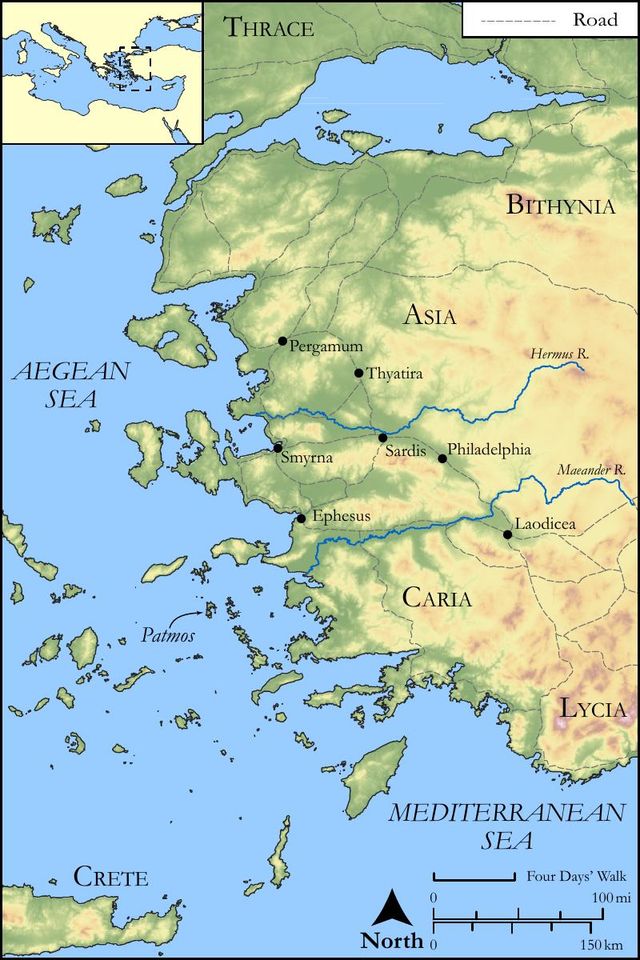
See on the biblical-era maps

Study this verse
Public-domain commentary
Matthew Henry
From his Commentary on the Whole Bible. Henry comments on passages, not single verses — this entry covers Revelation 6:3–8. His three-level outline is real structure in the source text, so it is rendered as structure.
The next three seals give us a sad prospect of great and desolating judgments with which God punishes those who either refuse or abuse the everlasting gospel. Though some understand them of the persecutions that befell the church of Christ, and others of the destruction of the Jews, they rather seem more generally to represent God's terrible judgments, by which he avenges the quarrel of his covenant upon those who make light of it.
I.Upon opening the second seal, to which John was called to attend, another horse appears, of a different colour from the former, a red horse, Rev 6:4. This signifies the desolating judgment of war; he that sat upon this red horse had power to take peace from the earth, and that the inhabitants of the earth should kill one another. Who this was that sat upon the red horse, whether Christ himself, as Lord of hosts, or the instruments that he raised up to conduct the war, is not clear; but this is certain,
1.That those who will not submit to the bow of the gospel must expect to be cut in sunder by the sword of divine justice.
2.That Jesus Christ rules and commands, not only in the kingdom of grace, but of providence. And,
3.That the sword of war is a dreadful judgment; it takes away peace from the earth, one of the greatest blessings, and it puts men upon killing one another. Men, who should love one another and help one another, are, in a state of war, set upon killing one another.
II.Upon opening the third seal, which John was directed to observe, another horse appears, different from the former, a black horse, signifying famine, that terrible judgment; and he that sat on the horse had a pair of balances in his hand (Rev 6:5), signifying that men must now eat their bread by weight, as was threatened (Lev 26:26), They shall deliver your bread to you by weight. That which follows in Rev 6:6, of the voice that cried, A measure of wheat for a penny, and three measures of barley for a penny, and see thou hurt not the oil and the wine, has made some expositors think this was not a vision of famine, but of plenty; but if we consider the quantity of their measure, and the value of their penny, at the time of this prophecy, the objection will be removed; their measure was but a single quart, and their penny was our sevenpence-halfpenny, and that is a large sum to give for a quart of wheat. However, it seems this famine, as all others, fell most severely upon the poor; whereas the oil and the wine, which were dainties of the rich, were not hurt; but if bread, the staff of life, be broken, dainties will not supply the place of it. Here observe,
1.When a people loathe their spiritual food, God may justly deprive them of their daily bread.
2.One judgment seldom comes alone; the judgment of war naturally draws after it that of famine; and those who will not humble themselves under one judgment must expect another and yet greater, for when God contends he will prevail. The famine of bread is a terrible judgment; but the famine of the word is more so, though careless sinners are not sensible of it.
III.Upon opening the fourth seal, which John is commanded to observe, there appears another horse, of a pale colour. Here observe,
1.The name of the rider - Death, the king of terrors; the pestilence, which is death in its empire, death reigning over a place or nation, death on horseback, marching about, and making fresh conquests every hour.
2.The attendants or followers of this king of terrors - hell, a state of eternal misery to all those who die in their sins; and, in times of such a general destruction, multitudes go down unprepared into the valley of destruction. It is an awful thought, and enough to make the whole world to tremble, that eternal damnation immediately follows upon the death of an impenitent sinner. Observe,
(1.)There is a natural as well as judicial connection between one judgment and another: war is a wasting calamity, and draws scarcity and famine after it; and famine, not allowing men proper sustenance, and forcing them to take that which is unwholesome, often draws the pestilence after it.
(2.)God's quiver is full of arrows; he is never at a loss for ways and means to punish a wicked people.
(3.)In the book of God's counsels he has prepared judgments for scorners as well as mercy for returning sinners.
(4.)In the book of the scriptures God has published threatenings against the wicked as well as promises to the righteous; and it is our duty to observe and believe the threatenings as well as the promises.
IV.After the opening of these seals of approaching judgments, and the distinct account of them, we have this general observation, that God gave power to them over the fourth part of the earth, to kill with the sword, and with hunger, and with death, and with the beasts of the earth, Rev 6:8. He gave them power, that is, those instruments of his anger, or those judgments themselves; he who holds the winds in his hand has all public calamities at his command, and they can only go when he sends them and no further than he permits. To the three great judgments of war, famine, and pestilence, is here added the beasts of the earth, another of God's sore judgments, mentioned Eze 14:21, and mentioned here the last, because, when a nation is depopulated by the sword, famine, and pestilence, the small remnant that continue in a waste and howling wilderness encourage the wild beasts to make head against them, and they become easy prey. Others, by the beasts of the field, understand brutish, cruel, savage men, who, having divested themselves of all humanity, delight to be the instruments of the destruction of others.
Historical interpretation
Seven Centuries of Reception
6 surviving comments on this verse. Each one is dated, so this reads as a timeline rather than a list.
Select a marker to jump to its quote. Markers stagger vertically where authors wrote within a few decades of each other.
"And when He had opened the second seal, I heard the second living creature saying, Come and see. And there went out another horse that was red, and to him that sate upon him was given a great sword." The red horse, and he that sate upon him, having a sword, signify the coming wars, as we read in the Gospel: "For nation shall rise against nation, and kingdom against kingdom; and there shall be great earthquakes in divers places." This is the ruddy horse.
The same words of exhortation to “come and see” are repeated, but for a different reason. The white horse is portrayed as good, but the red horse is portrayed as evil. Just as in regard to the good, joy is promised for the church’s victory, so here there is a warning against evil from a foreknowledge of the future.
I suppose that the second living creature is the bull to depict the sacred sacrifices of the holy martyrs, since the first [creature] signified the apostolic authority.
And when he had opened the second seal, I heard the second living creature, etc. We are also commanded to diligently observe the opposing cavalry, so that just as joy is taken from the Church's successes, caution is taken from foreknowledge of adversities.
And when he had opened the second seal, I heard the second living creature, saying: Come, and see. What does it mean that a similar command is given in a dissimilar situation, if not that concern for the future struggle is here given in the same way as joy for the achieved victory was above?
But secondly, there is the blessing of Christ to us, who opened the second seal of the little scroll, and added to us the release of our shame, restoring to us the divine vision; He was tempted as the Lord and overcame the tempter so that He might show not only victory but also that the adversary was defeated. The adversary did not bite the heel of the rider nor trip up our steps (Ps. 140:4) according to God's commandments, but rather, falling backward and being sent away in servitude, and hearing from the Man whom he wrestled with long ago, even though God was in Him, He said, "Depart, Satan," (Matt. 4:10) and Satan went away in shame. And now, for the first time, the adversary knowing his own weakness, he who boasts of sitting above the clouds on his throne, will be made like the Most High, imagining himself according to what was described by Isaiah. (Isa. 14:13-14)
When it happened, a fiery red horse came out, led by one of the holy creatures; and to the one sitting on the horse it was given the power to take peace from the earth so that people would kill one another, and a great sword was given to him. The fiery red horse is a riddle [αἴνιγμα] of blood; therefore, a sword is given to the one seated upon it, by which to destroy and divide the unity of those on earth toward evil. They were united in their idolatry and so that they might kill one another; that is, to destroy each other through hostile contracts. For the Lord "did not come to bring peace upon the earth, but a sword; and to set a son against his father, and a daughter-in-law against her mother-in-law," (Matt. 10:34-35) the new and godly against the ancient and condemned.
Continue studying Revelation 6:3 across the web’s major study libraries — every link below opens this exact verse, chapter, or book on the destination site.
Read & Compare
 BibleGatewayThis verse in more than 200 translations and 70 languages.
 Bible.comThe YouVersion reader — hundreds of translations, reading plans, and highlights.
 ESV.orgCrossway's official English Standard Version reader.
 NET BibleThe NET translation with 60,000+ translators' notes on every rendering decision.
 STEP BibleTyndale House's free study tool — original text, vocabulary, and scholarly resources.
 BibliaLogos Bible Software's free web reader.
 USCCBThe New American Bible (Revised Edition) with the U.S. bishops' study notes.
Commentaries
 BibleHub CommentariesDozens of classic commentaries on this verse, gathered on one page.
 StudyLightMore than 100 commentary sets — the largest collection on the web.
 BibleRefPlain-English commentary on what this verse means, verse by verse.
 Enduring WordDavid Guzik's free commentary on this chapter, widely used by Bible teachers.
 Bible Study ToolsVerse commentary alongside Greek and Hebrew study aids.
Original Language & Research
- BibleHub InterlinearThe verse word by word — original language, transliteration, and English.
- BibleHub LexiconEvery word's original-language definition and Strong's entry.
 Blue Letter BibleDeep-study tools — Strong's numbers, concordance, and word studies.
 CNTR CollationThe earliest Greek manuscripts of this verse, collated letter by letter.
Sermons, Hymns & Audio


TrulyRandomVerse is not affiliated with these sites and doesn’t control their content. They’re linked because they’re genuinely useful.
Summary
Revelation 6:3 describes the pivotal moment when the Lamb opens the second of seven seals, initiating a new phase of divine judgment upon the earth. Following the appearance of the rider on the white horse, this verse sets the stage for the next dramatic revelation, as John hears one of the four living creatures summon him to witness the unfolding events, signaling an escalation in the prophetic narrative of the end times.
Context
ShowHideLiterary Context
This verse is an integral part of the "Seal Judgments" found in Revelation chapter 6. It directly follows the opening of the first seal and the appearance of the rider on the white horse in Revelation 6:1-2. The sequential opening of these seals by the Lamb signifies a divinely orchestrated series of events leading to the consummation of God's plan. The immediate consequence of this second seal's opening is revealed in Revelation 6:4, which depicts the rider on a fiery red horse, symbolizing widespread war and the removal of peace from the earth. The recurring phrase "Come and see" connects this second seal to the preceding and subsequent seal openings, creating a rhythmic and urgent progression of divine revelation.
Historical & Cultural Context
The book of Revelation was written by John, likely during the reign of Emperor Domitian (c. AD 95), a period marked by intense persecution of Christians in the Roman Empire. The imagery of seals, scrolls, and beasts would have resonated with readers familiar with Old Testament prophetic literature (e.g., Daniel, Ezekiel) and contemporary apocalyptic writings. The concept of a sealed scroll often represented a divine decree or a book of destiny, whose contents could only be revealed by one with ultimate authority. The "beast" or living creature here is one of the four described in Revelation 4:6-8, which are celestial beings surrounding God's throne, serving as guardians of His holiness and heralds of His judgments. Their presence underscores the divine origin and eternal significance of these unfolding events.
Key Themes
ShowHideThe opening of the second seal contributes significantly to several major themes within Revelation. Firstly, it powerfully reinforces the theme of Divine Sovereignty and Judgment. The Lamb's systematic opening of each seal demonstrates God's absolute control over human history, even amidst chaos and tribulation. Secondly, it highlights the Escalation of Judgment, as each successive seal introduces a new, often more severe, form of divine wrath upon a rebellious world. While the first seal might represent conquest or a false peace, the second immediately ushers in widespread conflict and violence, as seen in Revelation 6:4. Thirdly, the repeated invitation "Come and see" (also found in Revelation 6:1, 6:5, and 6:7) emphasizes the Unveiling of Prophecy and the direct, visual nature of John's revelatory experience, underscoring the certainty and reality of these future events.
Exposition and Analysis
ShowHideKey Word Analysis
ShowHideThis word, derived from the comparative of "two," signifies not merely a numerical position but also a sequential progression in time and order. In the context of the seals, it indicates the next stage in God's unfolding judgments, building upon the previous event. Its use here emphasizes the structured and intentional nature of the apocalyptic revelations.
This term refers to a "live thing" or "living creature," rather than a wild animal or monstrous entity (for which other Greek words are used in Revelation, like thērion). In Revelation 4:6-8, these "living creatures" are described as cherubic or seraphic beings surrounding God's throne, full of eyes, and proclaiming God's holiness. Their role as heralds of the seals underscores the divine authority behind the judgments.
This primary verb means "to hear" in various senses, including to give audience, understand, or be reported. John's act of hearing is crucial to the revelatory process, as it signifies his reception of divine communication. It emphasizes that these events are not merely visions but are accompanied by authoritative declarations from the heavenly realm, confirming their significance and reality.
Verse Breakdown
ShowHide"And when he had opened the second seal"
This clause highlights the active role of the Lamb (Jesus Christ) as the sole agent capable of initiating these apocalyptic events. The "second seal" marks a distinct phase in the judgments, indicating a progression from the first. The opening of the seal signifies the revelation of its contents and the commencement of the associated judgment, which in this case, involves the unleashing of war and conflict.
"I heard the second beast say, Come and see"
John, the recipient of the vision, is the one who hears. The "second beast" (one of the four living creatures from Revelation 4:6-8) acts as a divine herald, summoning John's attention to the next scene. The imperative "Come and see" is a direct command, urging John to observe closely what is about to unfold. This phrase serves as a dramatic transition, drawing the reader's attention along with John's to the impending revelation of the red horse and its rider.
Literary Devices
ShowHideThe verse employs several significant literary devices. Repetition is evident in the recurring phrase "second seal" and "second beast," which not only marks the sequential nature of the events but also creates a rhythmic progression that builds anticipation. The command "Come and see" is also a form of Repetition, appearing with each of the first four seals, reinforcing the urgency and importance of John's observation. Symbolism is central, with the "seal" representing a divinely ordained decree or a hidden truth about to be revealed, and the "beast" (living creature) symbolizing a celestial being with a specific role in God's throne room. The act of the living creature speaking is a form of Anthropomorphism, attributing human-like speech to a non-human, spiritual entity, thereby emphasizing its communicative role in the divine drama.
Theological and Thematic Connections
ShowHideRevelation 6:3 underscores the profound truth of God's sovereign control over history and His unwavering commitment to bringing His purposes to fruition. The Lamb's authority to open the seals demonstrates that even the most chaotic and destructive events are not random but are part of a divinely ordained plan. This passage reminds us that judgment is an integral aspect of God's character, a necessary response to human rebellion and sin. It prepares the reader for the escalating intensity of tribulation, yet always within the framework of God's ultimate power and justice. The "Come and see" invitation is not just for John but for all who read, urging us to witness the unfolding of God's righteous judgments and to recognize His hand in all things.
Reflection and Application
ShowHideRevelation 6:3, though depicting a moment of impending judgment, offers profound reassurance to the believer. The fact that the Lamb, Jesus Christ, is the one opening the seals signifies that all events, even those that bring tribulation and chaos, are under His divine control and serve His ultimate purposes. This understanding should cultivate a deep sense of trust and peace, knowing that our God is sovereign over all history, from its beginning to its glorious end. In a world often marked by conflict and instability, this verse calls us to remember that no event is outside of God's purview. It encourages us to live with a posture of watchfulness, not out of fear, but out of an eager anticipation for Christ's return and the final establishment of His kingdom. Our response should be one of faithful endurance, actively participating in God's mission while patiently awaiting His perfect timing for the consummation of all things.
Questions for Reflection
ShowHideFAQ
ShowHideWho is the "second beast" mentioned in Revelation 6:3, and what is its role?
ShowHideThe "second beast" in Revelation 6:3 refers to one of the four living creatures (Greek: zōa) described in Revelation 4:6-8. These are not the "beast from the sea" or "beast from the earth" mentioned later in Revelation (e.g., Revelation 13:1), which are symbolic of oppressive political or religious powers. Instead, the living creatures are celestial beings, often identified with the cherubim or seraphim of Old Testament prophecy (Ezekiel 1:5-12). Their role in Revelation is to surround God's throne, worship Him continually, and serve as divine heralds. In the context of the seals, each of the first four living creatures calls out "Come and see," summoning John to witness the unfolding judgments. This signifies that the judgments are not random but are divinely sanctioned and announced from the very presence of God.
Christ-Centered Fulfillment
ShowHideRevelation 6:3, though initiating a sequence of judgments, finds its ultimate Christ-centered fulfillment in the Lamb's absolute authority and His role as the sovereign King and Judge. The Lamb, explicitly identified as Jesus Christ (Revelation 5:5-6), is the only one found worthy to open the sealed scroll, demonstrating His unique qualification to execute God's plan for history and redemption. His opening of the second seal foreshadows His future reign and judgment, as prophesied in passages like John 5:22, where Jesus states, "For the Father judges no one, but has given all judgment to the Son." This act by the Lamb affirms that even the unfolding of tribulation and the escalation of judgment are under the precise control of the one who was slain and has triumphed, ensuring that all things work towards His ultimate glory and the establishment of His righteous kingdom (Philippians 2:9-11). Thus, the chaos unleashed by the second seal is not arbitrary but serves the redemptive purposes of the Lamb, who will ultimately bring all things to their just and glorious conclusion, culminating in His final victory and the new creation (Revelation 21:1-4).