


Numbers 13:6
Bible text: King James Version (1769 Blayney text) · Public domain
Bible text: Berean Standard Bible · Public domain
Bible text: American Standard Version (1901) · Public domain
Bible text: World English Bible, Messianic edition · Public domain
Bible text: Geneva Bible (1599) · Public domain
Bible text: Young's Literal Translation · Public domain
- לְמַטֵּהle·ma·Tehfor [the] tribe ofH4294Prep-l ¦ N-mscNoun Singular Masculine Constructלְforמַטֵּה[the] tribe of
- יְהוּדָהye·hu·DahJudahH3063N-properNoun Proper Location
- כָּלֵבka·LevCalebH3612N-proper-mNoun Proper Masculine
- בֶּןben[the] son ofH1121N-mscNoun Singular Masculine Construct
- יְפֻנֶּהye·fu·NehJephunnehH3312N-proper-mNoun Proper Masculine
English is a literal word-by-word gloss of the Hebrew, not the KJV's wording. Why?
This is the original text the KJV's translators worked from — each Hebrew word with its own literal English meaning in this verse, prepared by scholars at Tyndale House, Cambridge. The KJV translates whole sentences, not word by word, so its wording differs: one Hebrew word can become several English words, and the KJV may choose “the LORD” where the gloss reads “Yahweh”. Both are faithful — they answer different questions. For the KJV's own rendering, switch to the KJV text.
Details
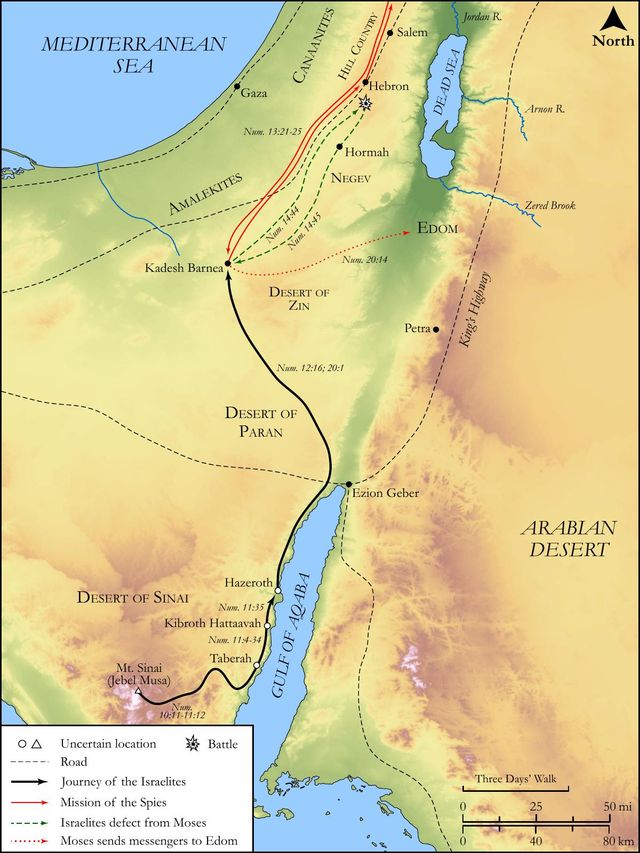
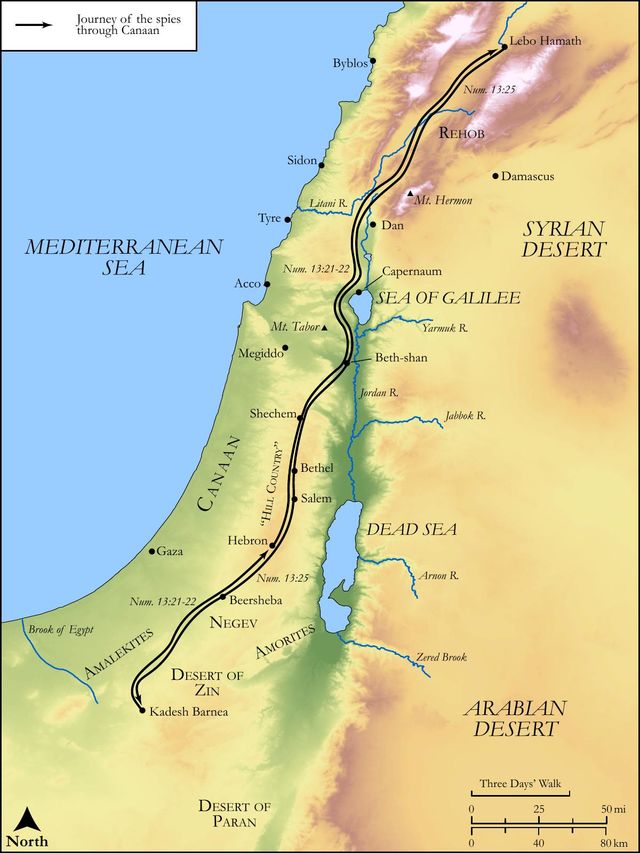
See on the biblical-era maps
Study this verse
Public-domain commentary
Matthew Henry
From his Commentary on the Whole Bible. Henry comments on passages, not single verses — this entry covers Numbers 13:1–20. His two-level outline is real structure in the source text, so it is rendered as structure.
Here we have, I. Orders given to send spies to search out the land of Canaan. It is here said, God directed Moses to send them (Num 13:1, Num 13:2), but it appears by the repetition of the story afterwards (Deu 1:22) that the motion came originally from the people; they came to Moses, and said, We will send men before us; and it was the fruit of their unbelief. They would not take God's word that it was a good land, and that he would, without fail, put them in possession of it. They could not trust the pillar of cloud and fire to show them the way to it, but had a better opinion of their own politics than of God's wisdom. How absurd was it for them to send to spy out a land which God himself had spied out for them, to enquire the way into it when God himself had undertaken to show them the way! But thus we ruin ourselves by giving more credit to the reports and representations of sense than to divine revelation; we walk by sight, not by faith; whereas, if we will receive the witness of men, without doubt the witness of God is greater. The people making this motion to Moses, he (perhaps not aware of the unbelief at the bottom of it) consulted God in the case, who bade him gratify the people in this matter, and send spies before them: "Let them walk in their own counsels." Yet God was no way accessory to the sin that followed, for the sending of these spies was so far from being the cause of the sin that if the spies had done their duty, and the people theirs, it might have been the confirmation of their faith, and of good service to them.
II.The persons nominated that were to be employed in this service (Num 13:4, etc.), one of each tribe, that it might appear to be the act of the people in general; and rulers, person of figure in their respective tribes, some of the rulers of thousands or hundreds, to put the greater credit upon their embassy. This was designed for the best, but it proved to have this ill effect that the quality of the persons occasioned the evil report they brought up to be the more credited and the people to be the more influenced by it. Some think that they are all named for the sake of two good ones that were among them, Caleb and Joshua. Notice is taken of the change of Joshua's name upon this occasion, Num 13:16. He was Moses's minister, but had been employed, though of the tribe of Ephraim, as general of the forces that were sent out against Amalek. The name by which he was generally called and known in his own tribe was Oshea, but Moses called him Joshua, in token of his affection to him and power over him; and now, it should seem, he ordered others to call him so, and fixed that to be his name henceforward. Oshea signifies a prayer for salvation, Save thou; Joshua signifies a promise of salvation, He will save, in answer to that prayer: so near is the relation between prayers and promises. Prayers prevail for promises, and promises direct and encourage prayers. Some think that Moses designed, by taking the first syllable of the name Jehovah and prefixing it to his name, which turned Hoshea into Jehoshua, to put an honour upon him, and to encourage him in this and all his future services with the assurances of God's presence. Yet after this he is called Hoshea, Deu 32:44. Jesus is the same name with Joshua, and it is the name of our Lord Christ, of whom Joshua was a type as successor to Moses, Israel's captain, and conqueror of Canaan. There was another of the same name, who was also a type of Christ, Zac 6:11. Joshua was the saviour of God's people from the powers of Canaan, but Christ is their Saviour from the powers of hell.
III.The instructions given to those spies.
They were sent into the land of Canaan the nearest way, to traverse the country, and to take account of its present state, Num 13:17. Two heads of enquiry were given them in charge,
1.Concerning the land itself: See what that is (Num 13:18, and again, Num 13:19), see whether it be good or bad, and (Num 13:20) whether it be fat or lean. All parts of the earth do not share alike in the blessing of fruitfulness; some countries are blessed with a richer soil than others. Moses himself was well satisfied that Canaan was a very good land, but he sent these spies to bring an account of it for the satisfaction of the people; as John Baptist sent to Jesus, to ask whether he was the Christ, not to inform himself, but to inform those he sent. They must take notice whether the air was healthful or no, what the soil was, and what the productions; and, for the better satisfaction of the people, they must bring with them some of the fruits.
2.Concerning the inhabitants - their number, few or many - their size and stature, whether strong able-bodied men or weak, - their habitations, whether they lived in tents or houses, whether in open villages or in walled towns, - whether the woods were standing as in those countries that are uncultivated, through the unskillfulness and slothfulness of the inhabitants, or whether the woods were cut down, and the country made champaign, for the convenience of tillage. These were the things they were to enquire about. Perhaps there had not been of late years such commerce between Egypt and Canaan as there was in Jacob's time, else they might have informed themselves of these things without sending men on purpose to search. See the advantage we may derive from books and learning, which acquaint those that are curious and inquisitive with the state of foreign countries, at a much greater distance than Canaan was now from Israel, without this trouble and expense.
IV.Moses dismisses the spies with this charge, Be of good courage, intimating, not only that they should be themselves encouraged against the difficulties of this expedition, but that they should bring an encouraging account to the people and make the best of every thing. It was not only a great undertaking they were put upon, which required good management and resolution, but it was a great trust that was reposed in them, which required that they should be faithful.
Continue studying Numbers 13:6 across the web’s major study libraries — every link below opens this exact verse, chapter, or book on the destination site.
Read & Compare
 BibleGatewayThis verse in more than 200 translations and 70 languages.
 Bible.comThe YouVersion reader — hundreds of translations, reading plans, and highlights.
 ESV.orgCrossway's official English Standard Version reader.
 NET BibleThe NET translation with 60,000+ translators' notes on every rendering decision.
 STEP BibleTyndale House's free study tool — original text, vocabulary, and scholarly resources.
 BibliaLogos Bible Software's free web reader.
 USCCBThe New American Bible (Revised Edition) with the U.S. bishops' study notes.
Commentaries
 BibleHub CommentariesDozens of classic commentaries on this verse, gathered on one page.
 StudyLightMore than 100 commentary sets — the largest collection on the web.
 BibleRefPlain-English commentary on what this verse means, verse by verse.
 Enduring WordDavid Guzik's free commentary on this chapter, widely used by Bible teachers.
 Bible Study ToolsVerse commentary alongside Greek and Hebrew study aids.
Original Language & Research
- BibleHub InterlinearThe verse word by word — original language, transliteration, and English.
- BibleHub LexiconEvery word's original-language definition and Strong's entry.
 Blue Letter BibleDeep-study tools — Strong's numbers, concordance, and word studies.
 SefariaThe Hebrew text with Rashi and centuries of Jewish commentary.
Sermons, Hymns & Audio


TrulyRandomVerse is not affiliated with these sites and doesn’t control their content. They’re linked because they’re genuinely useful.
Summary
Numbers 13:6 introduces Caleb, son of Jephunneh, from the tribe of Judah, as one of the twelve chosen leaders to scout the land of Canaan. This concise identification is foundational, setting the stage for his distinct and pivotal role as one of only two spies who would return with a faithful report, demonstrating unwavering trust in God's promises amidst widespread fear and doubt. This initial mention foreshadows his exceptional character and future significance in the conquest and inheritance of the Promised Land.
Context
ShowHideLiterary Context
Numbers 13 marks a crucial juncture in the Israelites' wilderness journey, transitioning from their organizational and legal preparations at Mount Sinai to the imminent challenge of entering the Promised Land. The preceding chapters detail the census, tribal arrangements, and various laws, all designed to prepare the nation for its destiny. The divine command to send spies, initiated by God to Moses in Numbers 13:1-2, is not merely a reconnaissance mission but a test of faith for the nascent nation. The subsequent list of tribal leaders, including Caleb in this verse, serves to formally introduce the individuals whose actions will profoundly impact Israel's future. The narrative immediately following, particularly in Numbers 14, starkly contrasts the unwavering faith of Caleb and Joshua with the unbelief of the other ten spies and the people, leading directly to the forty-year wilderness wandering.
Historical & Cultural Context
The events of Numbers unfold during the Israelites' exodus from Egypt, typically dated to the mid-15th century BC. This period saw a tribal society where lineage, family, and tribal affiliation were paramount for identity, social standing, and authority. Each tribe was represented by its designated leaders, often elders or chiefs, who acted on behalf of their people. The practice of sending scouts or spies (Hebrew: meraggelim) to assess enemy territory was a common and critical military strategy among the nations. Such missions were essential for understanding the terrain, resources, and defenses of a land before launching a conquest. The land of Canaan was populated by various indigenous groups, notably the Anakim, renowned for their formidable stature and strength, which instilled significant fear in the spies and the Israelite populace, as vividly described in Numbers 13:28-33.
Key Themes
ShowHideThe introduction of Caleb in Numbers 13:6 significantly contributes to several overarching themes within the book of Numbers and the Pentateuch. Firstly, it highlights the theme of Divine Command and Human Response, where God initiates a mission, but its successful outcome is contingent upon the people's obedience and faith. Secondly, it underscores Leadership and Representation, as these chosen men were not mere individuals but embodied their respective tribes, and their actions would carry national consequences. Thirdly, and most profoundly for Caleb, this verse sets the stage for the central theme of Faithfulness vs. Unbelief. While only named here, Caleb's subsequent actions in Numbers 14:6-9 exemplify unwavering faith in God's promises, standing in stark contrast to the widespread fear and doubt that gripped the majority. Finally, Caleb's tribal affiliation with Judah foreshadows the Significance of the Tribe of Judah in Israel's history, a tribe destined for kingship and from which the Messiah would ultimately come, as prophesied in Genesis 49:10.
Exposition and Analysis
ShowHideKey Word Analysis
ShowHideAccording to the Strong's data, the name "Caleb" is "perhaps a form of כֶּלֶב (kelev), or else from the same root in the sense of forcible." While often popularly associated with the Hebrew word for "dog" (implying loyalty or devotion) or even a proposed root meaning "whole-hearted," the Strong's definition points to a potential connection to "forcible" or simply identifies him as one of three Israelites bearing this name. Regardless of the precise etymology, Caleb's character throughout the biblical narrative consistently demonstrates a forceful, unwavering commitment to God, aligning with the "whole-hearted" interpretation often applied to him, as seen in passages like Numbers 14:24 and Deuteronomy 1:36.
Derived from a root meaning "he will be prepared," this patronymic identifies Caleb's father. In ancient Israelite society, the father's name was crucial for establishing an individual's lineage and distinguishing them within the broader tribal structure. While the meaning of "Jephunneh" does not directly comment on Caleb's character, it serves the vital function of precisely locating Caleb within his family, confirming his identity and legitimacy as a tribal representative selected for this significant mission.
From a root meaning "celebrated," Judah was the fourth son of Jacob and Leah. The Strong's data notes that it refers to "Jehudah (or Judah), the name of five Israelites; also of the tribe descended from the first, and of its territory." The tribe of Judah would become the most prominent and powerful in Israelite history, destined to produce the line of kings, including David, and ultimately the Messiah. Caleb's affiliation with this tribe elevates his significance, implicitly connecting his faithfulness to the future leadership and redemptive purposes associated with Judah.
Verse Breakdown
ShowHide"Of the tribe of Judah"
This opening phrase immediately establishes Caleb's tribal affiliation, which was foundational to identity, status, and authority in ancient Israel. The tribe of Judah held a preeminent position, having received a patriarchal blessing from Jacob that foretold its future leadership and the coming of a scepter-bearer. Caleb's representation of this powerful tribe underscores his own importance and the weight of the mission he was entrusted with on behalf of his people.
"Caleb the son of Jephunneh"
This clause provides the precise personal identification of the individual. By naming Caleb and his father, the text firmly places him within his specific family unit and tribal lineage. This detail was essential for confirming his legitimate selection as a leader among his people, chosen for a mission of national significance. It also serves to distinguish him and to mark him as an individual whose actions will be particularly noteworthy in the unfolding narrative of Israel's journey.
Literary Devices
ShowHideNumbers 13:6, despite its brevity, employs several subtle yet effective literary devices. The verse functions as part of a Nominal Listing, a common biblical technique used to formally introduce characters or groups, thereby lending authority, historical accuracy, and narrative weight. In this specific context, the list of spies serves as a formal roll call of those entrusted with a critical national mission. More significantly, the mere mention of Caleb's name here acts as a powerful instance of Foreshadowing. Without explicitly detailing his future deeds, the text implicitly sets him apart for readers familiar with the broader biblical narrative. His name, particularly if understood as "whole-hearted," becomes a Symbol of unwavering faith and devotion, contrasting sharply with the fear and unbelief that will characterize the majority of the spies and the nation. This implicit contrast is further developed through Juxtaposition, as Caleb's name is listed among others who will ultimately fail the test of faith, highlighting his unique character even before his actions are fully detailed.
Theological and Thematic Connections
ShowHideThe concise mention of Caleb in Numbers 13:6, while seemingly a simple identification, carries profound theological weight. It introduces an individual whose life would become a powerful testament to the transformative power of unwavering faith and wholehearted devotion to God. In a narrative frequently marked by Israel's rebellion, complaining, and unbelief, Caleb emerges as a radiant beacon of trust in God's promises, even when confronted with seemingly insurmountable obstacles. His selection as a leader from the prominent tribe of Judah suggests God's sovereign hand in raising up specific individuals for particular purposes within His grand redemptive plan. Caleb's story powerfully demonstrates that faithfulness, rather than mere lineage or numerical strength, is the key to receiving God's blessings and fulfilling His divine will. His life serves as a timeless example that God honors those who fully commit to Him, granting them strength, perseverance, and a promised inheritance even when others falter.
Reflection and Application
ShowHideCaleb's introduction in Numbers 13:6, though concise, serves as a powerful reminder that true character is often revealed not in grand pronouncements, but in simple, foundational identifications that set the stage for future actions. His subsequent life demonstrates that genuine leadership and spiritual vitality are marked by a wholehearted commitment to God, even when the majority succumbs to fear and doubt. For believers today, Caleb's example urges us to examine our own hearts: are we truly "whole-hearted" in our devotion to the Lord, or do we allow circumstances, popular opinion, or the perceived strength of our "giants" to sway our faith? His unwavering trust in God's ability to overcome any obstacle, even the formidable Anakim, challenges us to stand firm on God's promises, to cultivate courage in the face of daunting challenges, and to trust that God will honor our faithfulness. By emulating Caleb's steadfastness, we can anticipate being led into the "promised land" of God's blessings and purposes for our lives, experiencing the fulfillment of His divine promises.
Questions for Reflection
ShowHideFAQ
ShowHideWhy is Caleb specifically mentioned as "the son of Jephunneh"?
ShowHideIn ancient Israelite society, lineage was paramount for establishing identity, authority, and tribal affiliation. Mentioning "the son of Jephunneh" precisely identifies Caleb within his family unit and tribal structure, confirming his legitimacy as a representative of the tribe of Judah. This detail was not merely for record-keeping but underscored his standing and the weight of his selection for such a critical mission. It also served to distinguish him from any other individuals who might have shared the name Caleb, ensuring clarity in a culture where names were often repeated.
What makes Caleb so important in the Bible?
ShowHideCaleb is pivotal because he, along with Joshua, was one of only two spies who brought back a positive and faithful report from the land of Canaan, despite the formidable challenges presented by its inhabitants. While the other ten spies and the entire nation succumbed to fear and unbelief, Caleb courageously declared, "We should go up at once and take possession, for we are well able to overcome it" (Numbers 13:30). His unwavering faith stood in stark contrast to the widespread rebellion, leading to God's promise that he alone, along with Joshua, would enter the Promised Land, unlike the rest of his disobedient generation. He later received Hebron as his inheritance, a testament to God's faithfulness to those who "wholly followed the Lord" (Numbers 14:24).
Is Caleb related to Judah by birth, or is he adopted into the tribe?
ShowHideThe text explicitly states, "Of the tribe of Judah," indicating his tribal affiliation by descent. While some Jewish traditions and scholarly interpretations suggest Caleb might have been a Kenizzite (a non-Israelite group mentioned in Genesis 15:19) who was integrated into the tribe of Judah, the biblical narrative consistently presents him as a full and legitimate member of the tribe of Judah. This highlights the capacity for integration and the importance of faithfulness within the tribal structure, regardless of potential ancestral origins, as Caleb fully embraced his identity and role within Israel.
Christ-Centered Fulfillment
ShowHideCaleb's wholehearted faithfulness and unwavering trust in God's promises serve as a powerful Old Testament type pointing to the perfect obedience and ultimate victory of Jesus Christ. Just as Caleb stood as a faithful remnant against the unbelief of his generation, Jesus perfectly fulfilled God's will, demonstrating complete trust in the Father even unto death on the cross (Philippians 2:8). Caleb's courage to face the formidable giants in the land of Canaan (Numbers 13:33), believing God would give Israel victory, powerfully foreshadows Christ's ultimate triumph over the spiritual "giants" of sin, death, and the devil, securing our eternal access to the true and eternal inheritance (Colossians 2:15). Caleb's inheritance of the Promised Land, granted by God because he "wholly followed the Lord" (Numbers 14:24), prefigures the ultimate inheritance of eternal life and the new heavens and new earth that is granted to all who, by faith, follow the true Son of David, our Messiah. He is the one who truly leads His people into their promised rest, not by human strength or partial obedience, but by divine power and perfect faithfulness, securing for us a better and lasting inheritance in the heavenly Canaan (Hebrews 4:8-9).