


Nehemiah 11:9
Bible text: King James Version (1769 Blayney text) · Public domain
Bible text: Berean Standard Bible · Public domain
Bible text: American Standard Version (1901) · Public domain
Bible text: World English Bible, Messianic edition · Public domain
Bible text: Geneva Bible (1599) · Public domain
Bible text: Young's Literal Translation · Public domain
- וְיוֹאֵלve·yo·'Eland JoelH3100Conj-w ¦ N-proper-mNoun Proper MasculineוְandיוֹאֵלJoel
- בֶּןben[the] son ofH1121N-mscNoun Singular Masculine Construct
- זִכְרִיzikh·RiZikriH2147N-proper-mNoun Proper Masculine
- פָּקִידpa·Kid[was] overseerH6496N-msNoun Singular Masculine Absolute
- עֲלֵיהֶם'a·lei·Hemover themH5921Prep ¦ 3mpPrepositionעֲלֵיoverהֶםthem
- וִיהוּדָהvi·hu·Dahand JudahH3063Conj-w ¦ N-properNoun Proper LocationוִandיהוּדָהJudah
- בֶןven[the] son ofH1121N-mscNoun Singular Masculine Construct
- הַסְּנוּאָהha·se·nu·'Ah<the> SenaahH5574Art ¦ N-msNoun Gentilic Singular Masculine Absoluteהַ<the>סְּנוּאָהSenaah
- עַל'aloverH5921PrepPreposition
- הָעִירha·'Irthe cityH5892Art ¦ N-fsNoun Singular Feminine Absoluteהָtheעִירcity
- מִשְׁנֶהmish·Neh[was] second in commandH4932N-msNoun Singular Masculine Absolute
English is a literal word-by-word gloss of the Hebrew, not the KJV's wording. Why?
This is the original text the KJV's translators worked from — each Hebrew word with its own literal English meaning in this verse, prepared by scholars at Tyndale House, Cambridge. The KJV translates whole sentences, not word by word, so its wording differs: one Hebrew word can become several English words, and the KJV may choose “the LORD” where the gloss reads “Yahweh”. Both are faithful — they answer different questions. For the KJV's own rendering, switch to the KJV text.
Details
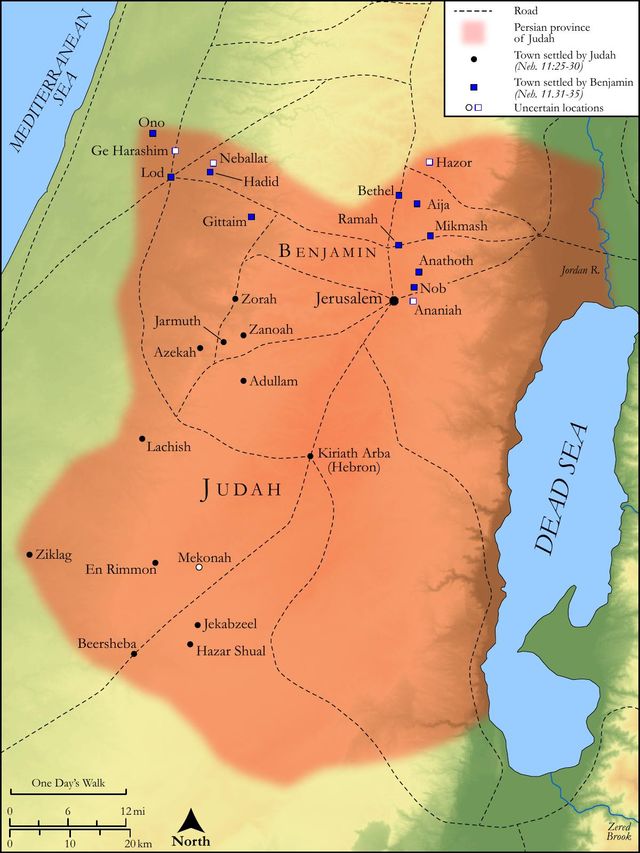
See on the biblical-era map
Study this verse
Public-domain commentary
Matthew Henry
From his Commentary on the Whole Bible. Henry comments on passages, not single verses — this entry covers Nehemiah 11:1–19. His four-level outline is real structure in the source text, so it is rendered as structure.
Jerusalem is called here the holy city (Neh 11:1), because there the temple was, and that was the place God had chosen to put his name there; upon this account, one would think, the holy seed should all have chosen to dwell there and have striven for a habitation there; but, on the contrary, it seems they declined dwelling there, 1. Because a greater strictness of conversation was expected from the inhabitants of Jerusalem than from others, which they were not willing to come up to. Those who care not for being holy themselves are shy of dwelling in a holy city; they would not dwell in the New Jerusalem itself for that reason, but would wish to have a continuing city here upon earth. Or, 2. Because Jerusalem, of all places, was most hated by the heathen their neighbours, and against it their malicious designs were levelled, which made that the post of danger (as the post of honour usually is) and therefore they were not willing to expose themselves there. Fear of persecution and reproach, and of running themselves into trouble, keeps many out of the holy city, and makes them backward to appear for God and religion, not considering that, as Jerusalem is with a special malice threatened and insulted by its enemies, so it is with a special care protected by its God and made a quiet habitation, Isa 33:20; Psa 46:4, Psa 46:5. Or, 3. Because it was more for their worldly advantage to dwell in the country. Jerusalem was no trading city, and therefore there was no money to be got there by merchandise, as there was in the country by corn and cattle. Note, All seek their own, not the things that are Jesus Christ's, Phi 2:21. It is a general and just complaint that most people prefer their own wealth, credit, pleasure, ease, and safety, before the glory of God and the public good. People being thus backward to dwell at Jerusalem, now that it was poor, we are here told,
I.By what means it was replenished.
1.The rulers dwelt there, Neh 11:1. That was the proper place for them to reside in, because there were set the thrones of judgment (Psa 122:5), and thither, in all difficult matters, the people resorted with their last appeals. And if it were an instance of eminent affection to the house of God, zeal for the public good, and of faith, and holy courage, and self-denial, to dwell there at this time, the rulers would be examples of these to their inferiors. Their dwelling there would invite and encourage others to dwell there too. Magnates magnetes - the mighty are magnetic. When great men choose the holy city for their habitation their example brings holiness into reputation, and their zeal will provoke very many.
2.There were some that willingly offered themselves to dwell at Jerusalem, nobly foregoing their own secular interest for the public welfare, Neh 11:2. It is upon record, to their honour, that when others were shy of venturing upon difficulty, loss, and danger, they sought the good of Jerusalem, because of the house of the Lord their God. Those shall prosper that thus love Zion, Psa 122:6, Psa 122:9. It is said, The people blessed them. They praised them; they prayed for them; they praised God for them. Many that do not appear forward themselves for the public good will yet give a good word to those that do. God and man will bless those that are public blessings, which should encourage us to be zealous in doing good.
3.They, finding that yet there was room, concluded upon a review of their whole body to bring one in ten to dwell in Jerusalem; who they should be was determined by lot, the disposal whereof, all knew, was of the Lord. This would prevent strife, and would be a great satisfaction to those on whom the lot fell to dwell at Jerusalem, that they plainly saw God appointing the bounds of their habitation. They observed the proportion of one in ten, as we may suppose, to bring the balance between the city and country to a just and equal poise; so it seems to refer to the ancient rule of giving the tenth to God; and what is given to the holy city he reckons given to himself.
II.By what persons it was replenished.
A general account is here given of the inhabitants of Jerusalem because the governors of Judah looked upon them as their strength in the Lord of hosts their God, and valued them accordingly, Zac 12:5.
1.Many of the children of Judah and Benjamin dwelt there; for, originally, part of the city law in the lot of one of those tribes and part in that of the other; but the greater part was in the lot of Benjamin, and therefore here we find of the children of Judah only 468 families in Jerusalem (Neh 11:6), but of Benjamin 928, Neh 11:7, Neh 11:8. Thus small were its beginnings, but afterwards, before our Saviour's time, it grew much more populous. Those of Judah all descended from Perez, or Pharez, that son of Judah of whom, as concerning the flesh, Christ came. And, though the Benjamites were more in number, yet of the men of Judah it is said (Neh 11:6) that they were valiant men, fit for service, and able to defend the city in case of an attack. Judah has not lost its ancient character of a lion's whelp, bold and daring. Of the Benjamites that dwelt in Jerusalem we are here told who was overseer, and who was second, Neh 11:9. For it is as necessary for a people to have good order kept up among themselves as to be fortified against the attacks of their enemies from abroad, to have good magistrates as to have good soldiers.
2.The priests and Levites did many of them settle at Jerusalem; where else should men that were holy to God dwell, but in the holy city?
(1.)Most of the priests, we may suppose, dwelt there, for their business lay where the temple was. Of those that did the work of the house in their courses here were 822 of one family, 242 of another, and 128 of another, Neh 11:12-14. It was well that those labourers were not few. It is said of some of them that they were mighty men of valour (Neh 11:14); it was necessary that they should be so, for the priesthood was not only a work, which required might, but a warfare, which required valour, especially now. Of one of these priests it is said that he was the son of one of the great men. It was no disparagement to the greatest man they had to have his son in the priesthood; he might magnify his office, for his office did not in the least diminish him.
(2.)Some of the Levites also came and dwelt at Jerusalem, yet but few in comparison, 284 in all (Neh 11:18), with 172 porters (Neh 11:19), for much of their work was to teach the good knowledge of God up and down the country, for which purpose they were to be scattered in Israel. As many as there was occasion for attended at Jerusalem; the rest were doing good elsewhere.
[1.]It is said of one of the Levites that he had the oversight of the outward business of the house of God, Neh 11:16. The priests were chief managers of the business within the temple gates; but this Levite was entrusted with the secular concerns of God's house, that were in ordine ad spiritualia - subservient to its spiritual concerns, the collecting of the contributions, the providing of materials for the temple service, and the like, which it was necessary to oversee, else the inward business would have been starved and have stood still. Those who take care of the ta exō the outward concerns of the church, the serving of its tables, are as necessary in their place as those who take care of its ta esō its inward concerns, who give themselves to the word and prayer.
[2.]It is said of another that he was the principal to begin the thanksgiving in prayer. Probably he had a good ear and a good voice, and was a scientific singer, and therefore was chosen to lead the psalm. He was precentor in the temple. Observe, Thanksgiving is necessary in prayer; they should go together; giving thanks for former mercies is a becoming way of begging further mercies. And care should be taken in public service that every thing be done in the best manner, decently and in good order - in prayer, that one speak and the rest join-in singing, that one begin and the rest follow.
Continue studying Nehemiah 11:9 across the web’s major study libraries — every link below opens this exact verse, chapter, or book on the destination site.
Read & Compare
 BibleGatewayThis verse in more than 200 translations and 70 languages.
 Bible.comThe YouVersion reader — hundreds of translations, reading plans, and highlights.
 ESV.orgCrossway's official English Standard Version reader.
 NET BibleThe NET translation with 60,000+ translators' notes on every rendering decision.
 STEP BibleTyndale House's free study tool — original text, vocabulary, and scholarly resources.
 BibliaLogos Bible Software's free web reader.
 USCCBThe New American Bible (Revised Edition) with the U.S. bishops' study notes.
Commentaries
 BibleHub CommentariesDozens of classic commentaries on this verse, gathered on one page.
 StudyLightMore than 100 commentary sets — the largest collection on the web.
 BibleRefPlain-English commentary on what this verse means, verse by verse.
 Enduring WordDavid Guzik's free commentary on this chapter, widely used by Bible teachers.
 Bible Study ToolsVerse commentary alongside Greek and Hebrew study aids.
Original Language & Research
- BibleHub InterlinearThe verse word by word — original language, transliteration, and English.
- BibleHub LexiconEvery word's original-language definition and Strong's entry.
 Blue Letter BibleDeep-study tools — Strong's numbers, concordance, and word studies.
 SefariaThe Hebrew text with Rashi and centuries of Jewish commentary.
Sermons, Hymns & Audio


TrulyRandomVerse is not affiliated with these sites and doesn’t control their content. They’re linked because they’re genuinely useful.
Summary
Nehemiah 11:9 introduces two pivotal figures, Joel the son of Zichri and Judah the son of Senuah, who were appointed to critical administrative roles in the repopulated Jerusalem. Joel served as "overseer," while Judah held the position of "second over the city," highlighting the meticulous organization and structured leadership essential for the restoration and secure governance of the post-exilic community in the holy city. This verse underscores the practical implementation of Nehemiah's vision for a thriving and well-managed Jerusalem, demonstrating the careful attention given to establishing a stable civil administration.
Context
ShowHideLiterary Context
Nehemiah 11 marks a crucial transition in the book, moving from the physical rebuilding of Jerusalem's walls and the spiritual renewal of the people to the practical necessity of repopulating the city. Following the completion of the wall in Nehemiah 6:15, the city remained "large and spacious, but there were few people in it" as noted in Nehemiah 7:4. Chapters 8-10 detail a profound spiritual revival, including the public reading of the Law, a national confession of sin, and the renewal of a covenant with God. Chapter 11 then addresses the demographic challenge, describing how one-tenth of the people were chosen by lot to dwell in Jerusalem, while others settled in surrounding towns. This chapter provides a detailed roster of the families and individuals who took up residence in the holy city, specifically listing priests, Levites, gatekeepers, and other officials, including the civil administrators mentioned in verse 9. This meticulous record emphasizes the divine and human effort invested in establishing a functional and secure capital for the restored Jewish community.
Historical & Cultural Context
The setting of Nehemiah is the post-exilic period, roughly 445 BC, during the reign of Artaxerxes I of Persia. After decades of exile in Babylon, Jewish communities were gradually returning to their ancestral land under Persian imperial decree. Jerusalem, though now fortified with rebuilt walls, was still a vulnerable provincial capital within the vast Persian Empire. Its sparse population made it susceptible to external threats and hindered its economic and spiritual vitality. The act of repopulating the city was therefore a strategic imperative, not just a demographic exercise. The appointment of specific administrative roles, such as an "overseer" and a "second over the city," reflects the common hierarchical governance structures prevalent in Israel's cities. Such officials were vital for maintaining public order, managing resources, ensuring defense, administering justice, and facilitating the daily life of an urban center, especially one undergoing significant reconstruction and re-establishment under foreign rule. These roles were critical for the fledgling community to thrive and demonstrate its capacity for self-governance within the imperial framework.
Key Themes
ShowHideNehemiah 11:9 contributes significantly to several overarching themes within the book of Nehemiah and the broader post-exilic narrative. First, it underscores the theme of Organized Leadership and Governance. The detailed listing of individuals and their specific administrative roles highlights the importance of structured authority and clear responsibilities for the effective functioning of a community. This was not a chaotic return, but a divinely guided, meticulously organized effort to re-establish a stable society. Second, the verse speaks to Community Responsibility and Participation. The repopulation of Jerusalem was a collective endeavor that required individuals to step forward and accept vital roles, demonstrating a communal commitment to the restoration of their capital and spiritual center. Joel and Judah exemplify this dedication to service. Finally, this verse subtly reinforces the theme of Divine Sovereignty Working Through Human Agency. While human effort and meticulous organization are evident, the entire restoration project, from the rebuilding of the walls to the appointment of officials, is consistently presented as divinely orchestrated. God raises up and empowers leaders, from Nehemiah himself to these lesser-known administrators, to fulfill His purposes, ensuring His people's flourishing and the re-establishment of His city, echoing the principle seen in Ezra 7:25 where God's hand is on the establishment of wise governance.
Exposition and Analysis
ShowHideKey Word Analysis
ShowHideThis term (H6496) is derived from a root meaning "to visit, to attend to, to appoint." In this context, pâqîyd denotes an appointed official, a superintendent, or a governor. It carries the strong connotation of someone specifically designated and entrusted with a sphere of authority and responsibility. An "overseer" was not merely a manager but a person holding a position of significant charge, likely involving the coordination of various aspects of city life, such as public works, defense, or the general welfare and administration of the inhabitants. The appointment of an "overseer" signifies a deliberate act of establishing order, accountability, and effective management within the newly populated city.
The Hebrew word mishneh (H4932) literally means "a repetition" or "a duplicate," but by implication, it refers to "a second (in order, rank, age, quality or location)." When used in a governmental context, as here, it clearly indicates a subordinate but highly important role, functioning as a chief deputy, assistant, or second-in-command. In the phrase "second over the city," Judah would have held significant executive authority, acting on behalf of the primary city leader (the overseer or a higher official), ensuring directives were carried out, and managing day-to-day operations. The presence of such a clear hierarchical structure underscores the practical and organized nature of the administration established in post-exilic Jerusalem.
Verse Breakdown
ShowHide"And Joel the son of Zichri [was] their overseer:"
This clause introduces Joel, identified by his patronymic, Zichri, as the "overseer" for the residents of Jerusalem. This designation immediately establishes his significant administrative authority within the newly settled city. His role would have involved general supervision of the city's affairs, ensuring order, managing resources, and possibly overseeing the various families and their functions within the city walls. The specific mention of his lineage grounds him within the community, indicating his established identity and perhaps his suitability for such a crucial role, likely chosen for his competence and trustworthiness.
"and Judah the son of Senuah [was] second over the city."
This second clause introduces Judah, son of Senuah, and specifies his role as "second over the city." This position indicates a clear hierarchy, with Judah serving as a chief deputy or second-in-command. His responsibilities would have been substantial, likely involving the execution of the overseer's directives, direct management of specific city departments, or acting in the overseer's stead during his absence. The dual appointments of Joel and Judah highlight the need for both primary leadership and robust supporting administration to manage the complexities of a growing and rebuilding urban center, ensuring continuity and efficiency in governance.
Literary Devices
ShowHideNehemiah 11:9, as part of a larger administrative record, primarily employs List as a literary device. This comprehensive enumeration of individuals and their specific roles serves to underscore the meticulous organization and the sheer scale of the repopulation effort. By detailing particular persons and their functions, the text lends a sense of historical accuracy and verifiability to the narrative, grounding the spiritual and physical restoration in tangible human actions. Furthermore, there is a strong element of Emphasis on order and structure; the very act of naming specific overseers and deputies highlights the paramount importance placed on establishing stable, functional governance in a city that had been desolate for so long. This detailed administrative record also carries a subtle Symbolism of restoration, showing that the rebuilding was not just of physical walls but also of a functioning, well-ordered society, reflecting God's desire for order among His people and the re-establishment of legitimate authority.
Theological and Thematic Connections
ShowHideThe appointment of Joel and Judah in Nehemiah 11:9 speaks to the profound biblical truth that God is a God of order, not chaos. While the grand narrative of Nehemiah focuses on physical rebuilding and spiritual revival, this verse reminds us that divine purposes are often realized through human organization, diligent administration, and the faithful service of appointed leaders. It illustrates that God raises up individuals for specific tasks, equipping them to contribute to the well-being of the community and the advancement of His kingdom. The establishment of clear roles and responsibilities within Jerusalem reflects God's wisdom in providing for His people's needs, including effective governance, ensuring stability and growth. This principle extends beyond the ancient city, affirming the importance of good leadership and structured service in any community, particularly within the church, where order facilitates worship, discipleship, and mission.
Reflection and Application
ShowHideNehemiah 11:9, though seemingly a simple administrative record, holds profound lessons for contemporary life. It reminds us that every thriving community—be it a family, a church, a city, or an organization—requires dedicated leadership, clear roles, and individuals willing to shoulder responsibility. Just as Joel and Judah were crucial for the stability and functionality of post-exilic Jerusalem, so too are those who commit to maintaining order, ensuring justice, and fostering growth in our modern contexts. This verse encourages us to value good governance, to recognize the importance of administrative gifts, and to consider how we might contribute to the well-being of our own communities through responsible service and leadership. It challenges us to see even administrative tasks as vital contributions to God's larger purposes, recognizing that God often works through organized human effort to achieve His plans for flourishing and order, demonstrating that faithfulness in seemingly mundane roles is deeply significant in His eyes.
Questions for Reflection
ShowHideFAQ
ShowHideWhy are these seemingly minor administrative details included in Scripture?
ShowHideThe inclusion of seemingly minor administrative details like the names and roles of Joel and Judah in Nehemiah 11:9 serves several crucial purposes. First, it underscores the meticulous nature of God's work and His attention to detail in the restoration of His people and city. It demonstrates that the rebuilding of Jerusalem was not a haphazard effort but a carefully planned and executed endeavor, involving specific individuals with defined responsibilities. Second, it highlights the importance of human agency and cooperation in fulfilling God's plans; God works through people, and their faithful service, even in administrative roles, is vital. Third, these details provide historical authenticity and a tangible record of the community's commitment to re-establishing order and governance after the exile. They show that the spiritual revival was accompanied by practical, structural changes necessary for a stable society, echoing the principle that "God is not a God of disorder but of peace" found in 1 Corinthians 14:33.
Christ-Centered Fulfillment
ShowHideWhile Nehemiah 11:9 describes the crucial administrative appointments for the earthly city of Jerusalem, it points forward to the ultimate and perfect "overseer" and "second" in the person and work of Jesus Christ. The necessity for human leaders like Joel and Judah to bring order and governance to a post-exilic community foreshadows the perfect and eternal governance established by Christ. He is the true Head of His body, the Church, providing perfect oversight and administration, ensuring its growth and purity (Colossians 1:18). As the Good Shepherd and the "Overseer of your souls," Jesus perfectly fulfills the role of providing direction, protection, and wise management for His people, guiding them into eternal life (1 Peter 2:25). The establishment of order in Jerusalem, a city destined to be destroyed and rebuilt many times, finds its eternal fulfillment in the New Jerusalem, where Christ Himself is the light and the ultimate authority, ensuring perfect peace, justice, and order for all eternity (Revelation 21:2-3). Thus, the administrative efforts of Joel and Judah, though essential for their time, ultimately serve as a faint echo of the flawless and everlasting reign of Christ over His redeemed people and His eternal kingdom.