


Nehemiah 11:6
- כָּלkolallH3605N-mscNoun Singular Masculine Construct
- בְּנֵיbe·nei[the] descendants ofH1121N-mpcNoun Plural Masculine Construct
- פֶרֶץFe·retzPerezH6557N-proper-mNoun Proper Masculine
- הַיֹּשְׁבִיםhai·yo·she·Vimwho were dwellingH3427Art ¦ V-Qal-Prtcpl-mpVerb Qal Participle Plural Masculine Absoluteהַwhoיֹּשְׁבִיםwere dwelling
- בִּירוּשָׁלִָםbi·ru·sha·Limin JerusalemH3389Prep-b ¦ N-properNoun Proper LocationבִּinירוּשָׁלִָםJerusalem
- אַרְבַּע'ar·Ba'fourH702Adj-cscAdjective Numerical Singular common gender Construct
- מֵאוֹתme·'othundred<s>H3967Adj-fpAdjective Numerical Plural Feminine Absolute
- שִׁשִּׁיםshi·ShimsixtyH8346Adj-mpAdjective Numerical Plural Masculine Absolute
- וּשְׁמֹנָהu·she·mo·Nahand eightH8083Conj-w ¦ Adj-csAdjective Numerical Singular common gender Absoluteוּandשְׁמֹנָהeight
- אַנְשֵׁי'an·sheimen ofH582N-mpcNoun Plural Masculine Construct
- חָיִלCha·yilstrengthH2428N-msNoun Singular Masculine Absolute
English is a literal word-by-word gloss of the Hebrew, not the KJV's wording. Why?
This is the original text the KJV's translators worked from — each Hebrew word with its own literal English meaning in this verse, prepared by scholars at Tyndale House, Cambridge. The KJV translates whole sentences, not word by word, so its wording differs: one Hebrew word can become several English words, and the KJV may choose “the LORD” where the gloss reads “Yahweh”. Both are faithful — they answer different questions. For the KJV's own rendering, switch to the KJV text.
Details
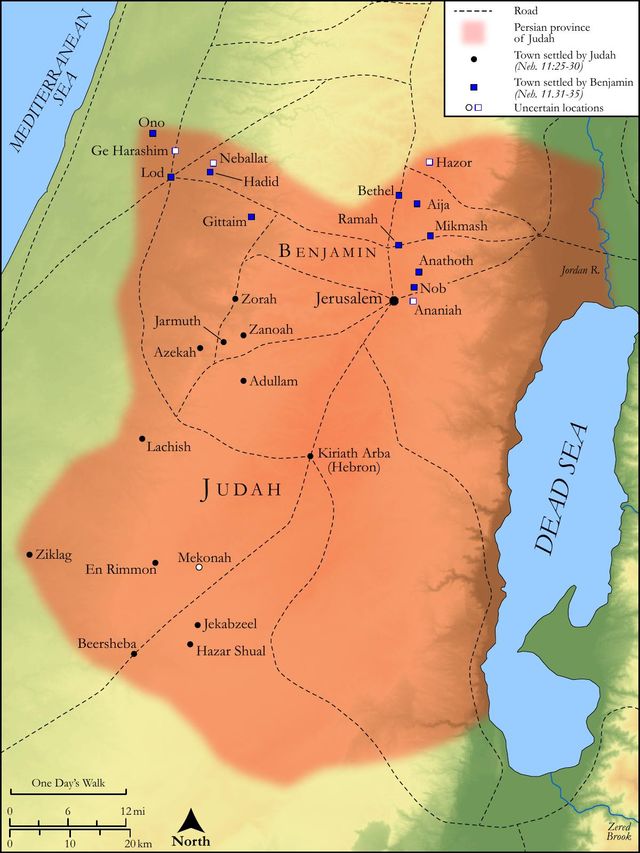
See on the biblical-era map
Study this verse
Public-domain commentary
Matthew Henry
From his Commentary on the Whole Bible. Henry comments on passages, not single verses — this entry covers Nehemiah 11:1–19. His four-level outline is real structure in the source text, so it is rendered as structure.
Jerusalem is called here the holy city (Neh 11:1), because there the temple was, and that was the place God had chosen to put his name there; upon this account, one would think, the holy seed should all have chosen to dwell there and have striven for a habitation there; but, on the contrary, it seems they declined dwelling there, 1. Because a greater strictness of conversation was expected from the inhabitants of Jerusalem than from others, which they were not willing to come up to. Those who care not for being holy themselves are shy of dwelling in a holy city; they would not dwell in the New Jerusalem itself for that reason, but would wish to have a continuing city here upon earth. Or, 2. Because Jerusalem, of all places, was most hated by the heathen their neighbours, and against it their malicious designs were levelled, which made that the post of danger (as the post of honour usually is) and therefore they were not willing to expose themselves there. Fear of persecution and reproach, and of running themselves into trouble, keeps many out of the holy city, and makes them backward to appear for God and religion, not considering that, as Jerusalem is with a special malice threatened and insulted by its enemies, so it is with a special care protected by its God and made a quiet habitation, Isa 33:20; Psa 46:4, Psa 46:5. Or, 3. Because it was more for their worldly advantage to dwell in the country. Jerusalem was no trading city, and therefore there was no money to be got there by merchandise, as there was in the country by corn and cattle. Note, All seek their own, not the things that are Jesus Christ's, Phi 2:21. It is a general and just complaint that most people prefer their own wealth, credit, pleasure, ease, and safety, before the glory of God and the public good. People being thus backward to dwell at Jerusalem, now that it was poor, we are here told,
I.By what means it was replenished.
1.The rulers dwelt there, Neh 11:1. That was the proper place for them to reside in, because there were set the thrones of judgment (Psa 122:5), and thither, in all difficult matters, the people resorted with their last appeals. And if it were an instance of eminent affection to the house of God, zeal for the public good, and of faith, and holy courage, and self-denial, to dwell there at this time, the rulers would be examples of these to their inferiors. Their dwelling there would invite and encourage others to dwell there too. Magnates magnetes - the mighty are magnetic. When great men choose the holy city for their habitation their example brings holiness into reputation, and their zeal will provoke very many.
2.There were some that willingly offered themselves to dwell at Jerusalem, nobly foregoing their own secular interest for the public welfare, Neh 11:2. It is upon record, to their honour, that when others were shy of venturing upon difficulty, loss, and danger, they sought the good of Jerusalem, because of the house of the Lord their God. Those shall prosper that thus love Zion, Psa 122:6, Psa 122:9. It is said, The people blessed them. They praised them; they prayed for them; they praised God for them. Many that do not appear forward themselves for the public good will yet give a good word to those that do. God and man will bless those that are public blessings, which should encourage us to be zealous in doing good.
3.They, finding that yet there was room, concluded upon a review of their whole body to bring one in ten to dwell in Jerusalem; who they should be was determined by lot, the disposal whereof, all knew, was of the Lord. This would prevent strife, and would be a great satisfaction to those on whom the lot fell to dwell at Jerusalem, that they plainly saw God appointing the bounds of their habitation. They observed the proportion of one in ten, as we may suppose, to bring the balance between the city and country to a just and equal poise; so it seems to refer to the ancient rule of giving the tenth to God; and what is given to the holy city he reckons given to himself.
II.By what persons it was replenished.
A general account is here given of the inhabitants of Jerusalem because the governors of Judah looked upon them as their strength in the Lord of hosts their God, and valued them accordingly, Zac 12:5.
1.Many of the children of Judah and Benjamin dwelt there; for, originally, part of the city law in the lot of one of those tribes and part in that of the other; but the greater part was in the lot of Benjamin, and therefore here we find of the children of Judah only 468 families in Jerusalem (Neh 11:6), but of Benjamin 928, Neh 11:7, Neh 11:8. Thus small were its beginnings, but afterwards, before our Saviour's time, it grew much more populous. Those of Judah all descended from Perez, or Pharez, that son of Judah of whom, as concerning the flesh, Christ came. And, though the Benjamites were more in number, yet of the men of Judah it is said (Neh 11:6) that they were valiant men, fit for service, and able to defend the city in case of an attack. Judah has not lost its ancient character of a lion's whelp, bold and daring. Of the Benjamites that dwelt in Jerusalem we are here told who was overseer, and who was second, Neh 11:9. For it is as necessary for a people to have good order kept up among themselves as to be fortified against the attacks of their enemies from abroad, to have good magistrates as to have good soldiers.
2.The priests and Levites did many of them settle at Jerusalem; where else should men that were holy to God dwell, but in the holy city?
(1.)Most of the priests, we may suppose, dwelt there, for their business lay where the temple was. Of those that did the work of the house in their courses here were 822 of one family, 242 of another, and 128 of another, Neh 11:12-14. It was well that those labourers were not few. It is said of some of them that they were mighty men of valour (Neh 11:14); it was necessary that they should be so, for the priesthood was not only a work, which required might, but a warfare, which required valour, especially now. Of one of these priests it is said that he was the son of one of the great men. It was no disparagement to the greatest man they had to have his son in the priesthood; he might magnify his office, for his office did not in the least diminish him.
(2.)Some of the Levites also came and dwelt at Jerusalem, yet but few in comparison, 284 in all (Neh 11:18), with 172 porters (Neh 11:19), for much of their work was to teach the good knowledge of God up and down the country, for which purpose they were to be scattered in Israel. As many as there was occasion for attended at Jerusalem; the rest were doing good elsewhere.
[1.]It is said of one of the Levites that he had the oversight of the outward business of the house of God, Neh 11:16. The priests were chief managers of the business within the temple gates; but this Levite was entrusted with the secular concerns of God's house, that were in ordine ad spiritualia - subservient to its spiritual concerns, the collecting of the contributions, the providing of materials for the temple service, and the like, which it was necessary to oversee, else the inward business would have been starved and have stood still. Those who take care of the ta exō the outward concerns of the church, the serving of its tables, are as necessary in their place as those who take care of its ta esō its inward concerns, who give themselves to the word and prayer.
[2.]It is said of another that he was the principal to begin the thanksgiving in prayer. Probably he had a good ear and a good voice, and was a scientific singer, and therefore was chosen to lead the psalm. He was precentor in the temple. Observe, Thanksgiving is necessary in prayer; they should go together; giving thanks for former mercies is a becoming way of begging further mercies. And care should be taken in public service that every thing be done in the best manner, decently and in good order - in prayer, that one speak and the rest join-in singing, that one begin and the rest follow.
Continue studying Nehemiah 11:6 across the web’s major study libraries — every link below opens this exact verse, chapter, or book on the destination site.
Read & Compare
 BibleGatewayThis verse in more than 200 translations and 70 languages.
 Bible.comThe YouVersion reader — hundreds of translations, reading plans, and highlights.
 ESV.orgCrossway's official English Standard Version reader.
 NET BibleThe NET translation with 60,000+ translators' notes on every rendering decision.
 STEP BibleTyndale House's free study tool — original text, vocabulary, and scholarly resources.
 BibliaLogos Bible Software's free web reader.
 USCCBThe New American Bible (Revised Edition) with the U.S. bishops' study notes.
Commentaries
 BibleHub CommentariesDozens of classic commentaries on this verse, gathered on one page.
 StudyLightMore than 100 commentary sets — the largest collection on the web.
 BibleRefPlain-English commentary on what this verse means, verse by verse.
 Enduring WordDavid Guzik's free commentary on this chapter, widely used by Bible teachers.
 Bible Study ToolsVerse commentary alongside Greek and Hebrew study aids.
Original Language & Research
- BibleHub InterlinearThe verse word by word — original language, transliteration, and English.
- BibleHub LexiconEvery word's original-language definition and Strong's entry.
 Blue Letter BibleDeep-study tools — Strong's numbers, concordance, and word studies.
 SefariaThe Hebrew text with Rashi and centuries of Jewish commentary.
Sermons, Hymns & Audio


TrulyRandomVerse is not affiliated with these sites and doesn’t control their content. They’re linked because they’re genuinely useful.
Summary
Nehemiah 11:6 meticulously records the specific contribution of the descendants of Perez, a prominent clan within the tribe of Judah, to the critical repopulation of Jerusalem following the Babylonian exile. It details that four hundred and sixty-eight "valiant men" from this lineage committed to dwelling in the city, underscoring the organized and intentional nature of the post-exilic restoration. This verse highlights the vital role of individual families and their dedicated members in transforming Jerusalem from a desolate ruin into a secure, thriving, and spiritually vibrant capital, demonstrating the blend of human commitment and divine orchestration in the re-establishment of the covenant community.
Context
ShowHideLiterary Context
Nehemiah 11 marks a crucial shift in the narrative from the physical rebuilding of Jerusalem's walls, completed in Nehemiah 6, and the subsequent spiritual renewal through the reading of the Law and covenant ceremonies described in Nehemiah 8-10. With the city's defenses secured and its spiritual foundation re-established, the immediate challenge became its repopulation. A city, however well-fortified, cannot thrive without inhabitants. Chapter 11 provides a detailed census, meticulously listing the families and individuals who volunteered or were chosen by lot to reside within the newly fortified walls, as opposed to those who remained in the surrounding towns. This census-like record, including the specific count of the sons of Perez, serves to document the practical implementation of Nehemiah's vision for a viable, inhabited capital, which was absolutely essential for the city's long-term security, economic vitality, and its role as the spiritual heart of the nation. It underscores the transition from external threats to internal consolidation, emphasizing the need for a living community to sustain the restored city.
Historical & Cultural Context
The period following the seventy-year Babylonian exile was one of immense challenge and opportunity for the Jewish people. Under the decrees of Persian kings, particularly Cyrus and Artaxerxes, exiles were permitted to return to their ancestral land. While many returned with Zerubbabel and Ezra, Jerusalem itself remained largely desolate, its walls in ruins, and its population sparse, making it highly vulnerable to hostile neighbors like Sanballat and Tobiah. Repopulating Jerusalem was not merely a matter of convenience; it was a strategic imperative for its defense, economic revival, and its role as the spiritual and administrative center of the returning nation. Culturally, lineage and tribal identity were paramount in post-exilic Israel, serving as foundational elements for land distribution, social organization, and religious continuity. The extensive genealogies found in books like Ezra 2 and Nehemiah 7 attest to this emphasis. The specific mention of "sons of Perez" in this verse highlights the importance of maintaining these tribal distinctions and acknowledging the distinct contributions of specific family units to the national restoration. Living in Jerusalem at this time required significant commitment and sacrifice, as it likely meant greater exposure to threats, economic hardship, and potentially fewer immediate comforts compared to settled rural areas. These individuals were pioneers, demonstrating a profound dedication to the collective good.
Key Themes
ShowHideNehemiah 11:6 contributes significantly to several overarching themes within Nehemiah and the broader post-exilic narrative. The most prominent is Repopulation and Restoration, illustrating the practical, human steps taken to transform Jerusalem from a desolate ruin into a vibrant, inhabited capital. This was not just a physical rebuilding of structures but the painstaking restoration of a living community, vital for the nation's identity and future. The theme of Commitment and Sacrifice is powerfully evident in the willingness of individuals, particularly the "valiant men" of Perez, to settle in a challenging and potentially dangerous environment for the sake of the collective good and God's purposes. Their presence was a testament to dedication beyond mere obligation, reflecting a deep sense of responsibility. Furthermore, the detailed listing of lineages, including the "sons of Perez," reinforces the theme of Lineage and Identity, highlighting the enduring importance of tribal heritage and the continuity of God's covenant people through generations. This meticulous record-keeping underscores the divine preservation of Israel's identity. Finally, the entire process, from the rebuilding of walls to the repopulation, is framed within the overarching theme of Divine Providence, demonstrating God's faithfulness in fulfilling His promises to His people and enabling their return and re-establishment in the land, as prophesied in Jeremiah 29:10-14. The human effort is seen as a response to God's guiding hand.
Exposition and Analysis
ShowHideKey Word Analysis
ShowHideThis term (H1121) refers to a male offspring, but in a broader sense, it signifies a "builder of the family name" or a descendant, encompassing literal and figurative relationships. In Nehemiah 11:6, "sons of Perez" emphasizes the generational continuity and the collective identity of a specific lineage. It highlights that the repopulation effort was not just about individuals, but about the re-establishment of family units and tribal representation, ensuring the long-term vitality and heritage of the community in Jerusalem.
This proper noun (H6557) refers to one of the twin sons of Judah and Tamar, whose dramatic birth is recorded in Genesis 38:29. The name itself means "breakthrough" or "breach," signifying a significant event. Perez's lineage was profoundly important, as he became an ancestor of King David and, ultimately, of Jesus Christ (Matthew 1:3). In the context of Nehemiah 11:6, the mention of "sons of Perez" underscores the continuing prominence and historical significance of this clan within the tribe of Judah, which was central to the leadership and future of post-exilic Israel. Their presence in Jerusalem symbolized the re-establishment of key tribal representation in the capital.
This term (H2428), often translated as "valiant" or "mighty," denotes more than mere physical strength. It signifies a "force" or "strength," whether of men, means, or other resources, encompassing qualities like valor, virtue, wealth, and capability. It describes individuals who are able, active, and worthy, often used in military or leadership contexts (e.g., David's "mighty men" in 2 Samuel 23:8). In Nehemiah 11:6, these "valiant men" were not just residents; they were capable individuals fit for the challenging task of settling, defending, and contributing to the security and stability of a city that had recently been rebuilt and still faced potential threats. Their presence contributed significantly to the city's overall strength and resilience.
Verse Breakdown
ShowHide"All the sons of Perez"
This phrase specifically identifies a particular lineage within the tribe of Judah, tracing their ancestry back to Perez. It underscores the importance of tribal and family identity in the post-exilic community, highlighting the contribution of a distinct, recognized clan to the repopulation effort. This specificity reflects the meticulous record-keeping and the emphasis on continuity of heritage.
"that dwelt at Jerusalem"
This clause indicates the precise location where these individuals resided, emphasizing their commitment to the capital city. It signifies their willingness to inhabit a place that was still vulnerable and required dedicated inhabitants for its security, revitalization, and spiritual re-establishment, distinguishing them from those who lived in the surrounding, perhaps safer, towns.
"[were] four hundred threescore and eight"
This precise numerical detail (468) reflects meticulous record-keeping, a common practice in ancient Israelite censuses and genealogies. It underscores the organized and intentional nature of the repopulation effort, demonstrating a careful accounting of the community's human resources and manpower. This precision lends historical authenticity to the account and highlights the tangible scale of the rebuilding and resettlement.
"valiant men"
This descriptive phrase qualifies the individuals, indicating that they were not merely residents, but men of strength, courage, capability, and worth (chayil). Their presence in Jerusalem was a strategic asset, contributing significantly to the city's defense, stability, and overall flourishing in a challenging post-exilic environment. It speaks to their character and their fitness for the demanding task of rebuilding a nation.
Literary Devices
ShowHideNehemiah 11:6 primarily employs Census Listing and Numerical Detail. The entire chapter functions as a detailed roster, or census, of those who came to dwell in Jerusalem and the surrounding towns. This device serves to provide a comprehensive and authoritative account of the repopulation efforts, lending credibility and historical weight to the narrative. The specific inclusion of "four hundred threescore and eight" is a prime example of Numerical Detail, which emphasizes the meticulous organization and the tangible scale of the rebuilding and resettlement. This precision highlights the administrative efforts involved in Nehemiah's leadership and the importance of every individual's contribution being accounted for. The mention of "sons of Perez" also functions as a form of Synecdoche, where a part (the clan of Perez) represents a larger whole (a significant portion of the tribe of Judah and its contribution), underscoring the vital role of key tribal groups in the city's restoration. This device efficiently conveys the broader participation through the specific example.
Theological and Thematic Connections
ShowHideNehemiah 11:6, though seemingly a mere statistical entry, carries profound theological weight, illustrating God's unwavering faithfulness in bringing His people back to their land and meticulously re-establishing their capital, thereby fulfilling ancient prophecies of restoration. The detailed listing of families and precise numbers demonstrates that God's grand plan for His people often unfolds through the specific, dedicated, and often sacrificial actions of individuals and communities. The "valiant men" of Perez embody the spirit of commitment and courage required for God's work, reminding us that every member, regardless of their perceived role or prominence, contributes indispensably to the overall strength and purpose of the collective body. This verse underscores the divine orchestration behind human effort, where God empowers and uses His people to rebuild not just physical structures, but also community, spiritual vitality, and the very fabric of their national identity. It is a testament to God's attention to detail and His reliance on human partnership in the outworking of His sovereign will.
Reflection and Application
ShowHideNehemiah 11:6, with its seemingly mundane numerical detail, offers a powerful and enduring lesson on the nature of God's work and our indispensable role within it. It reminds us that grand visions and monumental undertakings, such as the restoration of Jerusalem, are realized not by a few prominent figures alone, but through the faithful, often unsung, and courageous contributions of countless individuals. The "valiant men" of Perez were not necessarily the architects or the primary leaders, but their willingness to settle in a challenging, vulnerable city was absolutely crucial for its survival, defense, and flourishing. This calls us to deeply value every contribution within a community or a collective endeavor, recognizing that God uses specific individuals and groups in their unique capacities to accomplish His overarching purposes. Whether we are called to lead, to serve, to provide resources, or simply to "dwell" faithfully in a specific place or role, our commitment, courage, and dedication are vital. This verse encourages us to embrace our particular part, however small or seemingly insignificant it may appear, with the same valor and dedication as these men, understanding that our faithfulness contributes to something far greater than ourselves – the building up of God's kingdom and the flourishing of His people. It challenges us to consider where God is calling us to be "valiant" in our own spheres of influence.
Questions for Reflection
ShowHideFAQ
ShowHideWhy is such a specific number (468) mentioned for the sons of Perez?
ShowHideThe mention of a precise number like 468 (four hundred threescore and eight) for the sons of Perez reflects the meticulous record-keeping common in ancient Israelite administration and genealogies, particularly during significant national events like the return from exile and the repopulation of Jerusalem. This detail underscores the organized and intentional nature of Nehemiah's efforts to rebuild not just the walls but also the community itself. It signifies a careful census, ensuring that the city had adequate and specific representation from various clans and tribes, thereby demonstrating a tangible commitment to the restoration of Jerusalem as a viable capital. Such numerical precision also lends historical authenticity to the account, showing the diligence with which these records were maintained, much like the detailed lists found in Ezra 2 and Nehemiah 7. It emphasizes that every individual and family counted in the grand scheme of God's redemptive plan.
What was the significance of the "sons of Perez" in this context?
ShowHideThe "sons of Perez" refer to the descendants of Perez, one of the twin sons of Judah, whose unique birth is recorded in Genesis 38:29. Perez's lineage was highly significant, as he was a direct ancestor of King David and, ultimately, of the Messiah (Matthew 1:3). In the post-exilic period, the tribe of Judah, from which Perez descended, was central to the re-establishment of the Jewish nation and its spiritual leadership. The specific mention of the "sons of Perez" highlights the importance of tribal and family identity in the repopulation efforts. It shows that prominent and historically significant clans were actively participating in the rebuilding of Jerusalem, reinforcing the continuity of God's covenant people and their connection to the land and the capital. Their presence in Jerusalem was a testament to the re-establishment of key tribal representation in the city, ensuring its spiritual and political legitimacy.
Christ-Centered Fulfillment
ShowHideWhile Nehemiah 11:6 details a specific historical act of repopulating earthly Jerusalem, it points to a deeper, profound Christ-centered fulfillment in the New Testament. The physical restoration of the city and its inhabitants foreshadows the spiritual rebuilding of God's true people, the Church, with Christ as its indispensable cornerstone and head. Just as the "valiant men" of Perez were essential for the security and vitality of earthly Jerusalem, so too are believers, empowered by the Holy Spirit, vital, living members of the spiritual Jerusalem, the body of Christ (Ephesians 2:19-22). The meticulous counting of individuals in Nehemiah reflects God's intimate knowledge and sovereign care for each member of His covenant community, a truth profoundly realized in Christ, who knows His sheep by name and calls them into His fold (John 10:3-4). The commitment and sacrifice of these men to dwell in a vulnerable city prefigure the call to discipleship, where believers are called to live faithfully and courageously in a world often hostile to the gospel, contributing their unique gifts and "valiant" efforts to the building up of the kingdom (1 Peter 2:4-5). Ultimately, the repopulation of Jerusalem under Nehemiah's leadership anticipates the glorious gathering of all nations into the new Jerusalem, where Christ reigns supreme and every believer finds their true, eternal dwelling and purpose in Him, a city without need of sun or moon, for the glory of God illuminates it, and the Lamb is its lamp (Revelation 21:2-4).