


Matthew 5:34
Bible text: King James Version (1769 Blayney text) · Public domain
Bible text: Berean Standard Bible · Public domain
Bible text: American Standard Version (1901) · Public domain
Bible text: World English Bible, Messianic edition · Public domain
Bible text: Geneva Bible (1599) · Public domain
Bible text: Young's Literal Translation · Public domain
- ἐγὼegōI myselfG1473P-1NSPersonal pronoun Nominative 1st Singular
- δὲdehoweverG1161CONJConjunction
- λέγωlegōsayG3004V-PAI-1SVerb Present Active Indicative 1st Singular
- ὑμῖνhuminto youG4771P-2DPPersonal pronoun Dative 2nd Plural
- μὴmēnotG3361PRT-NNegative Particle Negative
- ὀμόσαιomosaito swearG3660V-AANVerb Aorist Active Infinitive
- ὅλωςholōsat allG3654ADVAdverb
- μήτεmēteneither [swear]G3383CONJ-NConjunction Negative
- ἐνenbyG1722PREPPreposition
- τῷtō<the>G3588T-DSMDefinite article Dative Singular Masculine
- οὐρανῷouranōheavenG3772N-DSMNoun Dative Singular Masculine
- ὅτιhotibecauseG3754CONJConjunction
- θρόνοςthronos[the] throneG2362N-NSMNoun Nominative Singular Masculine
- ἐστὶνestinit isG1510V-PAI-3SVerb Present Active Indicative 3rd Singular
- τοῦtou<the>G3588T-GSMDefinite article Genitive Singular Masculine
- θεοῦtheouof GodG2316N-GSM-TNoun Genitive Singular Masculine Title
English is a literal word-by-word gloss of the Greek, not the KJV's wording. Why?
This is the original text the KJV's translators worked from — each Greek word with its own literal English meaning in this verse, prepared by scholars at Tyndale House, Cambridge. The KJV translates whole sentences, not word by word, so its wording differs: one Greek word can become several English words, and the KJV may choose “charity” where the gloss reads “love”. Both are faithful — they answer different questions. For the KJV's own rendering, switch to the KJV text.
Details
See on the biblical-era maps

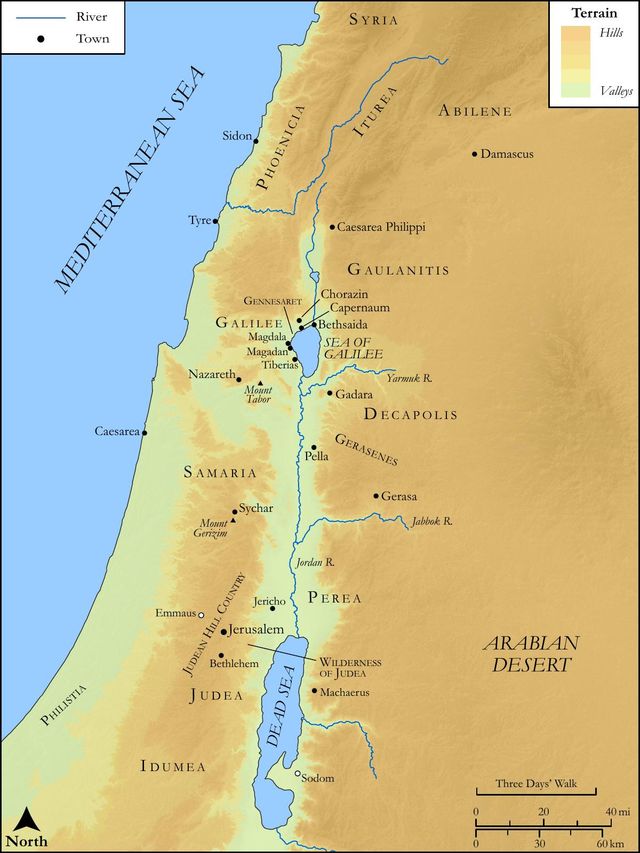
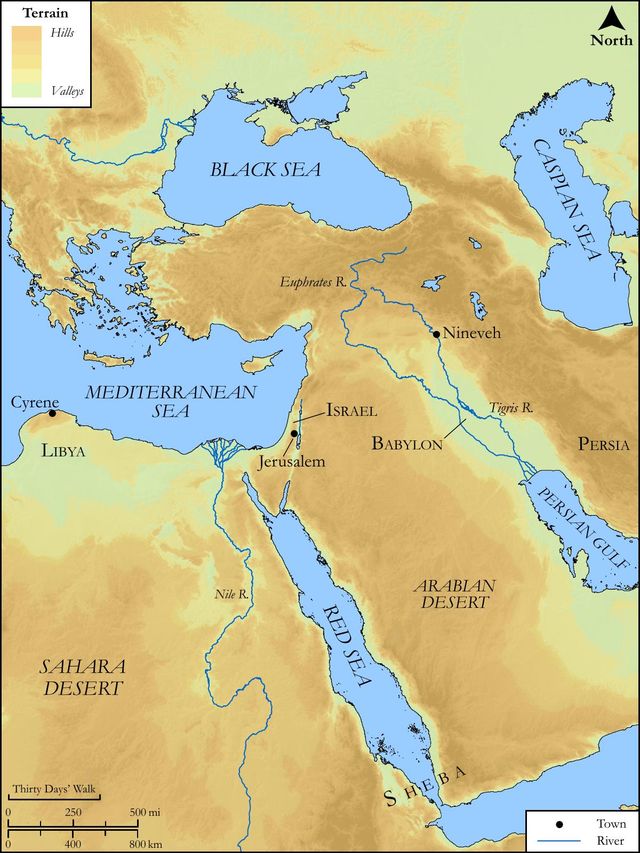
Study this verse
Public-domain commentary
Matthew Henry
From his Commentary on the Whole Bible. Henry comments on passages, not single verses — this entry covers Matthew 5:33–37. His three-level outline is real structure in the source text, so it is rendered as structure.
We have here an exposition of the third commandment, which we are the more concerned right to understand, because it is particularly said, that God will not hold him guiltless, however he may hold himself, who breaks this commandment, by taking the name of the Lord in vain. Now as to this command,
I.It is agreed on all hands that it forbids perjury, forswearing, and the violation of oaths and vows, Mat 5:33.
This was said to them of old time, and is the true intent and meaning of the third commandment. Thou shalt not use, or take up, the name of God (as we do by an oath) in vain, or unto vanity, or a lie. He hath not lift up his soul unto vanity, is expounded in the next words, nor sworn deceitfully, Psa 24:4. Perjury is a sin condemned by the light of nature, as a complication of impiety toward God and injustice toward man, and as rendering a man highly obnoxious to the divine wrath, which was always judged to follow so infallibly upon that sin, that the forms of swearing were commonly turned into execrations or imprecations; as that, God do so to me, and more also; and with us, So help me God; wishing I may never have any help from God, if I swear falsely. Thus, by the consent of nations, have men cursed themselves, not doubting but that God would curse them, if they lied against the truth then, when they solemnly called God to witness to it.
It is added, from some other scriptures, but shalt perform unto the Lord thine oaths (Num 30:2); which may be meant, either, 1. Of those promises to which God is a party, vows made to God; these must be punctually paid (Ecc 5:4, Ecc 5:5): or, 2. Of those promises made to our brethren, to which God was a Witness, he being appealed to concerning our sincerity; these must be performed to the Lord, with an eye to him, and for his sake: for to him, by ratifying the promises with an oath, we have made ourselves debtors; and if we break a promise so ratified, we have not lied unto men only, but unto God.
II.It is here added, that the commandment does not only forbid false swearing, but all rash, unnecessary swearing:
Swear not at all, Mat 5:34; Compare Jam 5:12. Not that all swearing is sinful; so far from that, if rightly done, it is a part of religious worship, and we in it give unto God the glory due to his name. See Deu 6:13; Deu 10:20; Isa 45:23; Jer 4:2. We find Paul confirming what he said by such solemnities (Co2 1:23), when there was a necessity for it. In swearing, we pawn the truth of something known, to confirm the truth of something doubtful or unknown; we appeal to a greater knowledge, to a higher court, and imprecate the vengeance of a righteous Judge, if we swear deceitfully.
Now the mind of Christ in this matter is,
1.That we must not swear at all, but when we are duly called to it, and justice or charity to our brother, or respect to the commonwealth, make it necessary for the end of strife (Heb 6:16), of which necessity the civil magistrate is ordinarily to be the judge. We may be sworn, but we must now swear; we may be adjured, and so obliged to it, but we must not thrust ourselves upon it for our own worldly advantage.
2.That we must not swear lightly and irreverently, in common discourse: it is a very great sin to make a ludicrous appeal to the glorious Majesty of heaven, which, being a sacred thing, ought always to be very serious: it is a gross profanation of God's holy name, and of one of the holy things which the children of Israel sanctify to the Lord: it is a sin that has no cloak, no excuse for it, and therefore a sign of a graceless heart, in which enmity to God reigns: Thine enemies take thy name in vain.
3.That we must in a special manner avoid promissory oaths, of which Christ more particularly speaks here, for they are oaths that are to be performed. The influence of an affirmative oath immediately ceases, when we have faithfully discovered the truth, and the whole truth; but a promissory oath binds so long, and may be so many ways broken, by the surprise as well as strength of a temptation, that it is not to be used but upon great necessity: the frequent requiring and using of oaths, is a reflection upon Christians, who should be of such acknowledged fidelity, as that their sober words should be as sacred as their solemn oaths.
4.That we must not swear by any other creature. It should seem there were some, who, in civility (as they thought) to the name of God, would not make use of that in swearing, but would swear by heaven or earth, etc. This Christ forbids here (Mat 5:34) and shows that there is nothing we can swear by, but it is some way or other related to God, who is the Fountain of all beings, and therefore that it is as dangerous to swear by them, as it is to swear by God himself: it is the verity of the creature that is laid at stake; now that cannot be an instrument of testimony, but as it has regard to God, who is the summum verum - the chief Truth. As for instance,
(1.)Swear not by the heaven; "As sure as there is a heaven, this is true;" for it is God's throne, where he resides, and in a particular manner manifests his glory, as a Prince upon his throne: this being the inseparable dignity of the upper world, you cannot swear by heaven, but you swear by God himself.
(2.)Nor by the earth, for it is his footstool. He governs the motions of this lower world; as he rules in heaven, so he rules over the earth; and though under his feet, yet it is also under his eye and care, and stands in relation to him as his, Psa 24:1. The earth is the Lord's; so that in swearing by it, you swear by its Owner.
(3.)Neither by Jerusalem, a place for which the Jews had such a veneration, that they could not speak of any thing more sacred to swear by; but beside the common reference Jerusalem has to God, as part of the earth, it is in special relation to him, for it is the city of the great King (Psa 48:2), the city of God (Psa 46:4), he is therefore interested in it, and in every oath taken by it.
(4.)"Neither shalt thou swear by the head; though it be near thee, and an essential part of thee, yet it is more God's than thine; for he made it, and formed all the springs and powers of it; whereas thou thyself canst not, from any natural intrinsic influence, change the colour of one hair, so as to make it white or black; so that thou canst not swear by thy head, but thou swearest by him who is the Life of thy head, and the Lifter up of it." Psa 3:3.
5.That therefore in all our communications we must content ourselves with, Yea, yea, and nay, nay, Mat 5:37. In ordinary discourse, if we affirm a thing, let us only say, Yea, it is so; and, if need be, to evidence our assurance of a thing, we may double it, and say, Yea, yea, indeed it is so: Verily, verily, was our Saviour's yea, yea. So if we deny a thing, let is suffice to say, No; or if it be requisite, to repeat the denial, and say, No, no; and if our fidelity be known, that will suffice to gain us credit; and if it be questioned, to back what we say with swearing and cursing, is but to render it more suspicious. They who can swallow a profane oath, will not strain at a lie. It is a pity that this, which Christ puts in the mouths of all his disciples, should be fastened, as a name of reproach, upon a sect faulty enough other ways, when (as Dr. Hammond says) we are not forbidden any more than yea and nay, but are in a manner directed to the use of that.
The reason is observable; For whatsoever is more than these cometh of evil, though it do not amount to the iniquity of an oath. It comes ek tou Diabolou; so an ancient copy has it: it comes from the Devil, the evil one; it comes from the corruption of men's nature, from passion and vehemence; from a reigning vanity in the mind, and a contempt of sacred things: it comes from that deceitfulness which is in men, All men are liars; therefore men use these protestations, because they are distrustful one of another, and think they cannot be believed without them. Note, Christians should, for the credit of their religion, avoid not only that which is in itself evil, but that which cometh of evil, and has the appearance of it. That may be suspected as a bad thing, which comes from a bad cause. An oath is physic, which supposes a disease.
Historical interpretation
Eleven Centuries of Reception
12 surviving comments on this verse. Each one is dated, so this reads as a timeline rather than a list.
Select a marker to jump to its quote. Markers stagger vertically where authors wrote within a few decades of each other.
In the next place proceeding to mendacity, the minister of covetousness (of false swearing I am silent, since even swearing is not lawful )-is trade adapted for a servant of God? But, covetousness apart, what is the motive for acquiring? When the motive for acquiring ceases, there will be no necessity for trading.
Otherwise; They who live in the simplicity of the faith have not need to swear, with them ever, what is is, what is not is not; by this their life and their conversation are ever preserved in truth.
By the grace of gospel teaching, the law given by Moses acquired an advantage. The law prescribes that one must not swear falsely; but according to the gospel one must not swear at all. The Holy Spirit had seen fit to order this through Solomon when he said, “Do not accustom your mouth to oaths.” And again: “Even as a well-chastised servant is not deterred from envy, whoever swears and does business will not be purged from sin.” Therefore it is absolutely inappropriate for us to swear. What need is there for us to swear when we are not allowed to lie at all and our words must always be true and trustworthy, so much so that they may be taken as an oath? On this, the Lord not only forbids us to swear falsely but even to swear, lest we appear to tell the truth only when we swear and lest (while we should be truthful in our every word) we think it is all right to lie when we do not take an oath. For this is the purpose of an oath: Everyone who swears, swears to the fact what he is saying is true. Therefore the Lord does not want a gap between our oath and our ordinary speech. Even as there must be no faithlessness in an oath, in our words there must be no lie. For both false swearing and lying are punished with divine judgment, as the Scripture says: “The mouth that lies kills the soul.” So whoever speaks the truth swears, for it is written: “A faithful witness will not lie.”
"Again, ye have heard that it was said to them of old time, Thou shalt not forswear thyself, but shalt perform unto the Lord thine oaths. But I say unto you, swear not at all."
Why did He go straightway not to theft, but to false witness, passing over that commandment? Because he that steals, doth upon occasion swear also; but he that knows not either swearing or speaking falsehood, much less will he choose to steal. So that by this He hath overthrown the other sin likewise: since falsehood comes of stealing.
But what means, "Thou shalt perform unto the Lord thine oaths?" It is this, "thou shalt be true in swearing." "But I say unto you, swear not at all."
Next, to lead them farther away from swearing by God, He saith, "Neither by Heaven, for it is God's throne, nor by the earth, for it is the footstool of His feet; nor by Jerusalem, for it is the city of the great King:" still speaking out of the prophetical writings, and signifying Himself not to be opposed to the ancients. This was because they had a custom of swearing by these objects, and He intimates this custom near the end of His Gospel.
But mark, I pray thee, on what ground He magnifies the elements; not from their own nature, but from God's relation to them, such as it had been in condescension declared. For because the tyranny of idolatry was great, that the elements might not be thought worthy of honor for their own sake, He hath assigned this cause, which we have mentioned, which again would pass on to the glory of God. For He neither said, "because Heaven is beautiful and great," nor, "because earth is profitable;" but "because the one is God's throne, the other His footstool;" on every side urging them on towards their Lord.
"Neither by thy head," saith He, "because thou canst not make one hair white or black."
Here again, not as wondering at man, hath He withdrawn him from swearing by his head (for so man himself would be worshipped), but as referring the glory to God, and signifying that thou art not master even of thyself, and of course therefore not of the oaths made by thy head. For if no one would give up his own child to another, much more will not God give up His own work to thee. For though it be thy head, yet is it the property of another; and so far from being master thereof, thou shalt not be able to do with it, no not the least thing of all. For He said not, "Thou canst not make one hair grow;" but, "Not so much as change its quality."
"But what," it may be said, "if any one should require an oath, and apply constraint?" Let the fear of God be more powerful than the constraint: since, if thou art to bring forward such excuses, thou wilt keep none of the things which are enjoined.
Yea, for first with respect to thy wife thou wilt say, "what if she be contentious and extravagant;" and then as to the right eye, "what if I love it, and am quite on fire?" and of the unchaste look, "what then, if I cannot help seeing?" and of our anger against a brother, "what if I be hasty, and not able to govern my tongue?" and in general, all His sayings thou mayest on this wise trample under foot. Yet surely with regard to human laws thou darest not in any case use this allegation, nor say, "what then if this or that be the case," but, willing or unwilling, thou receivest what is written.
And besides, thou wilt never have compulsion to undergo at all. For he that hath hearkened unto those former blessings, and hath framed himself to be such as Christ enjoined, will have no such constraint to endure from any, being held in reverence and veneration by all.
"But let your yea, be yea; and your nay, nay: for that which exceedeth these cometh of the evil one."
What is it then that "exceeds yea" and "nay"? it is the oath, not the perjury. For this latter is quite acknowledged, and no man needs to learn that it is of the evil one; and it is not an excess, but an opposite: whereas an excess means something more, and added over and above: which kind of thing swearing is.
"What then," saith one, "was it of the evil one? and if it was of the evil one, how was it a law?" Well, this same thing thou wilt say concerning the wife also; how is that now accounted adultery, which was before permitted?
What now may one reply to this? That the precepts then uttered had reference to the weakness of them who were receiving the laws; since also to be worshipped with the vapor of sacrifice is very unworthy of God, just as to lisp is unworthy of a philosopher. That kind of thing accordingly was now laid down to be adultery, and swearing to be of the evil one, now that the principles of virtue have advanced. But if these things had been, from the first, laws of the devil, they would not have attained to so great goodness. Yea, for had those not been forerunners in the first place, these which we now have would not have been so easily received. Do not thou then require their excellency now, when their use is past: but then, when the time was calling for them. Or rather, if thou wilt, even now: yea, for now also is their virtue shown: and most of all for the very cause, by reason of which we find fault with them. For their appearing such now, is the greatest commendation of them. For had they not brought us up well, and made us meet for the reception of the greater precepts, they would not have appeared such.
Therefore as the breast, when it hath fulfilled all its part, and is dismissing the child to the more manly diet, after that appears useless; and the parents who before thought it necessary for the babe, now abuse it with ten thousand mockeries (and many even not content with words of abuse, anoint it also with bitter drugs; that when their words have not power to remove the child's unseasonable propensity towards it, the real things may quench their longing): so also Christ saith, that they are of the evil one, not to indicate that the old law is of the devil, but in order that with most exceeding earnestness He might lead them away from their ancient poverty.
But if the old law had belonged to the devil, it would not have led people away from idolatry, but rather would have drawn them on and cast them into it; for this did the devil desire. But now we see the opposite effect produced by the old law. And indeed this very thing, the oath, was ordained of old for this cause, that they might not swear by the idols. For "ye shall swear," saith He, "by the true God." They were then no small advantages which the law effected, but rather very great. For that they came unto the "strong meat," was the work of its care.
"What then," it may be said, "is not swearing of the evil one?" Yes, indeed it is altogether of the evil one; that is, now, after so high a rule of self-restraint; but then not so.
"But how," one may say, "should the same thing become at one time good, at another time not good?" Nay, I say the very contrary: how could it help becoming good and not good, while all things are crying aloud, that they are so: the arts, the fruits of the earth, and all things else?
See it, for example, taking place first in our own kind. Thus, to be carried, in the earliest age of life, is good, but afterwards pernicious; to eat food that hath been softened in the mouth, in the first scene of our life, is good, but afterwards it is full of disgust; to be fed upon milk and to fly to the breast, is at first profitable and healthful, but tends afterwards to decay and harm. Seest thou how the same actions, by reason of the times, appear good, and again not so? Yea, and to wear the robe of a child is well as long as you are a boy, but contrariwise, when you are become a man, it is disgraceful. Wouldest thou learn of the contrary case too, how to the child again the things of the man are unsuited? Give the boy a man's robe, and great will be the laughter; and greater the danger, he being often upset in walking after that fashion. Allow him to handle public affairs, and to traffic, and sow, and reap, and great again will be the laughter.
Note how He exalts the elements of the world, not from their own nature, but from the respect which they have to God, so that there is opened no occasion of idolatry.
Or; of evil, that is, from their weakness to whom the Law permitted the use of an oath. Not that by this the old Law is signified to be from the Devil, but He leads us from the old imperfection to the new abundance.
(Versed 34 onwards) But I say to you, do not swear at all: neither by heaven, for it is the throne of God; nor by the earth, for it is his footstool; nor by Jerusalem, for it is the city of the great King. Nor should you swear by your head, because you cannot make a single hair white or black. Let your word be 'Yes, yes' or 'No, no'; anything more than this comes from evil. The Jews have always had this wicked habit of swearing by the elements, as the prophetic word often accuses them (Isaiah 65). Whoever swears, worships, or loves the one by whom they swear. In the law it is commanded that we do not swear, except by the Lord our God (Deut. VI and VII). The Jews, by swearing by angels, and by the city of Jerusalem, and by the temple, and by the elements, honored and worshipped creatures and earthly things with the honor and worship due to God. Finally, consider that here the Savior did not prohibit swearing by God, but by heaven, and earth, and Jerusalem, and by your own head. And this was granted in the law as if to little children, so that just as they would sacrifice animals to God and not to idols, they would be allowed to swear by God: not that they would do this rightly, but because it was better to offer this to God than to demons. However, evangelical truth does not require an oath, since every faithful statement is considered as if made under oath.
This was allowed under the Law, as to children; as they offered sacrifice to God, that they might not do it to idols, so they were permitted to swear by God; not that the thing was right, but that it were better done to God than to dæmons.
Lastly, consider that the Saviour does not here forbid to swear by God, but by the Heaven, the Earth, by Jerusalem, by a man's head. For this evil practice of swearing by the elements the Jews had always, and are thereof often accused in the prophetic writing's. For he who swears, shows either reverence or love for that by which he swears. Thus when the Jews swore by the Angels, by the city of Jerusalem, by the temple and the elements, they paid to the creature the honour and worship belonging to God; for it is commanded in the Law that we should not swear but by the Lord our God.
Therefore Evangelic verity does not admit an oath, since the whole discourse of the faithful is instead of an oath.
But it may be asked why, when it was said, But I say unto you, Swear not at all, it was added, neither by heaven, for it is God's throne, etc., up to neither by your head. I suppose it was for this reason, that the Jews did not think they were bound by the oath, if they had sworn by such things: and since they had heard it said, You shall perform unto the Lord your oath, they did not think an oath brought them under obligation to the Lord, if they swore by heaven, or earth, or by Jerusalem, or by their head; and this happened not from the fault of Him who gave the command, but because they did not rightly understand it. Hence the Lord teaches that there is nothing so worthless among the creatures of God, as that any one should think that he may swear falsely by it; since created things, from the highest down to the lowest, beginning with the throne of God and going down to a white or black hair, are ruled by divine providence. Neither by heaven, says He, for it is God's throne; nor by the earth, for it is His footstool: i.e., when you swear by heaven or the earth, do not imagine that your oath does not bring you under obligation to the Lord; for you are convicted of swearing by Him who has heaven for His throne, and the earth for His footstool. Neither by Jerusalem, for it is the city of the great King; a better expression than if He had said, My [city]; although, however, we understand Him to have meant this. And, because He is undoubtedly the Lord, the man who swears by Jerusalem is bound by his oath to the Lord. Neither shall you swear by your head. Now, what could any one suppose to belong more to himself than his own head? But how is it ours, when we have not the power of making one hair white or black? Hence, whoever should wish to swear even by his own head, is bound by his oath to God, who in an ineffable way keeps all things in His power, and is everywhere present. And here also all other things are understood, which could not of course be enumerated; just as that saying of the apostle we have mentioned, By your rejoicing, I die daily. And to show that he was bound by this oath to the Lord, he has added, which I have in Christ Jesus.
But yet (I make the remark for the sake of the carnal) we must not think that heaven is called God's throne, and the earth His footstool, because God has members placed in heaven and in earth, in some such way as we have when we sit down; but that seat means judgment. And since, in this organic whole of the universe, heaven has the greatest appearance, and earth the least—as if the divine power were more present where the beauty excels, but still were regulating the least degree of it in the most distant and in the lowest regions—He is said to sit in heaven, and to tread upon the earth. But spiritually the expression heaven means holy souls, and earth sinful ones: and since the spiritual man judges all things, yet he himself is judged of no man, he is suitably spoken of as the seat of God; but the sinner to whom it is said, Earth you are, and unto earth shall you return, because, in accordance with that justice which assigns what is suitable to men's deserts, he is placed among things that are lowest, and he who would not remain in the law is punished under the law, is suitably taken as His footstool.
(de Mendac. 15.) But what we could not understand by mere words, from the conduct of the saints we may gather in what sense should be understood what might easily be drawn the contrary way, unless explained by example. The Apostle has used oaths in his Epistles, and by this shows us how that ought to be taken, I say unto you, Swear not at all, namely, lest by allowing ourselves to swear at all we come to readiness in swearing, from readiness we come to a habit of swearing, and from a habit of swearing we fall into perjury. And so the Apostle is not found to have used an oath but only in writing, the greater thought and caution which that requires not allowing of slip of the tongue. Yet is the Lord's command so universal, Swear not at all, that He would seem to have forbidden it even in writing. But since it would be an impiety to accuse Paul of having violated this precept, especially in his Epistles, we must understand the word at all as implying that, as far as lays in your power, you should not make a practice of swearing, not aim at it as a good thing in which you should take delight.
(cont. Faust. xix. 23.) Therefore in his writings, as writing allows of greater circumspection, the Apostle is found to have used an oath in several places, that none might suppose that there is any direct sin in swearing what is true; but only that our weak hearts are better preserved from perjury by abstaining from all swearing whatever.
(Serm. in Mont. i. 17.) Or; It is added, By the Heaven, &c. because the Jews did not consider themselves bound when they swore by such things. As if He had said, When you swear by the Heaven and the Earth, think not that you do not owe your oath to the Lord your God, for you are proved to have sworn by Him whose throne the heaven is, and the earth His footstool; which is not meant as though God had such limbs set upon the heaven and the earth, after the manner of a man who is sitting; but that seat signifies God's judgment of us. And since in the whole extent of this universe it is the heaven that has the highest beauty, God is said to sit upon the heavens as showing divine power to be more excellent than the most surpassing show of beauty; and He is said to stand upon the earth, as putting to lowest use a lesser beauty. Spiritually by the heavens are denoted holy souls, by the earth the sinful, seeing He that is spiritual judgeth all things. (1 Cor. 2:15.) But to the sinner it is said, Earth thou art, and unto earth thou shalt return. (Gen. 3:19.) And he who would abide under a law, is put under a law, and therefore He adds, it is the footstool of His feet. Neither by Jerusalem, for it is the city of the Great King; this is better said than 'it is mine;' though it is understood to mean the same. And because He is also truly Lord, whoso swears by Jerusalem, owes his oath to the Lord. Neither by thy head. What could any think more entirely his own property than his own head? But how is it ours when we have not power to make one hair black or white? Whoso then swears by his own head also owes his vows to the Lord; and by this the rest may be understood.
For no man can swear often, but he must sometimes forswear himself; as he who has a custom of much speaking will sometimes speak foolishly.
Having forbidden swearing, He instructs us how we ought to speak, Let your speech be yea, yea; nay, nay. That is, to affirm any thing it is sufficient to say, 'It is so:' to deny, to say, 'It is not so.' Or, yea, yea; nay, nay, are therefore twice repeated, that what you affirm with the mouth you should prove in deed, and what you deny in word, you should not establish by your conduct.
(non occ.) The Lord has hitherto taught to abstain from injuring our neighbour, forbidding anger with murder, lust with adultery, and the putting away a wife with a bill of divorce. He now proceeds to teach to abstain from injury to God, forbidding not only perjury as an evil in itself, but even all oaths as the cause of evil, saying, Ye have heard it said by them of old, Thou shall not forswear thyself. It is written in Leviticus, Thou shalt not forswear thyself in my name; (c. 19:12.) and that they should not make gods of the creature, they are commanded to render to God their oaths, and not to swear by any creature, Render to the Lord thy oaths; that is, if you shall have occasion to swear, you shall swear by the Creator and not by the creature. As it is written in Deuteronomy, Thou shall fear the Lord thy God, and shall swear by his name. (c. 6:13.)
Continue studying Matthew 5:34 across the web’s major study libraries — every link below opens this exact verse, chapter, or book on the destination site.
Read & Compare
 BibleGatewayThis verse in more than 200 translations and 70 languages.
 Bible.comThe YouVersion reader — hundreds of translations, reading plans, and highlights.
 ESV.orgCrossway's official English Standard Version reader.
 NET BibleThe NET translation with 60,000+ translators' notes on every rendering decision.
 STEP BibleTyndale House's free study tool — original text, vocabulary, and scholarly resources.
 BibliaLogos Bible Software's free web reader.
 USCCBThe New American Bible (Revised Edition) with the U.S. bishops' study notes.
Commentaries
 BibleHub CommentariesDozens of classic commentaries on this verse, gathered on one page.
 StudyLightMore than 100 commentary sets — the largest collection on the web.
 BibleRefPlain-English commentary on what this verse means, verse by verse.
 Enduring WordDavid Guzik's free commentary on this chapter, widely used by Bible teachers.
 Bible Study ToolsVerse commentary alongside Greek and Hebrew study aids.
Original Language & Research
- BibleHub InterlinearThe verse word by word — original language, transliteration, and English.
- BibleHub LexiconEvery word's original-language definition and Strong's entry.
 Blue Letter BibleDeep-study tools — Strong's numbers, concordance, and word studies.
 CNTR CollationThe earliest Greek manuscripts of this verse, collated letter by letter.
Sermons, Hymns & Audio


TrulyRandomVerse is not affiliated with these sites and doesn’t control their content. They’re linked because they’re genuinely useful.
Summary
In Matthew 5:34, as part of His revolutionary "Sermon on the Mount," Jesus issues a radical command concerning the practice of oath-taking. Moving beyond the traditional Jewish understanding that sought to regulate oaths, Jesus calls His followers to such a profound level of integrity and truthfulness in their everyday speech that the need for any oath, whether by God's name or by any part of His creation, becomes entirely superfluous. He grounds this prohibition in God's ultimate sovereignty over all things, asserting that to swear by heaven, earth, Jerusalem, or one's own head is, in essence, to swear by God Himself, as all these belong to Him.
Context
ShowHideLiterary Context
This verse is situated within the broader discourse of Jesus' Sermon on the Mount, specifically within the "antitheses" (Matthew 5:21-48), where Jesus reinterprets or expands upon traditional Old Testament laws with a focus on the spirit and intention behind the law, rather than mere external observance. Following His teaching on anger, lust, and divorce, Jesus directly addresses the Mosaic Law concerning oaths, as found in passages like Leviticus 19:12 and Numbers 30:2. In Matthew 5:33, Jesus first acknowledges the Old Testament command to keep one's oaths to the Lord, setting the stage for His more radical prohibition in Matthew 5:34-37. His teaching here is not a repudiation of the Law but a deeper exposition of its divine intent, pushing His disciples toward an internal righteousness that transcends legalistic compliance.
Historical & Cultural Context
During the time of Jesus, the practice of oath-taking was deeply ingrained in Jewish society and religious life. While the Old Testament prohibited false oaths and encouraged keeping vows made to the Lord, rabbinic traditions had developed a complex system of distinguishing between binding and non-binding oaths. People would swear by various entities—heaven, earth, Jerusalem, or even their own head—believing that only oaths made directly in God's name were truly inviolable. This system often led to a legalistic maneuvering, where individuals might make promises by "lesser" entities, feeling justified in breaking them without incurring divine judgment. This created a culture where truthfulness was often conditional, dependent on the object by which one swore, rather than an inherent quality of one's speech. Jesus' teaching directly confronts this casuistry, aiming to restore integrity to all forms of communication.
Key Themes
ShowHideJesus' teaching in Matthew 5:34 contributes significantly to several key themes within the Sermon on the Mount and the broader Gospel of Matthew. One prominent theme is Radical Righteousness, emphasizing an internal transformation of the heart that goes beyond mere external obedience to the law. Jesus calls His followers to a standard of truthfulness so profound that oaths become unnecessary, reflecting a deep-seated integrity. This ties into the theme of Authenticity Over Legalism, where the focus shifts from external adherence to rules or clever loopholes to a genuine alignment of one's words with one's intentions. Furthermore, the verse powerfully underscores God's Sovereignty Over All Creation. By declaring that heaven is "God's throne" and implicitly that earth, Jerusalem, and even one's head are under His dominion (as expanded in Matthew 5:35-36), Jesus asserts that any oath, regardless of its object, ultimately invokes God's authority and presence. This reinforces the idea that all aspects of life are lived before God.
Exposition and Analysis
ShowHideKey Word Analysis
ShowHideThis verb means "to swear, i.e., take (or declare on) oath." In this context, it refers to the act of making a solemn declaration, often invoking a divine witness or a sacred object, to confirm the truth of a statement or the binding nature of a promise. Jesus' use of this word, combined with the negative particle and "at all," indicates a comprehensive prohibition against this practice.
This is a strong, absolute negation. Mḗ is a particle of qualified negation, often used with prohibitions, while hólōs means "completely, altogether; not by any means." Together, they form an emphatic prohibition, signifying a complete absence of oath-taking. It moves beyond merely avoiding false oaths to a rejection of the practice itself as a means of validating one's speech, suggesting that the believer's word should always be truthful without needing external validation.
Derived from a root meaning "to sit," thrónos denotes a stately seat, specifically a royal seat or "throne." By implication, it signifies power or, concretely, a potentate. When Jesus states that heaven is "God's throne," He is not merely describing a physical location but asserting God's supreme, sovereign authority and universal dominion. To swear by heaven is therefore to invoke the very seat of God's ultimate power.
Verse Breakdown
ShowHide"But I say unto you"
This introductory phrase, characteristic of Jesus' "antitheses" in the Sermon on the Mount, signals a profound reinterpretation or intensification of existing understanding. It marks a shift from what "was said to the people long ago" (Matthew 5:21, 27, 31, 33, 38, 43) to Jesus' authoritative, divine teaching, emphasizing His unique authority as the ultimate interpreter of God's will.
"Swear not at all"
This is the core command, an absolute prohibition against the practice of oath-taking. It is a call to such radical honesty and integrity that a believer's simple "yes" or "no" should be sufficient and completely reliable, rendering oaths unnecessary. It challenges the common cultural practice of using oaths to validate speech or to distinguish between binding and non-binding promises.
"neither by heaven; for it is God's throne"
Jesus provides the first reason for His prohibition, specifically addressing swearing by "heaven." He argues that heaven is not a neutral entity by which one can swear casually, but it is "God's throne." This statement directly links any oath involving heaven to God Himself, asserting His ultimate ownership and authority over it. It draws on Old Testament imagery (e.g., Isaiah 66:1) and implies that to swear by God's throne is to swear by God, making such an oath implicitly binding and potentially blasphemous if not honored.
Literary Devices
ShowHideThe verse employs several significant literary devices. Hyperbole is evident in the absolute command "Swear not at all," which, while strong, is understood to emphasize the spirit of truthfulness rather than an absolute prohibition in all contexts (e.g., legal oaths, which are sometimes necessary). This hyperbole serves to shock the audience into a new understanding of integrity. There is also clear Symbolism at play, particularly with "heaven" symbolizing the very presence and authority of God. By stating "for it is God's throne," Jesus uses metonymy, where "throne" stands for God's sovereign rule and power. This Metonymy underscores the theological truth that all creation, especially heaven, is intrinsically linked to God's dominion. The phrase also functions as a Reasoned Argument, where Jesus provides a theological basis ("for it is God's throne") for His ethical command, demonstrating that the prohibition is not arbitrary but rooted in the nature of God's universal sovereignty.
Theological and Thematic Connections
ShowHideJesus' teaching on oaths in Matthew 5:34-37 elevates the standard of truthfulness for His followers, demanding an internal integrity that renders external vows unnecessary. This command is not merely about avoiding false oaths, but about cultivating a heart so committed to truth that one's simple word is always trustworthy. It challenges the legalistic tendency to compartmentalize truth, asserting that all speech, regardless of its object, is ultimately spoken before the sovereign God who owns and governs all things. This profound call to radical honesty reflects God's own character as the God of truth, whose word is always faithful and true.
Reflection and Application
ShowHideJesus' command to "Swear not at all" challenges us to live lives of such profound integrity and transparency that our simple "yes" means yes, and our "no" means no. In a world often characterized by equivocation, half-truths, and the need for elaborate contracts or sworn statements, this teaching calls believers to embody a counter-cultural honesty that reflects the very character of God. It encourages us to examine the sincerity behind our words, ensuring that our intentions align with our expressions. This isn't about legalistically avoiding certain phrases, but about cultivating a heart that values truth in every interaction, eliminating any need to bolster our speech with external validation. It invites us to consider how our communication, both casual and formal, testifies to the trustworthiness of the God we serve, fostering a reputation for reliability that builds trust within our communities and beyond.
Questions for Reflection
ShowHideFAQ
ShowHideDoes Jesus' command "Swear not at all" prohibit all forms of oath-taking, including in legal settings?
ShowHideWhile Jesus' command "Swear not at all" is an emphatic prohibition, its primary aim is to cultivate a pervasive truthfulness in everyday communication, eliminating the need for manipulative or conditional swearing. Most biblical scholars interpret this as a prohibition against casual, unnecessary, or manipulative oaths that were common in Jesus' day, often used to evade responsibility or to give false weight to one's words. It is generally understood not to prohibit oaths required in formal legal settings, such as court testimony, where one is called upon to affirm truth under penalty of law. Jesus Himself answered under oath before the High Priest (Matthew 26:63-64), and the Apostle Paul frequently invoked God as a witness to the truth of his statements (Romans 1:9; 2 Corinthians 1:23). The core principle is radical honesty, making oaths unnecessary in daily life because one's word is always trustworthy.
Christ-Centered Fulfillment
ShowHideJesus' teaching in Matthew 5:34 finds its ultimate fulfillment in Christ Himself, who perfectly embodies the truthfulness He commands. Jesus is the Truth incarnate, and His every word and promise are absolutely trustworthy. Unlike the legalistic practices of His day, which sought to define degrees of truthfulness through oaths, Jesus' life demonstrated a seamless integrity where His "yes" was always "yes" and His "no" was always "no." The Apostle Paul articulates this perfectly in 2 Corinthians 1:20, declaring that "all the promises of God find their Yes in him." Christ's perfect obedience and unwavering faithfulness to the Father, even unto death on the cross, confirm His absolute reliability. He is the Lamb of God whose sacrifice is the ultimate fulfillment of God's promise of salvation (John 1:29). Through His Spirit, believers are empowered to live with this same Christ-like integrity, reflecting His truthfulness in a world prone to deception, thereby making their lives a living testimony to the One who is the Way, the Truth, and the Life.