


Matthew 5:33
Bible text: King James Version (1769 Blayney text) · Public domain
Bible text: King James Version with Strong's numbers · Public domain
Bible text: Berean Standard Bible · Public domain
Bible text: American Standard Version (1901) · Public domain
Bible text: World English Bible, Messianic edition · Public domain
Bible text: Geneva Bible (1599) · Public domain
Bible text: Young's Literal Translation · Public domain
- ΠάλινPalinAgainG3825ADVAdverb
- ἠκούσατεēkousateyou have heardG191V-AAI-2PVerb Aorist Active Indicative 2nd Plural
- ὅτιhotithatG3754CONJConjunction
- ἐρρέθηerrethēit was saidG2046V-API-3SVerb Aorist Passive Indicative 3rd Singular
- τοῖςtoisto theG3588T-DPMDefinite article Dative Plural Masculine
- ἀρχαίοις·archaioisancientsG744A-DPMAdjective Dative Plural Masculine
- οὐκoukNotG3756PRT-NNegative Particle Negative
- ἐπιορκήσειςepiorkēseiswill you swear falselyG1964V-FAI-2SVerb Future Active Indicative 2nd Singular
- ἀποδώσειςapodōseisyou will keepG591V-FAI-2SVerb Future Active Indicative 2nd Singular
- δὲdenowG1161CONJConjunction
- τῷtōto theG3588T-DSMDefinite article Dative Singular Masculine
- κυρίῳkuriōLordG2962N-DSM-TNoun Dative Singular Masculine Title
- τοὺςtoustheG3588T-APMDefinite article Accusative Plural Masculine
- ὅρκουςhorkousoathsG3727N-APMNoun Accusative Plural Masculine
- σουsouof youG4771P-2GSPersonal pronoun Genitive 2nd Singular
English is a literal word-by-word gloss of the Greek, not the KJV's wording. Why?
This is the original text the KJV's translators worked from — each Greek word with its own literal English meaning in this verse, prepared by scholars at Tyndale House, Cambridge. The KJV translates whole sentences, not word by word, so its wording differs: one Greek word can become several English words, and the KJV may choose “charity” where the gloss reads “love”. Both are faithful — they answer different questions. For the KJV's own rendering, switch to the KJV text.
Details
See on the biblical-era maps
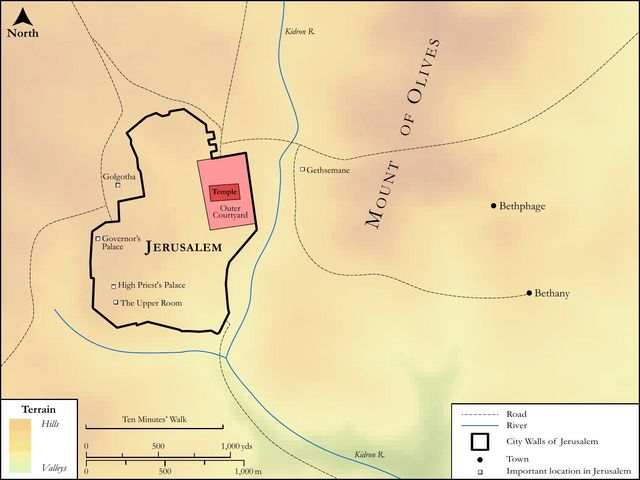
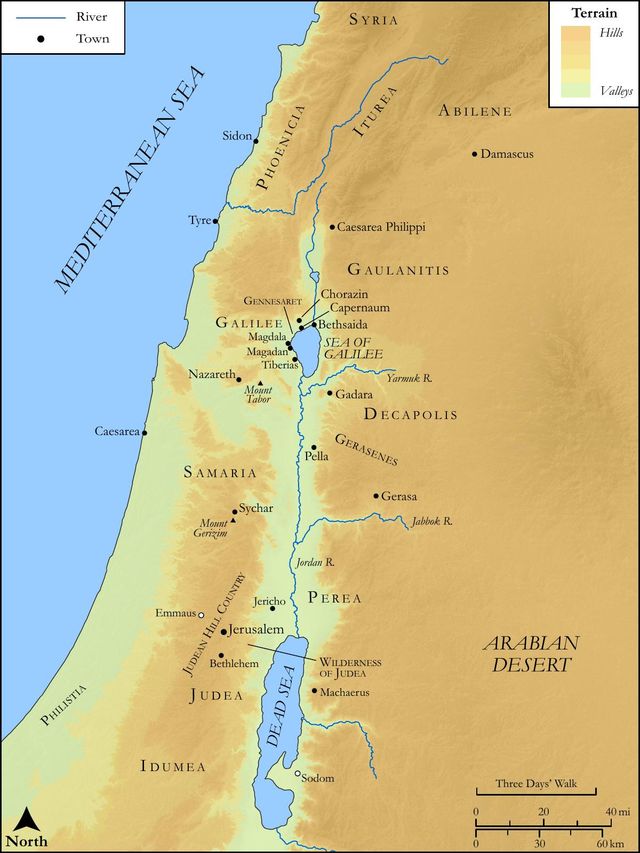
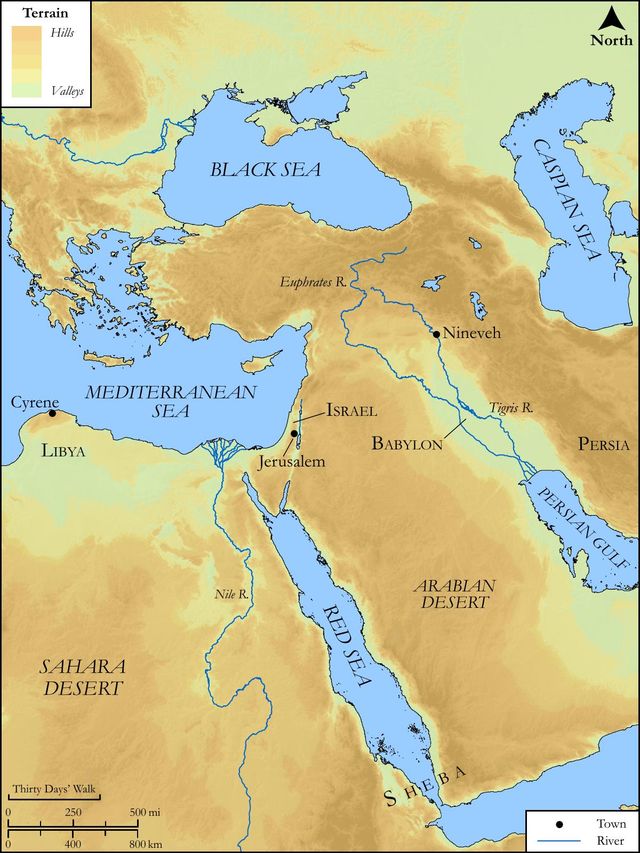
Study this verse
Public-domain commentary
Matthew Henry
From his Commentary on the Whole Bible. Henry comments on passages, not single verses — this entry covers Matthew 5:33–37. His three-level outline is real structure in the source text, so it is rendered as structure.
We have here an exposition of the third commandment, which we are the more concerned right to understand, because it is particularly said, that God will not hold him guiltless, however he may hold himself, who breaks this commandment, by taking the name of the Lord in vain. Now as to this command,
I.It is agreed on all hands that it forbids perjury, forswearing, and the violation of oaths and vows, Mat 5:33.
This was said to them of old time, and is the true intent and meaning of the third commandment. Thou shalt not use, or take up, the name of God (as we do by an oath) in vain, or unto vanity, or a lie. He hath not lift up his soul unto vanity, is expounded in the next words, nor sworn deceitfully, Psa 24:4. Perjury is a sin condemned by the light of nature, as a complication of impiety toward God and injustice toward man, and as rendering a man highly obnoxious to the divine wrath, which was always judged to follow so infallibly upon that sin, that the forms of swearing were commonly turned into execrations or imprecations; as that, God do so to me, and more also; and with us, So help me God; wishing I may never have any help from God, if I swear falsely. Thus, by the consent of nations, have men cursed themselves, not doubting but that God would curse them, if they lied against the truth then, when they solemnly called God to witness to it.
It is added, from some other scriptures, but shalt perform unto the Lord thine oaths (Num 30:2); which may be meant, either, 1. Of those promises to which God is a party, vows made to God; these must be punctually paid (Ecc 5:4, Ecc 5:5): or, 2. Of those promises made to our brethren, to which God was a Witness, he being appealed to concerning our sincerity; these must be performed to the Lord, with an eye to him, and for his sake: for to him, by ratifying the promises with an oath, we have made ourselves debtors; and if we break a promise so ratified, we have not lied unto men only, but unto God.
II.It is here added, that the commandment does not only forbid false swearing, but all rash, unnecessary swearing:
Swear not at all, Mat 5:34; Compare Jam 5:12. Not that all swearing is sinful; so far from that, if rightly done, it is a part of religious worship, and we in it give unto God the glory due to his name. See Deu 6:13; Deu 10:20; Isa 45:23; Jer 4:2. We find Paul confirming what he said by such solemnities (Co2 1:23), when there was a necessity for it. In swearing, we pawn the truth of something known, to confirm the truth of something doubtful or unknown; we appeal to a greater knowledge, to a higher court, and imprecate the vengeance of a righteous Judge, if we swear deceitfully.
Now the mind of Christ in this matter is,
1.That we must not swear at all, but when we are duly called to it, and justice or charity to our brother, or respect to the commonwealth, make it necessary for the end of strife (Heb 6:16), of which necessity the civil magistrate is ordinarily to be the judge. We may be sworn, but we must now swear; we may be adjured, and so obliged to it, but we must not thrust ourselves upon it for our own worldly advantage.
2.That we must not swear lightly and irreverently, in common discourse: it is a very great sin to make a ludicrous appeal to the glorious Majesty of heaven, which, being a sacred thing, ought always to be very serious: it is a gross profanation of God's holy name, and of one of the holy things which the children of Israel sanctify to the Lord: it is a sin that has no cloak, no excuse for it, and therefore a sign of a graceless heart, in which enmity to God reigns: Thine enemies take thy name in vain.
3.That we must in a special manner avoid promissory oaths, of which Christ more particularly speaks here, for they are oaths that are to be performed. The influence of an affirmative oath immediately ceases, when we have faithfully discovered the truth, and the whole truth; but a promissory oath binds so long, and may be so many ways broken, by the surprise as well as strength of a temptation, that it is not to be used but upon great necessity: the frequent requiring and using of oaths, is a reflection upon Christians, who should be of such acknowledged fidelity, as that their sober words should be as sacred as their solemn oaths.
4.That we must not swear by any other creature. It should seem there were some, who, in civility (as they thought) to the name of God, would not make use of that in swearing, but would swear by heaven or earth, etc. This Christ forbids here (Mat 5:34) and shows that there is nothing we can swear by, but it is some way or other related to God, who is the Fountain of all beings, and therefore that it is as dangerous to swear by them, as it is to swear by God himself: it is the verity of the creature that is laid at stake; now that cannot be an instrument of testimony, but as it has regard to God, who is the summum verum - the chief Truth. As for instance,
(1.)Swear not by the heaven; "As sure as there is a heaven, this is true;" for it is God's throne, where he resides, and in a particular manner manifests his glory, as a Prince upon his throne: this being the inseparable dignity of the upper world, you cannot swear by heaven, but you swear by God himself.
(2.)Nor by the earth, for it is his footstool. He governs the motions of this lower world; as he rules in heaven, so he rules over the earth; and though under his feet, yet it is also under his eye and care, and stands in relation to him as his, Psa 24:1. The earth is the Lord's; so that in swearing by it, you swear by its Owner.
(3.)Neither by Jerusalem, a place for which the Jews had such a veneration, that they could not speak of any thing more sacred to swear by; but beside the common reference Jerusalem has to God, as part of the earth, it is in special relation to him, for it is the city of the great King (Psa 48:2), the city of God (Psa 46:4), he is therefore interested in it, and in every oath taken by it.
(4.)"Neither shalt thou swear by the head; though it be near thee, and an essential part of thee, yet it is more God's than thine; for he made it, and formed all the springs and powers of it; whereas thou thyself canst not, from any natural intrinsic influence, change the colour of one hair, so as to make it white or black; so that thou canst not swear by thy head, but thou swearest by him who is the Life of thy head, and the Lifter up of it." Psa 3:3.
5.That therefore in all our communications we must content ourselves with, Yea, yea, and nay, nay, Mat 5:37. In ordinary discourse, if we affirm a thing, let us only say, Yea, it is so; and, if need be, to evidence our assurance of a thing, we may double it, and say, Yea, yea, indeed it is so: Verily, verily, was our Saviour's yea, yea. So if we deny a thing, let is suffice to say, No; or if it be requisite, to repeat the denial, and say, No, no; and if our fidelity be known, that will suffice to gain us credit; and if it be questioned, to back what we say with swearing and cursing, is but to render it more suspicious. They who can swallow a profane oath, will not strain at a lie. It is a pity that this, which Christ puts in the mouths of all his disciples, should be fastened, as a name of reproach, upon a sect faulty enough other ways, when (as Dr. Hammond says) we are not forbidden any more than yea and nay, but are in a manner directed to the use of that.
The reason is observable; For whatsoever is more than these cometh of evil, though it do not amount to the iniquity of an oath. It comes ek tou Diabolou; so an ancient copy has it: it comes from the Devil, the evil one; it comes from the corruption of men's nature, from passion and vehemence; from a reigning vanity in the mind, and a contempt of sacred things: it comes from that deceitfulness which is in men, All men are liars; therefore men use these protestations, because they are distrustful one of another, and think they cannot be believed without them. Note, Christians should, for the credit of their religion, avoid not only that which is in itself evil, but that which cometh of evil, and has the appearance of it. That may be suspected as a bad thing, which comes from a bad cause. An oath is physic, which supposes a disease.
Historical interpretation
Nine Centuries of Reception
12 surviving comments on this verse. Each one is dated, so this reads as a timeline rather than a list.
Select a marker to jump to its quote. Markers stagger vertically where authors wrote within a few decades of each other.
Otherwise; They who live in the simplicity of the faith have not need to swear, with them ever, what is is, what is not is not; by this their life and their conversation are ever preserved in truth.
The law had prescribed a penalty for false swearing, so that the ritual of an oath might hold false testimony in check.… But faith removes the need for using an oath. It establishes in truth the dealings of our life. Once the inclination to deceive has been checked, it enjoins simplicity in speaking and hearing.… Therefore those who are living in the simplicity of faith have no need for the ritual of an oath. With such people, what is, always is, and what is not, is not. For this reason, their every word and deed are always truthful.
"Again, ye have heard that it was said to them of old time, Thou shalt not forswear thyself, but shalt perform unto the Lord thine oaths. But I say unto you, swear not at all."
Why did He go straightway not to theft, but to false witness, passing over that commandment? Because he that steals, doth upon occasion swear also; but he that knows not either swearing or speaking falsehood, much less will he choose to steal. So that by this He hath overthrown the other sin likewise: since falsehood comes of stealing.
But what means, "Thou shalt perform unto the Lord thine oaths?" It is this, "thou shalt be true in swearing." "But I say unto you, swear not at all."
Next, to lead them farther away from swearing by God, He saith, "Neither by Heaven, for it is God's throne, nor by the earth, for it is the footstool of His feet; nor by Jerusalem, for it is the city of the great King:" still speaking out of the prophetical writings, and signifying Himself not to be opposed to the ancients. This was because they had a custom of swearing by these objects, and He intimates this custom near the end of His Gospel.
But mark, I pray thee, on what ground He magnifies the elements; not from their own nature, but from God's relation to them, such as it had been in condescension declared. For because the tyranny of idolatry was great, that the elements might not be thought worthy of honor for their own sake, He hath assigned this cause, which we have mentioned, which again would pass on to the glory of God. For He neither said, "because Heaven is beautiful and great," nor, "because earth is profitable;" but "because the one is God's throne, the other His footstool;" on every side urging them on towards their Lord.
"Neither by thy head," saith He, "because thou canst not make one hair white or black."
Here again, not as wondering at man, hath He withdrawn him from swearing by his head (for so man himself would be worshipped), but as referring the glory to God, and signifying that thou art not master even of thyself, and of course therefore not of the oaths made by thy head. For if no one would give up his own child to another, much more will not God give up His own work to thee. For though it be thy head, yet is it the property of another; and so far from being master thereof, thou shalt not be able to do with it, no not the least thing of all. For He said not, "Thou canst not make one hair grow;" but, "Not so much as change its quality."
"But what," it may be said, "if any one should require an oath, and apply constraint?" Let the fear of God be more powerful than the constraint: since, if thou art to bring forward such excuses, thou wilt keep none of the things which are enjoined.
Yea, for first with respect to thy wife thou wilt say, "what if she be contentious and extravagant;" and then as to the right eye, "what if I love it, and am quite on fire?" and of the unchaste look, "what then, if I cannot help seeing?" and of our anger against a brother, "what if I be hasty, and not able to govern my tongue?" and in general, all His sayings thou mayest on this wise trample under foot. Yet surely with regard to human laws thou darest not in any case use this allegation, nor say, "what then if this or that be the case," but, willing or unwilling, thou receivest what is written.
And besides, thou wilt never have compulsion to undergo at all. For he that hath hearkened unto those former blessings, and hath framed himself to be such as Christ enjoined, will have no such constraint to endure from any, being held in reverence and veneration by all.
"But let your yea, be yea; and your nay, nay: for that which exceedeth these cometh of the evil one."
What is it then that "exceeds yea" and "nay"? it is the oath, not the perjury. For this latter is quite acknowledged, and no man needs to learn that it is of the evil one; and it is not an excess, but an opposite: whereas an excess means something more, and added over and above: which kind of thing swearing is.
"What then," saith one, "was it of the evil one? and if it was of the evil one, how was it a law?" Well, this same thing thou wilt say concerning the wife also; how is that now accounted adultery, which was before permitted?
What now may one reply to this? That the precepts then uttered had reference to the weakness of them who were receiving the laws; since also to be worshipped with the vapor of sacrifice is very unworthy of God, just as to lisp is unworthy of a philosopher. That kind of thing accordingly was now laid down to be adultery, and swearing to be of the evil one, now that the principles of virtue have advanced. But if these things had been, from the first, laws of the devil, they would not have attained to so great goodness. Yea, for had those not been forerunners in the first place, these which we now have would not have been so easily received. Do not thou then require their excellency now, when their use is past: but then, when the time was calling for them. Or rather, if thou wilt, even now: yea, for now also is their virtue shown: and most of all for the very cause, by reason of which we find fault with them. For their appearing such now, is the greatest commendation of them. For had they not brought us up well, and made us meet for the reception of the greater precepts, they would not have appeared such.
Therefore as the breast, when it hath fulfilled all its part, and is dismissing the child to the more manly diet, after that appears useless; and the parents who before thought it necessary for the babe, now abuse it with ten thousand mockeries (and many even not content with words of abuse, anoint it also with bitter drugs; that when their words have not power to remove the child's unseasonable propensity towards it, the real things may quench their longing): so also Christ saith, that they are of the evil one, not to indicate that the old law is of the devil, but in order that with most exceeding earnestness He might lead them away from their ancient poverty.
But if the old law had belonged to the devil, it would not have led people away from idolatry, but rather would have drawn them on and cast them into it; for this did the devil desire. But now we see the opposite effect produced by the old law. And indeed this very thing, the oath, was ordained of old for this cause, that they might not swear by the idols. For "ye shall swear," saith He, "by the true God." They were then no small advantages which the law effected, but rather very great. For that they came unto the "strong meat," was the work of its care.
"What then," it may be said, "is not swearing of the evil one?" Yes, indeed it is altogether of the evil one; that is, now, after so high a rule of self-restraint; but then not so.
"But how," one may say, "should the same thing become at one time good, at another time not good?" Nay, I say the very contrary: how could it help becoming good and not good, while all things are crying aloud, that they are so: the arts, the fruits of the earth, and all things else?
See it, for example, taking place first in our own kind. Thus, to be carried, in the earliest age of life, is good, but afterwards pernicious; to eat food that hath been softened in the mouth, in the first scene of our life, is good, but afterwards it is full of disgust; to be fed upon milk and to fly to the breast, is at first profitable and healthful, but tends afterwards to decay and harm. Seest thou how the same actions, by reason of the times, appear good, and again not so? Yea, and to wear the robe of a child is well as long as you are a boy, but contrariwise, when you are become a man, it is disgraceful. Wouldest thou learn of the contrary case too, how to the child again the things of the man are unsuited? Give the boy a man's robe, and great will be the laughter; and greater the danger, he being often upset in walking after that fashion. Allow him to handle public affairs, and to traffic, and sow, and reap, and great again will be the laughter.
Note how He exalts the elements of the world, not from their own nature, but from the respect which they have to God, so that there is opened no occasion of idolatry.
Or; of evil, that is, from their weakness to whom the Law permitted the use of an oath. Not that by this the old Law is signified to be from the Devil, but He leads us from the old imperfection to the new abundance.
(Vers. 31 seqq.) However, it is said: Whoever divorces his wife, let him give her a certificate of divorce. But I say to you: whoever divorces his wife, except for the cause of fornication, makes her commit adultery; and whoever marries a divorced woman commits adultery. Again, you have heard that it was said to the ancients: You shall not swear falsely, but you shall perform your oaths to the Lord. In the later part, the Savior explains this place more fully, that Moses commanded the certificate of divorce to be given because of the hardness of the hearts of the husbands, not granting a separation, but removing homicide. For it is far better, even if a sorrowful discord were to arise, for blood to be shed through hatred.
This was allowed under the Law, as to children; as they offered sacrifice to God, that they might not do it to idols, so they were permitted to swear by God; not that the thing was right, but that it were better done to God than to dæmons.
Lastly, consider that the Saviour does not here forbid to swear by God, but by the Heaven, the Earth, by Jerusalem, by a man's head. For this evil practice of swearing by the elements the Jews had always, and are thereof often accused in the prophetic writing's. For he who swears, shows either reverence or love for that by which he swears. Thus when the Jews swore by the Angels, by the city of Jerusalem, by the temple and the elements, they paid to the creature the honour and worship belonging to God; for it is commanded in the Law that we should not swear but by the Lord our God.
Therefore Evangelic verity does not admit an oath, since the whole discourse of the faithful is instead of an oath.
The righteousness of the Pharisees is not to forswear oneself; and this is confirmed by Him who gives the command not to swear, so far as relates to the righteousness of the kingdom of heaven. For just as he who does not speak at all cannot speak falsely, so he who does not swear at all cannot swear falsely. But yet, since he who takes God to witness swears, this section must be carefully considered, lest the apostle should seem to have acted contrary to the Lord's precept, who often swore in this way, when he says, Now the things which I write unto you, behold, before God I lie not; and again, The God and Father of our Lord Jesus Christ, which is blessed for evermore, knows that I lie not. Of like nature also is that asseveration, For God is my witness, whom I serve with my spirit in the gospel of His Son, that without ceasing I make mention of you always in my prayers. Unless, perchance, one were to say that it is to be reckoned swearing only when something is spoken of by which one swears; so that he has not used an oath, because he has not said, by God; but has said, God is witness. It is ridiculous to think so; yet because of the contentious, or those very slow of apprehension, lest any one should think there is a difference, let him know that the apostle has used an oath in this way also, saying, By your rejoicing, I die daily. And let no one think that this is so expressed as if it were said, Your rejoicing makes me die daily; just as it is said, By his teaching he became learned, i.e. by his teaching it came about that he was perfectly instructed: the Greek copies decide the matter, where we find it written, Νὴ τὴν καύχησιν ὑμετέραν, an expression which is used only by one taking an oath. Thus, then, it is understood that the Lord gave the command not to swear in this sense, lest any one should eagerly seek after an oath as a good thing, and by the constant use of oaths sink down through force of habit into perjury. And therefore let him who understands that swearing is to be reckoned not among things that are good, but among things that are necessary, refrain as far as he can from indulging in it, unless by necessity, when he sees men slow to believe what it is useful for them to believe, except they be assured by an oath.
(cont. Faust. xix. 23.) Inasmuch as the sin of perjury is a grievous sin, he must be further removed from it who uses no oath, than he who is ready to swear on every occasion, and the Lord would rather that we should not swear and keep close to the truth, than that swearing we should come near to perjury.
(Serm. in Mont. i. 17.) This precept also confirms the righteousness of the Pharisees, not to forswear; inasmuch as he who swears not at all cannot forswear himself. But as to call God to witness is to swear, does not the Apostle break this commandment when he says several times to the Galatians, The things which I write unto you, behold, before God, I lie not. (Gal. 1:20.) So the Romans, God is my witness, whom I serve in my spirit. (Rom. 1:9) Unless perhaps some one may say, it is no oath unless I use the form of swearing by some object; and that the Apostle did not swear in saying, God is my witness. It is ridiculous to make such a distinction; yet the Apostle has used even this form, I die daily, by your boasting. (1 Cor. 15:31.) That this does not mean, your boasting has caused my dying daily, but is an oath, is clear from the Greek, which is νὴ τὴν ὑμετέραν καύχησιν.
For no man can swear often, but he must sometimes forswear himself; as he who has a custom of much speaking will sometimes speak foolishly.
Having forbidden swearing, He instructs us how we ought to speak, Let your speech be yea, yea; nay, nay. That is, to affirm any thing it is sufficient to say, 'It is so:' to deny, to say, 'It is not so.' Or, yea, yea; nay, nay, are therefore twice repeated, that what you affirm with the mouth you should prove in deed, and what you deny in word, you should not establish by your conduct.
. That is, when you take an oath, speak the truth.
(non occ.) The Lord has hitherto taught to abstain from injuring our neighbour, forbidding anger with murder, lust with adultery, and the putting away a wife with a bill of divorce. He now proceeds to teach to abstain from injury to God, forbidding not only perjury as an evil in itself, but even all oaths as the cause of evil, saying, Ye have heard it said by them of old, Thou shall not forswear thyself. It is written in Leviticus, Thou shalt not forswear thyself in my name; (c. 19:12.) and that they should not make gods of the creature, they are commanded to render to God their oaths, and not to swear by any creature, Render to the Lord thy oaths; that is, if you shall have occasion to swear, you shall swear by the Creator and not by the creature. As it is written in Deuteronomy, Thou shall fear the Lord thy God, and shall swear by his name. (c. 6:13.)
Continue studying Matthew 5:33 across the web’s major study libraries — every link below opens this exact verse, chapter, or book on the destination site.
Read & Compare
 BibleGatewayThis verse in more than 200 translations and 70 languages.
 Bible.comThe YouVersion reader — hundreds of translations, reading plans, and highlights.
 ESV.orgCrossway's official English Standard Version reader.
 NET BibleThe NET translation with 60,000+ translators' notes on every rendering decision.
 STEP BibleTyndale House's free study tool — original text, vocabulary, and scholarly resources.
 BibliaLogos Bible Software's free web reader.
 USCCBThe New American Bible (Revised Edition) with the U.S. bishops' study notes.
Commentaries
 BibleHub CommentariesDozens of classic commentaries on this verse, gathered on one page.
 StudyLightMore than 100 commentary sets — the largest collection on the web.
 BibleRefPlain-English commentary on what this verse means, verse by verse.
 Enduring WordDavid Guzik's free commentary on this chapter, widely used by Bible teachers.
 Bible Study ToolsVerse commentary alongside Greek and Hebrew study aids.
Original Language & Research
- BibleHub InterlinearThe verse word by word — original language, transliteration, and English.
- BibleHub LexiconEvery word's original-language definition and Strong's entry.
 Blue Letter BibleDeep-study tools — Strong's numbers, concordance, and word studies.
 CNTR CollationThe earliest Greek manuscripts of this verse, collated letter by letter.
Sermons, Hymns & Audio


TrulyRandomVerse is not affiliated with these sites and doesn’t control their content. They’re linked because they’re genuinely useful.
Summary
In Matthew 5:33, Jesus continues His radical reinterpretation of the Mosaic Law within the Sermon on the Mount, addressing the traditional understanding of oaths. He affirms the existing high standard that one must not swear falsely (commit perjury) and, conversely, must faithfully fulfill all oaths made to the Lord. This verse serves as a foundational statement, emphasizing the profound importance of verbal integrity and divine accountability before Jesus introduces an even higher ethical standard regarding the practice of oath-taking itself.
Context
ShowHideLiterary Context
This verse is an integral part of Jesus' Sermon on the Mount, specifically within a series of antitheses (Matthew 5:21-48) where He contrasts the traditional interpretation of the Law ("Ye have heard that it hath been said by them of old time") with His own deeper, more demanding teaching ("But I say unto you"). Matthew 5:33-37 forms a distinct unit on oaths, with verse 33 setting the stage by affirming the existing legal and moral obligation to fulfill sworn promises, before Jesus then challenges the very necessity of such oaths in the subsequent verses. This structure highlights Jesus' method of first validating the Law's integrity and then revealing its ultimate spiritual intent.
Historical & Cultural Context
Oaths played a significant role in ancient Jewish society, serving as a legal and social mechanism to confirm truthfulness, validate agreements, and solemnize promises. The Old Testament contains numerous commands regarding oaths, such as the prohibition against swearing falsely by God's name (e.g., Leviticus 19:12) and the imperative to fulfill vows made to the Lord (e.g., Numbers 30:2 and Deuteronomy 23:21). While the Law emphasized fulfilling oaths made to God, some Jewish traditions had developed complex casuistry around different types of oaths, leading to a system where certain oaths were considered less binding than others, or where the letter of the law was upheld while its spirit was neglected. This context is crucial for understanding why Jesus addresses the topic.
Key Themes
ShowHideThe primary themes in this passage revolve around the integrity of speech and the sanctity of oaths. Jesus underscores that one's word, especially when given under oath, must be absolutely trustworthy. The phrase "perform unto the Lord thine oaths" highlights divine accountability, emphasizing that all promises, regardless of their immediate human recipient, are ultimately made before God, who is the ultimate witness and judge of all commitments. This teaching also contributes to the broader theme of inward righteousness that permeates the Sermon on the Mount, moving beyond mere external compliance with the Law to address the heart's disposition towards truth and faithfulness. This internal focus is foundational to the ethics presented throughout Matthew 5.
Exposition and Analysis
ShowHideKey Word Analysis
ShowHideThis verb means "to swear falsely" or "to commit perjury." It denotes a deliberate act of breaking an oath or uttering a false oath, a grave offense in Jewish law, directly violating the command not to take the Lord's name in vain.
This word carries the sense of "to give away," "to pay back," "to render," or "to fulfill." In this context, it emphasizes the absolute necessity of carrying out or repaying one's solemn commitments made under oath, implying a debt owed.
Derived from a word meaning "a fence" or "limit," this noun refers to a sacred restraint or a solemn declaration confirmed by an appeal to God or something sacred. It signifies a binding promise made under divine witness, highlighting the serious and sacred nature of such commitments.
Verse Breakdown
ShowHide"Again, ye have heard that it hath been said by them of old time,"
This introductory phrase is characteristic of Jesus' teaching method in the Sermon on the Mount. It acknowledges the traditional, commonly understood interpretation of the Mosaic Law, which was often derived from rabbinic teachings and popular understanding rather than direct scriptural quotation. It sets up a contrast with what Jesus is about to declare.
"Thou shalt not forswear thyself,"
This is the negative command, echoing Old Testament prohibitions against perjury. It directly forbids the act of swearing falsely, which was considered a serious sin because it involved lying under the invocation of God's name, thereby dishonoring Him and undermining the very fabric of truth and justice in society.
"but shalt perform unto the Lord thine oaths:"
This is the positive command, emphasizing the sacred obligation to fulfill all vows and promises made. The phrase "unto the Lord" is crucial, underscoring that even if an oath is made to another person, its ultimate accountability is to God, who is the divine witness to all human commitments. This clause reinforces the binding nature of oaths and the divine expectation of faithfulness.
Literary Devices
ShowHideJesus employs Antithesis in His teaching method, though in this specific verse, it's more of a foundational statement leading into the broader antithetical structure of Matthew 5:33-37. The "not... but" structure within the verse itself ("Thou shalt not forswear thyself, but shalt perform...") functions as a direct, clear command, contrasting the forbidden action with the required one. The verse also serves as a form of Didacticism, as Jesus is directly instructing His disciples on ethical conduct. Furthermore, the phrase "Ye have heard that it hath been said by them of old time" acts as a Rhetorical Framing device, preparing the audience for a re-evaluation or deeper understanding of a familiar teaching.
Theological and Thematic Connections
ShowHideMatthew 5:33 firmly establishes the biblical principle that truthfulness and integrity are not merely human virtues but divine requirements, deeply rooted in God's own character as faithful and true. The command to fulfill oaths "unto the Lord" elevates all promises to a sacred level, implying that every word spoken carries weight before God. This teaching underscores the seriousness with which God views human speech and commitments, linking personal integrity directly to one's relationship with the divine. It prepares the way for Jesus' subsequent teaching that a simple "yes" or "no" should suffice, demonstrating that the need for oaths arises from a lack of inherent truthfulness, a condition that the Kingdom ethic seeks to transcend.
Reflection and Application
ShowHideMatthew 5:33 challenges believers to a profound level of integrity in their speech and commitments. While the subsequent verses in Matthew 5:34-37 advocate against the practice of making oaths altogether, this verse first affirms the existing, high standard: if a promise is made, especially one involving God, it must be kept without fail. For us today, this means that our words should be so reliable, our character so trustworthy, that formal oaths become unnecessary. It calls us to live with such consistent truthfulness that our "yes" means "yes" and our "no" means "no," reflecting the very character of God. This principle extends beyond formal vows to all our interactions, urging us to be people of our word, understanding that every promise, every commitment, is ultimately made in the presence of God.
Questions for Reflection
ShowHideFAQ
ShowHideWhat does "forswear thyself" mean in this context?
ShowHideIn Matthew 5:33, "forswear thyself" translates the Greek word epiorkeō, which specifically means "to swear falsely" or "to commit perjury." It refers to the act of breaking a solemn oath or making a false promise, particularly when invoking God's name or something sacred. This was considered a grave sin in Jewish law, as it not only involved lying but also dishonored God by using His name in a deceitful manner. The Old Testament explicitly prohibits such actions, as seen in Leviticus 19:12 and Exodus 20:7.
Does Matthew 5:33 contradict Jesus' later teaching in Matthew 5:34-37 about not swearing at all?
ShowHideNo, Matthew 5:33 does not contradict Matthew 5:34-37. Instead, verse 33 sets the stage by affirming the existing, high standard of the Mosaic Law: if one does make an oath, it must be fulfilled. This acknowledges the traditional understanding and the seriousness of oaths. Verses 34-37 then introduce Jesus' radical elevation of this standard, advocating for a level of integrity where oaths become unnecessary because one's simple "yes" or "no" is inherently trustworthy. Jesus is not abolishing the Law's demand for truthfulness but deepening it, calling His followers to a righteousness that surpasses mere external compliance, making their entire lives a testimony to truth.
Christ-Centered Fulfillment
ShowHideMatthew 5:33, while affirming the Old Testament's strictures on oaths, points forward to Christ as the ultimate embodiment of truth and the fulfillment of all divine promises. Jesus Himself is the "Amen" (Greek for "truth" or "so be it"), the faithful and true witness (Revelation 3:14), whose every word is absolute truth and whose promises are unfailingly kept. In Him, God's "Yes" is fully realized (2 Corinthians 1:20). Jesus' life perfectly exemplified the integrity He taught; He never needed to swear an oath because His word was inherently true and utterly reliable. His teaching here, that our "yes" should simply be "yes" and our "no," "no" (Matthew 5:37), invites His followers to participate in His own perfect truthfulness, reflecting the character of a God who cannot lie (Titus 1:2). As believers in Christ, we are called to live with such unwavering integrity that our speech patterns mirror His, making our lives a living testament to the One who is the Way, the Truth, and the Life (John 14:6).