


Judges 20:12
- וַיִּשְׁלְחוּvai·yish·le·Chuand they sentH7971Conj-w ¦ V-Qal-ConsecImperf-3mpVerb Qal Consecutive Imperfect 3rd Plural Masculineוַandיִּשְׁלְחוּthey sent
- שִׁבְטֵיshiv·Tei[the] tribes ofH7626N-mpcNoun Plural Masculine Construct
- יִשְׂרָאֵלYis·ra·'ElIsraelH3478N-properNoun Proper Location
- אֲנָשִׁים'a·na·ShimmenH582N-mpNoun Plural Masculine Absolute
- בְּכָלbe·kholin allH3605Prep-b ¦ N-mscNoun Singular Masculine Constructבְּinכָלall
- שִׁבְטֵיshiv·Tei[the] tribes ofH7626N-mpcNoun Plural Masculine Construct
- בִנְיָמִןvin·ya·MinBenjaminH1144N-proper-mNoun Proper Masculine
- לֵאמֹרle·Mor<to> sayingH559Prep-l ¦ V-Qal-InfVerb Qal Infinitive Constructלֵ<to>אמֹרsaying
- מָהmahwhat?H4100InterrogPronoun Interrogative
- הָרָעָהha·ra·'Ah[is] the evilH7451Art ¦ N-fsNoun Singular Feminine Absoluteהָ[is] theרָעָהevil
- הַזֹּאתha·Zot<the> thisH2063Art ¦ PrtParticle Demonstrativeהַ<the>זֹּאתthis
- אֲשֶׁר'a·SherwhichH834RelParticle Relative
- נִהְיְתָהnih·ye·Tahit has happenedH1961V-Niphal-Perf-3fsVerb Niphal Perfect 3rd Singular Feminine
- בָּכֶםba·Khemamong <the> youPrep-b ¦ 2mpSuffix Personal 2nd Plural Masculineבָּamong <the>כֶםyou
English is a literal word-by-word gloss of the Hebrew, not the KJV's wording. Why?
This is the original text the KJV's translators worked from — each Hebrew word with its own literal English meaning in this verse, prepared by scholars at Tyndale House, Cambridge. The KJV translates whole sentences, not word by word, so its wording differs: one Hebrew word can become several English words, and the KJV may choose “the LORD” where the gloss reads “Yahweh”. Both are faithful — they answer different questions. For the KJV's own rendering, switch to the KJV text.
Details
See on the biblical-era map
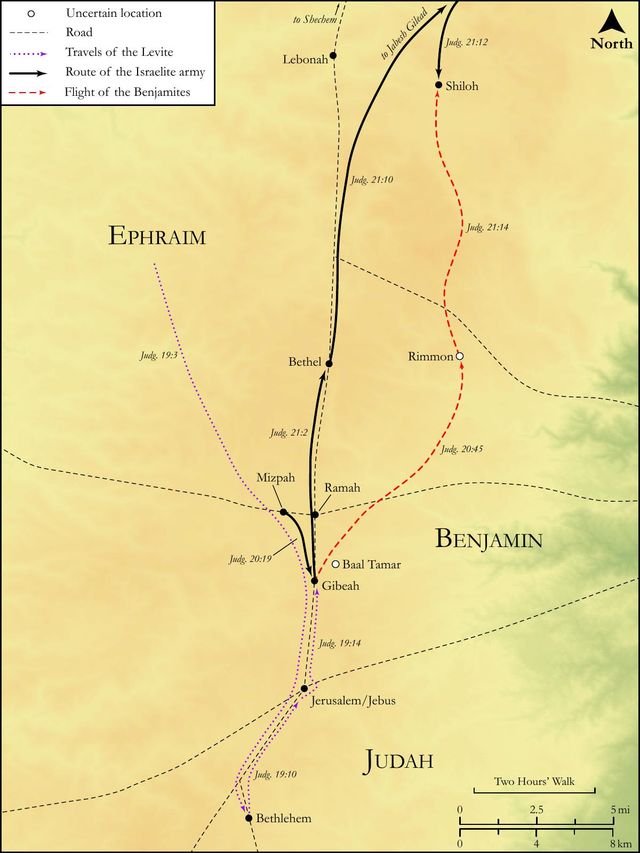
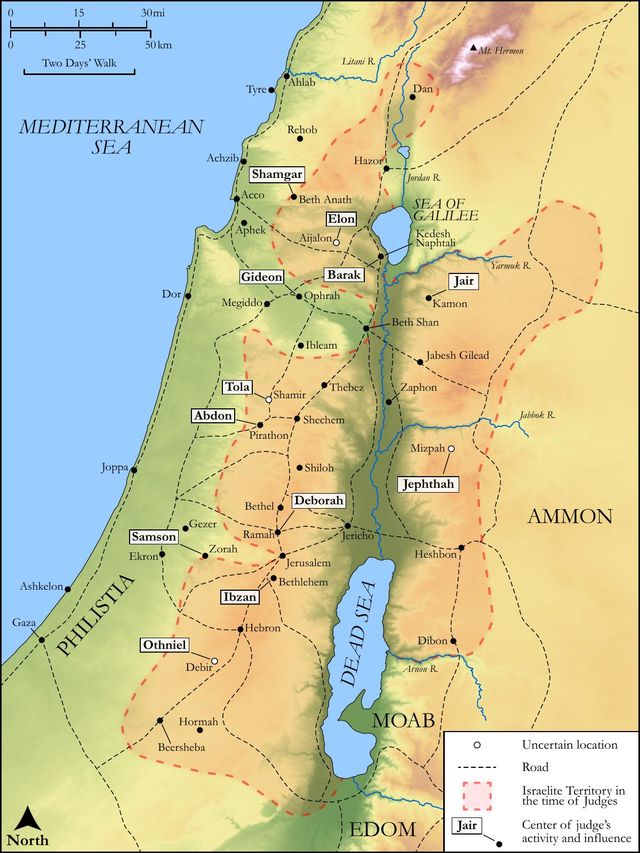
Study this verse
Public-domain commentary
Matthew Henry
From his Commentary on the Whole Bible. Henry comments on passages, not single verses — this entry covers Judges 20:12–17. His three-level outline is real structure in the source text, so it is rendered as structure.
Here is, I. The fair and just demand which the tribes of Israel, now encamped, sent to the tribe of Benjamin, to deliver up the malefactors of Gibeah to justice, Jdg 20:12, Jdg 20:13. If the tribe of Benjamin had come up, as they ought to have done, to the assembly, and agreed with them in their resolution, there would have been none to deal with but the men of Gibeah only, but they, by their absence, taking part with the criminals, application must be made to them all. The Israelites were zealous against the wickedness that was committed, yet they were discreet in their zeal, and did not think it would justify them in falling upon the whole tribe of Benjamin unless they, by refusing to give up the criminals, and protecting them against justice, should make themselves guilty, ex post facto - as accessaries after the fact. They desire them to consider how great the wickedness was that was committed (Jdg 20:12), and that it was done among them: and how necessary it was therefore that they should either punish the malefactors with death themselves, according to the law of Moses, or deliver them up to the general assembly, to be so much the more publicly and solemnly punished, that evil might be put away from Israel, the national guilt removed, the infection stopped by cutting off the gangrened part, and national judgments prevented; for the sin was so very like that of the Sodomites that they might justly fear, if they did not punish it, God would rain hail from heaven upon them, as he did, not only upon Sodom, but the neighbouring cities. If the Israelites had not made this reasonable demand, they would have had much more reason to lament the following desolations of Benjamin. All methods of accommodation must be used before we go to war or go to law. The demand was like that of Joab's to Abel, Sa2 20:20, Sa2 20:21. "Only deliver up the traitor, and we will lay down our arms." On these terms, and no other, God will be at peace with us, that we part with our sins, that we mortify and crucify our lusts, and then all shall be well; his anger will be turned away.
II.The wretched obstinacy and perverseness of the men of Benjamin, who seem to have been as unanimous and zealous in their resolutions to stand by the criminals as the rest of the tribes were to punish them, so little sense had they of their honour, duty, and interest. 1. They were so prodigiously vile as to patronise the wickedness that was committed: They would not hearken to the voice of their brethren (Jdg 20:13), either because those of that tribe were generally more vicious and debauched at this time than the rest of the tribes, and therefore would not bear to have that punished in others of which they knew themselves guilty (some of the most fruitful and pleasant parts of Canaan fell to the lot of this tribe; their land, like that of Sodom, was as the garden of the Lord, which perhaps helped to make the inhabitants, like the men of Sodom, wicked, and sinners before the Lord exceedingly, Gen 13:10, Gen 13:13), or because (as bishop Patrick suggests) they took it ill that the other tribes should meddle with their concerns; they would not do that which they knew was their duty because they were reminded of it by their brethren, by whom they scorned to be taught and controlled. If there were any wise men among them that would have complied with the demand made, yet they were overpowered by the majority, who thus made the crime of the men of Gibeah their own. Thus we have fellowship with the unfruitful works of darkness if we say A confederacy with those that have, and make ourselves guilty of other men's sins by countenancing and defending them. It seems there is no cause so bad but it will find some patrons, some advocates, to appear for it; but woe be to those by whom such offences come. Those will have a great deal to answer for that obstruct the course of necessary justice, and strengthen the hands of the wicked, by saying, O wicked man! thou shalt not die.
2.They were so prodigiously vain and presumptuous as to make head against the united force of all Israel. Never, surely, were men so wretchedly infatuated as they were when they took up arms in opposition,
(1.)To so good a cause as Israel had. How could they expect to prosper when they fought against justice, and consequently against the just God himself, against those that had the high priest and the divine oracle on their side, and so acted in downright rebellion against the sacred and supreme authority of the nation.
(2.)To so great a force as Israel had. The disproportion of their numbers was much greater than that, Luk 14:31, Luk 14:32, where he that had but 10,000 durst not meet him that came against him with 20,000, and therefore desired conditions of peace. There the enemy was but two to one, here above fifteen to one; yet they despised conditions of peace. All the forces they could bring into the field were but 26,000 men, besides 700 men of Gibeah (Jdg 20:15); yet with these they will dare to face 400,000 men of Israel, Jdg 20:17. Thus sinners are infatuated to their own ruin, and provoke him to jealousy who is infinitely stronger than they, Co1 10:22. But it should seem they depended upon the skill of their men to make up what was wanting in numbers, especially a regiment of slingers, 700 men, who, though left-handed, were so dexterous at slinging stones that they would not be a hair's breadth beside their mark, Jdg 20:16. But these good marksmen were very much out in their aim when they espoused this bad cause. Benjamin signifies the son of the right hand, yet we find his posterity left-handed.
Historical interpretation
Historical reception
1 surviving comment on this verse from the historical church.
When he realized that she was dead, he lifted her onto the mule and brought her home; then, dividing her limbs into twelve parts, he sent one to each of the tribes of Israel. In great distress over this, all the people met at Mizpah, and there, learning of the abominable deed from the Levite, desired to go to war, deciding that it was unlawful for anyone to go to his tent until vengeance was taken on the authors of this deed. With courage they rushed into battle, but the advice of wiser men changed their purpose as they decided not to engage the citizens in war but to put the charge to the test first with words and to determine the conditions for the guilty. Nor did it seem fair that the cost of a few men’s crimes should fall on all and that the private sins of young men should make the safety of the citizenry fall. So they sent men to demand that the Gabanites [Gibeonites] give up those guilty of this crime, and, if they did not do so, let them know that to have defended such a crime was not less than to have committed it.
Continue studying Judges 20:12 across the web’s major study libraries — every link below opens this exact verse, chapter, or book on the destination site.
Read & Compare
 BibleGatewayThis verse in more than 200 translations and 70 languages.
 Bible.comThe YouVersion reader — hundreds of translations, reading plans, and highlights.
 ESV.orgCrossway's official English Standard Version reader.
 NET BibleThe NET translation with 60,000+ translators' notes on every rendering decision.
 STEP BibleTyndale House's free study tool — original text, vocabulary, and scholarly resources.
 BibliaLogos Bible Software's free web reader.
 USCCBThe New American Bible (Revised Edition) with the U.S. bishops' study notes.
Commentaries
 BibleHub CommentariesDozens of classic commentaries on this verse, gathered on one page.
 StudyLightMore than 100 commentary sets — the largest collection on the web.
 BibleRefPlain-English commentary on what this verse means, verse by verse.
 Enduring WordDavid Guzik's free commentary on this chapter, widely used by Bible teachers.
 Bible Study ToolsVerse commentary alongside Greek and Hebrew study aids.
Original Language & Research
- BibleHub InterlinearThe verse word by word — original language, transliteration, and English.
- BibleHub LexiconEvery word's original-language definition and Strong's entry.
 Blue Letter BibleDeep-study tools — Strong's numbers, concordance, and word studies.
 SefariaThe Hebrew text with Rashi and centuries of Jewish commentary.
Sermons, Hymns & Audio


TrulyRandomVerse is not affiliated with these sites and doesn’t control their content. They’re linked because they’re genuinely useful.
Summary
Judges 20:12 records the unified tribes of Israel's formal and urgent demand for accountability from the tribe of Benjamin regarding the horrific crime committed in Gibeah. This pivotal moment, following the brutal abuse and murder of the Levite's concubine, represents a crucial, albeit ultimately failed, attempt at peaceful resolution and the pursuit of justice before the nation plunged into a devastating civil war, underscoring the profound moral outrage and the urgent need for communal purity within Israel.
Context
ShowHideLiterary Context
This verse is situated at a critical juncture in the book of Judges, immediately following the shocking and graphic account in Judges 19, where a Levite's concubine is brutally gang-raped and murdered by men of Gibeah, a city within the tribal territory of Benjamin. The Levite's subsequent act of dismembering her body and distributing the twelve pieces to each tribe served as an unprecedented and visceral call for national action, igniting widespread indignation throughout Israel. Judges 20:1-11 describes the assembly of all Israel (except Benjamin) at Mizpah, where they commit to a unified response. Judges 20:12 then details their first official step: a direct inquiry to Benjamin, seeking an explanation and the surrender of the perpetrators, thus setting the immediate stage for the tragic civil conflict that unfolds in the subsequent verses.
Historical & Cultural Context
The period of the Judges was characterized by a severe lack of central authority and widespread moral decay, famously encapsulated by the recurring refrain, "In those days there was no king in Israel; everyone did what was right in his own eyes" (Judges 21:25). This spiritual and political vacuum created an environment where such atrocities as the one in Gibeah could occur. The concept of corporate responsibility was deeply ingrained in Israelite society, meaning that the sin of individuals within a community could bring guilt and judgment upon the entire group if not properly addressed (Joshua 7). The other tribes' demand for accountability from Benjamin reflects this understanding: the "wickedness" committed in Gibeah was not merely a local crime but a defilement of the entire covenant community, requiring communal action to purge the evil from their midst and restore moral order.
Key Themes
ShowHideJudges 20:12 encapsulates several crucial themes that resonate throughout the book and the broader biblical narrative. Firstly, Accountability and Justice are paramount, as the assembled tribes seek to hold Benjamin responsible for the egregious violation of divine and societal norms. Secondly, the passage underscores Corporate Responsibility, demonstrating the expectation that a tribe should deal decisively with the wickedness committed within its borders to maintain communal purity and avoid shared guilt. Thirdly, the rhetorical question, "What wickedness is this that is done among you?" conveys profound Moral Outrage at an act deemed an abomination against God's law and the very fabric of Israelite identity. Lastly, the act of "sending men" indicates an initial Attempt at Peaceful Resolution, offering Benjamin a chance to willingly surrender the perpetrators and avoid further conflict, highlighting a desire for internal purification over immediate warfare.
Exposition and Analysis
ShowHideKey Word Analysis
ShowHideThis term (H7451) denotes something "bad" or "evil," encompassing both natural and moral depravity. It describes an act that is not merely wrong but is deeply harmful, grievous, and offensive. In this context, it emphasizes the abhorrent nature of the crime committed in Gibeah, a deed so utterly contrary to God's law and human decency that it provoked national outrage and demanded severe consequences. Its use here highlights the profound moral corruption that had taken root within a segment of Israel.
The verb (H7971) signifies a formal and deliberate dispatching or sending forth. It implies an official delegation or embassy, indicating that the tribes of Israel were not acting impulsively but with a structured, diplomatic approach. This "sending" was a serious overture, conveying the gravity of the situation and offering Benjamin a formal opportunity to address the atrocity internally before the situation escalated further.
This word (H7626) refers to a "rod," "staff," or "scepter," and by extension, a "clan" or "tribe." Its repeated use in the verse ("tribes of Israel," "tribe of Benjamin") underscores the tribal structure of Israelite society and the corporate identity of each lineage. The inquiry is directed not just at the individuals in Gibeah, but at the entire collective unit of Benjamin, emphasizing the deeply ingrained concept of corporate responsibility within the Israelite covenant community.
Verse Breakdown
ShowHide"And the tribes of Israel sent men through all the tribe of Benjamin, saying,"
This opening clause establishes the unified and decisive action taken by the other eleven tribes of Israel. The "sending of men" signifies a formal diplomatic mission, not a spontaneous, unorganized mob. The phrase "through all the tribe of Benjamin" indicates a comprehensive and public demand for accountability, ensuring that the message reached the entire tribal entity, not just the city of Gibeah. This highlights the collective nature of the inquiry and the expectation that the entire tribe would respond.
"What wickedness [is] this that is done among you?"
This is a powerful rhetorical question that conveys profound shock, indignation, and moral outrage. It is not a request for new information, as the Levite had already recounted the horrific events. Instead, it serves as a direct accusation and a demand for an explanation and accountability for why such an abomination was allowed to occur and persist within their midst. The phrase "among you" directly implicates the entire tribe of Benjamin, underscoring the principle of corporate responsibility for the sin committed within their jurisdiction and challenging their moral standing as a covenant people.
Literary Devices
ShowHideThe verse employs several potent literary devices to convey its urgent message and build narrative tension. The most prominent is the Rhetorical Question, "What wickedness is this that is done among you?" This question is not posed to elicit new information but to express the profound moral outrage, incredulity, and condemnation of the other tribes. It functions as a direct challenge, demanding accountability and emphasizing the gravity of the offense. There is also a strong element of Foreshadowing, as this direct inquiry, which is subsequently met with Benjamin's defiant refusal (as the narrative unfolds), inevitably leads to the devastating civil war that consumes the remainder of the chapter. The collective action of "the tribes of Israel" against a single tribe also presents a form of Synecdoche, where the part (the wicked men of Gibeah) is implicitly held to represent the whole (the tribe of Benjamin), underscoring the principle of corporate responsibility and the collective guilt that would be incurred if the tribe failed to act.
Theological and Thematic Connections
ShowHideJudges 20:12 profoundly illustrates the biblical principle that sin, especially grievous sin, is not merely a private matter but has far-reaching communal implications. The "wickedness" committed in Gibeah was an affront to God's holiness, a defilement of the land, and a betrayal of Israel's covenant identity, demanding a national response. This passage underscores God's unwavering demand for justice and purity within His people, demonstrating that unaddressed evil defiles the community and invites divine judgment. The other tribes' demand for Benjamin to "purge the evil" from their midst reflects the Mosaic law's repeated emphasis on removing sin to maintain covenant faithfulness and avoid corporate consequences, highlighting the interconnectedness of individual actions and communal well-being.
Reflection and Application
ShowHideJudges 20:12 serves as a sobering reminder that unchecked sin, whether individual or corporate, inevitably leads to devastating consequences. For individuals, it calls us to self-examination, prompting us to ask what "wickedness" might be festering in our own lives—unconfessed sins, unaddressed habits, or unrepented attitudes—that needs to be confronted and brought before God. For communities, especially the church, it highlights the critical need for internal accountability and the courage to address moral failings, even when uncomfortable or unpopular. Ignoring or condoning sin out of a misplaced sense of loyalty, a desire for superficial peace, or fear of conflict can ultimately lead to greater fragmentation, spiritual decay, and a compromised witness. True peace and flourishing come through righteousness, the courageous pursuit of justice, and a commitment to ensuring that our communities genuinely reflect God's holy character and His standards for living.
Questions for Reflection
ShowHideFAQ
ShowHideWhy did the other tribes hold the whole tribe of Benjamin accountable for the actions of a few men in Gibeah?
ShowHideThe concept of corporate responsibility was foundational in ancient Israelite society and covenant theology. Sin committed by individuals within a community, especially heinous acts like the one in Gibeah, was seen as defiling the entire community and bringing collective guilt upon them if not addressed. The tribe of Benjamin, as a whole, was expected to deal with the perpetrators and purge the evil from their midst, as per Mosaic law (e.g., Deuteronomy 13:5). Their failure to do so, and their subsequent protection of the wicked men of Gibeah, made the entire tribe complicit in the "wickedness." This is similar to the story of Achan in Joshua 7, where the sin of one man led to defeat and judgment for the entire nation until the sin was purged.
What was the "wickedness" referred to in this verse?
ShowHideThe "wickedness" (Hebrew: raʻ, H7451) refers to the horrific events detailed in Judges 19. A Levite and his concubine were staying in Gibeah, a city of Benjamin. A group of wicked men from Gibeah demanded to rape the Levite, but instead, they brutally gang-raped and abused his concubine throughout the night, leading to her death. This act was an extreme violation of hospitality, sexual purity, human dignity, and the covenant law. It was an abomination that deeply offended God's law and the moral fabric of Israelite society. The Levite's subsequent dismemberment of her body and sending a piece to each tribe was a desperate, graphic appeal for justice against this unparalleled atrocity.
Christ-Centered Fulfillment
ShowHideJudges 20:12, with its stark portrayal of human depravity and the desperate, yet ultimately flawed, search for justice in a fallen world, powerfully points to the ultimate need for Christ. The "wickedness" committed in Gibeah is a microcosm of humanity's pervasive sinfulness, demonstrating that a world where "everyone did what was right in his own eyes" inevitably leads to chaos, moral decay, and untold suffering. The inability of Israel, even in its unified outrage, to perfectly purge evil from its midst through human means foreshadows the profound need for a perfect, divine intervention. Jesus Christ perfectly fulfills the roles of both the innocent victim and the righteous judge. He is the ultimate Lamb of God, who takes away the sin of the world, bearing the full weight of humanity's "wickedness" on the cross, becoming sin for us so that in Him we might become the righteousness of God (2 Corinthians 5:21). Furthermore, as the true King and Judge, Christ alone has the authority and power to perfectly execute justice (John 5:22) and establish a new community—the Church—which He purifies and presents to Himself "without spot or wrinkle or any such thing, but holy and blameless" (Ephesians 5:27). Thus, the failed human attempt at justice in Judges 20:12 ultimately magnifies the perfect and redemptive justice found only in Christ, who alone can truly cleanse and restore.