


Judges 13:15
Bible text: King James Version (1769 Blayney text) · Public domain
Bible text: Berean Standard Bible · Public domain
Bible text: American Standard Version (1901) · Public domain
Bible text: World English Bible, Messianic edition · Public domain
Bible text: Geneva Bible (1599) · Public domain
Bible text: Young's Literal Translation · Public domain
- וַיֹּאמֶרvai·Yo·merand he saidH559Conj-w ¦ V-Qal-ConsecImperf-3msVerb Qal Consecutive Imperfect 3rd Singular Masculineוַandיֹּאמֶרhe said
- מָנוֹחַma·No·achManoahH4495N-proper-mNoun Proper Masculine
- אֶל'eltoH413PrepPreposition
- מַלְאַךְmal·'Akh[the] angel ofH4397N-mscNoun Singular Masculine Construct
- יְהוָהYah·wehYahwehH3068N-properNoun Proper Title
- נַעְצְרָהna'·tze·rahlet us detainH6113V-Qal-Imperf-1cpVerb Qal Imperfect 1st Plural common gender
- נָּאna'pleaseH4994PrtParticle Interjection
- אוֹתָךְ'o·Takh<obj.> youH853DirObjM ¦ 2msParticle Object Indicatorאוֹתָ<obj.>ךְyou
- וְנַעֲשֶׂהve·na·'a·Sehso we may prepareH6213Conj-w ¦ V-Qal-ConjImperf-1cpVerb Qal Conjunction+Imperfect 1st Plural common genderוְsoנַעֲשֶׂהwe may prepare
- לְפָנֶיךָle·fa·Nei·kha<to> before youH6440Prep-l ¦ N-mpc ¦ 2msNoun Plural Masculine Constructלְ<to>פָנֶיbeforeךָyou
- גְּדִיge·Dia kid ofH1423N-mscNoun Singular Masculine Construct
- עִזִּים'i·ZimgoatsH5795N-mpNoun Plural Masculine Absolute
English is a literal word-by-word gloss of the Hebrew, not the KJV's wording. Why?
This is the original text the KJV's translators worked from — each Hebrew word with its own literal English meaning in this verse, prepared by scholars at Tyndale House, Cambridge. The KJV translates whole sentences, not word by word, so its wording differs: one Hebrew word can become several English words, and the KJV may choose “the LORD” where the gloss reads “Yahweh”. Both are faithful — they answer different questions. For the KJV's own rendering, switch to the KJV text.
Details
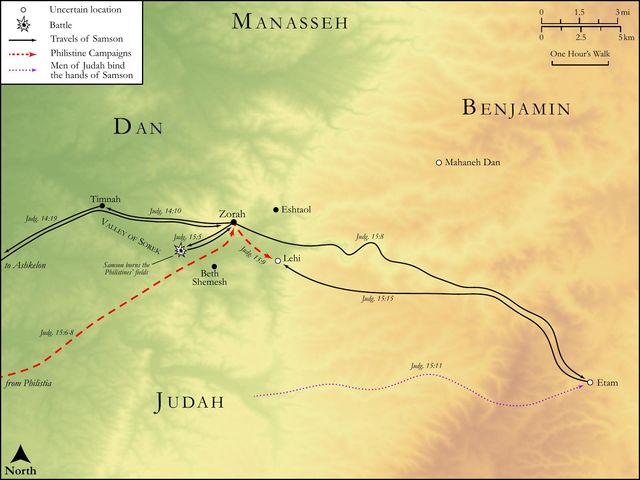
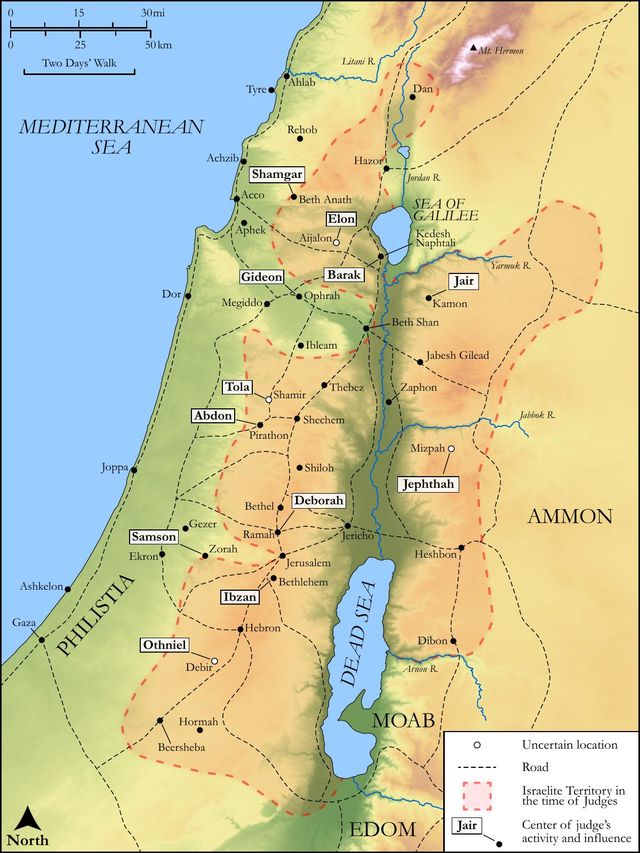
See on the biblical-era maps
Study this verse
Public-domain commentary
Matthew Henry
From his Commentary on the Whole Bible. Henry comments on passages, not single verses — this entry covers Judges 13:15–23. His four-level outline is real structure in the source text, so it is rendered as structure.
We have here an account,
I.Of what further passed between Manoah and the angel at this interview.
It was in kindness to him that while the angel was with him it was concealed from him that he was an angel; for, had he known it, it would have been such a terror to him that he durst not have conversed with him as he did (Jdg 13:16): He knew not that he was an angel. So Christ was in the world, and the world knew him not. Verily thou art a God that hidest thyself. We could not bear the sight of the divine glory unveiled. God having determined to speak to us by men like ourselves, prophets and ministers, even when he spoke by his angels, or by his Son, they appeared in the likeness of men, and were taken but for men of God. Now,
1.The angel declined to accept his treat, and appointed him to turn it into a sacrifice. Manoah, being desirous to show some token of respect and gratitude to this venerable stranger who had brought them these glad tidings, begged he would take some refreshment with him (Jdg 13:15): We will soon make ready a kid for thee. Those that welcome the message will be kind to the messengers for his sake that sends them, Th1 5:13. But the angel told him (Jdg 13:16) he would not eat of his bread, any more than he would of Gideon's, but, as there, directed him to offer it to God, Jdg 6:20, Jdg 6:21. Angels need not meat nor drink; but the glorifying of God is their meat and drink, and it was Christ's, Joh 4:34. And we in some measure do the will of God as they do it if, though we cannot live without meat and drink, yet we eat and drink to the glory of God, and so turn even our common meals into sacrifices.
2.The angel declined telling him his name, and would not so far gratify his curiosity. Manoah desired to know his name (Jdg 13:17), and of what tribe he was, not as if he doubted the truth of his message, but that they might return his visit, and be better acquainted with him (it is good to increase and improve our acquaintance with good men and good ministers); and he has a further design: "That when thy sayings come to pass, we may do thee honour, celebrate thee as a true prophet, and recommend others to thee for divine instructions, - that we may call the child that shall be born after thy name, and so do thee honour, - or that we may send thee a present, honouring one whom God has honoured." But the angel denies his request with something of a check to his curiosity (Jdg 13:18): Why askest thou thus after my name? Jacob himself could not prevail for this favour, Gen 32:29. Note, We have not what we ask when we ask we know not what. Manoah's request was honestly meant and yet was denied. God told Moses his name (Exo 3:13, Exo 3:14), because there was a particular occasion for his knowing it, but here there was no occasion. What Manoah asked for instruction in his duty he was readily told (Jdg 13:12, Jdg 13:13), but what he asked to gratify his curiosity was denied. God has in his word given us full directions concerning our duty, but never designed to answer all the enquiries of a speculative head. He gives him a reason for his refusal: It is secret. The names of angels were not as yet revealed, to prevent the idolizing of them. After the captivity, when the church was cured of idolatry, angels made themselves known to Daniel by their names, Michael and Gabriel; and to Zacharias the angel told his name unasked (Luk 1:19): I am Gabriel. But here it is secret, or it is wonderful, too wonderful for us. One of Christ's names is Wonderful, Isa 9:6. His name was long a secret, but by the gospel it is brought to light: Jesus a Saviour. Manoah must not ask because he must not know. Note,
(1.)There are secret things which belong not to us, and which we must content ourselves to be in the dark about while we are here in this world.
(2.)We must therefore never indulge a vain curiosity in our enquiries concerning these things, Col 2:18. Nescire velle quae Magister maximus docere non vult erudita inscitia est - To be willingly ignorant of those things which our great Master refuses to teach us is to be at once ignorant and wise.
3.The angel assisted and owned their sacrifice, and, at parting, gave them to understand who he was. He had directed them to offer their burnt-offering to the Lord, Jdg 13:16. Praises offered up to God are the most acceptable entertainment of the angels; see Rev 22:9, worship God. And Manoah, having so good a warrant, though he was no priest and had no altar, turned his meat into a meat offering, and offered it upon a rock to the Lord (Jdg 13:19), that is, he brought and laid it to be offered. "Lord, here it is, do what thou pleasest with it." Thus we must bring our hearts to God as living sacrifices, and submit them to the operation of his Spirit. All things being now ready,
(1.)The angel did wondrously, for his name was Wonderful. Probably the wonder he did was the same with what he had done for Gideon, he made fire to come either down from heaven or up out of the rock to consume the sacrifice.
(2.)He ascended up towards heaven in the flame of the sacrifice, Jdg 13:20. By this it appeared that he was not, as they thought, a mere man, but a messenger immediately from heaven. Thence certainly he descended, for thither he ascended, Joh 3:13; Joh 6:62. This signified God's acceptance of the offering and intimates to what we owe the acceptance of all our offerings, even to the mediation of the angel of the covenant, that other angel, who puts much incense to the prayers of saints and so offers them before the throne, Rev 8:3. Prayer is the ascent of the soul to God. But it is Christ in the heart by faith that makes it an offering of a sweet-smelling savour: without him our services are offensive smoke, but, in him, acceptable flame. We may apply it to Christ's sacrifice of himself for us; he ascended in the flame of his own offering, for by his own blood he entered in once into the holy place, Heb 9:12. While the angel did this, it is twice said (Jdg 13:19, Jdg 13:20) that Manoah and his wife looked on. This is a proof of the miracle: the matter of fact was true, for out of the mouth of these two eye-witnesses the report of it is established. The angel did all that was done in the sacrifice; they did but look on; yet doubtless, when the angel ascended towards heaven, their hearts ascended with him in thanksgiving for the promise which came thence and in expectation of the performance to come thence too. Yet, when the angel has ascended, they dared not, as those that were the witnesses of Christ's ascension, stand gazing up into heaven, but in holy fear and reverence they fell on their faces to the ground. And now,
[1.]They knew that it was an angel, Jdg 13:21. It was plain it was not the body of a man they saw, since it was not chained to the earth, nor prejudiced by fire; but ascended, and ascended in flame, and therefore with good reason they conclude it was an angel; for he maketh his angels spirits, and his ministers a flame of fire.
[2.]But he did not any more appear to them; it was for a particular occasion, now over, that he was sent, not to settle a constant correspondence, as with prophets. They must remember and observe what the angel had said and not expect to hear more.
II.We have an account of the impressions which this vision made upon Manoah and his wife.
While the angel did wondrously, they looked on, and said nothing (so it becomes us carefully to observe the wondrous works of God, and to be silent before him); but when he had gone, having finished his work, they had time to make their reflections.
1.In Manoah's reflection upon it there is great fear, Jdg 13:22. He had spoken with great assurance of the son they should shortly be the joyful parents of (Jdg 13:8, Jdg 13:12), and yet is now put into such a confusion by that very thing which should have strengthened and encouraged his faith that he counts upon nothing but their being both cut off immediately: We shall surely die. It was a vulgar opinion generally received among the ancient Jews that it was present death to see God or an angel; and this notion quite overcome his faith for the present, as it did Gideon's, Jdg 6:22.
2.In his wife's reflection upon it there is great faith, Jdg 13:23. Here the weaker vessel was the stronger believer, which perhaps was the reason why the angel chose once and again to appear to her. Manoah's heart began to fail him, but his wife, as a help meet for him, encouraged him. Two are better than one, for, if one fall into dejections and despondencies, the other will help to raise him up. Yoke-fellows should piously assist each other's faith and joy as there is occasion. None could argue better than Manoah's wife does here: We shall surely die, said her husband; "Nay," said she, "we need not fear that; let us never turn that against us which is really for us. We shall not die unless God be pleased to kill us: our death must come from his hand and his pleasure. Now the tokens of his favour which we have received forbid us to think that he designs our destruction. Had he thought fit to kill us,
(1.)He would not have accepted our sacrifice, and signified to us his acceptance of it by turning it to ashes, Psa 20:3, margin. The sacrifice was the ransom of our lives, and the fire fastening upon that was a plain indication of the turning away of his wrath from us. The sacrifice of the wicked is an abomination, but you see ours is not so.
(2.)He would not have shown us all these things, these strange sights, now at a time when there is little or no open vision (Sa1 3:1), nor would he have given these exceedingly great and precious promises of a son that shall be a Nazarite and a deliverer of Israel - he would not have told us such things as these if he had been pleased to kill us. We need not fear the withering of those roots out of which such a branch is yet to spring." Note, Hereby it appears that God designs not the death of sinners that he has accepted the great sacrifice which Christ offered up for their salvation, has put them in a way of obtaining his favour, and has assured them of it upon their repentance. Had he been pleased to kill them, he would not have done so. And let those good Christians who have had communion with God in the word and prayer, to whom he has graciously manifested himself, and who have had reason to think God has accepted their works, take encouragement thence in a cloudy and dark day. "God would not have done what he has done for my soul if he had designed to forsake me, and leave me to perish at last; for his work is perfect, nor will he mock his people with his favours." Learn to reason as Manoah's wife did, "If God had designed me to perish under his wrath, he would not have given me such distinguishing tokens of his favour." O woman! great is thy faith.
Continue studying Judges 13:15 across the web’s major study libraries — every link below opens this exact verse, chapter, or book on the destination site.
Read & Compare
 BibleGatewayThis verse in more than 200 translations and 70 languages.
 Bible.comThe YouVersion reader — hundreds of translations, reading plans, and highlights.
 ESV.orgCrossway's official English Standard Version reader.
 NET BibleThe NET translation with 60,000+ translators' notes on every rendering decision.
 STEP BibleTyndale House's free study tool — original text, vocabulary, and scholarly resources.
 BibliaLogos Bible Software's free web reader.
 USCCBThe New American Bible (Revised Edition) with the U.S. bishops' study notes.
Commentaries
 BibleHub CommentariesDozens of classic commentaries on this verse, gathered on one page.
 StudyLightMore than 100 commentary sets — the largest collection on the web.
 BibleRefPlain-English commentary on what this verse means, verse by verse.
 Enduring WordDavid Guzik's free commentary on this chapter, widely used by Bible teachers.
 Bible Study ToolsVerse commentary alongside Greek and Hebrew study aids.
Original Language & Research
- BibleHub InterlinearThe verse word by word — original language, transliteration, and English.
- BibleHub LexiconEvery word's original-language definition and Strong's entry.
 Blue Letter BibleDeep-study tools — Strong's numbers, concordance, and word studies.
 SefariaThe Hebrew text with Rashi and centuries of Jewish commentary.
Sermons, Hymns & Audio


TrulyRandomVerse is not affiliated with these sites and doesn’t control their content. They’re linked because they’re genuinely useful.
Summary
Judges 13:15 captures Manoah's earnest, yet incomplete, understanding of the divine messenger who has just confirmed the miraculous birth of Samson. Unaware that he is conversing with the Angel of the LORD, Manoah extends an offer of hospitality by proposing to prepare a meal, a gesture deeply rooted in Israel's customs of honoring esteemed guests, as when Abraham prepared a calf for the three men. This moment highlights Manoah's reverence and genuine desire for interaction, while simultaneously setting the stage for a profound revelation of God's direct involvement and the proper form of worship.
Context
ShowHideLiterary Context
This verse is situated at a pivotal moment in the narrative of Samson's miraculous birth. The Angel of the LORD has already appeared to Manoah's barren wife, announcing the extraordinary prophecy of a son who would begin to deliver Israel from the Philistines (Judges 13:2-5). Manoah, upon hearing this incredible news from his wife, prays fervently for the messenger to return, seeking further instruction regarding the child's upbringing (Judges 13:8). The Angel graciously reappears, but Manoah, still processing the divine encounter, does not fully grasp the visitor's true identity. His offer of a meal in Judges 13:15 is a natural human response to an honored guest, preceding the Angel's clarification that the offering should be a sacrifice to the LORD, not a meal for Him (Judges 13:16). This interaction culminates in the dramatic revelation of the Angel's divine nature as He ascends in the flame of the altar (Judges 13:20-22).
Historical & Cultural Context
Ancient Israelite society placed immense value on hospitality, viewing it as a sacred duty and a cornerstone of social interaction. Offering food and shelter to travelers or respected visitors was a deeply ingrained cultural norm, often extended even to strangers, as exemplified by Abraham's encounter with divine visitors in Genesis 18:1-8. Manoah's offer of a "kid" (a young goat) was a significant gesture, indicating a willingness to provide a substantial and honorable meal, reflecting the economic and social customs of the time. The period of the Judges, a tumultuous era marked by spiritual apostasy and foreign oppression, particularly from the Philistines, often saw God intervening directly through divine appearances (theophanies). These moments were crucial for reaffirming God's covenant faithfulness and initiating significant events, such as the birth of a deliverer like Samson, who would begin to rescue Israel from their oppressors (Judges 13:1).
Key Themes
ShowHideThis verse contributes to several overarching themes within the book of Judges and the broader biblical narrative. It highlights Divine Initiative and Intervention, as God actively sends His messenger to prepare for Samson's birth, despite Israel's spiritual decline and their repeated turning away from the Lord (Judges 2:11-19). The theme of Misunderstanding or Unawareness of the Divine is prominent, as Manoah initially treats the Angel of the LORD as a human prophet, underscoring humanity's limited perception of God's presence and the need for divine revelation. Manoah's actions also exemplify the cultural importance of Hospitality, a virtue frequently commended in Scripture, which often serves as a conduit for divine encounter (Hebrews 13:2). Finally, the interaction sets the stage for the profound theme of Sacrifice and Consecration, as the intended meal is transformed into an offering to the LORD, foreshadowing Samson's Nazarite consecration and the ultimate sacrificial work of God for His people (Numbers 6).
Exposition and Analysis
ShowHideKey Word Analysis
ShowHideThis is a highly significant and recurring figure throughout the Old Testament, often acting with divine authority, speaking as God Himself, and sometimes receiving worship without rebuke. The Hebrew term mălʼâk (H4397) means "a messenger; specifically, of God, i.e. an angel (also a prophet, priest or teacher)." The accompanying Yᵉhôvâh (H3068) refers to "(the) self-Existent or Eternal; Jehovah, Jewish national name of God." In Judges, this figure appears to Gideon (Judges 6:11-21) and here to Manoah and his wife. The phrase denotes a special manifestation of God, distinct from ordinary angels, often interpreted as a pre-incarnate appearance of the second person of the Trinity.
The verb ʻâtsâr (H6113) means "to inclose; by analogy, to hold back; also to maintain, rule, assemble." Manoah's request to "detain" the Angel indicates his desire for prolonged interaction, perhaps to gain more information, to properly honor the messenger, or to fully grasp the implications of the extraordinary news. It suggests a longing for continued divine presence and guidance, a natural human response to an encounter perceived as highly significant.
The term gᵉdîy (H1423) refers to "a young goat (from browsing)." It is often used in conjunction with ʻêz (H5795), meaning "a she-goat." In ancient Israel, a kid was a common and valuable animal used for food, often prepared for special guests or celebrations. Its mention here signifies a generous and appropriate offering of hospitality, demonstrating Manoah's respect and earnestness in welcoming his visitor, offering a substantial meal that would have been a mark of honor.
Verse Breakdown
ShowHide"And Manoah said unto the angel of the LORD"
This opening clause immediately establishes the speaker and the recipient of the address. Manoah, upon the Angel's second appearance, takes the initiative to interact directly, reflecting his earnest desire for clarification and his role as the head of the household. His direct address underscores his reverence, though he still does not fully comprehend the divine identity of his interlocutor, treating him as a revered human.
"I pray thee, let us detain thee"
Manoah's polite request, "I pray thee" (literally, "please"), conveys humility and respect, characteristic of Hebrew courtesy. His desire to "detain" the Angel indicates a wish for more than a fleeting encounter. He seeks to prolong the presence of this remarkable messenger, perhaps to understand more about the future child or simply to honor the one who brought such incredible news. This phrase reveals Manoah's earnestness and his desire to fully engage with the divine messenger.
"until we shall have made ready a kid for thee"
This specifies the purpose of Manoah's desire to detain the Angel: to prepare a meal. The "kid" (young goat) signifies a substantial and honorable offering, a common gesture of hospitality in Israel, as when Gideon made ready a kid for the angel of the LORD. Manoah's intention is to provide sustenance and show honor to his guest, treating him as a highly esteemed human prophet or dignitary, rather than recognizing the divine nature of the Angel of the LORD. This sets up the dramatic turn in the following verses, where the Angel redirects the offering from a meal to a sacrifice to the LORD, revealing His true identity.
Literary Devices
ShowHideThe passage employs several significant literary devices that enrich its theological depth. Irony is powerfully evident in Manoah's sincere act of hospitality, as he offers a meal to a divine being whom he perceives as a mere man. This highlights the profound gap between human understanding and divine reality, a recurring theme when the Angel of the LORD appears, emphasizing humanity's limited perception of God's true nature. There is also an element of Foreshadowing, as Manoah's intended meal for the Angel is transformed into a burnt offering to the LORD in subsequent verses (Judges 13:16-20), subtly preparing the reader for the sacrificial nature of God's work and the consecrated life of Samson. The entire encounter is a Theophany, a visible manifestation of God, though its full impact is only realized by Manoah and his wife later, reinforcing the theme of divine presence and intervention in human affairs, often veiled until the opportune moment.
Theological and Thematic Connections
ShowHideJudges 13:15 underscores the profound biblical theme of God's proactive engagement with humanity, even when His presence is not fully recognized. Manoah's sincere, albeit mistaken, act of hospitality reveals a heart open to the divine, demonstrating that God often meets us in our limited understanding and uses our earnest efforts, even when imperfectly directed, as a starting point for deeper revelation. This interaction highlights the mystery surrounding the "Angel of the LORD," a figure who embodies God's direct communication and authority, setting the stage for the miraculous birth of Samson and God's continued work of deliverance for Israel. The shift from an intended meal to a prescribed sacrifice also subtly introduces the theme of proper worship and the necessity of offering to God what is due to Him alone, distinguishing divine honor from human courtesy.
Reflection and Application
ShowHideManoah's encounter serves as a powerful reminder that God often works in ways we do not immediately comprehend, and His messengers may appear in unexpected forms. Manoah's earnest desire to show hospitality, even without full knowledge of his guest's identity, encourages us to cultivate a spirit of openness and generosity. In our own lives, we are called to be attentive to the seemingly ordinary moments and interactions where God might be present or at work. Our willingness to extend kindness, offer resources, and engage with others, even strangers, can become an act of worship and an opportunity for divine encounter. It challenges us to consider how we might be entertaining God's presence in our daily lives, and whether we are prepared to respond with reverence, obedience, and a willingness to have our perceptions transformed, allowing God to redirect our intentions towards His higher purposes.
Questions for Reflection
ShowHideFAQ
ShowHideWho was the "Angel of the LORD" that Manoah encountered?
ShowHideThe "Angel of the LORD" (Hebrew: mal'akh Yahweh) is a unique and significant figure in the Old Testament, distinct from ordinary angels. This figure often speaks with divine authority, receives worship without rebuke, and is sometimes identified with God Himself, particularly Yahweh. Theologically, many scholars interpret these appearances as theophanies or Christophanies—pre-incarnate manifestations of Jesus Christ, the second person of the Trinity. Manoah's interaction, particularly the Angel's subsequent ascent in the flame of the altar in Judges 13:20, strongly suggests a divine, rather than merely angelic, presence, confirming that Manoah and his wife had indeed "seen God" (Judges 13:22).
Why did Manoah offer a "kid" to the Angel, and why did the Angel refuse it as a meal?
ShowHideManoah offered a "kid" (a young goat) as a customary act of hospitality in Israel. It was a significant gesture to honor a respected guest or messenger, demonstrating generosity and reverence. However, the Angel of the LORD refused to eat it as a meal, instructing Manoah instead to offer it as a burnt offering to the LORD (Judges 13:16). This refusal and redirection highlighted the Angel's divine nature: He was not merely a human guest to be fed, but God Himself, who was to be worshipped through sacrifice. This act transformed Manoah's human hospitality into an act of divine worship, teaching Manoah and his wife the true identity of their visitor and the proper way to honor Him.
Christ-Centered Fulfillment
ShowHideManoah's offering of a "kid" to the Angel of the LORD, intended as a meal but divinely redirected as a sacrifice, profoundly foreshadows the ultimate sacrifice of Jesus Christ. The Angel of the LORD, often understood as a pre-incarnate appearance of Christ, does not consume the offering because He is not merely a recipient of human provision, but the very One to whom all true sacrifice is directed. In this sense, Christ is both the divine recipient of worship and, ultimately, the perfect sacrifice Himself. Just as the Angel's presence announced the birth of Samson, a deliverer for Israel, so the Incarnation of Christ, born of a virgin (Matthew 1:23), announced the arrival of the ultimate Deliverer for all humanity. Manoah's hospitality, though initially misdirected, points to the greater truth that in Christ, God Himself became the host, inviting us to His table (Revelation 3:20) and providing the ultimate feast through His body and blood, the sacrifice that takes away the sin of the world (John 1:29). The "kid" offered by Manoah finds its perfect fulfillment in the Lamb of God, whose one perfect sacrifice truly detains God's presence among us forever, not merely as a temporary visitor but as Emmanuel, God with us (Matthew 1:23).