


Judges 13:8
Bible text: King James Version (1769 Blayney text) · Public domain
Bible text: King James Version with Strong's numbers · Public domain
Bible text: Berean Standard Bible · Public domain
Bible text: American Standard Version (1901) · Public domain
Bible text: World English Bible, Messianic edition · Public domain
Bible text: Geneva Bible (1599) · Public domain
Bible text: Young's Literal Translation · Public domain
- וַיֶּעְתַּרvai·ye'·Tarand he prayedH6279Conj-w ¦ V-Qal-ConsecImperf-3msVerb Qal Consecutive Imperfect 3rd Singular Masculineוַandיֶּעְתַּרhe prayed
- מָנוֹחַma·No·achManoahH4495N-proper-mNoun Proper Masculine
- אֶל'eltoH413PrepPreposition
- יְהוָהYah·wehYahwehH3068N-properNoun Proper Title
- וַיֹּאמַרvai·yo·Marand he saidH559Conj-w ¦ V-Qal-ConsecImperf-3msVerb Qal Consecutive Imperfect 3rd Singular Masculineוַandיֹּאמַרhe said
- בִּיbipardon meH994PrtParticle Interjection
- אֲדוֹנָי'a·do·NaiO LordH136N-properNoun Proper Title
- אִישׁ'ish[the] man ofH376N-mscNoun Singular Masculine Construct
- הָאֱלֹהִיםha·'E·lo·Him<the> GodH430Art ¦ N-mpNoun Plural Masculine Absoluteהָ<the>אֱלֹהִיםGod
- אֲשֶׁר'a·SherwhomH834RelParticle Relative
- שָׁלַחְתָּsha·Lach·tayou sentH7971V-Qal-Perf-2msVerb Qal Perfect 2nd Singular Masculine
- יָבוֹאya·Vo'let him comeH935V-Qal-Imperf-3msVerb Qal Imperfect 3rd Singular Masculine
- נָאna'pleaseH4994PrtParticle Interjection
- עוֹד'OdagainH5750Adj-msAdjective Numerical Singular Masculine Absolute
- אֵלֵינוּ'e·Lei·nuto usH413Prep ¦ 1cpPreposition Definiteאֵלֵיtoנוּus
- וְיוֹרֵנוּve·yo·Re·nuso he may teach usH3384Conj-w ¦ V-Hiphil-ConjImperf-3ms ¦ 1cpVerb Hiphil Conjunction+Imperfect 3rd Singular Masculineוְsoיוֹרֵhe may teachנוּus
- מַהmahwhat?H4100InterrogPronoun Interrogative
- נַּעֲשֶׂהna·'a·Sehwill we doH6213V-Qal-Imperf-1cpVerb Qal Imperfect 1st Plural common gender
- לַנַּעַרla·Na·'arfor the ladH5288Prep-l ¦ N-msNoun Singular Masculine Absoluteלַfor theנַּעַרlad
- הַיּוּלָּדhai·yu·Ladwho is about to be bornH3205Art ¦ V-Pual-PassPrtcpl-msVerb Pual Participle Passive Singular Masculine Absoluteהַwhoיּוּלָּדis about to be born
English is a literal word-by-word gloss of the Hebrew, not the KJV's wording. Why?
This is the original text the KJV's translators worked from — each Hebrew word with its own literal English meaning in this verse, prepared by scholars at Tyndale House, Cambridge. The KJV translates whole sentences, not word by word, so its wording differs: one Hebrew word can become several English words, and the KJV may choose “the LORD” where the gloss reads “Yahweh”. Both are faithful — they answer different questions. For the KJV's own rendering, switch to the KJV text.
Details
See on the biblical-era maps
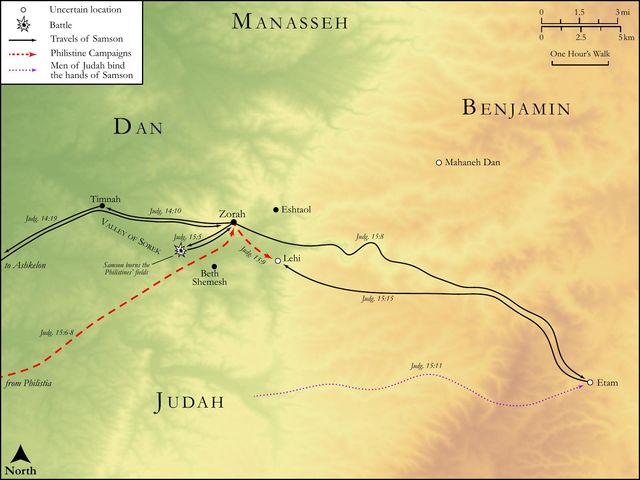
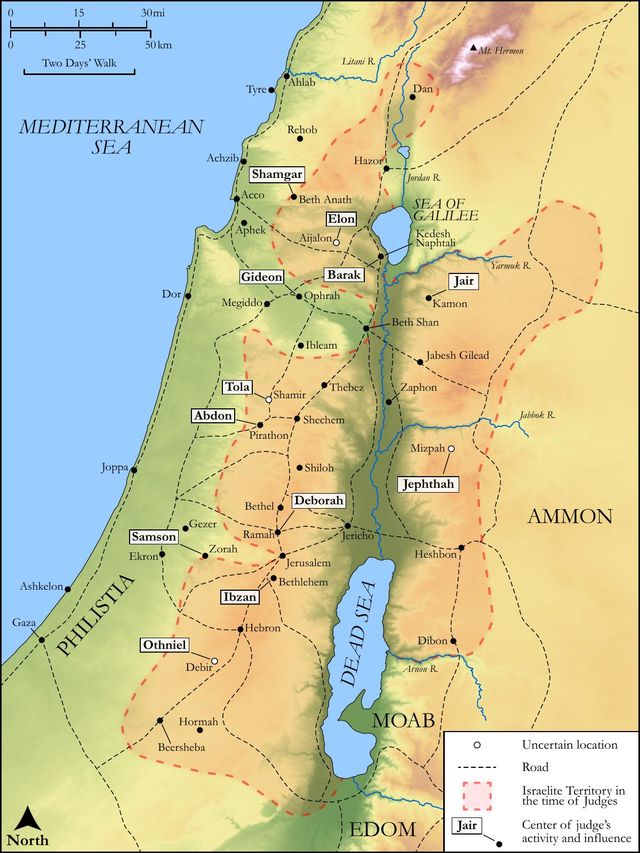
Study this verse
Public-domain commentary
Matthew Henry
From his Commentary on the Whole Bible. Henry comments on passages, not single verses — this entry covers Judges 13:8–14. His two-level outline is real structure in the source text, so it is rendered as structure.
We have here an account of a second visit which the angel of God made to Manoah and his wife.
I.Manoah earnestly prayed for it, Jdg 13:8.
He was not incredulous of the story his wife told him; he knew she was a virtuous woman, and therefore the heart of her husband did safely trust in her; he knew she would not go about to impose upon him, much less was he, as Josephus unworthily represents him, jealous of his wife's conversation with this stranger; but,
1.He takes it for granted that this child of promise shall in due time be given them, and speaks without hesitation of the child that shall be born. There was not found so great faith, no, not in Zechariah, a priest, then in waiting at the altar of the Lord, and to whom the angel himself appeared, as was in this honest Danite. Things hidden from the wise and prudent, who value themselves upon the niceness of their enquiries, are often revealed unto babes, who know how to prize God's gifts and to take God's word. Blessed are those that have not seen and yet, as Manoah here, have believed.
2.All his care is what they should do to the child that should be born. Note, Good men are more solicitous and desirous to know the duty that is to be done by them than to know the events that shall occur concerning them; for duty is ours, events are God's. Solomon enquires concerning the good men should do, not the good they should have, Ecc 2:3.
3.He therefore prays to God to send the same blessed messenger again, to give them further instructions concerning the management of this Nazarite, fearing lest his wife's joy for the promise might have made her forget some part of the precept, in which he was desirous to be fully informed, and lie under no mistake: "Lord, let the man of God come again unto us, for we desire to be better acquainted with him." Note, Those that have heard from heaven cannot but wish to hear more thence, again and again to meet with the man of God. Observe, He does not go or send his servants abroad, to find out this man of God, but seeks him upon his knees, prays to God to send him, and, thus seeking, finds him. Would we have God's messengers, the ministers of his gospel, to bring a word proper for us, and for our instruction? Entreat the Lord to send them to us, to teach us, Rom 15:30, Rom 15:32.
II.God graciously granted it:
God hearkened to the voice of Manoah, Jdg 13:9. Note, God will not fail some way or other to guide those by his counsel that are sincerely desirous to know their duty, and apply themselves to him to teach them, Psa 25:8, Psa 25:9.
1.The angel appears the second time also to the wife, when she is sitting alone, probably tending the flocks, or otherwise well employed in the field where she has retired. Solitude is often a good opportunity of communion with God; good people have thought themselves never less alone than when alone, if God be with them.
2.She goes in all haste to call her husband, doubtless humbly beseeching the stay of this blessed messenger till she should return and her husband with her, Jdg 13:10, Jdg 13:11. She did not desire him to go with her to her husband, but would fetch her husband to him. Those that would meet with God must attend where he is pleased to manifest himself. "Oh," says she, overjoyed, "my dear love, thy prayers are answered - yonder is the man of God, come to make us another visit - he that came the other day," or, as some read it, this day, for other is not in the original, and it is probable enough that both these visits were on the same day, and at the same place, and that the second time she sat expecting him. The man of God is very willing she should call her husband, Joh 4:16. Those that have an acquaintance with the things of God themselves should invite others to the same acquaintance, Joh 1:45, Joh 1:46. Manoah is not disgusted that the angel did not this second time appear to him, but very willingly goes after his wife to the man of God. To atone (as it were) for the first fatal miscarriage, when Eve earnestly pressed Adam to that which was evil, and he too easily yielded to her, let yoke-fellows excite one another to love and good works; and, if the wife will lead, let not the husband think it any disparagement to him to follow her in that which is virtuous and praiseworthy.
3.Manoah having come to the angel, and being satisfied by him that he was the same that had appeared to his wife, does, with all humility, (1.) Welcome the promise (Jdg 13:12): Now let thy words come to pass; this was the language, not only of his desire, but of his faith, like that of the blessed Virgin, Luk 1:38. "Be it according to thy word. Lord, I lay hold on what thou hast said, and depend upon it; let it come to pass." (2.) Beg that the prescriptions given might be repeated: How shall we order the child? The directions were given to his wife, but he looks upon himself as concerned to assist her in the careful management of this promised seed, according to order; for the utmost care of both the parents, and their constant joint endeavour, are little enough to be engaged for the good ordering of children that are devoted to God and to be brought up for him. Let not one devolve it on the other, but both do their best. Observe from Manoah's enquiry, [1.] In general, that, when God is pleased to bestow any mercy upon us, our great care must be how to use it well, and as we ought, because it is then only a mercy indeed when it is rightly managed. God has given us bodies, souls, estates; how shall we order them, that we may answer the intent of the donor, and give a good account of them? [2.] In particular, those to whom God has given children must be very careful how they order them, and what they do unto them, that they may drive out the foolishness that is bound up in their hearts, form their minds and manners well betimes, and train them in the way wherein they should go. Herein pious parents will beg divine assistance. "Lord, teach us how we may order our children, that they may be Nazarites, and living sacrifices to thee."
4.The angel repeats the directions he had before given (Jdg 13:13, Jdg 13:14): Of all that I forbad let her beware; and all that I commanded her let her observe. Note, There is need of a good deal both of caution and observation, for the right ordering both of ourselves and of our children. Beware and observe; take heed not only of drinking wine or strong drink, but of eating any thing that cometh of the vine. Those that would preserve themselves pure must keep at a distance from that which borders upon sin or leads to it. When she was with child of a Nazarite, she must not eat any unclean thing; so those in whom Christ is formed must carefully cleanse themselves from all filthiness of flesh and spirit, and do nothing to the prejudice of that new man.
Historical interpretation
Historical reception
1 surviving comment on this verse from the historical church.
But he, informed of this, devoutly offered his prayers to God, that the grace of this vision might be conferred on him also, saying, "To me, Lord, let Thine Angel come."
I am of opinion therefore that it was not from jealousy of his wife, because she was remarkable for her beauty that he acted thus, as one writer has supposed, but rather that he was filled with desire of the Divine grace, and sought to participate in the benefit of the heavenly vision. For one whose mind was depraved could not have found such favour with the Lord, as that an Angel should return to his house, who, having given those monitions which the Divine announcement made requisite, was suddenly carried away in the form of a smoking flame. This sight, which terrified the man, the woman interpreted more auspiciously, and so removed his solicitude, in that to see God is a sign of good not evil.
Continue studying Judges 13:8 across the web’s major study libraries — every link below opens this exact verse, chapter, or book on the destination site.
Read & Compare
 BibleGatewayThis verse in more than 200 translations and 70 languages.
 Bible.comThe YouVersion reader — hundreds of translations, reading plans, and highlights.
 ESV.orgCrossway's official English Standard Version reader.
 NET BibleThe NET translation with 60,000+ translators' notes on every rendering decision.
 STEP BibleTyndale House's free study tool — original text, vocabulary, and scholarly resources.
 BibliaLogos Bible Software's free web reader.
 USCCBThe New American Bible (Revised Edition) with the U.S. bishops' study notes.
Commentaries
 BibleHub CommentariesDozens of classic commentaries on this verse, gathered on one page.
 StudyLightMore than 100 commentary sets — the largest collection on the web.
 BibleRefPlain-English commentary on what this verse means, verse by verse.
 Enduring WordDavid Guzik's free commentary on this chapter, widely used by Bible teachers.
 Bible Study ToolsVerse commentary alongside Greek and Hebrew study aids.
Original Language & Research
- BibleHub InterlinearThe verse word by word — original language, transliteration, and English.
- BibleHub LexiconEvery word's original-language definition and Strong's entry.
 Blue Letter BibleDeep-study tools — Strong's numbers, concordance, and word studies.
 SefariaThe Hebrew text with Rashi and centuries of Jewish commentary.
Sermons, Hymns & Audio


TrulyRandomVerse is not affiliated with these sites and doesn’t control their content. They’re linked because they’re genuinely useful.
Summary
Judges 13:8 records Manoah's fervent and humble prayer to the LORD, requesting the return of the divine messenger to provide further, specific instruction regarding the upbringing of the son miraculously promised to him and his barren wife. This pivotal moment underscores Manoah's deep sense of parental responsibility and his profound reliance on God's guidance for nurturing a child destined for a unique, divinely appointed purpose in Israel's deliverance.
Context
ShowHideLiterary Context
This verse is situated within the opening narrative of Judges 13, which introduces the miraculous birth of Samson, one of Israel's most enigmatic judges. Immediately preceding this verse, an angel of the LORD (often identified as the "man of God" in this chapter) appears to Manoah's barren wife, announcing that she will conceive a son who is to be a Nazirite from birth and will begin the deliverance of Israel from the Philistines. This annunciation includes specific dietary and lifestyle prohibitions for the mother during pregnancy and for the child throughout his life (Judges 13:3-5). Manoah's wife then relays this extraordinary encounter and the specific instructions to her husband (Judges 13:6-7). Manoah's prayer in verse 8 is a direct, faith-filled response to this revelation, demonstrating his desire for direct divine confirmation and more detailed guidance, despite the clarity of the initial message. His earnest request leads to the angel's second appearance, this time to both Manoah and his wife, where the instructions are reiterated and further clarified, particularly regarding the Nazirite vow (Judges 13:9-14).
Historical & Cultural Context
The book of Judges chronicles a tumultuous period in Israel's history, characterized by a cyclical pattern of apostasy, oppression by foreign powers, and subsequent deliverance through divinely raised judges. At this point, Israel is under the oppressive hand of the Philistines, a powerful and technologically advanced people who occupied the coastal plain and exerted significant control over Israelite territories. Barrenness in ancient Israelite society was often viewed as a profound personal sorrow, a source of social shame, and sometimes even as a sign of divine disfavor, making the miraculous conception of Samson a powerful testament to God's sovereign intervention. The Nazirite vow, detailed in Numbers 6, was a special act of dedication to God, involving specific prohibitions such as abstaining from wine and strong drink, not cutting one's hair, and avoiding contact with dead bodies. Manoah's concern reflects the deeply ingrained cultural and religious understanding of parental responsibility to raise children, especially those set apart for God's service, in strict adherence to divine law and custom. His earnest prayer highlights the prevalent belief in direct divine communication and the expectation of God's active involvement in human affairs during this era.
Key Themes
ShowHideJudges 13:8 powerfully contributes to several overarching themes within the book of Judges and the broader biblical narrative. It highlights the theme of Divine Initiative and Providence, as God actively intervenes in human barrenness and orchestrates the birth of a deliverer, even before Israel cries out for help, demonstrating His unwavering commitment to His covenant people. Manoah's prayer underscores the theme of Seeking Divine Guidance, demonstrating a humble recognition that significant life responsibilities, especially those tied to God's purposes, require direct and specific instruction from the Almighty. This echoes the wisdom literature's emphasis on seeking God in all things, as seen in Proverbs 3:5-6. Furthermore, the verse emphasizes Parental Responsibility and Stewardship, as Manoah understands that this child is not merely his own, but a sacred trust to be nurtured according to God's specific will. This foreshadows the detailed instructions given to parents throughout scripture, such as those found in Deuteronomy 6:6-7.
Exposition and Analysis
ShowHideKey Word Analysis
ShowHideThis verb (H6279) conveys a sense of earnest pleading, supplicating, or praying fervently. It implies a deep sincerity and persistence in seeking a favorable response from God. Manoah's prayer was not a casual request but a heartfelt appeal, demonstrating his profound earnestness in fulfilling God's will for his son and his family. This term suggests a posture of humility and dependence, indicating a desire for divine intervention and clarity.
This proper name of God (H3068) refers to the self-Existent or Eternal One, the covenant God of Israel. Manoah's addressing his prayer to "the LORD" signifies his recognition of God's supreme authority, His covenant faithfulness, and His ability to intervene miraculously. It is a direct appeal to the sovereign God who had already initiated this extraordinary event, underscoring the theological weight of his petition.
The verb (H3384) means "to flow as water," "to lay or throw," but figuratively, "to point out" or "to instruct." It implies a desire for practical, actionable guidance, not just general theological principles. Manoah is not simply seeking abstract knowledge but concrete instructions on "what we shall do unto the child that shall be born," emphasizing his practical concern for the child's upbringing according to divine standards and his unique Nazirite calling.
Verse Breakdown
ShowHide"Then Manoah intreated the LORD,"
This opening clause immediately establishes Manoah's spiritual posture and the nature of his response to the extraordinary news. Upon hearing the divine promise and instructions from his wife, his first and most natural reaction is to turn to God in earnest prayer. The verb "intreated" highlights the depth of his sincerity and his profound reliance on divine wisdom, rather than human reasoning or presumption, in navigating this momentous event.
"and said, O my Lord, let the man of God which thou didst send come again unto us,"
Manoah addresses God directly, acknowledging His supreme authority and ownership ("O my Lord," using H136, ʼĂdônây). His specific request is for the reappearance of the "man of God," recognizing the divine messenger's authoritative role as God's representative. This demonstrates Manoah's desire for direct, unambiguous confirmation and further interaction with the source of the divine message, indicating his serious commitment to understanding and fulfilling God's will.
"and teach us what we shall do unto the child that shall be born."
This concluding clause reveals the core of Manoah's profound concern: practical guidance for the child's upbringing. He uses the plural "us," indicating a shared parental responsibility with his wife. The phrase "what we shall do" underscores his desire for specific, actionable instructions, recognizing the unique nature and destiny of this divinely promised son, who was to be a Nazirite from birth and destined to begin Israel's deliverance from the Philistines.
Literary Devices
ShowHideJudges 13:8 employs several literary devices that enhance its meaning and impact. Supplication is central, as Manoah's earnest prayer forms the core of the verse, demonstrating a model of seeking divine guidance and dependence on God. The use of the title "man of God" for the angel serves as a form of designation, emphasizing the divine authority and prophetic nature of the messenger, which Manoah clearly recognizes and respects. The phrase "come again unto us" and "teach us what we shall do" exhibits repetition of the theme of seeking instruction, underscoring Manoah's persistent and humble desire for clarity and practical guidance. This request also serves as foreshadowing, hinting at the extraordinary and specific requirements that will govern Samson's life as a Nazirite and a deliverer, setting the stage for the detailed instructions that follow in the subsequent verses. The entire interaction highlights divine intervention and theophany, as God responds directly to Manoah's prayer by sending His messenger again.
Theological and Thematic Connections
ShowHideManoah's heartfelt prayer in Judges 13:8 serves as a profound theological statement on the necessity of divine guidance in fulfilling God's purposes. It illustrates that even when God has clearly spoken, a humble and earnest desire for further clarity and practical instruction is commendable and often met with divine favor. This passage reminds us that God is not distant but is intimately involved in the details of our lives, especially when we seek to align ourselves with His will. Manoah's sense of stewardship over the child, recognizing him as a gift and a trust from God, highlights the biblical principle of raising children in the fear and admonition of the Lord, preparing them for their unique callings. His prayer is a testament to the power of persistent, faith-filled intercession that God honors.
Reflection and Application
ShowHideManoah's prayer in Judges 13:8 offers a timeless and powerful model for believers today, particularly in moments of significant responsibility or uncertainty. His immediate response to the extraordinary news of a divinely appointed child was not presumption or self-reliance, but a humble turning to the LORD for specific instruction. This teaches us the vital importance of prioritizing divine wisdom above all else, especially when facing monumental life decisions or entrusted with sacred trusts like raising children. We are reminded that children are not merely extensions of ourselves but unique individuals with divine potential, requiring intentional, God-centered nurturing. Manoah's example encourages us to be diligent in prayer, seeking God's specific guidance for our families, our callings, and every aspect of our lives, trusting that He is faithful to provide clarity and empower us to fulfill His purposes.
Questions for Reflection
ShowHideFAQ
ShowHideWhy did Manoah need more instruction if the angel had already spoken to his wife?
ShowHideWhile the angel had indeed given specific instructions to Manoah's wife regarding the child's Nazirite vow and his destiny to begin Israel's deliverance, Manoah's request for further instruction was likely driven by several factors. First, he had not personally heard the angel's message, and a direct encounter would provide confirmation and instill greater confidence in the divine origin of the promise. Second, the responsibility of raising a child set apart for such a significant divine purpose was immense, and Manoah, as the patriarch, likely desired to fully understand the implications and ensure he and his wife meticulously adhered to God's will. His prayer reflects a humble and earnest desire for comprehensive, practical guidance, not a lack of faith in his wife's report, but a profound sense of stewardship and a desire to leave no room for error in fulfilling God's specific plan for Samson. He wanted to know "what we shall do," implying a need for actionable steps and a shared understanding between both parents.
Christ-Centered Fulfillment
ShowHideManoah's earnest prayer for the "man of God" to return and "teach us what we shall do unto the child that shall be born" finds its ultimate and glorious fulfillment in the person and work of Jesus Christ. While Samson was a temporary deliverer, born for a specific purpose, he ultimately fell short of the full glory of God, demonstrating the limitations of human judges. Jesus, however, is the true and ultimate "man of God," not merely a messenger but God incarnate, the very Word made flesh who "dwelt among us, and we beheld His glory" (John 1:14). He is the one sent by the Father, not just to give instructions, but to perfectly reveal God's will and to embody it. Where Manoah sought guidance for a child who would begin to save Israel, God Himself, in Christ, provided the ultimate "child born" (Isaiah 9:6) who would fully and completely save His people from their sins (Matthew 1:21). Jesus is the perfect teacher, the one who truly "teaches us what we shall do" through His life, His commands, and His Holy Spirit, leading us into all truth and righteousness (John 14:26). Manoah's longing for divine instruction is met definitively in Christ, who is not only the message but the Way, the Truth, and the Life, through whom we truly know how to live according to God's perfect plan and enter into eternal life (John 14:6).