


Joshua 21:5
Bible text: King James Version (1769 Blayney text) · Public domain
Bible text: King James Version with Strong's numbers · Public domain
Bible text: Berean Standard Bible · Public domain
Bible text: American Standard Version (1901) · Public domain
Bible text: World English Bible, Messianic edition · Public domain
Bible text: Geneva Bible (1599) · Public domain
Bible text: Young's Literal Translation · Public domain
- וְלִבְנֵיve·liv·Neiand [belonged] to [the] descendants ofH1121Conj-w ¦ Prep-l ¦ N-mpcNoun Plural Masculine Constructוְandלִ[belonged] toבְנֵי[the] descendants of
- קְהָתke·HatKohathH6955N-proper-mNoun Proper Masculine
- הַנּוֹתָרִיםha·no·ta·Rimwhich remainedH3498Art ¦ V-Niphal-Prtcpl-mpVerb Niphal Participle Plural Masculine Absoluteהַwhichנּוֹתָרִיםremained
- מִמִּשְׁפְּחֹתmi·mish·pe·Chotfrom [the] clans ofH4940Prep-m ¦ N-fpcNoun Plural Feminine Constructמִfromמִּשְׁפְּחֹת[the] clans of
- מַטֵּהma·teh[the] tribe ofH4294N-mscNoun Singular Masculine Construct
- אֶפְרַיִם'Ef·ra·yimEphraimH669N-proper-mNoun Proper Masculine
- וּמִמַּטֵּהu·mi·ma·tehand from [the] tribe ofH4294Conj-w ¦ Prep-m ¦ N-mscNoun Singular Masculine Constructוּandמִfromמַּטֵּה[the] tribe of
- דָןdanDanH1835N-properNoun Proper Location
- וּמֵחֲצִיu·me·cha·Tziand from [the] half ofH2677Conj-w ¦ Prep-m ¦ N-mscNoun Singular Masculine Constructוּandמֵfromחֲצִי[the] half of
- מַטֵּהma·Teh[the] tribe ofH4294N-mscNoun Singular Masculine Construct
- מְנַשֶּׁהme·na·ShehManassehH4519N-proper-mNoun Proper Masculine
- בַּגּוֹרָלba·go·Ralby the lotH1486Prep-b ¦ N-msNoun Singular Masculine Absoluteבַּby theגּוֹרָלlot
- עָרִים'a·RimcitiesH5892N-mpNoun Plural Masculine Absolute
- עָשֶׂר'A·sertenH6235N-msNoun Singular Masculine Absolute
English is a literal word-by-word gloss of the Hebrew, not the KJV's wording. Why?
This is the original text the KJV's translators worked from — each Hebrew word with its own literal English meaning in this verse, prepared by scholars at Tyndale House, Cambridge. The KJV translates whole sentences, not word by word, so its wording differs: one Hebrew word can become several English words, and the KJV may choose “the LORD” where the gloss reads “Yahweh”. Both are faithful — they answer different questions. For the KJV's own rendering, switch to the KJV text.
Details
See on the biblical-era maps
Study this verse
Public-domain commentary
Matthew Henry
From his Commentary on the Whole Bible. Henry comments on passages, not single verses — this entry covers Joshua 21:1–8. His three-level outline is real structure in the source text, so it is rendered as structure.
Here is, I. The Levites' petition presented to this general convention of the states, now sitting at Shiloh, Jos 21:1, Jos 21:2. Observe, 1. They had not their lot assigned them till they made their claim. There is an inheritance provided for all the saints, that royal priesthood, but then they must petition for it. Ask, and it shall be given you. Joshua had quickened the rest of the tribes who were slack to put in their claims, but the Levites, it may be supposed, knew their duty and interest better than the rest, and were therefore forward in this matter, when it came to their turn, without being called upon. They build their claim upon a very good foundation, not their own merits nor services, but the divine precept: "The Lord commanded by the hand of Moses to give us cities, commanded you to grant them, which implied a command to us to ask them." Note, The maintenance of ministers is not an arbitrary thing, left purely to the good-will of the people, who may let them starve if they please; no, as the God of Israel commanded that the Levites should be well provided for, so has the Lord Jesus, the King of the Christian church, ordained, and a perpetual ordinance it is that those who preach the gospel should live of the gospel (Co1 9:14), and should live comfortably. 2. They did not make their claim till all the rest of the tribes were provided for, and then they did it immediately. There was some reason for it; every tribe must first know their own, else they would not know what they gave the Levites, and so it could not be such a reasonable service as it ought to be. But it is also an instance of their humility, modesty, and patience (and Levites should be examples of these and other virtues), that they were willing to be served last, and they fared never the worse for it. Let not God's ministers complain if at any time they find themselves postponed in men's thoughts and cares, but let them make sure of the favour of God and the honour that comes from him, and then they may well enough afford to bear the slights and neglects of men.
II.The Levites' petition granted immediately, without any dispute, the princes of Israel being perhaps ashamed that they needed to be called upon in this matter, and that the motion had not been made among themselves for the settling of the Levites.
1.The children of Israel are said to give the cities for the Levites. God had appointed how many they should be in all, forty-eight. It is probable that Joshua and the princes, upon consideration of the extent and value of the lot of each tribe as it was laid before them, had appointed how many cities should be taken out of each; and then the fathers of the several tribes themselves agreed which they should be, and therefore are said to give them, as an offering, to the Lord; so God had appointed. Num 35:8, Every one shall give of his cities to the Levites. Here God tried their generosity, and it was found to praise and honour, for it appears by the following catalogue that the cities they gave to the Levites were generally some of the best and most considerable in each tribe. And it is probable that they had an eye to the situation of them, taking care they should be so dispersed as that no part of the country should be too far distant from a Levites' city.
2.They gave them at the commandment of the Lord, that is, with an eye to the command and in obedience to it, which was it that sanctified the grant. They gave the number that God commanded, and it was well this matter was settled that the Levites might not ask more nor the Israelites offer less. They gave them also with their suburbs, or glebe-lands, belonging to them, so many cubits by measure from the walls of the city, as God had commanded (Num 35:4, Num 35:5), and did not go about to cut them short.
3.When the forty-eight cities were pitched upon, they were divided into four lots, as they lay next together, and then by lot were determined to the four several families of the tribe of Levi. When the Israelites had surrendered the cities into the hand of God, he would himself have the distributing of them among his servants.
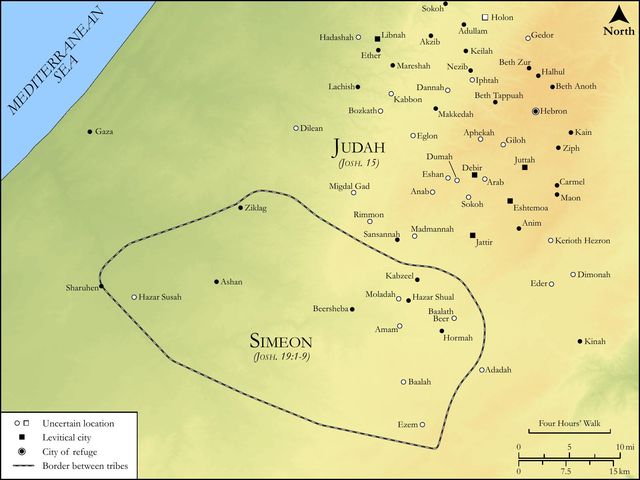
(1.)The family of Aaron, who were the only priests, had for their share the thirteen cities that were given by the tribes of Judah, Simeon, and Benjamin, Jos 21:4. God in wisdom ordered it thus, that though Jerusalem itself was not one of their cities, it being as yet in the possession of the Jebusites (and those generous tribes would not mock the Levites, who had another warfare to mind, with a city that must be recovered by the sword before it could be enjoyed), yet the cities that fell to their lot were those which lay next to Jerusalem, because that was to be, in process of time, the holy city, where their business would chiefly lie.
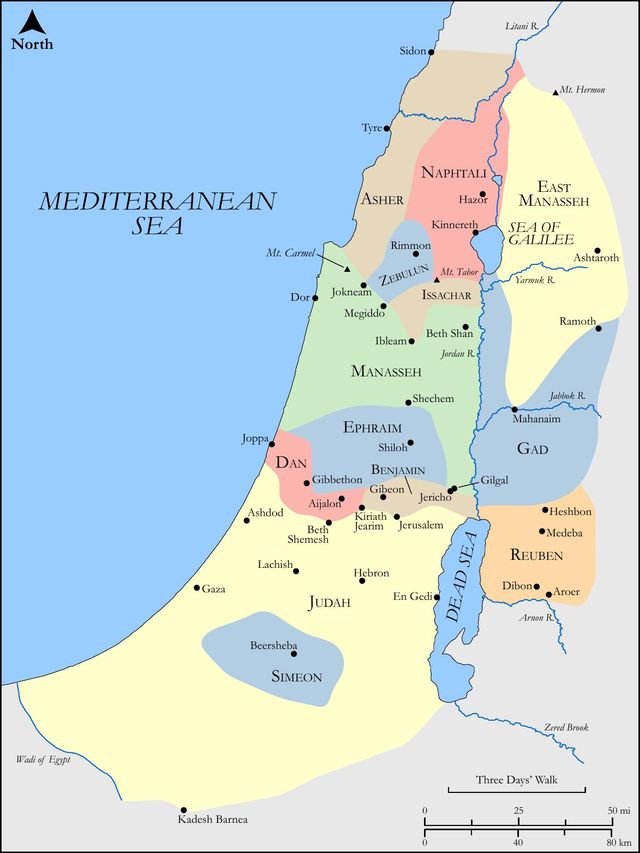
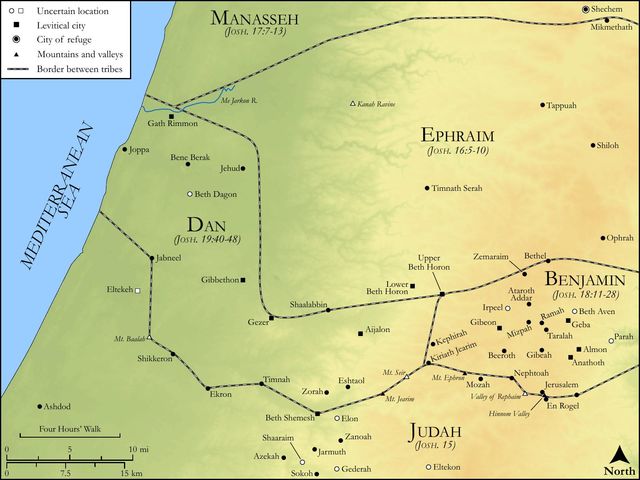
(2.)The Kohathite-Levites (among whom were the posterity of Moses, though never distinguished from them) had the cities that lay in the lot of Dan, which lay next to Judah, and in that of Ephraim, and the half-tribe of Manasseh, which lay next to Benjamin. So those who descended from Aaron's father joined nearest to Aaron's sons.
(3.)Gershon was the eldest son of Levi, and therefore, though the younger house of the Kohathites was preferred before his, yet his children had the precedency of the other family of Merari, Jos 21:6.
(4.)The Merarites, the youngest house, had their lot last, and it lay furthest off, Jos 21:7. The rest of the sons of Jacob had a lot for every tribe only, but Levi, God's tribe, had a lot for each of its families; for there is a particular providence directing and attending the removals and settlements of ministers, and appointing where those shall fix who are to be the lights of the world.
Historical interpretation
Historical reception
2 surviving comments on this verse. Each one is dated, so this reads as a timeline rather than a list.
Who will explain the diverse sites of the encampments, how this distribution must be retained in the resurrection for each priestly or levitical order of the saints, so that, just as the apostle says, nothing is done haphazardly in the resurrection, but everyone comes "in his own order, Christ first, then those who belong to Christ who have believed in his coming, when he will hand the kingdom over to our God and Father, when he will subject to him every principality and power"?On that occasion, without doubt, there will be some such observances of encampments and priestly distributions and ranks and signals of trumpets.
It was fitting that there be a drawing of lots even regarding the suburbs and cities so that perhaps the renowned division among the Levites might not seem perhaps indiscriminate and accidental. Therefore, the distribution by lot that took place among the sons of Israel was characterized by reason, by which someone was considered worthy of the first lot, and someone else the second, as we have already previously examined to the extent we were able. This was true in regard to both those who receive through Moses beyond the Jordan and those who receive from Jesus [Joshua] in the land of promise, where the first lot fell to Benjamin and afterwards to the rest, among whom Dan was the last. Even so it is necessary that there be some reason also in the order of priestly and levitical lots. Thus the first is drawn for someone, the second for someone else, and the third for another, through which these or those places are determined for each one.
Continue studying Joshua 21:5 across the web’s major study libraries — every link below opens this exact verse, chapter, or book on the destination site.
Read & Compare
 BibleGatewayThis verse in more than 200 translations and 70 languages.
 Bible.comThe YouVersion reader — hundreds of translations, reading plans, and highlights.
 ESV.orgCrossway's official English Standard Version reader.
 NET BibleThe NET translation with 60,000+ translators' notes on every rendering decision.
 STEP BibleTyndale House's free study tool — original text, vocabulary, and scholarly resources.
 BibliaLogos Bible Software's free web reader.
 USCCBThe New American Bible (Revised Edition) with the U.S. bishops' study notes.
Commentaries
 BibleHub CommentariesDozens of classic commentaries on this verse, gathered on one page.
 StudyLightMore than 100 commentary sets — the largest collection on the web.
 BibleRefPlain-English commentary on what this verse means, verse by verse.
 Enduring WordDavid Guzik's free commentary on this chapter, widely used by Bible teachers.
 Bible Study ToolsVerse commentary alongside Greek and Hebrew study aids.
Original Language & Research
- BibleHub InterlinearThe verse word by word — original language, transliteration, and English.
- BibleHub LexiconEvery word's original-language definition and Strong's entry.
 Blue Letter BibleDeep-study tools — Strong's numbers, concordance, and word studies.
 SefariaThe Hebrew text with Rashi and centuries of Jewish commentary.
Sermons, Hymns & Audio


TrulyRandomVerse is not affiliated with these sites and doesn’t control their content. They’re linked because they’re genuinely useful.
Summary
Joshua 21:5 meticulously records the divine allocation of ten cities to the non-priestly segment of the Kohathite clan, a specific Levitical family. This verse highlights God's faithful and precise fulfillment of His promise to provide for the Levites, who received no territorial inheritance, by scattering them among the other tribes of Israel to serve as spiritual guides and administrators throughout the land.
Context
ShowHideLiterary Context
Joshua 21 stands as a pivotal chapter in the book of Joshua, marking the culmination of the land distribution among the tribes of Israel. Following the conquest of Canaan and the division of the land by lot, detailed in Joshua 14-19, this chapter addresses the unique provision for the tribe of Levi. Unlike the other tribes, the Levites were not allotted a contiguous territory, as the Lord Himself was their inheritance, a theme powerfully articulated in Joshua 13:33. Instead, God commanded that they be given cities to dwell in, along with their pasturelands, scattered among all the other tribes. Joshua 21 systematically details the fulfillment of this divine decree, beginning with the request from the heads of the Levitical families in Joshua 21:1-3. Verse 4 specifically addresses the allocation to the Aaronite Kohathites (the priestly line), while verse 5 then specifies the provision for "the rest of the children of Kohath"—the non-priestly members of this clan, who had distinct duties related to the Tabernacle's furnishings. The chapter concludes with a powerful affirmation of God's unwavering faithfulness in fulfilling all His promises to Israel, as seen in Joshua 21:43-45.
Historical & Cultural Context
The allocation of cities to the Levites was a direct fulfillment of God's command given much earlier in the wilderness wanderings, particularly in Numbers 35:1-8. This divine instruction ensured that the Levites, who were set apart for sacred service, would be sustained and strategically positioned throughout the nascent nation. The method of "by lot" (Hebrew: goral) was a common and divinely sanctioned practice in ancient Israel for making important decisions, signifying that the outcome was not based on human preference or negotiation but on God's sovereign will. The scattering of the Levites among the tribes was crucial for the spiritual health and unity of Israel. As teachers of the Law, judges, and administrators of justice, their presence in various regions ensured accessibility to spiritual instruction and oversight, preventing spiritual drift and promoting adherence to the Mosaic covenant across the diverse tribal territories. This arrangement also prevented the formation of a concentrated, potentially powerful, priestly land-owning class, reinforcing their dependence on God and the generosity of the other tribes.
Key Themes
ShowHideJoshua 21:5, within the broader context of the chapter, powerfully illustrates several core themes. Firstly, it underscores Divine Faithfulness and Provision. The meticulous distribution of cities, determined by lot and precisely recorded, demonstrates God's unwavering commitment to His covenant promises and His detailed care for His chosen servants. This echoes the broader narrative of God's faithfulness throughout the book of Joshua, culminating in the declaration of Joshua 21:45. Secondly, it highlights Order and Administration within the newly settled nation. The systematic and precise allocation of cities, recorded with such detail, reflects the divinely guided organization of Israel's tribal and religious structure under Joshua's leadership. This was not a chaotic process but a testament to God's orderly nature, ensuring justice and spiritual guidance were accessible across the land, as also seen in the establishment of the Cities of Refuge. Thirdly, the verse contributes to the theme of the Unique Levitical Role. By providing cities for the Levites, including the Kohathites who were responsible for carrying the most sacred elements of the Tabernacle during the wilderness wanderings (Numbers 3:31), God ensured their continued function as spiritual instructors, mediators, and guardians of the Law, thereby promoting national unity and spiritual vitality throughout the land.
Exposition and Analysis
ShowHideKey Word Analysis
ShowHideFrom a primitive root meaning "to jut over or exceed"; by implication, "to excel"; (intransitively) "to remain or be left"; causatively, "to leave, cause to abound, preserve." In this context, "the rest" refers to those descendants of Kohath who were not of the priestly line of Aaron. This distinction is crucial, as the Aaronite priests had already received their allocation of thirteen cities in the preceding verse (Joshua 21:4). These non-priestly Kohathites had vital responsibilities related to the Tabernacle, primarily the carrying of its holy furnishings (such as the Ark of the Covenant, the table of showbread, the lampstand, and the altars) during Israel's wilderness journeys. Their continued provision in Canaan ensured the perpetuation of their sacred duties and their role in the spiritual life of the nation.
Or (shortened) גֹּרָל; from an unused root meaning "to be rough (as stone)"; properly, "a pebble, i.e. a lot (small stones being used for that purpose)"; figuratively, "a portion or destiny (as if determined by lot)." This phrase signifies that the distribution of cities was determined by casting lots, a practice in ancient Israel understood to be a means by which God revealed His will (Proverbs 16:33). The use of the lot removed any human bias or negotiation from the process, emphasizing that the allocation of these cities was not arbitrary but divinely ordained. It underscored God's sovereignty over the land and His meticulous involvement in the details of His people's lives and national affairs.
From an unused root meaning "to ally oneself"; "allied"; Kehath, an Israelite. Kohath was one of the three sons of Levi (along with Gershon and Merari), and his descendants formed a major clan within the tribe of Levi. While Aaron, the first high priest, was a descendant of Kohath, the term "the rest of the children of Kohath" in this verse specifically distinguishes them from the priestly (Aaronite) branch mentioned in Joshua 21:4. These non-priestly Kohathites had vital responsibilities related to the Tabernacle, primarily the carrying of its holy furnishings. Their continued provision in Canaan ensured the perpetuation of their sacred duties and their role in the spiritual life of the nation.
Verse Breakdown
ShowHide"And the rest of the children of Kohath [had]"
This opening clause immediately distinguishes this group from the priestly Kohathites who received their allocation in the preceding verse. It refers to the non-priestly descendants of Kohath, who, though not serving as priests, were integral to the Levitical service, particularly in the care and transport of sacred Tabernacle items. The phrase implies their receiving or possessing these cities as their divinely appointed dwelling places.
"by lot"
This crucial phrase indicates the method of distribution. It emphasizes that the allocation was not a human decision but a divine one, with God superintending the casting of lots to determine which cities would be assigned to this specific Levitical clan. This underscores God's sovereignty and meticulous involvement in the details of the land's division, ensuring fairness and divine order.
"out of the families of the tribe of Ephraim, and out of the tribe of Dan, and out of the half tribe of Manasseh"
This specifies the source of the cities. The Kohathites did not receive cities from a single tribe, but from three distinct tribal territories. This highlights the strategic scattering of the Levites throughout Israel, ensuring their presence and influence across various regions, fulfilling their role as spiritual instructors and administrators for all the tribes. It also demonstrates the cooperative effort required from the other tribes to fulfill God's command.
"ten cities"
This final clause provides the exact number of cities allocated to "the rest of the children of Kohath." The precision of this number, following the divine determination by lot and the naming of the contributing tribes, reinforces the theme of God's orderly provision and the meticulous fulfillment of His promises regarding the Levitical inheritance. This specific number contrasts with the thirteen cities given to the priestly Kohathites, demonstrating a tailored, divinely guided allocation.
Literary Devices
ShowHideJoshua 21:5, within the broader context of the chapter, employs several literary devices to convey its message. The primary device is Divine Command/Fulfillment Narrative, where the text systematically details the execution of God's earlier instructions regarding the Levitical cities (Numbers 35:1-8). This narrative structure emphasizes God's faithfulness and the reliability of His word, demonstrating that His decrees are always brought to pass. The Repetition of the phrase "by lot" throughout Joshua 21 (e.g., Joshua 21:4, Joshua 21:6, Joshua 21:8) serves to underscore the divine superintendence over the entire land distribution process, removing any human arbitrariness and highlighting God's sovereign control. Furthermore, the meticulous Enumeration of tribes and cities throughout the chapter, including the specific mention of Ephraim, Dan, and Manasseh in this verse, adds to the sense of historical accuracy and the thoroughness of God's provision. This detailed listing serves as a testament to the orderly nature of the divine plan and its precise execution, leaving no doubt about the fulfillment of God's promises.
Theological and Thematic Connections
ShowHideJoshua 21:5, in its specific detail, powerfully echoes the broader theological truth of God's meticulous faithfulness and His sovereign provision for His people. The precise allocation of cities to the Kohathites, determined by divine lot, underscores that God's promises are not vague generalities but specific, detailed commitments that He unfailingly brings to pass. This act of provision for the Levites, who were set apart for sacred service and had no land inheritance, illustrates God's care for those dedicated to Him, ensuring their sustenance and enabling their crucial role in the spiritual life of the nation. It highlights the divine order and wisdom in establishing a system where spiritual instruction and oversight were accessible throughout all the tribes, preventing spiritual decay and fostering national unity under God's law. This divine arrangement also prefigures the New Testament concept of the church as a scattered, yet unified, body, entrusted with the spiritual care and instruction of God's people.
Reflection and Application
ShowHideJoshua 21:5, though detailing an ancient administrative act, offers profound and timeless lessons for believers today. The meticulous care with which God provided for the Kohathites, down to the specific number of cities and the tribes from which they were drawn, serves as a powerful reminder of His unwavering faithfulness in fulfilling His promises. It encourages us to trust in God's provision for our own lives, recognizing that He is intimately concerned with our needs and purposes, just as He was for His servants in ancient Israel. This passage also highlights the importance of spiritual presence and instruction within communities. Just as the Levites were scattered to be spiritual anchors, we, as believers, are called to be salt and light in our spheres of influence, embodying God's truth and love in our daily lives. The divine order evident in this allocation also prompts us to consider the importance of structure, intentionality, and divine guidance in our own lives and in the life of the church, trusting that God works out His plans with precision for His glory and our good. It reminds us that our "inheritance" is not primarily earthly possessions but a relationship with God, and from that relationship flows His provision for our service.
Questions for Reflection
ShowHideFAQ
ShowHideWho were the Kohathites, and why were they mentioned separately from other Levites?
ShowHideThe Kohathites were one of the three main clans descended from Levi, the ancestor of the Levitical tribe. They were responsible for carrying the most sacred furnishings of the Tabernacle during Israel's wilderness journeys, such as the Ark of the Covenant and the altars. They are mentioned separately because, while all Levites served God, the Kohathites had distinct duties. Furthermore, within the Kohathite clan, there was a crucial distinction: the Aaronite Kohathites (descendants of Aaron, Moses' brother) were the priests, while "the rest of the children of Kohath" (as in Joshua 21:5) were non-priestly Levites with other specific service roles related to the Tabernacle's care and transport. This verse specifically addresses the provision for this non-priestly segment of the Kohathites.
What is the significance of the phrase "by lot" in the context of land distribution?
ShowHideThe phrase "by lot" (Hebrew: goral) signifies that the distribution of the cities was not based on human negotiation, preference, or strategic planning, but was determined by casting lots. In ancient Israel, this method was understood as a way of seeking and receiving divine direction, ensuring that the outcome was God's sovereign will (Proverbs 16:33). It emphasized that the land, and its division, ultimately belonged to God, and He was orchestrating the details of His people's inheritance and settlement, removing any potential for human dispute or perceived unfairness in the allocation process.
Why were the Levites, including the Kohathites, scattered among the other tribes instead of receiving a single territory?
ShowHideThe Levites did not receive a territorial inheritance like the other tribes because "the LORD God of Israel was their inheritance" (Joshua 13:33). Instead, God commanded that they be scattered among all the tribes by receiving cities and pasturelands. This strategic distribution served several vital purposes: it ensured that spiritual instruction, the teaching of the Law, and the administration of justice were accessible to all tribes throughout the land. The Levites served as spiritual guides, judges, and administrators, helping to maintain the nation's adherence to God's covenant and preventing spiritual drift in isolated areas. This arrangement fostered national unity under God's law and provided spiritual oversight across the entire land of Israel, ensuring that God's presence and commands were felt in every corner of the nation.
Christ-Centered Fulfillment
ShowHideJoshua 21:5, detailing the meticulous provision for the Kohathites, finds profound Christ-centered fulfillment in several ways. The Levites, particularly the Kohathites who handled the sacred objects of the Tabernacle, served as a foreshadowing of Christ's ultimate priestly and mediatorial work. Their unique inheritance (the Lord Himself) and their scattered presence among the tribes point to the spiritual inheritance believers receive in Christ and the church's mission in the world. Just as the Levites were provided for by God to facilitate spiritual access and instruction, so Christ is our ultimate provision, enabling our access to God through His perfect sacrifice (Hebrews 10:19-20). He is our true and eternal inheritance, far surpassing any earthly portion, for in Him "we have obtained an inheritance" (Ephesians 1:11). Furthermore, the scattering of the Levites throughout Israel to be spiritual guides prefigures the New Testament church. Believers, indwelt by the Holy Spirit, are now called to be a "royal priesthood" and a "holy nation" (1 Peter 2:9) scattered throughout the world, acting as salt and light (Matthew 5:13-16) to proclaim the gospel and embody God's truth. The precise fulfillment of God's promises to the Kohathites in Joshua 21:5 ultimately points to the even greater faithfulness of God in fulfilling His ultimate promise of salvation and eternal life through His Son, Jesus Christ, in whom "all the promises of God find their 'Yes'" (2 Corinthians 1:20), securing for us an imperishable inheritance in heaven (1 Peter 1:4).