


Joshua 21:4
Bible text: King James Version (1769 Blayney text) · Public domain
Bible text: King James Version with Strong's numbers · Public domain
Bible text: Berean Standard Bible · Public domain
Bible text: American Standard Version (1901) · Public domain
Bible text: World English Bible, Messianic edition · Public domain
Bible text: Geneva Bible (1599) · Public domain
Bible text: Young's Literal Translation · Public domain
- וַיֵּצֵאvai·ye·Tze'and it came outH3318Conj-w ¦ V-Qal-ConsecImperf-3msVerb Qal Consecutive Imperfect 3rd Singular Masculineוַandיֵּצֵאit came out
- הַגּוֹרָלha·go·Ralthe lotH1486Art ¦ N-msNoun Singular Masculine Absoluteהַtheגּוֹרָלlot
- לְמִשְׁפְּחֹתle·mish·pe·Chotof [the] clans ofH4940Prep-l ¦ N-fpcNoun Plural Feminine Constructלְofמִשְׁפְּחֹת[the] clans of
- הַקְּהָתִיha·ke·ha·Tithe Kohathite[s]H6956Art ¦ N-msNoun Gentilic Singular Masculine AbsoluteהַtheקְּהָתִיKohathite[s]
- וַיְהִיvay·Hiand it belongedH1961Conj-w ¦ V-Qal-ConsecImperf-3msVerb Qal Consecutive Imperfect 3rd Singular Masculineוַandיְהִיit belonged
- לִבְנֵיliv·Neito [the] descendants ofH1121Prep-l ¦ N-mpcNoun Plural Masculine Constructלִtoבְנֵי[the] descendants of
- אַהֲרֹן'a·ha·RonAaronH175N-proper-mNoun Proper Masculine
- הַכֹּהֵןha·ko·Henthe priestH3548Art ¦ N-msNoun Singular Masculine Absoluteהַtheכֹּהֵןpriest
- מִןminofH4480PrepPreposition
- הַלְוִיִּםhal·vi·Yimthe LevitesH3881Art ¦ N-mpNoun Gentilic Plural Masculine AbsoluteהַtheלְוִיִּםLevites
- מִמַּטֵּהmi·ma·Tehfrom [the] tribe ofH4294Prep-m ¦ N-mscNoun Singular Masculine Constructמִfromמַּטֵּה[the] tribe of
- יְהוּדָהYe·hu·dahJudahH3063N-properNoun Proper Location
- וּמִמַּטֵּהu·mi·ma·Tehand from [the] tribe ofH4294Conj-w ¦ Prep-m ¦ N-mscNoun Singular Masculine Constructוּandמִfromמַּטֵּה[the] tribe of
- הַשִּׁמְעֹנִיha·shim·'o·Nithe Simeonite[s]H8099Art ¦ N-msNoun Gentilic Singular Masculine AbsoluteהַtheשִּׁמְעֹנִיSimeonite[s]
- וּמִמַּטֵּהu·mi·ma·Tehand from [the] tribe ofH4294Conj-w ¦ Prep-m ¦ N-mscNoun Singular Masculine Constructוּandמִfromמַּטֵּה[the] tribe of
- בִנְיָמִןvin·ya·MinBenjaminH1144N-proper-mNoun Proper Masculine
- בַּגּוֹרָלba·go·Ralby the lotH1486Prep-b ¦ N-msNoun Singular Masculine Absoluteבַּby theגּוֹרָלlot
- עָרִים'a·RimcitiesH5892N-mpNoun Plural Masculine Absolute
- שְׁלֹשׁshe·Loshthir-H7969Adj-cscAdjective Numerical Singular common gender Construct
- עֶשְׂרֵה'es·RehteenH6240Adj-csAdjective Numerical Singular common gender Absolute
English is a literal word-by-word gloss of the Hebrew, not the KJV's wording. Why?
This is the original text the KJV's translators worked from — each Hebrew word with its own literal English meaning in this verse, prepared by scholars at Tyndale House, Cambridge. The KJV translates whole sentences, not word by word, so its wording differs: one Hebrew word can become several English words, and the KJV may choose “the LORD” where the gloss reads “Yahweh”. Both are faithful — they answer different questions. For the KJV's own rendering, switch to the KJV text.
Details
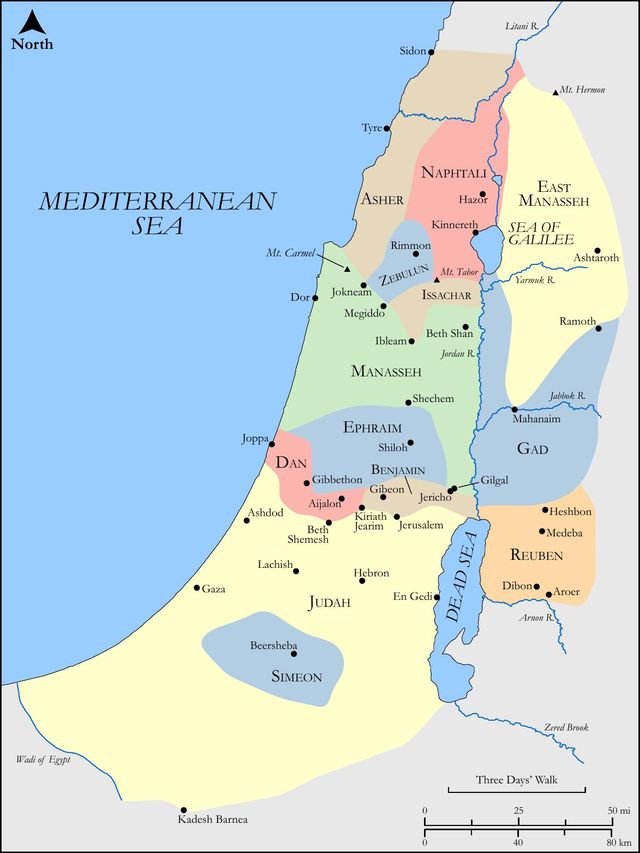
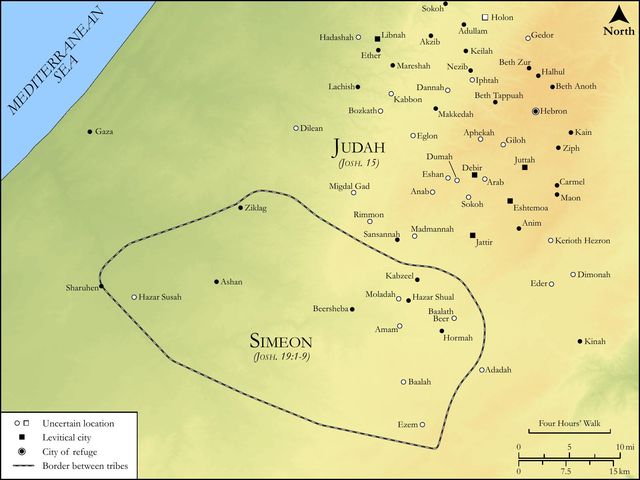
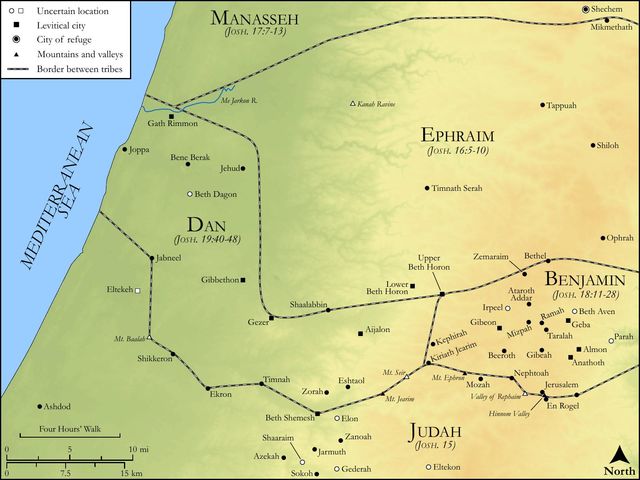
See on the biblical-era maps
Study this verse
Public-domain commentary
Matthew Henry
From his Commentary on the Whole Bible. Henry comments on passages, not single verses — this entry covers Joshua 21:1–8. His three-level outline is real structure in the source text, so it is rendered as structure.
Here is, I. The Levites' petition presented to this general convention of the states, now sitting at Shiloh, Jos 21:1, Jos 21:2. Observe, 1. They had not their lot assigned them till they made their claim. There is an inheritance provided for all the saints, that royal priesthood, but then they must petition for it. Ask, and it shall be given you. Joshua had quickened the rest of the tribes who were slack to put in their claims, but the Levites, it may be supposed, knew their duty and interest better than the rest, and were therefore forward in this matter, when it came to their turn, without being called upon. They build their claim upon a very good foundation, not their own merits nor services, but the divine precept: "The Lord commanded by the hand of Moses to give us cities, commanded you to grant them, which implied a command to us to ask them." Note, The maintenance of ministers is not an arbitrary thing, left purely to the good-will of the people, who may let them starve if they please; no, as the God of Israel commanded that the Levites should be well provided for, so has the Lord Jesus, the King of the Christian church, ordained, and a perpetual ordinance it is that those who preach the gospel should live of the gospel (Co1 9:14), and should live comfortably. 2. They did not make their claim till all the rest of the tribes were provided for, and then they did it immediately. There was some reason for it; every tribe must first know their own, else they would not know what they gave the Levites, and so it could not be such a reasonable service as it ought to be. But it is also an instance of their humility, modesty, and patience (and Levites should be examples of these and other virtues), that they were willing to be served last, and they fared never the worse for it. Let not God's ministers complain if at any time they find themselves postponed in men's thoughts and cares, but let them make sure of the favour of God and the honour that comes from him, and then they may well enough afford to bear the slights and neglects of men.
II.The Levites' petition granted immediately, without any dispute, the princes of Israel being perhaps ashamed that they needed to be called upon in this matter, and that the motion had not been made among themselves for the settling of the Levites.
1.The children of Israel are said to give the cities for the Levites. God had appointed how many they should be in all, forty-eight. It is probable that Joshua and the princes, upon consideration of the extent and value of the lot of each tribe as it was laid before them, had appointed how many cities should be taken out of each; and then the fathers of the several tribes themselves agreed which they should be, and therefore are said to give them, as an offering, to the Lord; so God had appointed. Num 35:8, Every one shall give of his cities to the Levites. Here God tried their generosity, and it was found to praise and honour, for it appears by the following catalogue that the cities they gave to the Levites were generally some of the best and most considerable in each tribe. And it is probable that they had an eye to the situation of them, taking care they should be so dispersed as that no part of the country should be too far distant from a Levites' city.
2.They gave them at the commandment of the Lord, that is, with an eye to the command and in obedience to it, which was it that sanctified the grant. They gave the number that God commanded, and it was well this matter was settled that the Levites might not ask more nor the Israelites offer less. They gave them also with their suburbs, or glebe-lands, belonging to them, so many cubits by measure from the walls of the city, as God had commanded (Num 35:4, Num 35:5), and did not go about to cut them short.
3.When the forty-eight cities were pitched upon, they were divided into four lots, as they lay next together, and then by lot were determined to the four several families of the tribe of Levi. When the Israelites had surrendered the cities into the hand of God, he would himself have the distributing of them among his servants.
(1.)The family of Aaron, who were the only priests, had for their share the thirteen cities that were given by the tribes of Judah, Simeon, and Benjamin, Jos 21:4. God in wisdom ordered it thus, that though Jerusalem itself was not one of their cities, it being as yet in the possession of the Jebusites (and those generous tribes would not mock the Levites, who had another warfare to mind, with a city that must be recovered by the sword before it could be enjoyed), yet the cities that fell to their lot were those which lay next to Jerusalem, because that was to be, in process of time, the holy city, where their business would chiefly lie.
(2.)The Kohathite-Levites (among whom were the posterity of Moses, though never distinguished from them) had the cities that lay in the lot of Dan, which lay next to Judah, and in that of Ephraim, and the half-tribe of Manasseh, which lay next to Benjamin. So those who descended from Aaron's father joined nearest to Aaron's sons.
(3.)Gershon was the eldest son of Levi, and therefore, though the younger house of the Kohathites was preferred before his, yet his children had the precedency of the other family of Merari, Jos 21:6.
(4.)The Merarites, the youngest house, had their lot last, and it lay furthest off, Jos 21:7. The rest of the sons of Jacob had a lot for every tribe only, but Levi, God's tribe, had a lot for each of its families; for there is a particular providence directing and attending the removals and settlements of ministers, and appointing where those shall fix who are to be the lights of the world.
Historical interpretation
Historical reception
3 surviving comments on this verse. Each one is dated, so this reads as a timeline rather than a list.
Who will explain the diverse sites of the encampments, how this distribution must be retained in the resurrection for each priestly or levitical order of the saints, so that, just as the apostle says, nothing is done haphazardly in the resurrection, but everyone comes "in his own order, Christ first, then those who belong to Christ who have believed in his coming, when he will hand the kingdom over to our God and Father, when he will subject to him every principality and power"?On that occasion, without doubt, there will be some such observances of encampments and priestly distributions and ranks and signals of trumpets.
It was fitting that there be a drawing of lots even regarding the suburbs and cities so that perhaps the renowned division among the Levites might not seem perhaps indiscriminate and accidental. Therefore, the distribution by lot that took place among the sons of Israel was characterized by reason, by which someone was considered worthy of the first lot, and someone else the second, as we have already previously examined to the extent we were able. This was true in regard to both those who receive through Moses beyond the Jordan and those who receive from Jesus [Joshua] in the land of promise, where the first lot fell to Benjamin and afterwards to the rest, among whom Dan was the last. Even so it is necessary that there be some reason also in the order of priestly and levitical lots. Thus the first is drawn for someone, the second for someone else, and the third for another, through which these or those places are determined for each one.
"First," it says, "the lot fell out for Kohath, and it came to pass for the sons of Aaron, the priests, who were among the Levites." Whose lot was it suitable to be the first to fall out? To whom was it fitting to be given first place, if not to Aaron, the first high priest, first in life, in merits, first in honors and power? Is it resolved among you now at least that this casting of lots is not accidental but that a heavenly power is present, governing it according to the judgment of divine providence? Where, therefore, does this just lot determine the first dwelling places for the sons of Aaron? "Thirteen cities by lot," it says, "in the tribe of Judah, in the tribe of Simeon, and in the tribe of Benjamin." You see how the dwelling places are dispensed to select persons in select tribes.
Continue studying Joshua 21:4 across the web’s major study libraries — every link below opens this exact verse, chapter, or book on the destination site.
Read & Compare
 BibleGatewayThis verse in more than 200 translations and 70 languages.
 Bible.comThe YouVersion reader — hundreds of translations, reading plans, and highlights.
 ESV.orgCrossway's official English Standard Version reader.
 NET BibleThe NET translation with 60,000+ translators' notes on every rendering decision.
 STEP BibleTyndale House's free study tool — original text, vocabulary, and scholarly resources.
 BibliaLogos Bible Software's free web reader.
 USCCBThe New American Bible (Revised Edition) with the U.S. bishops' study notes.
Commentaries
 BibleHub CommentariesDozens of classic commentaries on this verse, gathered on one page.
 StudyLightMore than 100 commentary sets — the largest collection on the web.
 BibleRefPlain-English commentary on what this verse means, verse by verse.
 Enduring WordDavid Guzik's free commentary on this chapter, widely used by Bible teachers.
 Bible Study ToolsVerse commentary alongside Greek and Hebrew study aids.
Original Language & Research
- BibleHub InterlinearThe verse word by word — original language, transliteration, and English.
- BibleHub LexiconEvery word's original-language definition and Strong's entry.
 Blue Letter BibleDeep-study tools — Strong's numbers, concordance, and word studies.
 SefariaThe Hebrew text with Rashi and centuries of Jewish commentary.
Sermons, Hymns & Audio


TrulyRandomVerse is not affiliated with these sites and doesn’t control their content. They’re linked because they’re genuinely useful.
Summary
Joshua 21:4 meticulously details the initial allocation of cities to the priestly families of the Kohathites, specifically the descendants of Aaron, within the broader distribution of the promised land to the Levites. This verse records that these particular Levites received thirteen cities by lot from the territories of the tribes of Judah, Simeon, and Benjamin, thereby underscoring God's precise fulfillment of His covenant promises and the divinely established order for Israel's spiritual administration.
Context
ShowHideLiterary Context
Joshua 21:4 is situated within a comprehensive chapter that chronicles the fulfillment of God's command to provide dwelling places for the Levites, who, unlike the other tribes, received no contiguous territorial inheritance. The preceding verses Joshua 21:1-3 establish the scene, describing how the heads of the Levitical families approached Eleazar the priest, Joshua, and the tribal leaders at Shiloh, reminding them of the Lord's specific instructions through Moses concerning their cities. The verses immediately following Joshua 21:5-8 continue to detail the allocation of cities to the other Levitical clans—the remaining Kohathites, the Gershonites, and the Merarites—each receiving a precise number of cities from designated tribes. This meticulous listing throughout the entire chapter emphasizes the divine precision and unwavering faithfulness in the land's distribution, ensuring that the Levites, though landless in the traditional sense, were strategically placed throughout Israel to fulfill their spiritual duties. The chapter as a whole stands as a powerful testament to God's faithfulness in fulfilling all His promises, echoing the overarching themes found throughout the book of Joshua.
Historical & Cultural Context
The unique provision of cities for the Levites was deeply rooted in Israel's covenant with Yahweh, distinguishing it from the practices of the nations in dedicating a portion of the population to religious service. Unlike other tribes who received large tracts of land for agricultural sustenance, the Levites were consecrated for sacred service, with their inheritance being the Lord Himself, as explicitly stated in Numbers 18:20. This meant their sustenance came from the tithes and offerings of the other tribes. The method of "casting lots" (Hebrew: goral) was a common and divinely sanctioned practice in ancient Israel for discerning God's will and ensuring absolute impartiality in significant decisions, as evidenced by its use in the division of the entire land (e.g., Joshua 14:2). The specific mention of the "children of Aaron the priest" highlights their distinct and elevated role within the Levites, as they alone were consecrated for the exclusive priestly duties at the tabernacle, and later, the temple. Their placement within the territories of Judah, Simeon, and Benjamin—regions that would later include significant historical and spiritual centers like Jerusalem and Bethlehem—ensured their strategic presence in key areas of Israelite life and future history.
Key Themes
ShowHideJoshua 21:4 contributes significantly to several overarching theological and narrative themes within the book of Joshua and the broader Pentateuch. Firstly, it powerfully illustrates Divine Faithfulness and Fulfillment of Promise. God had promised Moses that the Levites would receive cities (e.g., Numbers 35:1-8), and this chapter meticulously records the precise execution of that promise. Secondly, the verse highlights Divine Order and Sovereignty. The use of the lot emphasizes that the distribution was not arbitrary but divinely ordained, demonstrating God's meticulous governance over His people and their land. This divine oversight ensured justice and impartiality in the land's allocation. Thirdly, the specific mention of the "children of Aaron" underscores the Centrality of Priesthood and Worship in Israelite life. Their strategic placement throughout the tribes ensured that spiritual instruction, sacrificial worship, and judicial guidance were readily accessible to all, fostering national unity under God's law. This arrangement reflects God's profound desire for a holy people guided by His truth, a principle woven throughout the broader narrative of Deuteronomy.
Exposition and Analysis
ShowHideKey Word Analysis
ShowHideFrom an unused root meaning "to be rough (as stone)," this term properly refers to a pebble, indicating the small stones used for casting lots. Figuratively, it denotes a portion or destiny as if determined by lot. In the context of Joshua 21:4, "lot" signifies a method of decision-making in ancient Israel believed to reveal God's will, ensuring impartiality and affirming divine oversight in the fulfillment of His promises for land distribution.
This is a patronymic term referring to the descendants of Kohath, who was Levi's second son. The Kohathites constituted one of the three main divisions of the tribe of Levi. Their specific responsibility involved the care and transport of the most sacred articles of the tabernacle, including the Ark of the Covenant. This verse distinguishes the priestly Kohathites (the children of Aaron) from the rest of the Kohathites, who had different duties and received a separate allocation of cities.
An active participle meaning "one officiating," this term refers to a priest, or by courtesy, an acting priest (even if a layman). In Joshua 21:4, it specifically refers to the descendants of Aaron, who alone were consecrated for the sacred priestly duties. Their designation as "the priest" emphasizes their unique and indispensable role in Israel's worship, mediating between God and the people through sacrifices and rituals.
Verse Breakdown
ShowHide"And the lot came out for the families of the Kohathites:"
This opening clause immediately establishes the divine method of distribution—by lot, signaling God's sovereign direction—and identifies the primary recipients as the Kohathite families, setting the stage for the specific details of their inheritance.
"and the children of Aaron the priest, [which were] of the Levites,"
This clause further refines the identification of the recipients, specifying that within the broader Kohathite lineage, it was the direct descendants of Aaron, who held the exclusive priestly office, that were the focus of this particular allocation. This highlights their unique status and sacred responsibilities among all the Levites.
"had by lot out of the tribe of Judah, and out of the tribe of Simeon, and out of the tribe of Benjamin,"
This part of the verse meticulously details the specific tribal territories from which these priestly Kohathites received their cities. The repetition of "by lot" powerfully reinforces the divine, impartial nature of the distribution. These three tribes formed a significant geographical bloc in the southern part of Israel, indicating a strategic placement of the priests in key areas of the land.
"thirteen cities."
This final phrase provides the precise numerical count of cities allocated to the priestly Kohathites. The exact figure underscores the meticulous fulfillment of God's command and the detailed administration of the land's division, ensuring that the priests had adequate dwelling places to fulfill their vital spiritual and judicial duties across the nation.
Literary Devices
ShowHideJoshua 21:4, like much of the book of Joshua, employs Meticulous Detail and Precision in its enumeration of cities and tribes. This literary choice serves to powerfully underscore the unwavering faithfulness of God in fulfilling His promises exactly as foretold, leaving no room for doubt regarding the divine orchestration of events. The repeated mention of "by lot" throughout the chapter, including in this specific verse, functions as a powerful form of Emphasis on Divine Sovereignty and impartiality. It portrays God as the ultimate allocator of the land, removing human bias and affirming His direct involvement in the establishment of Israel. Furthermore, the specific identification of the "children of Aaron the priest" within the broader "families of the Kohathites" uses Specification to highlight the unique and central role of the priesthood in Israel's spiritual life, distinguishing their allocation from that of other Levitical clans and emphasizing their distinct sacred duties.
Theological and Thematic Connections
ShowHideJoshua 21:4 is a profound testament to God's meticulous faithfulness in fulfilling His covenant promises. The precise allocation of cities to the Levites, especially the priestly line of Aaron, demonstrates that God provides for those consecrated to His service, even when their inheritance differs from the norm. This divinely orchestrated arrangement ensured that spiritual instruction, sacrificial worship, and judicial oversight were dispersed throughout the entire nation, fostering a unified people grounded in God's law and centered on His presence. It powerfully illustrates God's divine order and His unwavering commitment to establishing a society where worship and obedience were central, not peripheral. The Levites, though without a traditional land inheritance, found their security and provision in the Lord Himself, serving as a living reminder to all Israel that true blessing and sustenance come from dependence on God alone.
Reflection and Application
ShowHideJoshua 21:4, while detailing an ancient land distribution, offers profound and enduring insights for contemporary believers. It serves as a powerful reminder that God is a God of order, precision, and unwavering faithfulness. Just as He meticulously provided for the Levites, ensuring their sustenance and strategic placement for ministry throughout Israel, so too does He care for and position His people today. We are called to serve Him in diverse capacities, and our "provision" or "inheritance" may not always look like that of others, but God's faithfulness to meet our needs and equip us for our unique calling is constant and assured. This verse challenges us to trust deeply in God's sovereign plan for our lives, recognizing that our circumstances, even those that seem unconventional or challenging, are often part of His purposeful design to use us for His glory and the spiritual benefit of those around us. It encourages us to embrace our distinctive roles within the body of Christ, knowing that our ultimate "inheritance" is found in Him, and He will faithfully sustain us as we serve.
Questions for Reflection
ShowHideFAQ
ShowHideWhy were the Levites, especially the children of Aaron, given cities scattered among the tribes instead of their own contiguous territory?
ShowHideThe Levites were uniquely set apart for sacred service to the Lord, and their "inheritance" was the Lord Himself, not a land portion like the other tribes (Numbers 18:20). Scattering them among all the tribes ensured that spiritual instruction, priestly service, and judicial wisdom were readily accessible throughout the entire nation. This strategic placement allowed them to fulfill their crucial role as spiritual guides, teachers of the Law, and administrators of justice, fostering a unified and God-centered society across all tribal territories. It also prevented them from becoming an isolated, self-serving entity and instead integrated them into the fabric of Israelite life, making them dependent on the tithes and offerings of the other tribes for their sustenance (Deuteronomy 18:1-2).
What was the significance of the "lot" in determining the cities for the Levites?
ShowHideThe casting of lots (Hebrew: goral) was a common and divinely sanctioned method in ancient Israel for making important decisions and discerning God's will, as seen in the division of the entire land (Joshua 14:2). It was not considered a game of chance but a solemn procedure believed to reveal divine direction and ensure absolute impartiality. In the context of the Levites' cities, using the lot underscored that their allocation was not based on human preference or political maneuvering but was divinely ordained. This reinforced God's sovereignty over the land and His unwavering faithfulness in fulfilling His promises with precision and justice, ensuring that the distribution was beyond reproach and truly God's design.
Who were the Kohathites, and why were the "children of Aaron" specifically mentioned within them?
ShowHideThe Kohathites were one of the three major divisions of the tribe of Levi, descended from Kohath, Levi's second son (Numbers 3:17-20). Their primary responsibility was the care and transport of the most sacred components of the Tabernacle, such as the Ark of the Covenant (Numbers 3:31). Within the Kohathite lineage, Aaron, Moses' brother, was chosen by God to be the first High Priest, and his descendants were exclusively designated for the priesthood. Joshua 21:4 specifically distinguishes the "children of Aaron the priest" because they held the most sacred duties of mediating between God and Israel through sacrifices and rituals. Their allocation of thirteen cities from Judah, Simeon, and Benjamin highlights their numerical significance and the importance of their widespread presence for the spiritual well-being and instruction of the nation.
Christ-Centered Fulfillment
ShowHideJoshua 21:4, with its meticulous account of the Levites' provision and strategic placement, finds profound Christ-centered fulfillment in the New Covenant. The priestly "children of Aaron" served as a powerful foreshadowing of the ultimate and perfect High Priest, Jesus Christ, who did not receive an earthly inheritance but offered Himself as the Lamb of God, who takes away the sin of the world. Just as the Levites were sustained by the offerings of the people, Christ, our great High Priest, perfectly fulfilled all sacrificial requirements, providing eternal sustenance and atonement for His people. The scattering of the Levites among the tribes to provide spiritual guidance and instruction prefigures the mission of the New Testament church, which, as the body of Christ, is scattered throughout the world not for a physical inheritance, but to be "salt and light" and to proclaim the Gospel of salvation (Matthew 5:13-16). Our true inheritance is not in earthly cities but in Christ Himself, who has secured for us a heavenly inheritance that is imperishable, undefiled, and unfading. God's faithfulness in providing for the Levites by lot is a testament to His sovereign plan, which ultimately culminates in His provision of salvation and eternal life through His Son, Jesus Christ, the one through whom all of God's promises find their resounding "Yes" and "Amen" (2 Corinthians 1:20).