


Joshua 14:4
Bible text: King James Version (1769 Blayney text) · Public domain
Bible text: King James Version with Strong's numbers · Public domain
Bible text: Berean Standard Bible · Public domain
Bible text: American Standard Version (1901) · Public domain
Bible text: World English Bible, Messianic edition · Public domain
Bible text: Geneva Bible (1599) · Public domain
Bible text: Young's Literal Translation · Public domain
- כִּיkiforH3588PrtParticle Conditional
- הָיוּha·Yuthey wereH1961V-Qal-Perf-3cpVerb Qal Perfect 3rd Plural common gender
- בְנֵיve·nei[the] descendants ofH1121N-mpcNoun Plural Masculine Construct
- יוֹסֵףyo·SefJosephH3130N-proper-mNoun Proper Masculine
- שְׁנֵיshe·NeitwoH8147Adj-cdcAdjective Numerical Dual common gender Construct
- מַטּוֹתma·TottribesH4294N-fpNoun Plural Feminine Absolute
- מְנַשֶּׁהme·na·ShehManassehH4519N-proper-mNoun Proper Masculine
- וְאֶפְרָיִםve·'ef·Ra·yimand EphraimH669Conj-w ¦ N-proper-mNoun Proper MasculineוְandאֶפְרָיִםEphraim
- וְלֹאve·lo'and notH3808Conj-w ¦ NegParticle Negativeוְandלֹאnot
- נָתְנוּna·te·Nupeople gaveH5414V-Qal-Perf-3cpVerb Qal Perfect 3rd Plural common gender
- חֵלֶקChe·leka portionH2506N-msNoun Singular Masculine Absolute
- לַלְוִיִּםlal·vi·Yimto the LevitesH3881Prep-l ¦ N-mpNoun Gentilic Plural Masculine Absoluteלַto theלְוִיִּםLevites
- בָּאָרֶץba·'A·retzin the landH776Prep-b ¦ N-fsNoun Singular Feminine Absoluteבָּin theאָרֶץland
- כִּיkithatH3588PrtParticle Conditional
- אִם'imexceptH518PrtParticle Conditional
- עָרִים'a·RimcitiesH5892N-mpNoun Plural Masculine Absolute
- לָשֶׁבֶתla·She·vetto dwell inH3427Prep-l ¦ V-Qal-InfVerb Qal Infinitive Constructלָtoשֶׁבֶתdwell in
- וּמִגְרְשֵׁיהֶםu·Mig·re·shei·Hemand their pasture landsH4054Conj-w ¦ N-mpc ¦ 3mpNoun Plural Masculine Constructוּandמִגְרְשֵׁיpasture landsהֶםtheir
- לְמִקְנֵיהֶםle·mik·nei·Hemfor their livestockH4735Prep-l ¦ N-msc ¦ 3mpNoun Singular Masculine Constructלְforמִקְנֵיlivestockהֶםtheir
- וּלְקִנְיָנָםu·le·kin·ya·Namand for their possession[s]H7075Conj-w ¦ Prep-l ¦ N-msc ¦ 3mpNoun Singular Masculine Constructוּandלְforקִנְיָנָpossession[s]םtheir
English is a literal word-by-word gloss of the Hebrew, not the KJV's wording. Why?
This is the original text the KJV's translators worked from — each Hebrew word with its own literal English meaning in this verse, prepared by scholars at Tyndale House, Cambridge. The KJV translates whole sentences, not word by word, so its wording differs: one Hebrew word can become several English words, and the KJV may choose “the LORD” where the gloss reads “Yahweh”. Both are faithful — they answer different questions. For the KJV's own rendering, switch to the KJV text.
Details
See on the biblical-era maps
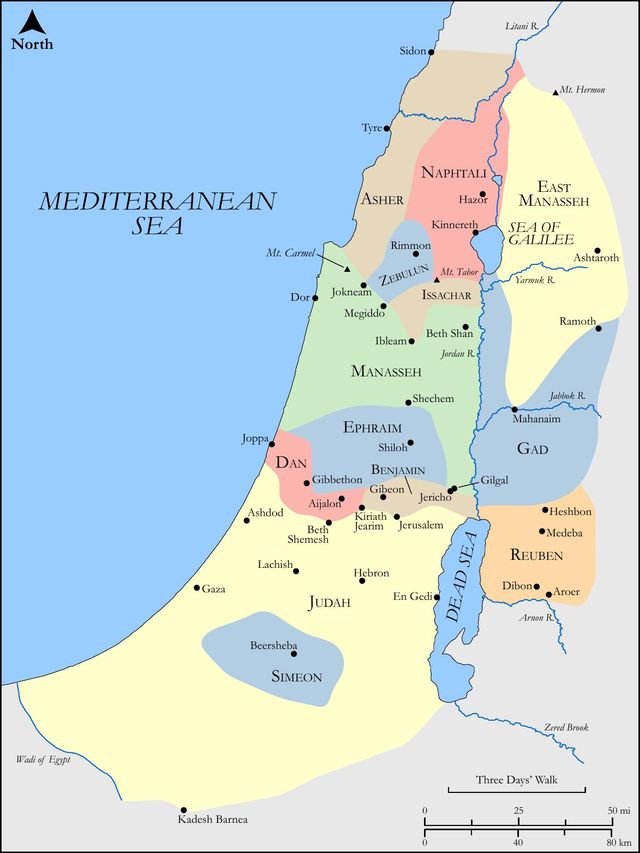
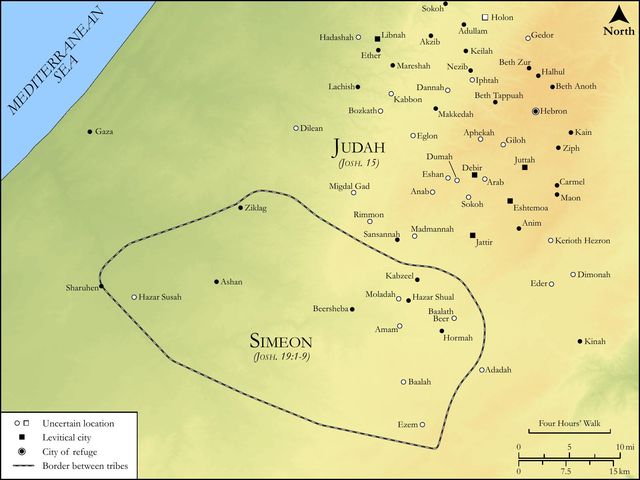
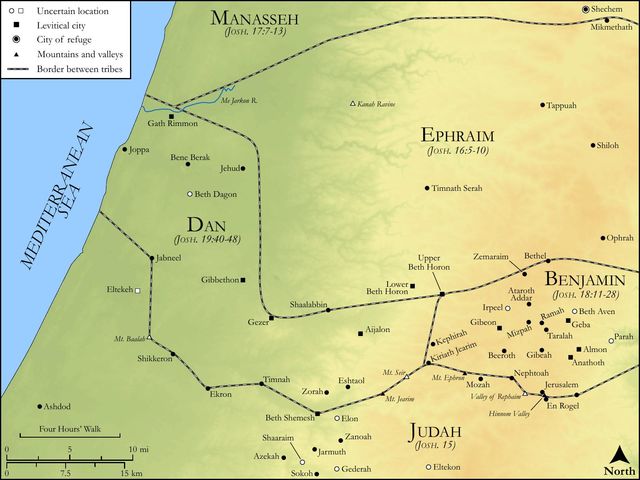
Study this verse
Public-domain commentary
Matthew Henry
From his Commentary on the Whole Bible. Henry comments on passages, not single verses — this entry covers Joshua 14:1–5. His two-level outline is real structure in the source text, so it is rendered as structure.
The historian, having in the foregoing chapter given an account of the disposal of the countries on the other side Jordan, now comes to tell us what they did with the countries in the land of Canaan. They were not conquered to be left desert, a habitation for dragons, and a court for owls, Isa 34:13. No, the Israelites that had hitherto been closely encamped in a body, and the greatest part of them such as never knew any other way of living, must now disperse themselves to replenish these new conquests. It is said of the earth, God created it not in vain; he formed it to be inhabited, Isa 45:18. Canaan would have been subdued in vain if it had not been inhabited. Yet every man might not go and settle where he pleased, but as there seems to have been in the days of Peleg an orderly and regular division of the habitable earth among the sons of Noah (Gen 10:25, Gen 10:32), so there was now such a division of the land of Canaan among the sons of Jacob. God had given Moses directions how this distribution should be made, and those directions are here punctually observed. See Num 26:53, etc.
I.The managers of this great affair were Joshua the chief magistrate, Eleazar the chief priest, and ten princes, one of each of the tribes that were now to have their inheritance, whom God himself had nominated (Num 34:17, etc.) some years before; and, it should seem, they were all now in being, and attended this service, that every tribe, having a representative of its own, might be satisfied that there was fair dealing, and might the more contentedly sit down by its lot.
II.The tribes among whom this dividend was to be made were nine and a half.
1.Not the two and a half that were already seated (Jos 14:3), though perhaps now that they saw what a good land Canaan was, and how effectually it was subdued, they might some of them repent their choice, and wish they had now been to have their lot with their brethren, upon which condition they would gladly have given up what they had on the other side Jordan; but it could not be admitted: they had made their election without power of revocation, and so must their doom be; they themselves have decided it, and they must adhere to their choice.
2.Not the tribe of Levi; this was to be otherwise provided for. God had distinguished them from, and dignified them above, the other tribes, and they must not now mingle themselves with them, nor cast in their lot among them, for this would entangle them in the affairs of this life, which would not consist with a due attendance on their sacred function. But,
3.Joseph made two tribes, Manasseh and Ephraim, pursuant to Jacob's adoption of Joseph's two sons, and so the number of the tribes was kept up to twelve, though Levi was taken out, which is intimated here (Jos 14:4): The children of Joseph were two tribes, therefore they gave no part to Levi, they being twelve without them.
III.The rule by which they went was the lot, Jos 14:2.
The disposal of that is of the Lord, Pro 16:33. It was here used in an affair of weight, and which could not otherwise be accommodated to universal satisfaction, and it was used in a solemn religious manner as an appeal to God, by consent of parties. In dividing by lot,
1.They referred themselves to God, and to his wisdom and sovereignty, believing him fitter to determine for them than they for themselves. Psa 47:4, He shall choose our inheritance for us.
2.They professed a willingness to abide by the determination of it; for every man must take what is his lot, and make the best of it. In allusion to this we are said to obtain an inheritance in Christ (Eph 1:11), eklerothemen - we have obtained it by lot, so the word signified; for it is obtained by a divine designation. Christ, our Joshua, gives eternal life to as many as were given him, Joh 17:2.
Historical interpretation
Two Centuries of Reception
3 surviving comments on this verse. Each one is dated, so this reads as a timeline rather than a list.
Select a marker to jump to its quote. Markers stagger vertically where authors wrote within a few decades of each other.
A first and a second distribution of the inheritance is reported. The first is indeed through Moses, but the second, and the more powerful, is depicted as accomplished through Jesus [Joshua]. Across the Jordan, Moses decrees property to the tribe of Reuben and the tribe of Gad and to half the tribe of Manasseh, but all the rest receive their inheritance through Jesus [Joshua]. We have already spoken first about how those who had pleased God through the law do not yet reach those things that have been perfected. They precede in time those who attain to the promises through faith in Jesus but must wait for those coming afterwards who will please God in a different time but by one faith, just as the apostle says, “They might not attain perfection without us.”
Just as those who submit to the law, which is the “shadow” of that true law, diligently serve a “shadow and copy” of “heavenly things,” so those who divide the inheritance of the land in Judea imitate the “copy and shadow” of a heavenly division. Thus truth was in heaven, “but a shadow and copy” of truth was on earth. And as long as this shadow remained on earth, there was an earthly Jerusalem; there was a temple, an altar and a visible worship; there were priests and high priests; and there existed regions and towns of Judea and all these things that are described in this book and are now recited.
The whole account of the land of Judah and of the tribes is typical of the church in heaven. Let us read Joshua, the son of Nun, or the concluding portions of Ezekiel, and we shall see that the historical division of the land as related by the one finds a counterpart in the spiritual and heavenly promises of the other. What is the meaning of the seven and eight steps in the description of the temple? Or again, what significance attaches to the fact that in the Psalter, after being taught the mystic alphabet by the one hundred and eighteenth psalm we arrive by fifteen steps at the point where we can sing: “Behold, now bless the Lord, all you servants of the Lord: you who stand in the house of the Lord, in the courts of the house of our God.” Why did two tribes and a half dwell on the other side of Jordan, a district abounding in cattle, while the remaining nine tribes and a half either drove out the old inhabitants from their possessions or dwelled with them? Why did the tribe of Levi receive no portion in the land but have the Lord for its portion? And how is it that of the priests and Levites, themselves, the high priest alone entered the Holy of Holies where were the cherubim and the mercy seat? Why did the other priests wear linen raiment only, and not have their clothing of wrought gold, blue, scarlet, purple and fine cloth? The priests and Levites of the lower order took care of the oxen and carts; those of the higher order carried the ark of the Lord on their shoulders. If you do away with the gradations of the tabernacle, the temple, the church, if, to use a common military phrase, all upon the right hand are to be “up to the same standard,” bishops are to no purpose, priests in vain, deacons useless. Why do virgins persevere? Widows toil? Why do married women practice continence? Let us all sin, and when once we have repented, we shall be on the same footing as the apostles.
Continue studying Joshua 14:4 across the web’s major study libraries — every link below opens this exact verse, chapter, or book on the destination site.
Read & Compare
 BibleGatewayThis verse in more than 200 translations and 70 languages.
 Bible.comThe YouVersion reader — hundreds of translations, reading plans, and highlights.
 ESV.orgCrossway's official English Standard Version reader.
 NET BibleThe NET translation with 60,000+ translators' notes on every rendering decision.
 STEP BibleTyndale House's free study tool — original text, vocabulary, and scholarly resources.
 BibliaLogos Bible Software's free web reader.
 USCCBThe New American Bible (Revised Edition) with the U.S. bishops' study notes.
Commentaries
 BibleHub CommentariesDozens of classic commentaries on this verse, gathered on one page.
 StudyLightMore than 100 commentary sets — the largest collection on the web.
 BibleRefPlain-English commentary on what this verse means, verse by verse.
 Enduring WordDavid Guzik's free commentary on this chapter, widely used by Bible teachers.
 Bible Study ToolsVerse commentary alongside Greek and Hebrew study aids.
Original Language & Research
- BibleHub InterlinearThe verse word by word — original language, transliteration, and English.
- BibleHub LexiconEvery word's original-language definition and Strong's entry.
 Blue Letter BibleDeep-study tools — Strong's numbers, concordance, and word studies.
 SefariaThe Hebrew text with Rashi and centuries of Jewish commentary.
Sermons, Hymns & Audio


TrulyRandomVerse is not affiliated with these sites and doesn’t control their content. They’re linked because they’re genuinely useful.
Summary
Joshua 14:4 serves as a pivotal administrative and theological clarification within the detailed account of Israel's land distribution in Canaan. It elucidates the unique allocation of territory, explaining that the descendants of Joseph received a double tribal portion through his sons, Manasseh and Ephraim, while the Levites, consecrated for sacred service to God, received no territorial inheritance but were instead provided with specific cities and their surrounding pasturelands for their sustenance. This verse underscores God's meticulous order, faithful provision, and the distinct roles within His covenant community, ensuring that all His people were cared for according to His divine plan.
Context
ShowHideLiterary Context
This verse is strategically placed within the extensive section of Joshua (chapters 13-19) that meticulously details the division of the Promised Land among the Israelite tribes. Following a general overview of the conquered territories and the tribes yet to receive their inheritance in Joshua 13, chapter 14 initiates the specific allocation process, beginning with Caleb's inheritance request. Joshua 14:4 functions as an essential explanatory note, a parenthetical clarification that accounts for the "twelve" tribal portions when only ten tribes (excluding Joseph and Levi) are explicitly listed as receiving large territorial allotments. It bridges the conceptual gap between the traditional twelve sons of Jacob and the actual land distribution, setting the stage for the specific inheritances of Manasseh and Ephraim in Joshua 16 and Joshua 17, and the subsequent detailed provision for the Levitical cities in Joshua 21.
Historical & Cultural Context
In ancient Israel, land inheritance was not merely an economic or practical matter; it was foundational to tribal identity, social security, and the tangible fulfillment of God's covenant promises. The allocation of land was a direct manifestation of God's faithfulness to His oath made to Abraham, Isaac, and Jacob, that their descendants would possess the land of Canaan (Genesis 12:7). The unique situation described in Joshua 14:4 stems from two distinct historical precedents. First, Jacob, prior to his death, adopted Joseph's two sons, Manasseh and Ephraim, elevating them to the status of full tribes, thereby granting Joseph a "double portion" of the inheritance, a privilege often reserved for the firstborn (Genesis 48:5-6). Second, the tribe of Levi was consecrated by divine decree for sacred service to Yahweh, specifically for duties related to the Tabernacle and, later, the Temple. Their inheritance was explicitly stated to be the Lord Himself, rather than a territorial possession (Deuteronomy 10:9). This unique arrangement ensured their dedication to spiritual duties, supported by tithes and offerings from the other tribes, and by specific cities scattered throughout the land, as meticulously detailed in Numbers 35:1-8.
Key Themes
ShowHideJoshua 14:4 profoundly contributes to several overarching themes within the book of Joshua and the broader Pentateuch. It powerfully illustrates Divine Faithfulness and Provision, demonstrating God's meticulous fulfillment of His covenant promises to Israel, ensuring every tribe, even those with unique circumstances, received their divinely appointed place and sustenance in the Promised Land. The verse also highlights the Divine Order and Wisdom inherent in the tribal structure of Israel, where exceptions (Joseph's double portion, Levi's non-territorial inheritance) are not arbitrary but reflect God's specific purposes and blessings for His people. Furthermore, it underscores the Theological Basis for Priesthood and Service, emphasizing that the Levites' lack of land was not a deprivation but a distinct privilege, allowing them to focus entirely on their sacred duties, with God as their ultimate inheritance and provider. This unique arrangement fostered Interdependence within the Community, as the other tribes were responsible for supporting the Levites, reflecting a holistic view of the covenant community where each part contributes to the well-being of the whole.
Exposition and Analysis
ShowHideKey Word Analysis
ShowHideThis refers to the patriarch Joseph, son of Jacob, whose remarkable faithfulness, wisdom, and prominence in Egypt led to a unique blessing upon his descendants. Through Jacob's adoption of Joseph's two sons, Manasseh and Ephraim (Genesis 48:5-6), Joseph effectively received a "double portion" of the tribal inheritance in the Promised Land, elevating his lineage above his brothers in terms of land allocation. This highlights a principle of divine blessing and reward for steadfastness and faithfulness, even across generations.
The descendants of Levi, another son of Jacob, were divinely set apart for sacred service to Yahweh. Unlike the other tribes, they were explicitly excluded from receiving a territorial inheritance because "the Lord God of Israel was their inheritance" (Joshua 13:33). Their primary role was to minister in the Tabernacle and later the Temple, to teach God's law, and to serve as spiritual guides and arbiters for the nation. Their provision came from the tithes and offerings of the other tribes, supplemented by specific cities and their surrounding pasturelands, ensuring they could dedicate themselves fully to their holy duties.
The term migrâsh is crucial for understanding the nature of the Levitical provision. It does not denote residential areas outside a city in the modern sense, but rather the open common lands, pasturelands, and fields immediately surrounding the Levitical cities. These areas were specifically designated for their livestock (cattle, flocks) and other possessions, providing a vital means of livelihood for the Levites who did not engage in large-scale agriculture or territorial farming. This precise provision is meticulously detailed in Numbers 35:2-5, ensuring they had sufficient resources to sustain themselves while fulfilling their spiritual responsibilities.
Verse Breakdown
ShowHide"For the children of Joseph were two tribes, Manasseh and Ephraim"
This foundational clause provides the administrative explanation for the unique land distribution. It clarifies that while Joseph was one of Jacob's twelve sons, his two sons, Manasseh and Ephraim, were elevated to the status of full tribes, each receiving a distinct land inheritance. This effectively meant that Joseph's lineage received a "double portion" of the land, fulfilling Jacob's prophetic blessing in Genesis 48. This divine and administrative decision ensured that the total number of land-receiving tribes remained twelve, despite Levi's exclusion from a territorial inheritance.
"therefore they gave no part unto the Levites in the land"
This clause states the direct consequence of the Levites' unique divine calling. Because their inheritance was the Lord Himself and their primary role was spiritual service to God and the nation, they were explicitly excluded from receiving a territorial land inheritance like the other tribes. This was a divine decree, not a human oversight, ensuring their complete dedication to their sacred duties without the distractions of agricultural or land management responsibilities. Their sustenance was to come from the tithes and offerings of the other tribes, signifying a community-wide support for those dedicated to spiritual ministry.
"save cities to dwell [in], with their suburbs for their cattle and for their substance"
This final clause specifies the precise nature of the Levites' provision. While they received no tribal territory, they were allocated specific cities scattered throughout the land, along with the surrounding pasturelands (migrâsh) for their livestock and other possessions. This arrangement, meticulously detailed in Numbers 35:1-8, ensured that the Levites had a place to live and a means of livelihood. Their dispersion among all the tribes allowed them to fulfill their teaching and priestly functions across the nation, while still being supported by the community they served.
Literary Devices
ShowHideJoshua 14:4 functions primarily as an Explanatory Parenthesis within the larger narrative of land distribution. It interrupts the sequential listing of tribal allocations to provide crucial background information that clarifies the administrative logic behind the division, particularly concerning the number of tribes receiving land. This verse also exemplifies the theme of Divine Economy and Order, showcasing God's meticulous and precise planning for the nation of Israel, where every detail, even exceptions to the general rule, serves a specific theological and practical purpose in establishing a covenant community. Furthermore, it is part of the broader Fulfillment Narrative of the book of Joshua, demonstrating how God faithfully brings to pass His ancient promises regarding the land and the establishment of His people within it, down to the specific provisions for each tribe and calling.
Theological and Thematic Connections
ShowHideJoshua 14:4, while seemingly an administrative detail, carries profound theological weight. It underscores God's meticulous planning and faithful provision for His people, demonstrating that His covenant promises are fulfilled with divine order and wisdom. The unique situations of Joseph's descendants receiving a double portion and the Levites receiving no territorial inheritance reveal that God's distribution of blessings and responsibilities is not uniform but tailored to individual and corporate callings. It highlights the principle that true inheritance is not always material; for the Levites, their greatest possession was their relationship with and service to the Lord. This arrangement also fostered a deep sense of interdependence within the Israelite community, where those who served God directly were supported by the tithes and provisions of the other tribes, illustrating the unity and mutual responsibility within God's people.
Reflection and Application
ShowHideJoshua 14:4, though set in the ancient context of land division, offers timeless principles for believers today. It reminds us that God is a God of order and intention, meticulously providing for all His people according to their unique callings and needs. Just as the Levites had a distinct, non-territorial inheritance focused on spiritual service, and Joseph's sons received a double portion of blessing, so too does God equip and provide for each believer in accordance with their specific role within His kingdom. This verse encourages us to embrace our individual gifts and callings, trusting that God will faithfully sustain us, whether our "inheritance" is primarily material or spiritual. It also highlights the vital importance of mutual support within the body of Christ, recognizing that those who are dedicated to full-time ministry or spiritual service often rely on the faithful provision and encouragement of the wider community, fostering a beautiful interdependence where every part contributes to the flourishing of the whole.
Questions for Reflection
ShowHideFAQ
ShowHideWhy did Joseph get two tribes, but Levi got none?
ShowHideJoseph received a "double portion" of the inheritance because Jacob, before his death, adopted Joseph's two sons, Manasseh and Ephraim, as his own, elevating them to the status of full tribes (Genesis 48:5-6). This was a special blessing for Joseph's faithfulness and prominence in preserving his family. In contrast, the tribe of Levi was consecrated for sacred service to God. Their inheritance was not territorial land but the Lord Himself (Deuteronomy 10:9). They were to be supported by the tithes and offerings of the other tribes and provided with specific cities and their surrounding pasturelands, allowing them to focus entirely on their priestly and teaching duties without the need to farm or manage territory.
What were the "suburbs" for the Levites?
ShowHideThe "suburbs" (Hebrew: migrâsh) for the Levites were not residential areas outside a city as we understand them today. Instead, they referred to the common pasturelands and open areas immediately surrounding the Levitical cities. These lands were specifically designated for their cattle, flocks, and other possessions, providing a vital means of livelihood for the Levites who did not receive agricultural land. This provision is meticulously detailed in Numbers 35:2-5, which specifies the dimensions of these migrâsh areas, ensuring the Levites had sufficient resources despite their lack of a tribal territory. This arrangement allowed them to be dispersed throughout Israel, fulfilling their spiritual duties while being sustained by the community.
Christ-Centered Fulfillment
ShowHideJoshua 14:4, with its intricate details of tribal inheritance and the unique status of the Levites, points forward to the ultimate and perfect inheritance found in Jesus Christ. While the Levites' inheritance was the Lord Himself, a spiritual reality amidst material provision, believers in Christ now possess an even greater, eternal inheritance that is "imperishable, undefiled, and unfading, kept in heaven" for them (1 Peter 1:4). Jesus, as our great High Priest, fulfills and supersedes the Levitical priesthood, offering a perfect and eternal sacrifice that truly cleanses from sin (Hebrews 7:26-27). Under the New Covenant, all believers are made a "royal priesthood" (1 Peter 2:9), whose service is no longer tied to a specific geographical land or temple, but to the global body of Christ. The meticulous provision for the Levites foreshadows God's unfailing care for those dedicated to His service in the New Testament era, where our sustenance and blessings flow from Christ himself, who promises to meet all our needs according to His riches in glory (Philippians 4:19). The "double portion" of Joseph, signifying abundant blessing and favor, finds its ultimate reality in the "fullness of life" that Jesus came to give (John 10:10), and the "every spiritual blessing in the heavenly places in Christ" that we receive as co-heirs with Him (Ephesians 1:3).