


Job 22:2
Bible text: King James Version (1769 Blayney text) · Public domain
Bible text: King James Version with Strong's numbers · Public domain
Bible text: Berean Standard Bible · Public domain
Bible text: American Standard Version (1901) · Public domain
Bible text: World English Bible, Messianic edition · Public domain
Bible text: Geneva Bible (1599) · Public domain
Bible text: Young's Literal Translation · Public domain
- הַלְאֵלhal·'El¿ to GodH410Interrog ¦ Prep-l ¦ N-msNoun Singular Masculine Absoluteהַ¿לְtoאֵלGod
- יִסְכָּןyis·konwill he be of useH5532V-Qal-Imperf-3msVerb Qal Imperfect 3rd Singular Masculine
- גָּבֶרGa·vera manH1397N-msNoun Singular Masculine Absolute
- כִּיkiforH3588PrtParticle Conditional
- יִסְכֹּןyis·Konwill he be of use?H5532V-Qal-Imperf-3msVerb Qal Imperfect 3rd Singular Masculine
- עָלֵימוֹ'a·Lei·movon himH5921Prep ¦ 3mpPrepositionעָלֵיonמוֹhim
- מַשְׂכִּילmas·Kila wise [person]H7919V-Hiphil-Prtcpl-msVerb Hiphil Participle Singular Masculine Absolute
English is a literal word-by-word gloss of the Hebrew, not the KJV's wording. Why?
This is the original text the KJV's translators worked from — each Hebrew word with its own literal English meaning in this verse, prepared by scholars at Tyndale House, Cambridge. The KJV translates whole sentences, not word by word, so its wording differs: one Hebrew word can become several English words, and the KJV may choose “the LORD” where the gloss reads “Yahweh”. Both are faithful — they answer different questions. For the KJV's own rendering, switch to the KJV text.
Details
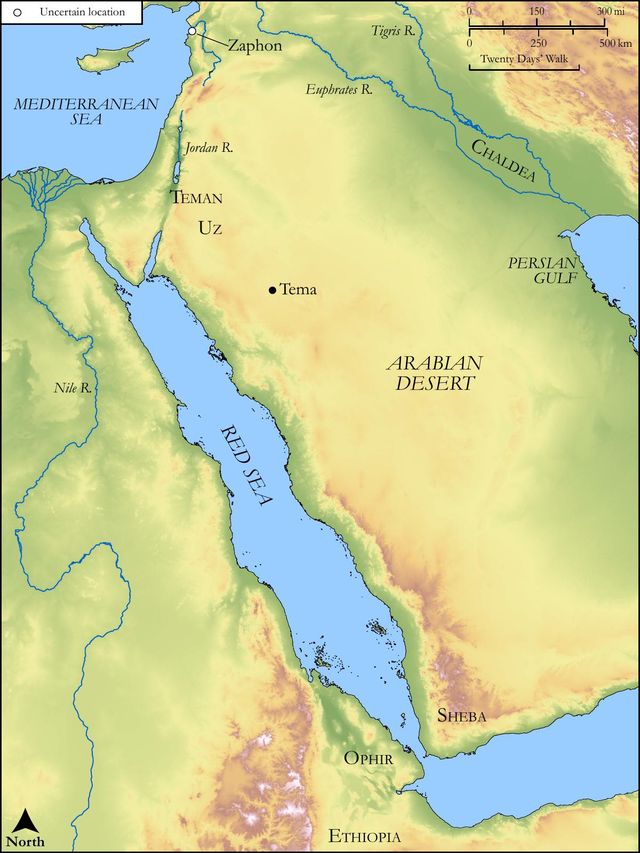
See on the biblical-era map
Study this verse
Public-domain commentary
Matthew Henry
From his Commentary on the Whole Bible. Henry comments on passages, not single verses — this entry covers Job 22:1–4. His two-level outline is real structure in the source text, so it is rendered as structure.
Eliphaz here insinuates that, because Job complained so much of his afflictions, he thought God was unjust in afflicting him; but it was a strained innuendo. Job was far from thinking so. What Eliphaz says here is therefore unjustly applied to Job, but in itself it is very true and good,
I.That when God does us good it is not because he is indebted to us; if he were, there might be some colour to say, when he afflicts us, "He does not deal fairly with us." But whoever pretends that he has by any meritorious action made God his debtor, let him prove this debt, and he shall be sure not to lose it, Rom 11:35. Who has given to him, and it shall be recompensed to him again? But Eliphaz here shows that the righteousness and perfection of the best man in the world are no real benefit or advantage to God, and therefore cannot be thought to merit any thing from him.
1.Man's piety is no profit to God, no gain, Job 22:1, Job 22:2. If we could by any thing merit from God, it would be by our piety, our being righteous, and making our way perfect. If that will not merit, surely nothing else will. If a man cannot make God his debtor by his godliness, and honesty, and obedience to his laws, much less can he by his wit, and learning, and worldly policy. Now Eliphaz here asks whether any man can possibly be profitable to God. It is certain that he cannot. By no means. He that is wise may be profitable to himself. Note, Our wisdom and piety are that by which we ourselves are, and are likely to be, great gainers. Wisdom is profitable to direct, Ecc 10:10. Godliness is profitable to all things, Ti1 4:8. If thou be wise, thou shalt be wise for thyself, Pro 9:12. The gains of religion are infinitely greater than the losses of it, and so it will appear when they are balanced. But can a man be thus profitable to God? No, for such is the perfection of God that he cannot receive any benefit or advantage by men; what can be added to that which is infinite? And such is the weakness and imperfection of man that he cannot offer any benefit or advantage to God. Can the light of a candle be profitable to the sun or the drop of the bucket to the ocean? He that is wise is profitable to himself, for his own direction and defence, his own credit and comfort; he can with his wisdom entertain himself and enrich himself; but can he so be profitable to God? No; God needs not us nor our services. We are undone, for ever undone, without him; but he is happy, for ever happy, without us. Is it any gain to him, any real addition to his glory or wealth, if we make our way perfect? Suppose it were absolutely perfect, yet what is God the better? Much less when it is so far short of being perfect.
2.It is no pleasure to him. God has indeed expressed himself in his word well pleased with the righteous; his countenance beholds them and his delight is in them and their prayers; but all that adds nothing to the infinite satisfaction and complacency which the Eternal Mind has in itself. God can enjoy himself without us, though we could have but little enjoyment of ourselves without our friends. This magnifies his condescension, in that, though our services be no real profit or pleasure to him, yet he invites, encourages, and accepts them.
II.That when God restrains or rebukes us it is not because he is in danger from us or jealous of us (Job 22:4):
"Will he reprove thee for fear of thee, and take thee down from thy prosperity lest thou shouldst grow too great for him, as princes sometimes have thought it a piece of policy to curb the growing greatness of a subject, lest he should become formidable?" Satan indeed suggested to our first parents that God forbade them the tree of knowledge for fear of them, lest they should be as gods, and so become rivals with him; but it was a base insinuation. God rebukes the good because he loves them, but he never rebukes the great because he fears them. He does not enter into judgment with men, that is, pick a quarrel with them and seek occasion against them, through fear lest they should eclipse his honour or endanger his interest. Magistrates punish offenders for fear of them. Pharaoh oppressed Israel because he feared them. It was for fear that Herod slew the children of Bethlehem and that the Jews persecuted Christ and his apostles. But God does not, as they did, pervert justice for fear of any. See Job 35:5-8.
Historical interpretation
Four Centuries of Reception
3 surviving comments on this verse. Each one is dated, so this reads as a timeline rather than a list.
Select a marker to jump to its quote. Markers stagger vertically where authors wrote within a few decades of each other.
The things that are administered by the Holy Spirit are worthy of description. Therefore, they are described, so that the reader may take advantage of the things being read. If the speeches of those three who came to Job were not useful, so that the reader might gain nothing from what was said to Job through them, to be sure the divine Providence would have not reported the speeches of those three in the book of Job. It is possible, therefore, to obtain a certain advantage from their speeches by observing carefully their doctrine.Notice that the fault in their speeches is singular: every time they accuse Job, they believe that he is suffering his misfortunes because he had sinned. They do not see that there are many reasons why adversities happen to people. It was established that these are the things that happen, both good and bad, or whatever you want to call them.
“Is it not the Lord that teaches understanding and knowledge?” This statement is wise. Indeed, the true doctor of virtue cannot be a person. “He that teaches man knowledge” is also mentioned in the psalms and is no one else but God. And the prophet says, “Teach me your ordinances,” because he knows that God is the true and perfect doctor. In truth God teaches, by lighting the soul of the pupil from him and by illuminating his mind with his light, his truthful word. For this reason, the righteous men, who received the grace of teaching, teach us.
“Then Eliphaz the Temanite answered and said, ‘Is it not the Lord who teaches understanding and knowledge?’ ” After being defeated, Eliphaz eventually agrees with this. Then, since what had been said allowed everyone to come to the conclusion that Job was not impious and that the conduct of a person could not be judged on the basis of his punishments, notice the perfidy at which he almost arrives to suppress the role of Providence.
1. By comparison with God, our knowledge is ignorance, for it is by participation, and not by comparison, with God that we become imbued with wisdom. What wonder then when that is said, as if in the way of instruction, which might have been known, even if it had been kept silent? And yet further he subjoins the power of God as defending it.
Continue studying Job 22:2 across the web’s major study libraries — every link below opens this exact verse, chapter, or book on the destination site.
Read & Compare
 BibleGatewayThis verse in more than 200 translations and 70 languages.
 Bible.comThe YouVersion reader — hundreds of translations, reading plans, and highlights.
 ESV.orgCrossway's official English Standard Version reader.
 NET BibleThe NET translation with 60,000+ translators' notes on every rendering decision.
 STEP BibleTyndale House's free study tool — original text, vocabulary, and scholarly resources.
 BibliaLogos Bible Software's free web reader.
 USCCBThe New American Bible (Revised Edition) with the U.S. bishops' study notes.
Commentaries
 BibleHub CommentariesDozens of classic commentaries on this verse, gathered on one page.
 StudyLightMore than 100 commentary sets — the largest collection on the web.
 BibleRefPlain-English commentary on what this verse means, verse by verse.
 Enduring WordDavid Guzik's free commentary on this chapter, widely used by Bible teachers.
 Bible Study ToolsVerse commentary alongside Greek and Hebrew study aids.
Original Language & Research
- BibleHub InterlinearThe verse word by word — original language, transliteration, and English.
- BibleHub LexiconEvery word's original-language definition and Strong's entry.
 Blue Letter BibleDeep-study tools — Strong's numbers, concordance, and word studies.
 SefariaThe Hebrew text with Rashi and centuries of Jewish commentary.
Sermons, Hymns & Audio


TrulyRandomVerse is not affiliated with these sites and doesn’t control their content. They’re linked because they’re genuinely useful.
Summary
Job 22:2 introduces Eliphaz's final and most aggressive speech to Job, presenting a rhetorical question that challenges the very premise of human righteousness benefiting God. Eliphaz argues that since God is utterly self-sufficient and gains nothing from human goodness or wisdom, Job's immense suffering cannot be a divine test or a means for God's purposes, but must instead be a direct and punitive consequence of hidden sin, thereby justifying his subsequent accusations against Job.
Context
ShowHideLiterary Context
This verse serves as the opening salvo of Eliphaz the Temanite's third and final discourse (Job 22:1-30) to Job, marking a significant escalation in the friends' accusations. Having exhausted general theological principles and veiled criticisms in his previous speeches, Eliphaz now abandons subtlety and launches into direct, specific, and unfounded charges of wickedness against Job (e.g., Job 22:5-9). The rhetorical question posed in Job 22:2 is foundational to his argument, setting a theological premise: God's absolute self-sufficiency means that human suffering, especially for one claiming righteousness, must be punitive. This premise allows Eliphaz to dismiss Job's pleas of innocence and his laments of unjust affliction, framing Job's suffering as undeniable proof of his guilt. The immediate context of Eliphaz's speech is his frustration with Job's unwavering insistence on innocence and his continued questioning of God's justice.
Historical & Cultural Context
The book of Job is set in the land of Uz, where a pervasive belief in retributive justice dominated theological thought. It was a widely accepted tenet that prosperity was a clear indicator of divine favor and righteousness, while suffering was unequivocally interpreted as divine punishment for sin. This theological framework, often termed "Deuteronomic theology" due to its prominence in the Old Testament covenant stipulations (though not exclusive to Israel), posited a direct and observable correlation between one's actions and one's circumstances. Eliphaz, along with Job's other companions, operates entirely within the confines of this rigid paradigm. They find themselves utterly incapable of comprehending suffering that is not directly attributable to personal transgression, rendering Job's case—a righteous man enduring profound suffering—a profound and inexplicable theological anomaly within their worldview. Their arguments are deeply rooted in a common ancient understanding of how deities interacted with humanity, where human conduct was seen as directly influencing divine blessings or curses.
Key Themes
ShowHideJob 22:2 encapsulates several pivotal themes that are meticulously explored throughout the book of Job. Firstly, it prominently features the theme of God's Absolute Self-Sufficiency (Aseity). Eliphaz correctly asserts that God is not dependent on humanity for His existence, power, or glory. This profound truth is echoed in various biblical passages, such as Psalm 50:12 ("For every beast of the forest is mine, the cattle on a thousand hills.") and Acts 17:25 ("nor is he served by human hands, as though he needed anything, since he himself gives to all mankind life and breath and everything."). However, Eliphaz misapplies this truth, leading to the second crucial theme: The Misunderstanding of Divine Justice. He adheres to a simplistic, mechanistic view of retributive justice, failing to grasp the multifaceted nature of God's purposes in allowing suffering, which can include testing, refining, or revealing His glory, as the narrative of Job ultimately demonstrates (e.g., Job 42:7 where God rebukes the friends for not speaking rightly of Him). Finally, the verse touches on The Nature of Human Righteousness, suggesting that while wisdom and righteousness benefit the individual, they do not add to God's perfection, thereby questioning the very purpose of human piety from Eliphaz's limited and flawed perspective.
Exposition and Analysis
ShowHideKey Word Analysis
ShowHideDerived from the root H5532, this verb means "to be familiar with," "to minister to," "to be serviceable to," or "to be advantageous." In Eliphaz's rhetorical question, "Can a man be profitable unto God?", it implies whether a human being can truly add anything of inherent value, necessity, or gain to God's divine essence, wealth, or power. The implied answer from Eliphaz's perspective is a resounding "No," emphasizing God's absolute independence and self-sufficiency. The term also carries a nuance of "to be able to stand" or "to endure," suggesting that human righteousness cannot establish a claim or leverage over God.
From the root H7919, this term refers to one who is "circumspect and hence, intelligent." It encompasses practical skill, discernment, and moral insight, often leading to a life of flourishing and success. Eliphaz's comparison, "as he that is wise may be profitable unto himself," highlights the self-benefiting nature of human wisdom. A wise person's actions typically lead to personal advantage, well-being, and prosperity. Eliphaz contrasts this with God, asserting that human wisdom or righteousness cannot offer a similar advantage or gain to the Almighty. This leads him to conclude that Job's suffering must be for his own sin, not for God's purpose or benefit, since God does not "profit" from human actions.
Verse Breakdown
ShowHide"Can a man be profitable unto God"
This is a rhetorical question, strategically posed by Eliphaz to elicit an obvious negative response from his audience. It asserts the absolute transcendence and self-sufficiency (aseity) of God, implying that the finite, created human being cannot possibly add anything of intrinsic value or necessity to the infinite, uncreated Creator. Eliphaz correctly understands God's independence from creation. However, his profound misapplication of this truth lies in his subsequent conclusion: if God gains nothing from human righteousness, then there is no conceivable reason for God to allow a righteous person to suffer, making Job's suffering necessarily punitive.
"as he that is wise may be profitable unto himself?"
This clause provides the crucial comparative element for Eliphaz's argument. He observes that human wisdom inherently benefits the wise person; their prudent decisions, moral integrity, and righteous living typically lead to personal advantage, prosperity, and overall well-being. By drawing this parallel, Eliphaz implies that since God does not "profit" from human righteousness in the same transactional way a person profits from their own wisdom, there is no divine incentive to bless, protect, or even test the righteous from suffering unless that suffering is a deserved consequence of sin. This reveals Eliphaz's limited, almost transactional, understanding of the divine-human relationship.
Literary Devices
ShowHideEliphaz's statement in Job 22:2 employs several key literary devices to drive home his flawed argument. The most prominent is the Rhetorical Question, "Can a man be profitable unto God...?" This question is not posed to solicit an answer but to assert a theological truth—God's absolute independence and self-sufficiency—as an undeniable premise for Eliphaz's subsequent accusations against Job. It compels the listener to agree with the implied negative answer, thereby establishing the foundation for Eliphaz's condemnation. Closely related is Analogy or Comparison, indicated by the conjunction "as" ("as he that is wise may be profitable unto himself?"). Eliphaz draws a parallel between the self-benefiting nature of human wisdom and the supposed lack of benefit God derives from human righteousness. This comparison, while containing a kernel of truth about God's aseity, is ultimately flawed in its application, as it limits God's reasons for interacting with humanity solely to a transactional "profit." Furthermore, there is a strong element of Dramatic Irony at play. The audience (and God Himself, as revealed later in the book) knows that Eliphaz's conclusions are fundamentally incorrect regarding the reason for Job's suffering, even though his premise about God's self-sufficiency is true. This irony powerfully underscores the friends' limited understanding of divine wisdom, justice, and the multifaceted purposes of suffering.
Theological and Thematic Connections
ShowHideEliphaz's question, though originating from a flawed theological framework concerning the reasons for Job's suffering, nonetheless points to a profound and essential truth about God: His absolute self-sufficiency (aseity). God is not dependent on His creation for His existence, power, glory, or happiness. Our righteousness, worship, or service do not add to His perfection or fill any deficiency within Him. This truth fundamentally liberates us from the erroneous idea that we must "earn" God's favor or somehow contribute to His divine essence. Instead, our acts of obedience and worship are not for God's benefit in a transactional sense, but are rather responses to His inherent worth and overflowing grace, expressions of our love, and means by which we align ourselves with His perfect will. These acts ultimately bring benefit to ourselves and others, and supremely glorify Him. The profound error of Eliphaz lies not in the premise of God's self-sufficiency, but in his inability to reconcile this truth with the complex reality of righteous suffering, leading him to a rigid, simplistic, and ultimately unmerciful judgment of Job.
Reflection and Application
ShowHideJob 22:2, despite its problematic origin in Eliphaz's misguided counsel, offers a crucial and liberating reminder of God's majestic independence and complete sufficiency. Understanding that our service, worship, and good deeds do not "profit" God in the sense of adding to His being should cultivate profound humility and gratitude within us. We serve not because God has a need that we must fulfill, but because of His boundless grace, His inherent worthiness, and our loving response to Him. This perspective liberates us from the subtle yet pervasive trap of performance-based religion, where we might mistakenly believe our actions make God more complete, obligate Him to bless us, or earn us favor. Instead, our pursuit of righteousness becomes an act of joyful obedience, a natural demonstration of our transformed nature, and a means by which God graciously works His sovereign purposes in the world through us. It also challenges us to critically examine our own interpretations of suffering, moving beyond simplistic cause-and-effect explanations and instead trusting in God's sovereign, often mysterious, purposes, even when they defy our limited human understanding.
Questions for Reflection
ShowHideFAQ
ShowHideDoes this verse mean our good deeds are meaningless to God?
ShowHideNo, not at all. While Eliphaz's premise that God does not need anything from humanity is profoundly true—affirming God's absolute self-sufficiency (aseity)—his subsequent conclusion that therefore human righteousness is irrelevant or only for personal gain is false. Our good deeds are far from meaningless; they are commanded by God, deeply pleasing to Him, demonstrate our love and obedience, and ultimately bring Him glory. Ephesians 2:10 clearly states that we are "created in Christ Jesus for good works, which God prepared beforehand, that we should walk in them." God delights in the obedience of His people, not because it makes Him more divine, but because it reflects His perfect character and fulfills His redemptive purposes. Our righteousness benefits us by aligning us with God's will and leading to a life of flourishing, and it glorifies God by showcasing His transformative power and grace at work in us.
How does Eliphaz's view here contrast with the book of Job's overall message?
ShowHideEliphaz's view in Job 22:2, and throughout his speeches, serves as a prime example of the rigid, simplistic retributive theology that the book of Job fundamentally challenges and ultimately refutes. Eliphaz, like Job's other friends, operates under the firm conviction that suffering is always a direct, punitive consequence of sin. Therefore, since God supposedly gains nothing from human righteousness, Job's immense suffering must be due to his own hidden wickedness. The book of Job's overarching message, however, is that God's ways are far more complex, mysterious, and sovereign than human wisdom can comprehend. It powerfully demonstrates that suffering is not always a punishment for sin; it can be a test of faith, a refining process, a means for God to display His glory and sovereignty, or even a part of a contest between God and Satan unseen by human eyes. God Himself rebukes Eliphaz and the other friends for their misguided theology at the end of the book, stating, "My wrath is kindled against thee, and against thy two friends: for ye have not spoken of me the thing that is right, as my servant Job hath" (Job 42:7). The book ultimately affirms God's perfect justice, but also His infinite sovereignty and wisdom that transcend human understanding.
Christ-Centered Fulfillment
ShowHideEliphaz's assertion that a man cannot "profit" God finds its profoundest theological fulfillment and reinterpretation in the person and redemptive work of Jesus Christ. While it is an eternal truth that the infinite, self-existent God needs nothing from finite humanity, Christ, being God incarnate, perfectly embodies this divine self-sufficiency while simultaneously becoming the ultimate "profit" for humanity. In His pre-existent state, Christ was eternally equal with God, needing nothing, yet He "emptied himself, by taking the form of a servant, being born in the likeness of men" (Philippians 2:6-7). His sinless life, sacrificial death on the cross, and glorious resurrection were not to add to God's inherent glory or power, but to reconcile a fallen humanity to a holy God, thereby demonstrating God's immeasurable love, perfect justice, and boundless grace. Our "profit" to God is not found in our own works, which are tainted by sin and inadequacy, but in our being found "in Christ," having His perfect righteousness graciously imputed to us (2 Corinthians 5:21). Through Christ, we are enabled to live lives that bring true glory to God, not because He needs our glory, but because He delights in our transformed hearts and desires to display His magnificent grace through us. All things were created through Him and for Him (Colossians 1:16-17), affirming His ultimate sovereignty and the truth that He is the sole source of all good, rather than a recipient of human "profit" or a beneficiary of our works.