


Job 18:21
- אַךְ'akhsurelyH389AdvAdverb
- אֵלֶּה'E·lehtheseH428PrtParticle Demonstrative
- מִשְׁכְּנוֹתmish·ke·Not[are] [the] dwelling places ofH4908N-fpcNoun Plural Feminine Construct
- עַוָּל'a·Valan evil-doerH5767N-msNoun Singular Masculine Absolute
- וְזֶהve·Zehand thisH2088Conj-w ¦ PrtParticle Demonstrativeוְandזֶהthis
- מְקוֹםme·Kom[is the] place ofH4725N-mscNoun Singular Masculine Construct
- לֹאlo'[one who] notH3808NegParticle Negative
- יָדַעya·da'he knowsH3045V-Qal-Perf-3msVerb Qal Perfect 3rd Singular Masculine
- אֵל'ElGodH410N-msNoun Singular Masculine Absolute
English is a literal word-by-word gloss of the Hebrew, not the KJV's wording. Why?
This is the original text the KJV's translators worked from — each Hebrew word with its own literal English meaning in this verse, prepared by scholars at Tyndale House, Cambridge. The KJV translates whole sentences, not word by word, so its wording differs: one Hebrew word can become several English words, and the KJV may choose “the LORD” where the gloss reads “Yahweh”. Both are faithful — they answer different questions. For the KJV's own rendering, switch to the KJV text.
Details
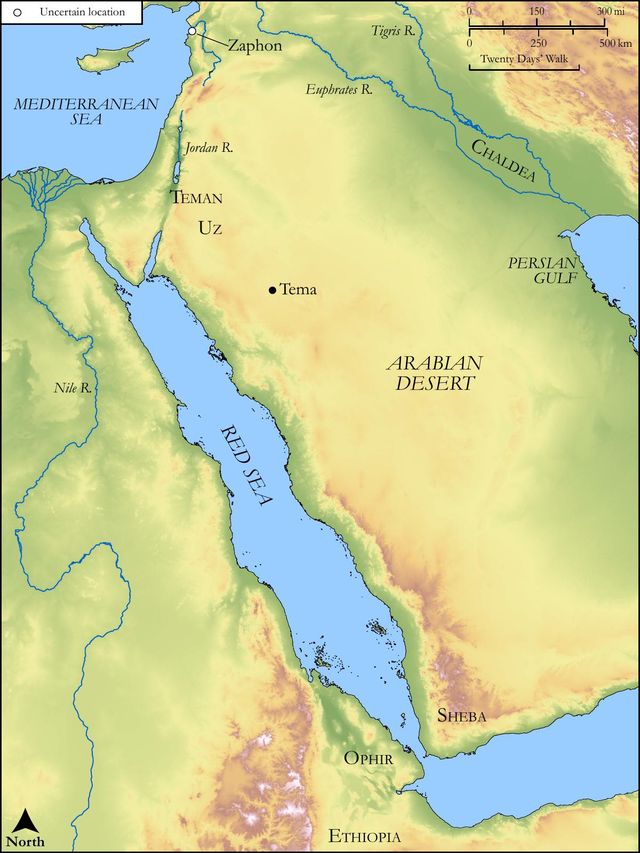
See on the biblical-era map
Study this verse
Public-domain commentary
Matthew Henry
From his Commentary on the Whole Bible. Henry comments on passages, not single verses — this entry covers Job 18:11–21. His two-level outline is real structure in the source text, so it is rendered as structure.
Bildad here describes the destruction itself which wicked people are reserved for in the other world, and which, in some degree, often seizes them in this world. Come, and see what a miserable condition the sinner is in when his day comes to fall.
I.See him disheartened and weakened by continual terrors arising from the sense of his own guilt and the dread of God's wrath (Job 18:11, Job 18:12): Terror shall make him afraid on every side. The terrors of his own conscience shall haunt him, so that he shall never be easy. Wherever he goes, these shall follow him; which way soever he looks, these shall stare him in the face. It will make him tremble to see himself fought against by the whole creation, to see Heaven frowning on him, hell gaping for him, and earth sick of him. He that carries his own accuser, and his own tormentor, always in his bosom, cannot but be afraid on every side. This will drive him to his feet, like the malefactor, who, being conscious of his own guilt, takes to his heels and flees when none pursues, Pro 28:1. But his feet will do him no service; they are fast in the snare, Job 18:9. The sinner may as soon overpower the divine omnipotence as flee from the divine omniscience, Amo 9:2, Amo 9:3. No marvel that the sinner is dispirited and distracted with fear, for,
1.He sees his ruin approaching: Destruction shall be ready at his side, to seize him whenever justice gives the word, so that he is brought into desolation in a moment, Psa 73:19.
2.He feels himself utterly unable to grapple with it, either to escape it or to bear up under it. That which he relied upon as his strength (his wealth, power, pomp, friends, and the hardiness of his own spirit) shall fail him in the time of need, and be hunger-bitten, that is, it shall do him no more service than a famished man, pining away for hunger, would do in work or war. The case being thus with him, no marvel that he is a terror to himself. Note, The way of sin is a way of fear, and leads to everlasting confusion, of which the present terrors of an impure and unpacified conscience are earnests, as they were to Cain and Judas.
II.See him devoured and swallowed up by a miserable death; and miserable indeed a wicked man's death is, how secure and jovial soever his life was. 1. See him dying, arrested by the first-born of death (some disease, or some stroke that has in it a more than ordinary resemblance of death itself; so great a death, as it is called, Co2 1:10, a messenger of death that has in it an uncommon strength and terror), weakened by the harbingers of death, which devour the strength of his skin, that is, it shall bring rottenness into his bones and consume them. His confidence shall then be rooted out of his tabernacle (Job 18:14), that is, all that he trusted to for his support shall be taken from him, and he shall have nothing to rely upon, no, not his own tabernacle. His own soul was his confidence, but that shall be rooted out of the tabernacle of the body, as a tree that cumbered the ground. "Thy soul shall be required of thee." 2. See him dead, and see his case then with an eye of faith. (1.) He is then brought to the king of terrors. He was surrounded with terrors while he lived (Job 18:11), and death was the king of all those terrors; they fought against the sinner in death's name, for it is by reason of death that sinners are all their lifetime subject to bondage (Heb 2:15), and at length they will be brought to that which they so long feared, as a captive to the conqueror. Death is terrible to nature; our Saviour himself prayed, Father, save me from this hour. But to the wicked it is in a special manner the king of terrors, both as it is a period to that life in which they placed their happiness and a passage to that life where they will find their endless misery. How happy then are the saints, and how much indebted to the Lord Jesus, by whom death is so far abolished, and the property of it altered, that this king of terrors becomes a friend and servant! (2.) He is then driven from the light into darkness (Job 18:18), from the light of this world, and his prosperous condition in it, into darkness, the darkness of the grave, the darkness of hell, into utter darkness, never to see light (Psa 49:19), not the least gleam, nor any hopes of it. (3.) He is then chased out of the world, hurried and dragged away by the messengers of death, sorely against his will, chased as Adam out of paradise, for the world is his paradise. It intimates that he would fain stay here; he is loth to depart, but go he must; all the world is weary of him, and therefore chases him out, as glad to get rid of him. This is death to a wicked man.
III.See his family sunk and cut off, Job 18:15.
The wrath and curse of God light and lie, not only upon his head and heart, but upon his house too, to consume it with the timber and stones thereof, Zac 5:4. Death itself shall dwell in his tabernacle, and, having expelled him, shall take possession of his house, to the terror and destruction of all that he leaves behind. Even the dwelling shall be ruined for the sake of its owner: Brimstone shall be scattered upon his habitation, rained upon it as upon Sodom, to the destruction of which this seems to have reference. Some think he here upbraids Job with the burning of his sheep and servants with fire from heaven. The reason is here given why his tabernacle is thus marked for ruin: Because it is none of his; that is, it was unjustly got, and kept, from the rightful owner, and therefore let him not expect either the comfort or the continuance of it. His children shall perish, either with him or after him, Job 18:16. So that, his roots being in his own person dried up beneath, above his branch (every child of his family) shall be cut off. Thus the houses of Jeroboam, Baasha, and Ahab, were cut off; none that descended from them were left alive. Those who take root in the earth may expect it will thus be dried up; but, if we be rooted in Christ, even our leaf shall not wither, much less shall our branch be cut off. Those who consult the true honour of their family, and the welfare of its branches, will be afraid of withering it by sin. The extirpation of the sinner's family is mentioned again (Job 18:19): He shall neither have son nor nephew, child nor grandchild, to enjoy his estate and bear up his name, nor shall there be any remaining in his dwelling akin to him. Sin entails a curse upon posterity, and the iniquity of the fathers is often visited upon the children. Herein, also, it is probable that Bildad reflects upon the death of Job's children and servants, as a further proof of his being a wicked man; whereas all that are written childless are not thereby written graceless; there is a name better than that of sons and daughters.
IV.See his memory buried with him, or made odious; he shall either be forgotten or spoken of with dishonour (Job 18:17):
His remembrance shall perish from the earth; and, if it perish thence, it perishes wholly, for it was never written in heaven, as the names of the saints are, Luk 10:20. All his honour shall be laid and lost in the dust, or stained with perpetual infamy, so that he shall have no name in the street, departing without being desired. Thus the judgments of God follow him, after death, in this world, as an indication of the misery his soul is in after death, and an earnest of that everlasting shame and contempt to which he shall rise in the great day. The memory of the just is blessed, but the name of the wicked shall rot, Pro 10:7.
V.See a universal amazement at his fall, Job 18:20.
Those that see it are affrighted, so sudden is the change, so dreadful the execution, so threatening to all about him: and those that come after, and hear the report of it, are astonished at it; their ears are made to tingle, and their hearts to tremble, and they cry out, Lord, how terrible art thou in thy judgments! A place or person utterly ruined is said to be made an astonishment, Deu 28:37; Ch2 7:21; Jer 25:9, Jer 25:18. Horrible sins bring strange punishments.
VI.See all this averred as the unanimous sense of the patriarchal age, grounded upon their knowledge of God and their many observations of his providence (Job 18:21): Surely such are the dwellings of the wicked, and this is the place (this the condition) of him that knows not God! See here what is the beginning, and what is the end, of the wickedness of this wicked world.
1.The beginning of it is ignorance of God, and it is a wilful ignorance, for there is that to be known of him which is sufficient to leave them for ever inexcusable. They know not God, and then they commit all iniquity. Pharaoh knows not the Lord, and therefore will not obey his voice.
2.The end of it, and that is utter destruction. Such, so miserable, are the dwellings of the wicked. Vengeance will be taken of those that know not God, Th2 1:8. For those whom he has not honour from he will get himself honour upon. Let us therefore stand in awe and not sin, for it will certainly be bitterness in the latter end.
Historical interpretation
Historical reception
2 surviving comments on this verse. Each one is dated, so this reads as a timeline rather than a list.
That these words are to be understood as speaking of the antichrist is shown when it is added, “In his days the last shall be astonished, and horror shall seize on the first.” He will then let himself loose against the righteous with such a measure of iniquity that even the hearts of the very elect shall be struck with no small consternation. Hence it is written, “Insomuch that if it were possible, they shall deceive the very elect,” which clearly isn’t said because the elect shall fall but because they shall tremble with terrible alarms. Now, at that time, both the latest elect and the first elect are described as maintaining the conflict for righteousness against him. They that shall be found among the elect at the end of the world are destined to be laid low in the death of the flesh. And they too who proceeded from the former times of the world, that is, Enoch and Elijah, shall be brought back among humankind and shall be exposed to the savageness of his cruelty while still in their mortal flesh. This one’s forces will be let loose with such terrible power that “the latest are astonished at, and the first do dread.” … Then he adds, “Surely such are the dwellings of the ungodly, such is the place of those who do not know God,” in that he who is now lifted up from ignorance of God is then brought to his own “dwellings” where his own wickedness plunges him into woes. One day he finds “darkness his place,” who while he made himself glad here in the counterfeit light of righteousness, was occupying the place of another. For bad people act deceitfully, striving to possess for themselves the righteous person’s good name, as of another place. But they are then brought to their own place, when they are tormented with everlasting fire, as the deserved punishment of their iniquity.
28. For he had said above; He shall drive him from fight into darkness, and translate him out of the world; and upon subjoining his miseries, he added; Surely, such are the dwellings of the wicked, and this is the place of him that knoweth not God. In that he who is now lifted up from not knowing God, is then brought to his own ‘dwellings,’ when his own wickedness plunges him into woes; and one day he finds ‘darkness his place,’ who, while he made himself glad here in the counterfeit light of righteousness, was occupying the place of another. For bad men in all that they do in dissimulation, are striving to possess themselves of the righteous man’s name of credit, as of another’s place. But they are then brought to their own place, when they are tormented with everlasting fire, as the desert of their iniquity. For here in all that they do they are ministering to their desire of winning praise, and by the semblance of good works, they are opening wider the bosom of the mind to avarice. So let the wicked man go now, and full blown with complete equipments, let him build his habitations here below, let him spread a name of glory, let him multiply estates, and delight himself in abundant stores, but when he shall be brought to everlasting punishments, then surely he shall know that ‘such are the dwellings of the wicked, and this is the place of him that knoweth not God.’ Now Bildad said this rightly, but he did not know who it was that he was saying it to. But the heart of a good man is seriously afflicted, when sentences are pronounced against him upon an unfair estimate.
Continue studying Job 18:21 across the web’s major study libraries — every link below opens this exact verse, chapter, or book on the destination site.
Read & Compare
 BibleGatewayThis verse in more than 200 translations and 70 languages.
 Bible.comThe YouVersion reader — hundreds of translations, reading plans, and highlights.
 ESV.orgCrossway's official English Standard Version reader.
 NET BibleThe NET translation with 60,000+ translators' notes on every rendering decision.
 STEP BibleTyndale House's free study tool — original text, vocabulary, and scholarly resources.
 BibliaLogos Bible Software's free web reader.
 USCCBThe New American Bible (Revised Edition) with the U.S. bishops' study notes.
Commentaries
 BibleHub CommentariesDozens of classic commentaries on this verse, gathered on one page.
 StudyLightMore than 100 commentary sets — the largest collection on the web.
 BibleRefPlain-English commentary on what this verse means, verse by verse.
 Enduring WordDavid Guzik's free commentary on this chapter, widely used by Bible teachers.
 Bible Study ToolsVerse commentary alongside Greek and Hebrew study aids.
Original Language & Research
- BibleHub InterlinearThe verse word by word — original language, transliteration, and English.
- BibleHub LexiconEvery word's original-language definition and Strong's entry.
 Blue Letter BibleDeep-study tools — Strong's numbers, concordance, and word studies.
 SefariaThe Hebrew text with Rashi and centuries of Jewish commentary.
Sermons, Hymns & Audio


TrulyRandomVerse is not affiliated with these sites and doesn’t control their content. They’re linked because they’re genuinely useful.
Summary
Bildad the Shuhite concludes his second discourse in Job 18:21 with a stark, unwavering declaration concerning the inevitable and complete ruin awaiting the wicked. This verse encapsulates his rigid theology of immediate retributive justice, asserting that the desolate state he has meticulously described throughout his address is the undeniable dwelling and ultimate destiny of those who are estranged from God, lacking a true, relational knowledge of Him. It serves as a definitive, albeit simplistic, pronouncement of divine judgment against the unrighteous, implicitly accusing Job of wickedness due to his profound suffering.
Context
ShowHideLiterary Context
Job 18:21 serves as the climactic and concluding declaration of Bildad's second speech to Job, found in Job chapter 18. Following Job's lament in Job 17, where Job expresses his profound despair and the perceived injustice of his suffering, Bildad responds with a harsh, unyielding condemnation rather than comfort. Throughout Job 18:5-20, Bildad paints a vivid and gruesome picture of the wicked person's demise: their light is extinguished, their prosperity vanishes, their children are cut off, their memory perishes, and terrors consume them. Verse 21 is the emphatic summary of this detailed portrayal, presenting the described desolation as the universal and inescapable fate of those who do not know God, thereby implicitly accusing Job of wickedness due to his calamitous circumstances, suggesting his suffering is a just consequence of his presumed sin.
Historical & Cultural Context
The book of Job belongs to the wisdom literature of the ancient Near East, a genre that often explored the profound problem of suffering and divine justice. In this cultural milieu, a prevalent theological framework, often termed "retribution theology," posited a direct and immediate correlation between one's moral conduct and one's temporal prosperity or suffering. Righteousness was believed to lead to blessings and well-being, while wickedness inevitably resulted in curses and calamity. Bildad, like Job's other friends, operates firmly within this traditional understanding, viewing Job's severe suffering as irrefutable proof of his sin. The concept of "dwellings" (Hebrew: mishkan) and "place" (Hebrew: maqom) carried significant weight, representing security, legacy, and well-being. To describe these as utterly desolate for the wicked underscored a complete and irreversible ruin, a fate worse than death in a society where one's name, lineage, and social standing were paramount.
Key Themes
ShowHideJob 18:21 powerfully contributes to several overarching themes within the book of Job and broader biblical theology. Primarily, it highlights the theme of Retributive Justice, albeit from Bildad's flawed perspective, which posits that God's justice is always immediate, visible, and perfectly aligned with human suffering. This verse encapsulates his conviction that the "dwellings of the wicked" are destined for destruction as a direct consequence of their actions. Secondly, it addresses the Consequences of Rejecting God, emphasizing that a fundamental lack of relationship and reverence, expressed by the phrase "knoweth not God," leads to utter desolation. This stands in stark contrast to the blessings promised to the righteous, as seen in passages like Psalm 1:6. Finally, the verse underscores the Futility of a Godless Life, suggesting that a life lived apart from divine knowledge and obedience ultimately results in emptiness, insecurity, and ruin, regardless of any temporary prosperity. The entire book of Job, however, serves to challenge and refine this simplistic view of divine justice, demonstrating God's sovereignty and wisdom beyond human comprehension, as articulated in God's speeches to Job in chapters 38-41.
Exposition and Analysis
ShowHideKey Word Analysis
ShowHideThis term (מִשְׁכָּן) primarily refers to a residence, habitation, or dwelling place, often implying a place of security, rest, and established presence. It is notably used for the Tabernacle, the dwelling place of God among His people. In this context, its application to the wicked's fate highlights the complete reversal of their expected security and stability. Their "dwellings" are not places of peace or prosperity but of desolation and emptiness, reflecting their inner spiritual emptiness and external ruin. Bildad uses it to signify the comprehensive destruction of their entire existence and legacy.
Derived from a root meaning "to act perversely" or "to be unjust," this intensive adjective (עַוָּל) describes someone who is morally evil, unjust, or unrighteous. It denotes a character marked by deliberate wrongdoing and a deviation from God's righteous standards. Bildad applies this label to Job's perceived state, asserting that Job's suffering is a direct result of his presumed wickedness, which he equates with a lack of true knowledge of God.
This Hebrew verb (יָדַע) signifies far more than mere intellectual acquaintance or factual knowledge. It denotes a deep, intimate, experiential, and relational knowing, often implying a covenantal relationship. In biblical usage, to "know" God means to acknowledge His sovereignty, to obey His commands, to live in a personal, committed relationship with Him, and to experience His presence. Therefore, "he that knoweth not God" refers not simply to someone ignorant of God's existence, but to one who lacks a saving, transformative relationship with Him, and thus lives without acknowledging His authority or moral demands. This spiritual alienation is presented as the root cause of their wickedness and subsequent downfall.
Verse Breakdown
ShowHide"Surely such [are] the dwellings of the wicked"
Bildad asserts with absolute certainty that the horrific conditions he has just described throughout Job 18 are the inevitable and characteristic state of the wicked. The term "dwellings" (mishkan) here is used metaphorically to encompass their entire existence, including their home, family, prosperity, and legacy. It implies a total and inescapable desolation, a divine judgment manifest in their physical, social, and spiritual ruin. This declaration is presented as an undeniable truth, foundational to Bildad's understanding of divine justice, and is meant to be a direct, albeit harsh, word to Job.
"and this [is] the place [of him that] knoweth not God"
This clause provides the theological rationale for the wicked's fate, equating "the wicked" with "him that knoweth not God." The "place" (maqom) reinforces the idea of a fixed, unavoidable destiny or condition. The crucial phrase "knoweth not God" (yada' elohim) underscores that the ultimate problem is not merely a lack of information about God, but a profound, relational estrangement. It speaks of a life lived without acknowledging, revering, or having a personal covenantal relationship with the Creator. This spiritual alienation, rather than specific transgressions alone, is presented as the foundational sin leading to their ultimate ruin and desolation.
Literary Devices
ShowHideBildad's concluding statement in Job 18:21 employs several potent literary devices to convey his rigid theological conviction. Parallelism is evident in the two clauses, where "the dwellings of the wicked" are equated with "the place of him that knoweth not God." This synonymous parallelism reinforces the idea that wickedness is fundamentally synonymous with a lack of true, relational knowledge of God, creating a sense of definitive and inescapable judgment. Irony is subtly present, as Bildad, in his attempt to "comfort" Job by explaining his suffering, instead delivers a harsh condemnation, ironically misapplying the very wisdom he purports to uphold. Furthermore, the verse uses powerful Imagery of desolation and lack, contrasting sharply with the typical ancient Near Eastern desire for security, legacy, and a flourishing household. The phrase "knoweth not God" functions as a form of Metonymy, where the absence of intimate, relational knowledge stands in for a life of active rebellion, spiritual indifference, or practical atheism towards God, leading directly to the described consequences.
Theological and Thematic Connections
ShowHideJob 18:21, though spoken from a perspective the book of Job ultimately critiques as simplistic and incomplete, nonetheless touches upon profound biblical truths regarding humanity's relationship with God and the consequences of spiritual alienation. Bildad's assertion that the wicked's ruin stems from their not "knowing God" resonates with the broader biblical emphasis on the vital importance of a true, relational knowledge of the Creator as the foundation for life, wisdom, and blessing. While the book challenges the direct, immediate, and simplistic cause-and-effect retribution theology of Job's friends, it does not negate the ultimate reality of divine judgment or the inherent futility of a life lived apart from God. The verse highlights the stark contrast between those who acknowledge God's sovereignty and those who live in rebellion or indifference, foreshadowing the ultimate eschatological divide between the righteous and the unrighteous. It underscores that true security and flourishing are found not in worldly possessions or status, but in a right relationship with the Almighty.
Reflection and Application
ShowHideWhile we must approach Bildad's words with the understanding that the book of Job ultimately refutes his simplistic application of retributive justice to Job's suffering, Job 18:21 still offers a profound truth for our reflection: a life alienated from God is fundamentally devoid of lasting security, true blessing, and ultimate meaning. The "dwellings" of those who do not truly "know" God, in the deep, experiential sense, are ultimately characterized by spiritual emptiness, insecurity, and a lack of divine favor, regardless of outward appearances. This verse serves as a powerful, albeit stark, reminder of the paramount importance of cultivating an authentic, intimate, and obedient relationship with the Creator. For believers, it underscores the value of clinging to God's wisdom and His revealed truth rather than pursuing worldly paths, understanding that true peace, security, and purpose come from genuinely knowing Him and walking in His ways, regardless of immediate circumstances. It prompts us to examine whether our lives reflect a genuine, relational knowledge of God or merely a superficial, intellectual acknowledgment, urging us towards deeper communion and submission to His will.
Questions for Reflection
ShowHideFAQ
ShowHideDoes "knoweth not God" imply intellectual ignorance or something deeper?
ShowHideThe phrase "knoweth not God" (Hebrew: yada' elohim) in Job 18:21 implies far more than mere intellectual ignorance. In biblical Hebrew, the verb yada' (יָדַע) signifies a deep, intimate, experiential, and relational knowledge, often implying a covenantal relationship. Therefore, "he that knoweth not God" refers not simply to someone who is unaware of God's existence, but to one who lacks a personal, transformative relationship with Him, and thus lives without acknowledging His sovereignty, obeying His commands, or revering His person. It speaks to a profound spiritual alienation and a life lived in practical disregard of God's claims. This is a common theme in the Old Testament, where "knowing the Lord" is synonymous with obedience and faithfulness, as seen in Jeremiah 9:24.
How does Bildad's view of the wicked's fate compare to the overall message of the book of Job?
ShowHideBildad's view in Job 18:21, which posits a direct and immediate correlation between wickedness and suffering, represents a traditional "retribution theology" prevalent in the ancient Near East. He believes that Job's calamities are proof of his wickedness, and that the wicked inevitably face utter desolation in this life. However, the overall message of the book of Job profoundly challenges and refines this simplistic view. The book demonstrates that suffering is not always a direct consequence of sin, and that God's ways are often inscrutable to human understanding. While the book affirms God's ultimate justice and the eventual judgment of the wicked, it critiques the friends' rigid and uncompassionate application of retribution theology to Job's innocent suffering. The book ultimately points to God's sovereignty and wisdom, which transcend human categories of justice, as revealed in God's speeches to Job in chapters 38-41.
Christ-Centered Fulfillment
ShowHideWhile Job 18:21, spoken by Bildad, presents a rigid and ultimately incomplete view of divine justice, its core assertion about the fate of those who "know not God" finds its ultimate and perfect fulfillment in the person and work of Jesus Christ. Jesus is the one who perfectly "knows" God the Father, not merely intellectually, but in an eternal, intimate, and relational union, as declared in John 1:18 and John 10:15. He is the one through whom true knowledge of God is revealed and made possible for humanity. The "place" and "dwellings" of the wicked, characterized by desolation and separation, stand in stark contrast to the eternal "dwellings" Jesus prepares for those who believe in Him, promising to take them to be with Him in His Father's house. Furthermore, the "knowing God" that Bildad speaks of as absent in the wicked is precisely what Jesus defines as eternal life: "And this is eternal life, that they know you, the only true God, and Jesus Christ whom you have sent" (John 17:3). Ultimately, the judgment prophesied for those who reject God is fulfilled in Christ's role as the righteous judge, who will separate the sheep from the goats, consigning those who do not "know" Him (in the sense of a saving relationship) to eternal separation, as described in Matthew 25:41. Thus, Job 18:21, through a Christ-centered lens, points to the profound necessity of a saving relationship with God through Jesus, the only way to escape the ultimate desolation of a life lived apart from the Creator and to find true and lasting dwelling with God.