


Isaiah 15:9
- כִּיkithatH3588PrtParticle Conditional
- מֵיmei[the] waters ofH4325N-mpcNoun Plural Masculine Construct
- דִימוֹןdi·mOnDimonH1775N-properNoun Proper Location
- מָלְאוּMal·'uthey are fullH4390V-Qal-Perf-3cpVerb Qal Perfect 3rd Plural common gender
- דָםDambloodH1818N-msNoun Singular Masculine Absolute
- כִּיkithatH3588PrtParticle Conditional
- אָשִׁית'a·ShitI will putH7896V-Qal-Imperf-1csVerb Qal Imperfect 1st Singular common gender
- עַל'alonH5921PrepPreposition
- דִּימוֹןdi·MonDimonH1775N-properNoun Proper Location
- נוֹסָפוֹתno·sa·Fotadded [things]H3254V-Niphal-Prtcpl-fpVerb Niphal Participle Plural Feminine Absolute
- לִפְלֵיטַתlif·lei·Tat[will be] for [the] escaped remnant ofH6413Prep-l ¦ N-fscNoun Singular Feminine Constructלִ[will be] forפְלֵיטַת[the] escaped remnant of
- מוֹאָבmo·'AvMoabH4124N-properNoun Proper Location
- אַרְיֵה'ar·Yeha lionH738N-msNoun Singular Masculine Absolute
- וְלִשְׁאֵרִיתve·lish·'e·Ritand for [the] remainder ofH7611Conj-w ¦ Prep-l ¦ N-fscNoun Singular Feminine Constructוְandלִforשְׁאֵרִית[the] remainder of
- אֲדָמָה'a·da·Mah[the] landH127N-fsNoun Singular Feminine Absolute
English is a literal word-by-word gloss of the Hebrew, not the KJV's wording. Why?
This is the original text the KJV's translators worked from — each Hebrew word with its own literal English meaning in this verse, prepared by scholars at Tyndale House, Cambridge. The KJV translates whole sentences, not word by word, so its wording differs: one Hebrew word can become several English words, and the KJV may choose “the LORD” where the gloss reads “Yahweh”. Both are faithful — they answer different questions. For the KJV's own rendering, switch to the KJV text.
Details
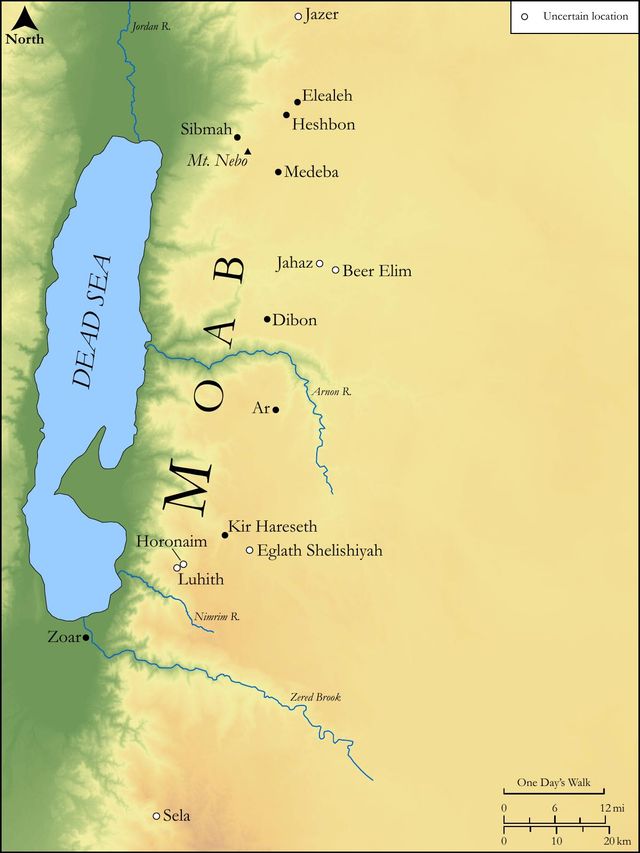
See on the biblical-era map
Study this verse
Public-domain commentary
Matthew Henry
From his Commentary on the Whole Bible. Henry comments on passages, not single verses — this entry covers Isaiah 15:6–9. His two-level outline is real structure in the source text, so it is rendered as structure.
Here the prophet further describes the woeful and piteous lamentations that should be heard throughout all the country of Moab when it should become a prey to the Assyrian army. "By this time the cry has gone round about all the borders of Moab," Isa 15:8. Every corner of the country has received the alarm, and is in the utmost confusion upon it. It has reached to Eglaim, a city at one end of the country, and to Beer-elim, a city as far the other way. Where sin has been general, and all flesh have corrupted their way, what can be expected but a general desolation? Two things are here spoken of as causes of this lamentation: -
I.The waters of Nimrim are desolate (Isa 15:6), that is, the country is plundered and impoverished, and all the wealth and substance of it swept away by the victorious army. Famine is usually the sad effect of war. Look into the fields that were well watered, the fruitful meadows that yielded delightful prospects and more delightful products, and there all is eaten up, or carried off by the enemy's foragers, and the remainder trodden to dirt by their horses. If an army encamp upon green fields, their greenness is soon gone. Look into the houses, and they are stripped too (Isa 15:7): The abundance of wealth that they had gotten with a great deal of art and industry, and that which they had laid up with a great deal of care and confidence, shall they carry away to the brook of the willows. Either the owners shall carry it thither to hide it or the enemies shall carry it thither to pack it up and send it home, by water perhaps, to their own country. Note,
1.Those that are eager to get abundance of this world, and solicitous to lay up what they have gotten, little consider what may become of it and in how short a time it may be all taken from them. Great abundance, by tempting the robbers, exposes the owners; and those who depend upon it to protect them often find it does but betray them.
2.In times of distress great riches are often great burdens, and do but increase the owner's care or the enemies' strength. Cantabit vacuus coram latrone viator - The penniless traveller will exult, when accosted by a robber, in having nothing about him.
II.The waters of Dimon are turned into blood (Isa 15:9), that is, the inhabitants of the country are slain in great numbers, so that the waters adjoining to the cities, whether rivers or pools, are discoloured with human gore, inhumanly shed like water. Dimon signifies bloody; the place shall answer to its name. Perhaps it was that place in the country of Moab where the waters seemed to the Moabites as blood (Kg2 3:22, Kg2 3:23), which occasioned their overthrow. But now, says God, I will bring more upon Dimon, more blood than was shed, or thought to be seen, at that time. I will bring additions upon Dimon (so the word is), additional plagues; I have yet more judgments in reserve for them. For all this, God's anger is not turned away. When he judges he will overcome; and to the roll of curses shall be added many like words, Jer 36:32. See here what is the yet more evil to be brought upon Dimon, upon Moab, which is now to be made a land of blood. Some flee, and make their escape, others sit still, and are overlooked, and are as a remnant of the land; but upon both God will bring lions, beasts of prey (which are reckoned one of God's four judgments, Eze 14:21), and these shall glean up those that have escaped the sword of the enemy. Those that continue impenitent in sin, when they are preserved from one judgment, are but reserved for another.
Historical interpretation
Historical reception
2 surviving comments on this verse. Each one is dated, so this reads as a timeline rather than a list.
(Verse 3 and following) Over Nebo and over Medeba, Moab will wail; on every head there is baldness, every beard is shaved off. In its streets they are dressed in sackcloth; on its rooftops and in its squares everyone wails and goes down in weeping. Heshbon and Elealeh cry out; their voices are heard as far as Jahaz; therefore the armed men of Moab cry aloud; his soul trembles. My heart cries out for Moab; its bars are dragged away, to Luhith and to Heshbon they come, crying; on the way to Horonaim they raise a cry of destruction; the waters of Nimrim are a desolation; the grass is withered, the vegetation fails, the greenery is no more. According to the magnitude of their work and their visitation, they shall be led to the torrent of the willows; because a cry hath gone round the border of Moab unto Eglaim, the howling thereof unto Beer Elim. For the waters of Dimon have been filled with blood: for I will bring more upon Dimon, lions upon them that shall flee out of Moab, and upon the remnant of the land. Therefore, since every teaching contrary to the truth, which is born without the inspiration of God from human understanding in the darkness of error, has been laid waste by the night, and its arguments, which are understood as walls, have been destroyed by the words of Ecclesiastes; so that they fall into eternal silence, to such an extent that their entire faction turns to repentance and tears, over Nabo, that is, over prophecy and authority, that is, over their leaders, and over Medaba, where there are no fruitful trees, but barren thickets, in which beasts dwell, as it is written in the twenty-eighth psalm: And he will reveal the hidden things of the forest: there will be wailing and lamentation, and all the ornaments of eloquence will be taken away from their heads, so that they remain naked and deformed. And if anything seemed to have masculinity in a beard, when shaved by a Ecclesiastical man, it is considered effeminate and weak. In their crossroads, that is, the byways of errors, while each one fabricates according to his own will, he is equipped with the sack of penance, and over the roofs and tamed places, in which they first believed themselves to be lofty; and in the streets (because they do not enter by the narrow way, which leads to life, but by the broad way, which leads to death) there will be wailing. And they shall by no means ascend into pride, but descend into weeping. Then they shall understand all their vain thoughts, which are interpreted as Esbon, and the futile ascent of pride, which sounds like Eleale, so that the voice of their deeds may be heard, and the commandment they thought was from God, condemning themselves by their own confession. Therefore, the bars, that is, those who were strong in Moab and understood their error, shall howl, and they who had hopes will begin to have regrets when their soul howls to itself. Where the Prophet speaks with compassionate affection to those whose souls cried out to him, and says: My heart will cry out to Moab, that I may provoke them to repentance. But their beams and all the foundations, which seemed to have support in their heresies, will reach as far as Segor, that is, to the little one: and it will be shown that they are not strong, but fragile. And this Segor, that is, the small repentance, if it perseveres, will lead them to perfect salvation: which is signified by the three-year-old heifer, as we read in Genesis, where Abraham is commanded to offer a calf, a ram, and a three-year-old goat, a perfect sacrifice, that he may deservedly be the heir of the Lord (Genesis 15). And when they have repented, through tears of sorrow, that is, the tears of their cheeks, they will ascend to higher things. And through this as if through a hole and entrance of sorrow, they will raise the cry of contrition to the Lord, so that they may say: Sacrifice to God is a contrite spirit: a contrite and humble heart God will not despise (Ps. 50:19). And this will happen because the waters of Nemrim, that is, the teachings of heretics, which are compared to leopards and transgressors, will be deserted and brought to nothing. They are stubborn, whose variations and blemishes are not changed (Jeremiah XIII), and apostates, of whom we read in the Psalms, I have regarded all the sinners of the earth as transgressors (Psalm CXVIII, 119). Also, every plant and sprout, and everything that seemed green in their speech, withered. And they were visited by God according to the magnitude of their sins, so that those whom they had not felt through blessings, they would come to know through afflictions. Finally, they will be led to the valley or torrent of willows, so that no fruit remains in them. For they say that this is the nature of the seeds of these trees, that whoever drinks it in a cup will be barren. Hence the holy ones who, because of their sins, began to be in the confusion of this world, hang their organs in the willows of the Babylonian rivers (Ps. CXXXVI). The cry of the Moabites goes around all the borders, either calling for repentance or mourning for the error, so that they can offer through their wailing the calves of their lips and reach the spring of the Lord's rams, or the mighty ones, because Elim signifies both. But the waters of Dimon, which is interpreted as sufficient pain or sorrow, which had polluted many with its sprinkling, will be accused by deceived peoples of not being for their salvation, but for their bloodshed. Hence the prophetic speech promises that over flowing tears, which is interpreted as Dibon, they will accumulate not just one sorrow, but multiple additions of sorrow: so that after they have fully repented and fled from the Moabite lion, they may have God as their leader, whom the Septuagint called Ariel, which is interpreted as lion of God: I will refrain from discussing their translation in this place, because it disagrees with the Hebrew truth in many places, and from what we have interpreted, the sense of that can also be understood.
(Verse 9) Because the waters of Dibon are filled with blood. Where there was once luxury due to fertile fields and constantly flowing springs, there the streams of blood will flow due to the multitude of those killed.
For I will set upon Dibon additional things for those who have fled from Moab, a lion, and the remnants of the land. Lest anyone think it is a mistake of the scribe, and wishes to correct the error, let it be known that the name is written with both the letter M and the letter B: E of which Dimon is interpreted as silence; Dibon, flowing. With both names given because of the quietly flowing waters, to this day this small town is called both Dimon and Dibon interchangeably. As for the statement: I will set upon Dibon additional things, and seemed to ask a question about what it was, he explained in the following verse, saying: For those who have fled from Moab, a lion, and the remnants of the land: so that even those who have escaped in flight may be consumed by beasts. Although we can also understand the lion, the king of the enemies, through a metaphor, so that no one can escape his power, as if it were a roar.
Continue studying Isaiah 15:9 across the web’s major study libraries — every link below opens this exact verse, chapter, or book on the destination site.
Read & Compare
 BibleGatewayThis verse in more than 200 translations and 70 languages.
 Bible.comThe YouVersion reader — hundreds of translations, reading plans, and highlights.
 ESV.orgCrossway's official English Standard Version reader.
 NET BibleThe NET translation with 60,000+ translators' notes on every rendering decision.
 STEP BibleTyndale House's free study tool — original text, vocabulary, and scholarly resources.
 BibliaLogos Bible Software's free web reader.
 USCCBThe New American Bible (Revised Edition) with the U.S. bishops' study notes.
Commentaries
 BibleHub CommentariesDozens of classic commentaries on this verse, gathered on one page.
 StudyLightMore than 100 commentary sets — the largest collection on the web.
 BibleRefPlain-English commentary on what this verse means, verse by verse.
 Enduring WordDavid Guzik's free commentary on this chapter, widely used by Bible teachers.
 Bible Study ToolsVerse commentary alongside Greek and Hebrew study aids.
Original Language & Research
- BibleHub InterlinearThe verse word by word — original language, transliteration, and English.
- BibleHub LexiconEvery word's original-language definition and Strong's entry.
 Blue Letter BibleDeep-study tools — Strong's numbers, concordance, and word studies.
 SefariaThe Hebrew text with Rashi and centuries of Jewish commentary.
Sermons, Hymns & Audio


TrulyRandomVerse is not affiliated with these sites and doesn’t control their content. They’re linked because they’re genuinely useful.
Summary
Isaiah 15:9 delivers a chilling culmination to the oracle against Moab, intensifying the prophetic vision of divine judgment. It graphically portrays the waters of Dimon, a significant Moabite city, as being "full of blood," signifying an unprecedented and catastrophic loss of life. The verse further declares that even those who manage to escape the initial wave of destruction will face a subsequent, relentless peril in the form of "lions," symbolizing an inescapable and comprehensive divine wrath that leaves no one untouched and no refuge secure, ensuring the complete desolation of the land.
Context
ShowHideLiterary Context
Isaiah 15:9 serves as the grim and climactic conclusion to the "burden of Moab," a prophetic oracle that spans Isaiah chapters 15 and 16. The preceding verses in Isaiah 15 meticulously detail widespread lamentation and national catastrophe across Moabite cities such as Ar, Kir, and Dibon (which is likely synonymous with Dimon). The imagery employed includes traditional signs of deep mourning—shaved heads, sackcloth, and public weeping—all indicative of profound national distress. Verse 9 escalates this sorrow from emotional anguish to the physical horror of mass slaughter and relentless pursuit, emphasizing the utter totality of the impending judgment. It moves beyond the distress of national collapse to depict the literal bloodshed and the complete eradication of any hope for survival, leaving no doubt as to the severity of God's decree.
Historical & Cultural Context
Moab, situated to the east of the Dead Sea, maintained a complex and frequently adversarial relationship with ancient Israel, despite their shared ancestry through Lot, Abraham's nephew, as recorded in Genesis 19:37. Throughout their history, Moab often acted as an oppressor or adversary to Israel, which led to various prophetic condemnations. The prophecy in Isaiah 15-16 is widely understood to refer to a historical invasion, most likely by the Assyrian Empire, a dominant regional power during the time of Isaiah. The mention of "lions" is particularly significant in this context. While it could literally refer to wild animals preying on scattered survivors, it more powerfully symbolizes a fierce, relentless invading army—a common biblical metaphor for destructive forces, as also seen in Jeremiah 4:7. The imagery of "waters full of blood" vividly evokes the horror of ancient warfare, where rivers and wells could become choked with the dead, rendering them unusable and symbolizing complete and utter devastation.
Key Themes
ShowHideThis verse profoundly contributes to several overarching themes prevalent in Isaiah and the broader prophetic literature. Firstly, it powerfully underscores the theme of Divine Judgment, demonstrating God's sovereign right and absolute power to hold nations accountable for their wickedness and opposition to His people. The extreme severity of the judgment pronounced upon Moab highlights that God's warnings are not idle threats but carry certain and devastating consequences. Secondly, it emphasizes the Inescapability of God's Wrath. The declaration that even those who flee one peril will encounter another ("lions upon him that escapeth") vividly illustrates that no human effort, strategic retreat, or hidden refuge can ultimately thwart divine justice. This resonates deeply with the truth found in Amos 9:2, where God declares that even if His people attempt to hide in Sheol or ascend to heaven, His hand will surely find them. Finally, the explicit declaration, "for I will bring more upon Dimon," powerfully reinforces the theme of Divine Sovereignty, asserting that this catastrophic event is not a random historical occurrence but a direct, intentional act of God's will and purpose, demonstrating His ultimate control over the destinies of all nations.
Exposition and Analysis
ShowHideKey Word Analysis
ShowHideThis term (H1775) refers to a place in Palestine, specifically identified as Dimon. It is widely considered an alternative or symbolic name for Dibon, a major Moabite city frequently mentioned elsewhere in the oracle (e.g., Isaiah 15:2). The choice of this name may also carry a phonetic resemblance or subtle wordplay with the Hebrew word for "blood" (dam), thereby intensifying the imagery of the verse and suggesting that the very identity of the place becomes tragically synonymous with its bloody fate.
The word (H1818) denotes blood, specifically as that which, when shed, causes death in humans or animals. Figuratively, especially in the plural, it refers to bloodshed. In this context, "full of blood" signifies not merely a few casualties but an overwhelming, catastrophic loss of life, portraying a scene of mass slaughter so immense that it contaminates the very water sources, rendering them unusable and horrific.
This word (H738) literally means "lion," an animal known for its ferocity and violence. In biblical usage, it often symbolizes fierce, destructive forces. Here, it signifies a relentless, savage, and complete destruction that pursues even the scattered survivors, leaving no hope for escape or refuge. It can represent powerful invading armies or overwhelming calamities that act as divine agents of judgment.
Verse Breakdown
ShowHide"For the waters of Dimon shall be full of blood:"
This opening clause immediately establishes a gruesome and shocking scene. "Dimon" is understood as a significant Moabite city, likely Dibon. The imagery of its waters—encompassing rivers, wells, or springs—being "full of blood" is a powerful hyperbole. It signifies an immense and horrific slaughter, implying that the bloodshed is so vast and pervasive that it contaminates the very life source of the city, rendering it uninhabitable and a monument to death. This paints a picture of utter devastation and the complete extinguishing of life.
"for I will bring more upon Dimon,"
This declarative statement unequivocally reveals the divine agency behind the catastrophe. The "I" explicitly refers to the Lord, asserting His direct involvement and sovereign control over these unfolding events. The phrase "bring more" indicates that the judgment described is not a singular, isolated event but an escalating, continuous, or additional wave of destruction. This implies that the initial devastation will not be the end; further, even greater calamities are yet to come upon the already suffering city and region, intensifying the horror.
"lions upon him that escapeth of Moab,"
This vivid imagery describes the dire fate of those who manage to survive the initial wave of destruction. "Lions" here are symbolic of fierce, relentless, and inescapable destructive forces. These could be literal wild animals preying on the weakened and scattered, or more likely, subsequent waves of invading armies or calamitous events that relentlessly pursue and destroy the scattered remnants of the Moabite population. It powerfully underscores the utter lack of refuge or hope for those attempting to flee, emphasizing the inescapable nature of God's judgment.
"and upon the remnant of the land."
This final phrase broadens the scope of the judgment from individual escapees to encompass the entire remaining population and the very territory of Moab. It signifies that the judgment is comprehensive and total, leaving no portion of the land or its inhabitants untouched. Even the "remnant," those who might have hoped to rebuild or find safety, will face the same inescapable doom, ensuring the complete and devastating fulfillment of the prophecy of desolation.
Literary Devices
ShowHideIsaiah 15:9 masterfully employs several potent literary devices to convey its message of overwhelming judgment and inescapable doom. Imagery is central, with phrases such as "waters... full of blood" and "lions upon him that escapeth" creating vivid, horrifying mental pictures of mass death and relentless pursuit. This stark visual language is designed to evoke a strong emotional response and underscore the severity of the impending catastrophe. Hyperbole is clearly evident in the declaration that waters will be "full of blood," an exaggeration used to emphasize the immense scale of the slaughter rather than a literal prediction of water transforming into blood. This amplifies the sense of complete devastation and the horror of the scene. Symbolism is also prominent, particularly with "lions" representing not just literal predators but powerful, destructive forces—most likely invading armies or divine agents of judgment—that will pursue and annihilate the survivors. The mention of "Dimon" itself may contain a subtle Wordplay, as it phonetically resembles the Hebrew word for "blood" (dam), subtly reinforcing the verse's central theme of bloodshed and the city's tragic fate. Finally, the explicit declaration "for I will bring more" demonstrates Divine Persona, emphasizing that the judgment is not a random historical occurrence but a direct, intentional act of God's sovereign will and purpose.
Theological and Thematic Connections
ShowHideIsaiah 15:9 stands as a stark and profound reminder of God's unwavering justice and His absolute sovereign authority over all nations. It powerfully illustrates that rebellion and opposition to His divine will, even from nations seemingly distant from Israel's covenant, do not go unpunished. The graphic imagery of total destruction underscores the gravity of sin and the comprehensive nature of divine judgment when it falls. Yet, even within this severe pronouncement, there is an implicit call to acknowledge God's power and to seek His mercy, as the ultimate hope for any nation or individual lies in aligning with His righteous ways. The relentless pursuit of the "lions" symbolizes the inescapable consequences of unrepentant sin, a truth consistently woven throughout the tapestry of Scripture.
Reflection and Application
ShowHideWhile Isaiah 15:9 is a specific prophecy against ancient Moab, it offers timeless and profound principles for all generations. It serves as a powerful reminder of the seriousness with which God regards sin and rebellion, not only in individuals but also in nations and communities. The graphic depiction of judgment should stir within us a holy fear and profound reverence for God's power and righteousness. It compels us to critically examine our own lives and allegiances: are we living in alignment with His will, or are we, like Moab, setting ourselves against Him? The verse also highlights the profound futility of attempting to escape God's ultimate justice through human means; there is no hiding place from His all-seeing eye and sovereign hand. This truth should lead us not to despair, but to a deeper understanding of the urgent need for repentance and reliance on God's boundless mercy, which alone provides true refuge and salvation. It challenges us to reflect deeply on the inevitable consequences of societal and personal sin, recognizing that God's justice will ultimately prevail, and to live our lives in light of His coming kingdom.
Questions for Reflection
ShowHideFAQ
ShowHideWhat was the relationship between Moab and Israel?
ShowHideMoab was a nation descended from Lot, Abraham's nephew, making them distant relatives of the Israelites. Despite this kinship, their relationship was consistently marked by hostility and conflict. Moabites frequently opposed Israel, as vividly seen in the story of Balak and Balaam in Numbers 22-24, and they often engaged in idolatry and immoral practices that were anathema to Israel's covenant with Yahweh. This long history of antagonism and spiritual deviation contributed significantly to the prophetic judgments pronounced against Moab, including the one found in Isaiah 15.
Does "lions" refer to literal animals or something else?
ShowHideWhile literal lions were indeed present in the ancient Near East and could prey on scattered populations, in biblical prophecy, "lions" (as used in Isaiah 15:9) frequently serve as a powerful symbol for fierce, destructive forces. In the context of national judgment, this imagery typically refers to invading armies that are relentless, savage, and leave no survivors. For example, Jeremiah 4:7 employs the imagery of a lion coming out of its thicket to describe an invading army. Therefore, in Isaiah 15:9, "lions" most likely symbolizes the inescapable and utterly devastating nature of the military conquest or divine judgment that would befall Moab.
What is the significance of "Dimon" being "full of blood"?
ShowHideThe phrase "the waters of Dimon shall be full of blood" is a powerful and gruesome piece of hyperbole used to convey the immense scale of the impending slaughter. Dimon is likely an alternative name for Dibon, a major Moabite city. The imagery suggests that the bloodshed will be so vast and pervasive that it will contaminate the very water sources—rivers, wells, or springs—which are essential for life. This signifies not just a battle, but a complete and utter devastation, where life is extinguished on a massive scale, and the very environment becomes a testament to death and judgment. It powerfully evokes the horror of the plague of blood in Egypt, where God demonstrated His absolute power over life and death.
Christ-Centered Fulfillment
ShowHideWhile Isaiah 15:9 graphically depicts God's righteous judgment upon a rebellious nation, its ultimate Christ-centered fulfillment is found in the profound truth of how God's holy wrath against sin is both perfectly displayed and ultimately satisfied in the person and work of Jesus Christ. The terrifying imagery of "waters full of blood" and the relentless pursuit of "lions" speaks to the terrifying reality of divine justice, which demands a complete reckoning for all sin and rebellion. Humanity, in its fallen state, stands condemned by its sin, facing an inescapable judgment (as powerfully articulated in Romans 3:23 and Romans 6:23). However, the glorious good news of the Gospel is that God, in His infinite love and perfect wisdom, provided a way for humanity to escape this deserved wrath. Jesus, the Lamb of God who takes away the sin of the world, voluntarily bore the full weight of God's judgment on the cross, His own precious blood shed as the ultimate and perfect atonement for our sins (Hebrews 9:22). He became the one upon whom the divine "lions" of judgment fell, so that all who believe in Him might be eternally spared. Thus, the terrifying judgment prophesied for Moab finds its profound echo in the judgment due to all humanity, but its ultimate resolution and the only true hope are found in the cross of Christ, where divine justice and boundless mercy converge, offering deliverance from the wrath to come for all who trust in Him (Romans 5:9).