


Genesis 42:4
Bible text: King James Version (1769 Blayney text) · Public domain
Bible text: Berean Standard Bible · Public domain
Bible text: American Standard Version (1901) · Public domain
Bible text: World English Bible, Messianic edition · Public domain
Bible text: Geneva Bible (1599) · Public domain
Bible text: Young's Literal Translation · Public domain
- וְאֶתve·'Etand <obj.>H853Conj-w ¦ DirObjMParticle Object Indicatorוְandאֶת<obj.>
- בִּנְיָמִיןbin·ya·MinBenjaminH1144N-proper-mNoun Proper Masculine
- אֲחִי'a·Chi[the] brother ofH251N-mscNoun Singular Masculine Construct
- יוֹסֵףyo·SefJosephH3130N-proper-mNoun Proper Masculine
- לֹאlo'notH3808NegParticle Negative
- שָׁלַחsha·Lachhe sentH7971V-Qal-Perf-3msVerb Qal Perfect 3rd Singular Masculine
- יַעֲקֹבya·'a·KoJacobH3290N-proper-mNoun Proper Masculine
- אֶת'etwithH854PrepPreposition
- אֶחָיו'e·Chavhis brothersH251N-mpc ¦ 3msNoun Plural Masculine Constructאֶחָיbrothersוhis
- כִּיkiforH3588PrtParticle Conditional
- אָמַר'a·Marhe saidH559V-Qal-Perf-3msVerb Qal Perfect 3rd Singular Masculine
- פֶּןpenlestH6435PrtParticle Conditional
- יִקְרָאֶנּוּyik·ra·'E·nuit should happen to himH7122V-Qal-Imperf-3ms ¦ 3msVerb Qal Imperfect 3rd Singular Masculineיִקְרָאֶit should happen toנּוּhim
- אָסוֹן'a·SonharmH611N-msNoun Singular Masculine Absolute
English is a literal word-by-word gloss of the Hebrew, not the KJV's wording. Why?
This is the original text the KJV's translators worked from — each Hebrew word with its own literal English meaning in this verse, prepared by scholars at Tyndale House, Cambridge. The KJV translates whole sentences, not word by word, so its wording differs: one Hebrew word can become several English words, and the KJV may choose “the LORD” where the gloss reads “Yahweh”. Both are faithful — they answer different questions. For the KJV's own rendering, switch to the KJV text.
Details
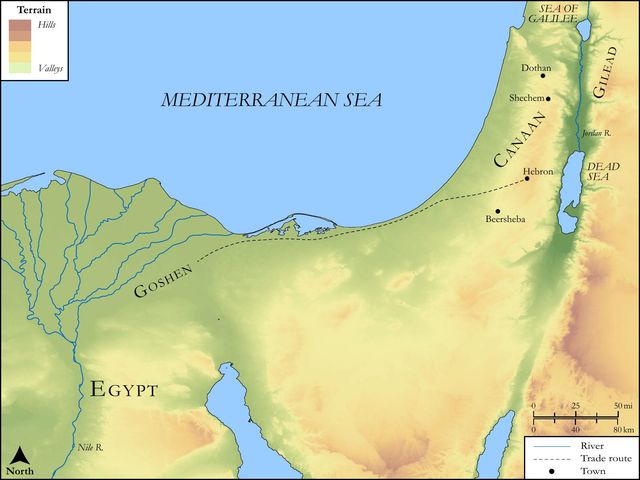
See on the biblical-era maps


Study this verse
Public-domain commentary
Matthew Henry
From his Commentary on the Whole Bible. Henry comments on passages, not single verses — this entry covers Genesis 42:1–6. His two-level outline is real structure in the source text, so it is rendered as structure.
Though Jacob's sons were all married, and had families of their own, yet, it should seem, they were still incorporated in one society, under the conduct and presidency of their father Jacob. We have here,
I.The orders he gave them to go and buy corn in Egypt, Gen 42:1, Gen 42:2. Observe,
1.The famine was grievous in the land of Canaan. It is observable that all the three patriarches, to whom Canaan was the land of promise, met with famine in that land, which was not only to try their faith, whether they could trust God though he should slay them, though he should starve them, but to teach them to seek the better country, that is, the heavenly, Heb 11:14-16. We have need of something to wean us from this world, and make us long for a better.
2.Still, when there was famine in Canaan, there was corn in Egypt. Thus Providence orders it, that one place should be a succour and supply to another; for we are all brethren. The Egyptians, the seed of accursed Ham, have plenty, when God's blessed Israel want: Thus God, in dispensing common favours, often crosses hands. Yet observe, The plenty Egypt now had was owing, under God, to Joseph's prudence and care: if his brethren had not sold him into Egypt, but respected him according to his merits, who knows but he might have done the same thing for Jacob's family which now he had done for Pharaoh, and the Egyptians might then have come to them to buy corn? but those who drive away from among them wise and good men know not what they do.
3.Jacob saw that there was corn in Egypt; he saw the corn that his neighbours had bought there and brought home. It is a spur to exertion to see where supplies are to be had, and to see others supplied. Shall others get food for their souls, and shall we starve while it is to be had?
4.He reproved his sons for delaying to provide corn for their families. Why do you look one upon another? Note, When we are in trouble and want, it is folly for us to stand looking upon one another, that is, to stand desponding and despairing, as if there were no hope, no help, - to stand disputing either which shall have the honour of going first or which shall have the safety of coming last, - to stand deliberating and debating what we shall do, and doing nothing, - to stand dreaming under a spirit of slumber, as if we had nothing to do, and to stand delaying, as if we had time at command. Let it never be said, "We left that to be done tomorrow which we could a well have done today." 5. He quickened them to go to Egypt: Get you down thither. Masters of families must not only pray for daily bread for their families, and food convenient, but must lay out themselves with care and industry to provide it.
II.Their obedience to these orders, Gen 42:3.
They went down to buy corn; they did not send their servants, but very prudently went themselves, to lay out their own money. Let none think themselves too great nor too good to take pains. Masters of families should see with their own eyes, and take heed of leaving too much to servants. Only Benjamin went not with them, for he was his father's darling. To Egypt they came, among others, and, having a considerable cargo of corn to buy, they were brought before Joseph himself, who probably expected they would come; and, according to the laws of courtesy, they bowed down themselves before him, Gen 42:6. Now their empty sheaves did obeisance to his full one. Compare this with Isa 60:14 and Rev 3:9.
Historical interpretation
Historical reception
1 surviving comment on this verse from the historical church.
Nor does everyone undertake this business matter, but only the sons of Jacob and only those sons of more mature age. Thus ten sons go, whereas the youngest son does not go. The father did not send him; else “infirmity may befall him.” Benjamin, the youngest, was still subject to infirmity. Granted, [in] the name Benjamin the patriarch is read, but Paul, who was of the tribe of Benjamin, was being prefigured. Jacob was right to hesitate over his infirmity. Indeed, he was made infirm so that he could be healed. Paul suffered blindness, but this was an infirmity unto salvation.Yes, that blindness brought Paul light. We have received the story; let us come to know the mystery. The patriarchs had gone at first without Benjamin, as the apostles first went without Paul. Each came, not as the first, but was summoned by those who were the first, and by his arrival he made the goods of those who were first more plenteous.
Continue studying Genesis 42:4 across the web’s major study libraries — every link below opens this exact verse, chapter, or book on the destination site.
Read & Compare
 BibleGatewayThis verse in more than 200 translations and 70 languages.
 Bible.comThe YouVersion reader — hundreds of translations, reading plans, and highlights.
 ESV.orgCrossway's official English Standard Version reader.
 NET BibleThe NET translation with 60,000+ translators' notes on every rendering decision.
 STEP BibleTyndale House's free study tool — original text, vocabulary, and scholarly resources.
 BibliaLogos Bible Software's free web reader.
 USCCBThe New American Bible (Revised Edition) with the U.S. bishops' study notes.
Commentaries
 BibleHub CommentariesDozens of classic commentaries on this verse, gathered on one page.
 StudyLightMore than 100 commentary sets — the largest collection on the web.
 BibleRefPlain-English commentary on what this verse means, verse by verse.
 Enduring WordDavid Guzik's free commentary on this chapter, widely used by Bible teachers.
 Bible Study ToolsVerse commentary alongside Greek and Hebrew study aids.
Original Language & Research
- BibleHub InterlinearThe verse word by word — original language, transliteration, and English.
- BibleHub LexiconEvery word's original-language definition and Strong's entry.
 Blue Letter BibleDeep-study tools — Strong's numbers, concordance, and word studies.
 SefariaThe Hebrew text with Rashi and centuries of Jewish commentary.
Sermons, Hymns & Audio


TrulyRandomVerse is not affiliated with these sites and doesn’t control their content. They’re linked because they’re genuinely useful.
Summary
Genesis 42:4 details Jacob's protective decision to withhold his youngest son, Benjamin, from accompanying his elder brothers on a grain-buying mission to Egypt amidst a severe famine. This choice, deeply influenced by the lingering trauma of Joseph's presumed death, underscores Jacob's intense fear of further loss and his profound parental anxiety. Unbeknownst to Jacob, this human apprehension and protective measure are intricately woven into God's sovereign plan, providentially setting the stage for the eventual reunion of his fragmented family and the revelation of Joseph's true identity, orchestrating events for their preservation.
Context
ShowHideLiterary Context
This verse is strategically placed within the unfolding narrative of the famine and Jacob's sons' journey to Egypt, which begins in Genesis 42:1-3. It immediately follows Jacob's command for his sons to go to Egypt and precedes their arrival and initial encounter with Joseph. The specific mention of Benjamin's exclusion serves as a crucial plot point, creating the very tension and circumstances that Joseph will later exploit to test his brothers and bring Benjamin to Egypt, thereby setting in motion the full family reunion. It highlights the emotional and relational dynamics within Jacob's family, particularly the lingering grief over Joseph and the special status of Benjamin, which will drive much of the subsequent narrative in Genesis 43.
Historical & Cultural Context
The narrative is set during a widespread famine, a common and devastating occurrence in the lands of the patriarchs, which often forced migrations and interactions between different peoples. Egypt, with its reliance on the Nile for agriculture, was often a granary for the region during such times, making it a logical destination for those seeking sustenance. The patriarchal society of the time placed immense value on family lineage and the continuation of the family name, especially through sons. Jacob's intense protectiveness of Benjamin, the youngest son of his beloved Rachel, reflects this cultural emphasis on preserving the family line and the deep emotional bonds within the patriarchal household. The dangers of travel, including bandits and unknown foreign authorities, would have been very real concerns, amplifying Jacob's fears for his sons' safety.
Key Themes
ShowHideGenesis 42:4 powerfully contributes to several overarching themes within the book of Genesis. It reinforces the theme of Divine Sovereignty and Providence, demonstrating how God works through human decisions, even those driven by fear, to accomplish His ultimate purposes. Jacob's decision, though motivated by human anxiety, is a necessary step in God's plan to bring the entire family to Egypt, where they will be preserved and grow into a great nation, as promised to Abraham in Genesis 12:2. The verse also highlights the theme of Familial Reconciliation, as Benjamin's absence creates the initial tension that Joseph uses to orchestrate his brothers' return, paving the way for the eventual revelation and healing of past wounds, a process that culminates in Genesis 45. Furthermore, it underscores the theme of Parental Love and Trauma, showcasing the deep emotional scars left by Joseph's presumed death and Jacob's desperate attempt to prevent a similar tragedy from befalling Benjamin, his last link to Rachel.
Exposition and Analysis
ShowHideKey Word Analysis
ShowHideFrom the Hebrew words meaning "son of the right hand," Benjamin is identified as the youngest son of Jacob and Rachel, Joseph's only full brother. This name carries connotations of strength, favor, and special status. In this verse, his specific naming highlights his unique and precious position in Jacob's heart, especially after the presumed loss of Joseph. His very name underscores the significance of Jacob's decision to protect him.
This verb signifies "to send away, for, or out," implying an act of dispatching or commissioning. The negative "sent not" emphasizes Jacob's deliberate refusal to allow Benjamin to embark on the journey. This is a conscious, active decision to withhold Benjamin, contrasting sharply with his willingness to send his other ten sons, thereby underscoring the depth of his protective instinct and the perceived danger of the mission.
This term denotes "hurt," "calamity," "disaster," or "fatal accident." It implies a severe and potentially life-threatening misfortune, not merely a minor inconvenience or setback. Jacob's use of this word reveals the profound depth of his anxiety and the lingering trauma from Joseph's presumed death. He fears a grave, potentially fatal, outcome for Benjamin, mirroring the tragedy he believed had befallen Joseph.
Verse Breakdown
ShowHide"But Benjamin, Joseph's brother,"
This opening phrase immediately establishes the subject of Jacob's exceptional treatment. Benjamin is not just any son; he is specifically identified as "Joseph's brother," highlighting his unique connection to the son Jacob mourned as lost. This familial tie explains the profound emotional weight Jacob places on Benjamin's safety, as he is the last remaining son of Jacob's beloved wife, Rachel.
"Jacob sent not with his brethren;"
This clause states Jacob's decisive action—or rather, inaction—regarding Benjamin. While the other ten sons are dispatched to Egypt, Jacob explicitly withholds Benjamin. This direct contrast underscores Jacob's differential treatment and intense protectiveness towards Benjamin, setting him apart from his siblings and emphasizing the extraordinary nature of Jacob's fear.
"for he said,"
This introduces Jacob's rationale for his decision, indicating that his action is not arbitrary but is a direct consequence of his spoken concern. It provides the audience with insight into Jacob's internal state and motivations, revealing his deep-seated anxieties.
"Lest peradventure mischief befall him."
This final clause articulates the specific fear driving Jacob's decision. The phrase "lest peradventure" (Hebrew pên) expresses a strong apprehension of a negative outcome. "Mischief" (Hebrew ʼâçôwn) signifies a severe calamity or fatal accident. Jacob genuinely fears that Benjamin could suffer a tragic, perhaps deadly, fate similar to what he believed happened to Joseph, making his decision a desperate attempt to prevent a recurring, unbearable loss.
Literary Devices
ShowHideThe verse effectively employs several literary devices to convey its profound meaning. Emphasis is clearly placed on Benjamin through his specific naming and the immediate identification as "Joseph's brother," distinguishing him from the other sons and highlighting his unique significance to Jacob. This emphasis foreshadows Benjamin's crucial role in the unfolding narrative. Pathos is powerfully evoked through Jacob's stated fear of "mischief befall[ing] him." This reveals the deep emotional trauma Jacob still carries from Joseph's presumed death, eliciting sympathy for the aging patriarch's anxiety and protective instinct. Furthermore, there is a strong element of Dramatic Irony at play. Jacob's fear-driven decision to keep Benjamin safe, though understandable from his perspective, is ironically the very action that God uses to orchestrate the family's journey to Egypt, the reunion with Joseph, and their ultimate preservation. Jacob's human anxiety inadvertently aligns with divine providence, setting the stage for the fulfillment of God's larger plan.
Theological and Thematic Connections
ShowHideGenesis 42:4 serves as a poignant illustration of the interplay between human fear and divine sovereignty. Jacob's decision, born out of deep trauma and a profound desire to protect his beloved son, appears to be a purely human response to a dire situation. Yet, within the broader narrative of Genesis, it becomes clear that this very human anxiety is providentially woven into God's grand design. God uses Jacob's fear to ensure that Benjamin's eventual journey to Egypt is delayed and occurs under specific circumstances, creating the necessary conditions for Joseph to reveal himself and for the entire family to be brought into Egypt, thus preserving the covenant line during the famine. This highlights God's ability to work through and even utilize human limitations and fears to accomplish His perfect will, demonstrating that His plans are not thwarted by human weakness but often incorporate them.
Reflection and Application
ShowHideThis verse offers a profound reflection on the nature of parental love, the enduring impact of trauma, and the mysterious ways of divine providence. Jacob's intense protectiveness of Benjamin, while deeply relatable, also reveals how past hurts can lead to overprotection and a struggle to fully trust in God's unseen hand. For us, it prompts an examination of our own anxieties and fears, especially those rooted in past experiences. Are we, like Jacob, allowing past "mischief" to dictate our present decisions, perhaps hindering God's unfolding plan in our lives? This passage reminds us that even when our human efforts are driven by fear or a desire for control, God remains sovereign, capable of weaving our anxieties and protective instincts into His larger tapestry of redemption. It calls us to a deeper trust in God's providence, even when circumstances seem perilous or our understanding is limited. Our responsibility is to act faithfully and wisely, while simultaneously releasing control to the God who works all things for good for those who love Him.
Questions for Reflection
ShowHideFAQ
ShowHideWhy was Jacob so protective of Benjamin?
ShowHideJacob's intense protectiveness of Benjamin stemmed primarily from the traumatic presumed death of Joseph, Benjamin's full brother and also a son of Jacob's beloved wife, Rachel. Benjamin was the only remaining son of Rachel, making him uniquely precious to Jacob and representing his last tangible link to his deeply cherished wife. The patriarch feared that if Benjamin were to accompany his brothers, he too might suffer a similar "mischief" or fatal accident, which would be an unbearable loss for the aging father, compounding his already profound grief. His decision was a desperate attempt to prevent a repeat of the sorrow he experienced when he believed Joseph was lost forever, as seen in Genesis 37:35.
What does "lest peradventure mischief befall him" truly mean?
ShowHideThe King James Version phrase "lest peradventure mischief befall him" translates the Hebrew word אָסוֹן (ason), which signifies a severe calamity, disaster, or fatal accident. It implies a grave, life-threatening misfortune rather than a minor inconvenience or setback. Jacob's concern was for Benjamin's very life and well-being, reflecting the depth of his anxiety and the lingering trauma from Joseph's disappearance. The phrase conveys Jacob's profound apprehension that Benjamin would meet a tragic end, similar to what he believed had happened to Joseph in Genesis 37:33.
Christ-Centered Fulfillment
ShowHideWhile Genesis 42:4 directly portrays human fear and a father's protective instinct, it subtly points to the broader narrative of divine providence that culminates in Christ. Jacob's reluctance to "send" his beloved son Benjamin into potential danger stands in stark contrast to God the Father's willingness to "send" His beloved Son, Jesus, into a world fraught with sin and suffering. Jacob's fear was rooted in the potential for "mischief" (calamity or death) to befall Benjamin, a fear that humanly speaking was justified. Yet, God the Father, in His infinite love and wisdom, willingly sent His only Son, knowing full well that "mischief"—the ultimate suffering and death on the cross—would indeed befall Him. Just as Benjamin's eventual journey to Egypt was essential for the salvation and reunion of Jacob's family, so too was Christ's mission, culminating in His sacrificial death and resurrection, essential for the salvation and spiritual reunion of humanity with God. The Father's ultimate act of love in sending His Son, even to face the "mischief" of the cross, demonstrates a divine purpose far surpassing human fear, ensuring the ultimate redemption and preservation of His chosen people, fulfilling the promise of a "seed" who would crush the serpent's head (Genesis 3:15). This divine sending is the ultimate act of love, for "God so loved the world, that he gave his only Son, that whoever believes in him should not perish but have eternal life."