


Genesis 42:3
Bible text: King James Version (1769 Blayney text) · Public domain
Bible text: Berean Standard Bible · Public domain
Bible text: American Standard Version (1901) · Public domain
Bible text: World English Bible, Messianic edition · Public domain
Bible text: Geneva Bible (1599) · Public domain
Bible text: Young's Literal Translation · Public domain
- וַיֵּרְדוּvai·ye·re·Duand they went downH3381Conj-w ¦ V-Qal-ConsecImperf-3mpVerb Qal Consecutive Imperfect 3rd Plural Masculineוַandיֵּרְדוּthey went down
- אֲחֵי'a·chei[the] brothers ofH251N-mpcNoun Plural Masculine Construct
- יוֹסֵףyo·SefJosephH3130N-proper-mNoun Proper Masculine
- עֲשָׂרָה'a·sa·RahtenH6235N-fsNoun Singular Feminine Absolute
- לִשְׁבֹּרlish·Borto buy grainH7666Prep-l ¦ V-Qal-InfVerb Qal Infinitive Constructלִtoשְׁבֹּרbuy grain
- בָּרbargrainH1250N-msNoun Singular Masculine Absolute
- מִמִּצְרָיִםmi·mitz·Ra·yimfrom EgyptH4714Prep-m ¦ N-properNoun Proper LocationמִfromמִּצְרָיִםEgypt
English is a literal word-by-word gloss of the Hebrew, not the KJV's wording. Why?
This is the original text the KJV's translators worked from — each Hebrew word with its own literal English meaning in this verse, prepared by scholars at Tyndale House, Cambridge. The KJV translates whole sentences, not word by word, so its wording differs: one Hebrew word can become several English words, and the KJV may choose “the LORD” where the gloss reads “Yahweh”. Both are faithful — they answer different questions. For the KJV's own rendering, switch to the KJV text.
Details
See on the biblical-era maps


Study this verse
Public-domain commentary
Matthew Henry
From his Commentary on the Whole Bible. Henry comments on passages, not single verses — this entry covers Genesis 42:1–6. His two-level outline is real structure in the source text, so it is rendered as structure.
Though Jacob's sons were all married, and had families of their own, yet, it should seem, they were still incorporated in one society, under the conduct and presidency of their father Jacob. We have here,
I.The orders he gave them to go and buy corn in Egypt, Gen 42:1, Gen 42:2. Observe,
1.The famine was grievous in the land of Canaan. It is observable that all the three patriarches, to whom Canaan was the land of promise, met with famine in that land, which was not only to try their faith, whether they could trust God though he should slay them, though he should starve them, but to teach them to seek the better country, that is, the heavenly, Heb 11:14-16. We have need of something to wean us from this world, and make us long for a better.
2.Still, when there was famine in Canaan, there was corn in Egypt. Thus Providence orders it, that one place should be a succour and supply to another; for we are all brethren. The Egyptians, the seed of accursed Ham, have plenty, when God's blessed Israel want: Thus God, in dispensing common favours, often crosses hands. Yet observe, The plenty Egypt now had was owing, under God, to Joseph's prudence and care: if his brethren had not sold him into Egypt, but respected him according to his merits, who knows but he might have done the same thing for Jacob's family which now he had done for Pharaoh, and the Egyptians might then have come to them to buy corn? but those who drive away from among them wise and good men know not what they do.
3.Jacob saw that there was corn in Egypt; he saw the corn that his neighbours had bought there and brought home. It is a spur to exertion to see where supplies are to be had, and to see others supplied. Shall others get food for their souls, and shall we starve while it is to be had?
4.He reproved his sons for delaying to provide corn for their families. Why do you look one upon another? Note, When we are in trouble and want, it is folly for us to stand looking upon one another, that is, to stand desponding and despairing, as if there were no hope, no help, - to stand disputing either which shall have the honour of going first or which shall have the safety of coming last, - to stand deliberating and debating what we shall do, and doing nothing, - to stand dreaming under a spirit of slumber, as if we had nothing to do, and to stand delaying, as if we had time at command. Let it never be said, "We left that to be done tomorrow which we could a well have done today." 5. He quickened them to go to Egypt: Get you down thither. Masters of families must not only pray for daily bread for their families, and food convenient, but must lay out themselves with care and industry to provide it.
II.Their obedience to these orders, Gen 42:3.
They went down to buy corn; they did not send their servants, but very prudently went themselves, to lay out their own money. Let none think themselves too great nor too good to take pains. Masters of families should see with their own eyes, and take heed of leaving too much to servants. Only Benjamin went not with them, for he was his father's darling. To Egypt they came, among others, and, having a considerable cargo of corn to buy, they were brought before Joseph himself, who probably expected they would come; and, according to the laws of courtesy, they bowed down themselves before him, Gen 42:6. Now their empty sheaves did obeisance to his full one. Compare this with Isa 60:14 and Rev 3:9.
Continue studying Genesis 42:3 across the web’s major study libraries — every link below opens this exact verse, chapter, or book on the destination site.
Read & Compare
 BibleGatewayThis verse in more than 200 translations and 70 languages.
 Bible.comThe YouVersion reader — hundreds of translations, reading plans, and highlights.
 ESV.orgCrossway's official English Standard Version reader.
 NET BibleThe NET translation with 60,000+ translators' notes on every rendering decision.
 STEP BibleTyndale House's free study tool — original text, vocabulary, and scholarly resources.
 BibliaLogos Bible Software's free web reader.
 USCCBThe New American Bible (Revised Edition) with the U.S. bishops' study notes.
Commentaries
 BibleHub CommentariesDozens of classic commentaries on this verse, gathered on one page.
 StudyLightMore than 100 commentary sets — the largest collection on the web.
 BibleRefPlain-English commentary on what this verse means, verse by verse.
 Enduring WordDavid Guzik's free commentary on this chapter, widely used by Bible teachers.
 Bible Study ToolsVerse commentary alongside Greek and Hebrew study aids.
Original Language & Research
- BibleHub InterlinearThe verse word by word — original language, transliteration, and English.
- BibleHub LexiconEvery word's original-language definition and Strong's entry.
 Blue Letter BibleDeep-study tools — Strong's numbers, concordance, and word studies.
 SefariaThe Hebrew text with Rashi and centuries of Jewish commentary.
Sermons, Hymns & Audio


TrulyRandomVerse is not affiliated with these sites and doesn’t control their content. They’re linked because they’re genuinely useful.
Summary
Genesis 42:3 marks a critical juncture in the patriarchal narrative, detailing the journey of Joseph's ten elder brothers to Egypt to procure grain amidst a severe famine gripping Canaan. This seemingly ordinary act of necessity, driven by widespread scarcity, unknowingly propels them towards a dramatic and divinely orchestrated reunion with their long-lost brother Joseph, setting in motion God's intricate plan for the preservation and future formation of the nascent nation of Israel.
Context
ShowHideLiterary Context
This verse immediately follows Jacob's directive to his sons to journey to Egypt to acquire food, as the famine had become unbearable in Canaan, as detailed in Genesis 42:1-2. The narrative thread leading to this moment is intricately woven with the preceding chapters, particularly the story of Joseph's betrayal by these very brothers, who sold him into slavery in Genesis 37:28. His subsequent rise to power as Pharaoh's second-in-command, a position achieved through divine favor and the interpretation of prophetic dreams, enabled Egypt to prepare for the seven years of famine that now afflicted the entire region. The exclusion of Benjamin, Jacob's youngest and Joseph's full brother, from this perilous journey underscores Jacob's lingering grief and protective instincts, adding a layer of poignant tension to the brothers' mission.
Historical & Cultural Context
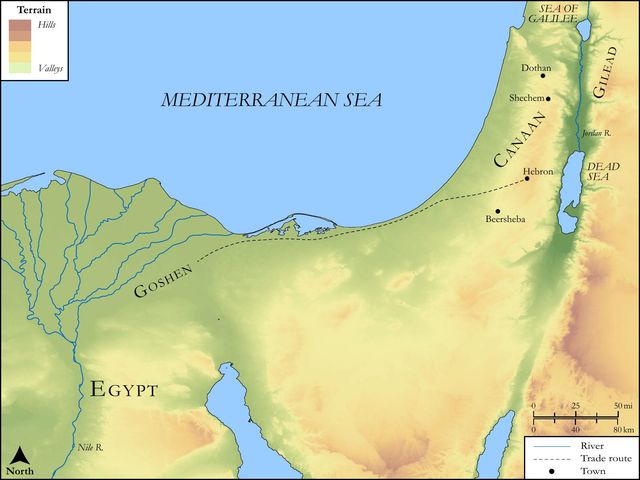
The lands of Canaan and Egypt were highly susceptible to famine, as agricultural productivity was directly dependent on rainfall and the consistent flooding of rivers like the Nile. Egypt, with its predictable Nile inundation, was often a granary for the surrounding regions during times of drought. The journey from Canaan to Egypt was a significant undertaking, involving travel across arid lands, highlighting the dire circumstances that compelled Jacob's sons to venture into a foreign land. The practice of storing grain in anticipation of lean years, as Joseph wisely implemented, was a crucial survival strategy in this agricultural society. Furthermore, the concept of a powerful central authority, like Pharaoh in Egypt, controlling vital resources such as grain, was typical of the hierarchical societies of the time, making Egypt the logical destination for those seeking sustenance.
Key Themes
ShowHideGenesis 42:3 contributes significantly to several overarching themes in the book of Genesis. Foremost is the theme of Divine Providence, demonstrating God's sovereign hand at work, using even human sin and natural disaster (the famine) to orchestrate His redemptive purposes and preserve His covenant people. This aligns with Joseph's later profound theological insight that what his brothers "meant for evil, God meant for good" (Genesis 50:20). The verse also introduces the theme of Dramatic Irony, as the brothers embark on their journey completely unaware that the powerful Egyptian official they must appeal to for survival is their long-lost brother. This sets the stage for a narrative arc of Consequences and Reconciliation, where the brothers will be confronted with their past actions and undergo a transformative process leading to repentance and familial restoration, crucial for the continuity of the covenant lineage established with Abraham.
Exposition and Analysis
ShowHideGenesis 42:3, "And Joseph's ten brethren went down to buy corn in Egypt," is a compact yet profoundly significant statement that propels the narrative forward toward its climax, initiating the process of familial reconciliation and the preservation of God's covenant people.
Key Word Analysis
ShowHideThis proper name, meaning "let him add," is crucial. The verse specifically identifies the brothers as "Joseph's ten brethren," immediately linking the current desperate journey to the past act of betrayal. It underscores the profound dramatic irony: they are going to the very brother they wronged, who now holds their lives in his hands, without recognizing him. This highlights the personal and familial stakes of their mission.
Translated as "brethren," this primitive word denotes a brother in the widest sense of literal relationship. Its use here emphasizes the familial bond, however strained, between Joseph and those who betrayed him. It reminds the reader that these are not strangers but family members, whose actions against one of their own have led to this moment of reckoning and potential restoration.
Rendered as "went down," this verb signifies a literal descent, as Egypt is geographically lower than Canaan. However, it also carries symbolic weight, representing a descent into a challenging, unknown, and potentially dangerous situation where the brothers will face the consequences of their past. It suggests a humbling journey, both geographically and spiritually, as they are forced to seek aid from a foreign power.
Translated as "corn" in the KJV, this word refers to grain of any kind, such as wheat or barley. It is derived from a root meaning "to winnow," indicating processed grain. This detail highlights the immediate, practical purpose of their journey: to acquire essential foodstuffs to survive the devastating famine. It underscores the dire necessity driving their actions and the fundamental need for sustenance in a time of widespread scarcity.
Verse Breakdown
ShowHide"And Joseph's ten brethren"
This opening phrase immediately establishes the central characters and the underlying tension. The specific mention of "Joseph's" brothers, rather than simply "Jacob's sons," serves as a poignant reminder of their past sin against him, setting the stage for the dramatic irony and the eventual confrontation. The number "ten" highlights the absence of Benjamin, underscoring Jacob's protective instincts and adding another layer of complexity to the unfolding narrative.
"went down"
This phrase denotes both a literal geographical descent from the higher elevations of Canaan to the lower Nile Valley of Egypt, and a symbolic descent into a situation of vulnerability and dependence. It signifies a journey into the unknown, where the brothers will be stripped of their usual familial authority and forced to humble themselves before a foreign power.
"to buy corn"
This clause reveals the immediate, practical motivation for their journey: the desperate need for food due to the severe famine. "Corn" here refers to grain in general (e.g., wheat, barley), the staple food of Canaan and Egypt. This highlights the widespread crisis and the brothers' dire circumstances, emphasizing their reliance on external provision.
"in Egypt"
This specifies the destination, a land renowned for its agricultural abundance, especially during times of regional drought. Egypt represents a place of both potential salvation and potential danger for the Israelites, foreshadowing their future sojourn and exodus. It is the locus of Joseph's power and the stage for the unfolding divine drama.
Literary Devices
ShowHideThe verse is rich in Dramatic Irony, as the reader is aware of Joseph's identity and position in Egypt, while his brothers remain oblivious. This creates suspense and anticipation for their inevitable, unrecognized encounter. The phrase "went down" employs Symbolism, representing not only a literal geographical descent but also a metaphorical descent into a humbling and challenging situation, where the brothers will confront the consequences of their past actions. Furthermore, the entire scene acts as Foreshadowing, hinting at the future reconciliation of the family and the preservation of the covenant lineage, which will ultimately lead to the formation of the nation of Israel and their later, prolonged sojourn in Egypt.
Theological and Thematic Connections
ShowHideGenesis 42:3 is a powerful testament to God's meticulous sovereignty and redemptive purpose, even amidst human sin and widespread suffering. The famine, a natural disaster, becomes a divinely appointed catalyst, compelling Joseph's brothers to journey to Egypt, thereby initiating the process of reconciliation and the preservation of the covenant family. This seemingly mundane act of buying grain is, in fact, a crucial step in God's overarching plan to sustain the lineage through which the Messiah would eventually come, demonstrating His faithfulness to His promises despite human failings. The narrative underscores that God works through both ordinary circumstances and extraordinary events to bring about His perfect will.
Reflection and Application
ShowHideGenesis 42:3 offers profound insights into God's providential care and the transformative power of His redemptive plan. It reminds us that even when our circumstances seem dire, or when we are compelled by necessity into uncomfortable or challenging situations, God is often at work behind the scenes, orchestrating events for a greater, often unseen, purpose. This narrative encourages us to cultivate a deep trust in His sovereignty, even when the path ahead is unclear or when we are facing the consequences of past actions—whether our own or those of others. It highlights the importance of humility in acknowledging our dependence on God and others, and the potential for profound reconciliation and restoration that God can bring about in broken relationships and families. Ultimately, it calls us to look beyond immediate difficulties and recognize the larger tapestry of God's faithfulness unfolding in our lives.
Questions for Reflection
ShowHideFAQ
ShowHideWhy did Jacob send only ten of his sons to Egypt?
ShowHideJacob's decision to send only ten of his sons, keeping Benjamin at home, was primarily driven by profound grief and a protective instinct. Having already lost Joseph, whom he believed to be dead, Jacob feared that harm might also befall Benjamin, his youngest son and Joseph's full brother, both born to his beloved wife Rachel. This choice reflects Jacob's deep sorrow and his desire to preserve at least one of his youngest, most cherished sons, highlighting the emotional weight of Joseph's presumed loss on the patriarch.
What does "corn" mean in this verse?
ShowHideIn the King James Version, the term "corn" in Genesis 42:3 refers to grain in general, such as wheat or barley, which were staple crops throughout Canaan and Egypt. It does not denote maize, or what is commonly known as "corn" in modern American English, as maize was indigenous to the Americas and unknown in that region at this historical period. The original Hebrew word, bâr (H1250), accurately conveys the meaning of "grain" or "provision," indicating the brothers' purpose was to acquire essential foodstuffs for survival during the severe famine.
Christ-Centered Fulfillment
ShowHideThe journey of Joseph's brothers to Egypt, initiated in Genesis 42:3, serves as a profound Old Testament foreshadowing of Christ's redemptive work. Joseph himself stands as a remarkable type of Christ: like Joseph, Jesus was rejected and betrayed by His own people (John 1:11), yet through His suffering and subsequent exaltation to the right hand of God (Philippians 2:9-11), He became the ultimate means of salvation and reconciliation for humanity. Just as Joseph, though unrecognized by his brothers, held the power to save his family from physical famine, so Jesus, the true Bread of Life, offers spiritual sustenance and eternal salvation to all who come to Him in faith, even those who once rejected Him. This narrative of a scattered and estranged family being brought back together and sustained through the provision of one who was once despised powerfully illustrates the spiritual reconciliation and abundant life offered to humanity through the atoning work of Jesus Christ, who brings forgiveness and restoration to all who believe (Colossians 1:19-20).