


Genesis 41:26
Bible text: King James Version (1769 Blayney text) · Public domain
Bible text: Berean Standard Bible · Public domain
Bible text: American Standard Version (1901) · Public domain
Bible text: World English Bible, Messianic edition · Public domain
Bible text: Geneva Bible (1599) · Public domain
Bible text: Young's Literal Translation · Public domain
- שֶׁבַעShe·va'sevenH7651Adj-csAdjective Numerical Singular common gender Absolute
- פָּרֹתpa·RotcowsH6510N-fpNoun Plural Feminine Absolute
- הַטֹּבֹתha·to·Vot<the> goodH2896Art ¦ Adj-fpAdjective Plural Feminine Absoluteהַ<the>טֹּבֹתgood
- שֶׁבַעShe·va'[are] sevenH7651Adj-csAdjective Numerical Singular common gender Absolute
- שָׁנִיםsha·NimyearsH8141N-mpNoun Plural Masculine Absolute
- הֵנָּהHe·nahtheyH2007Pro-3fpPronoun Personal 3rd Plural Feminine
- וְשֶׁבַעve·She·va'and sevenH7651Conj-w ¦ Adj-csAdjective Numerical Singular common gender Absoluteוְandשֶׁבַעseven
- הַשִּׁבֳּלִיםha·shi·bo·Limthe ears of grainH7641Art ¦ N-mpNoun Plural Masculine Absoluteהַtheשִּׁבֳּלִיםears of grain
- הַטֹּבֹתha·to·Vot<the> goodH2896Art ¦ Adj-fpAdjective Plural Feminine Absoluteהַ<the>טֹּבֹתgood
- שֶׁבַעShe·va'[are] sevenH7651Adj-csAdjective Numerical Singular common gender Absolute
- שָׁנִיםsha·NimyearsH8141N-mpNoun Plural Masculine Absolute
- הֵנָּהHe·nahtheyH2007Pro-3fpPronoun Personal 3rd Plural Feminine
- חֲלוֹםcha·Lom[is] dreamH2472N-msNoun Singular Masculine Absolute
- אֶחָד'e·ChadoneH259Adj-fsAdjective Numerical Singular Feminine Absolute
- הוּאHu'itH1931Pro-3msPronoun Personal 3rd Singular Masculine
English is a literal word-by-word gloss of the Hebrew, not the KJV's wording. Why?
This is the original text the KJV's translators worked from — each Hebrew word with its own literal English meaning in this verse, prepared by scholars at Tyndale House, Cambridge. The KJV translates whole sentences, not word by word, so its wording differs: one Hebrew word can become several English words, and the KJV may choose “the LORD” where the gloss reads “Yahweh”. Both are faithful — they answer different questions. For the KJV's own rendering, switch to the KJV text.
Details
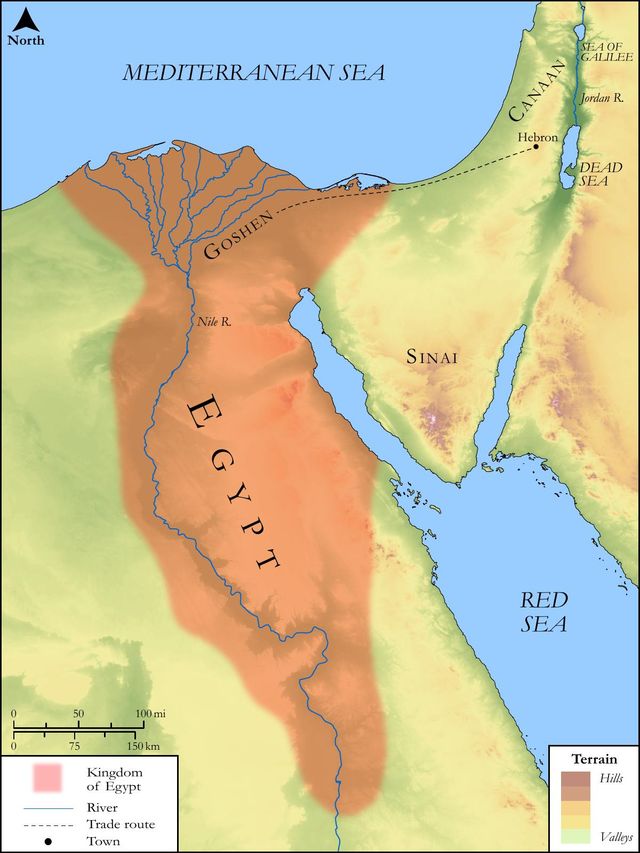
See on the biblical-era maps


Study this verse
Public-domain commentary
Matthew Henry
From his Commentary on the Whole Bible. Henry comments on passages, not single verses — this entry covers Genesis 41:17–32. His two-level outline is real structure in the source text, so it is rendered as structure.
Here, I. Pharaoh relates his dream. He dreamt that he stood upon the bank of the river Nile, and saw the kine, both the fat ones and the lean ones, come out of the river. For the kingdom of Egypt had no rain, as appears, Zac 14:18, but the plenty of the year depended upon the overflowing of the river, and it was about one certain time of the year that it overflowed. If it rose to fifteen or sixteen cubits, there was plenty; if to twelve or thirteen only, or under, there was scarcity. See how many ways Providence has of dispensing its gifts; yet, whatever the second causes are, our dependence is still the same upon the first Cause, who makes every creature that to us that it is, be it rain or river.
II.Joseph interprets his dream, and tells him that it signified seven years of plenty now immediately to ensue, which should be succeeded by as many years of famine. Observe,
1.The two dreams signified the same thing, but the repetition was to denote the certainty, the nearness, and the importance, of the event, Gen 41:32. Thus God has often shown the immutability of his counsel by two immutable things, Heb 6:17, Heb 6:18. The covenant is sealed with two sacraments; and in the one of them there are both bread and wine, wherein the dream is one, and yet it is doubled, for the thing is certain.
2.Yet the two dreams had a distinct reference to the two things wherein we most experience plenty and scarcity, namely, grass and corn. The plenty and scarcity of grass for the cattle were signified by the fat kine and the lean ones; the plenty and scarcity of herb for the service of man by the full ears and the thin ones.
3.See what changes the comforts of this life are subject to. After great plenty may come great scarcity; how strong soever we may think our mountain stands, if God speak the word, it will soon be moved. We cannot be sure that tomorrow shall be as this day, next year as this, and much more abundant, Isa 56:12. We must learn how to want, as well as how to abound.
4.See the goodness of God in sending the seven years of plenty before those of famine, that provision might be made accordingly. Thus he sets the one over-against the other, Ecc 7:14. With what wonderful wisdom has Providence, that great housekeeper, ordered the affairs of this numerous family from the beginning hitherto! Great variety of seasons there have been, and the product of the earth is sometimes more and sometimes less; yet, take one time with another, what was miraculous concerning the manna is ordinarily verified in the common course of Providence, He that gathers much has nothing over, and he that gathers little has no lack, Exo 16:18.
5.See the perishing nature of our worldly enjoyments. The great increase of the years of plenty was quite lost and swallowed up in the years of famine; and the overplus of it, which seemed very much, yet did but just serve to keep men alive, Gen 41:29-31. Meat for the belly, and the belly for meats, but God shall destroy both it and them, Co1 6:13. There is bread which endures to everlasting life, which shall not be forgotten, and which it is worth while to labour for, Joh 6:27. Those that make the things of this world their good things will find but little pleasure in remembering that they have received them, Luk 16:25.
6.Observe, God revealed this beforehand to Pharaoh, who, as king of Egypt, was to be the father of his country, and to make prudent provision for them. Magistrates are called shepherds, whose care it must be, not only to rule, but to feed.
Historical interpretation
Historical reception
1 surviving comment on this verse from the historical church.
However, I do not think that this dream is demonstrated to one or two, but to all; because the seven fat years of this world, rich with secular abundance, are absorbed by those ages which are yet to come, in which there will be perpetual rest and observance of the spiritual law, which Ephraem holds dear to God and fruitful for the three patriarchs. A good cow, not one with a distended body but abundant in spiritual milk and grace, on whose beauty God says He will sit, as it is written: Ephraem, the learned cow, loves victory. But I passed over the beauty of her neck. Therefore, our head should not be fattened by the oil of sinners, nor should false fruits delight us, lest it be said of us: You have sown wickedness and harvested iniquity. I am not moved by her thin and rotten ears of grain, for even David was better when he wasted away like a spider's web; and a contrite spirit is a sacrifice to God; and those who have been oppressed by the spirit of evil in this world will be saved by a more excellent one.
Continue studying Genesis 41:26 across the web’s major study libraries — every link below opens this exact verse, chapter, or book on the destination site.
Read & Compare
 BibleGatewayThis verse in more than 200 translations and 70 languages.
 Bible.comThe YouVersion reader — hundreds of translations, reading plans, and highlights.
 ESV.orgCrossway's official English Standard Version reader.
 NET BibleThe NET translation with 60,000+ translators' notes on every rendering decision.
 STEP BibleTyndale House's free study tool — original text, vocabulary, and scholarly resources.
 BibliaLogos Bible Software's free web reader.
 USCCBThe New American Bible (Revised Edition) with the U.S. bishops' study notes.
Commentaries
 BibleHub CommentariesDozens of classic commentaries on this verse, gathered on one page.
 StudyLightMore than 100 commentary sets — the largest collection on the web.
 BibleRefPlain-English commentary on what this verse means, verse by verse.
 Enduring WordDavid Guzik's free commentary on this chapter, widely used by Bible teachers.
 Bible Study ToolsVerse commentary alongside Greek and Hebrew study aids.
Original Language & Research
- BibleHub InterlinearThe verse word by word — original language, transliteration, and English.
- BibleHub LexiconEvery word's original-language definition and Strong's entry.
 Blue Letter BibleDeep-study tools — Strong's numbers, concordance, and word studies.
 SefariaThe Hebrew text with Rashi and centuries of Jewish commentary.
Sermons, Hymns & Audio


TrulyRandomVerse is not affiliated with these sites and doesn’t control their content. They’re linked because they’re genuinely useful.
Summary
Genesis 41:26 presents Joseph's divinely inspired interpretation of Pharaoh's two disturbing dreams, succinctly declaring that the seven prosperous cows and seven full ears of grain both symbolize seven years of abundant harvest, and crucially, that these distinct visions convey a singular, unified prophetic message. This pivotal declaration not only unveils the impending period of plenty but also foreshadows the subsequent years of severe famine, setting the stage for God's providential preservation of Egypt and Joseph's remarkable elevation.
Context
ShowHideLiterary Context
This verse is the interpretive climax of a dramatic narrative arc within the book of Genesis. Following Pharaoh's unsettling dreams of seven fat cows devoured by seven lean ones, and seven full ears of grain consumed by seven thin, scorched ones, his own wise men and magicians are utterly stumped. The chief butler, remembering Joseph's accurate interpretation of his own dream years prior, finally recommends Joseph to Pharaoh (Genesis 40:23 leading to Genesis 41:9-13). Joseph, brought directly from prison, immediately deflects any personal credit, humbly asserting that "it is not in me: God shall give Pharaoh an answer of peace" (Genesis 41:16). This establishes the divine source of the interpretation, making Genesis 41:26 the authoritative, God-given explanation that unlocks the mystery and sets the stage for Pharaoh's subsequent actions and Joseph's elevation to second-in-command over all Egypt (Genesis 41:40-41).
Historical & Cultural Context
Dreams held immense significance in Egypt and among the nations round about, often believed by them to be messages from their gods, conveying omens, warnings, or divine will. Rulers like Pharaoh frequently consulted interpreters, priests, or magicians to discern the meaning of such visions, as the stability and prosperity of the kingdom were thought to depend on heeding divine communications. Egypt, heavily reliant on the Nile River's annual inundation for its agricultural fertility, would have found dreams concerning cows (representing livestock and prosperity) and grain (representing staple food and harvest) particularly potent and anxiety-inducing. The concept of a seven-year cycle, while not unique, would have resonated within a society deeply attuned to agricultural rhythms. Joseph's ability to interpret, especially after the failure of Pharaoh's own court, would have been seen as a profound demonstration of divine favor, elevating him to a position of immense authority and trust, a common trajectory for divinely gifted individuals in ancient narratives.
Key Themes
ShowHideGenesis 41:26 powerfully contributes to several overarching themes in Genesis and the broader biblical narrative. Firstly, it highlights Divine Sovereignty and Providence, demonstrating God's absolute control over natural phenomena (famine and abundance) and the destinies of nations, even those outside the covenant people. God's plan for Israel's preservation, through Joseph, is subtly advanced here, as the famine will eventually bring Jacob's family to Egypt. Secondly, the verse underscores the theme of God-Given Wisdom and Revelation, showcasing how God imparts extraordinary insight to His chosen servants, enabling them to interpret divine mysteries and provide guidance for rulers, as seen throughout the wisdom literature. Joseph's humility in attributing his ability to God reinforces the idea that true wisdom comes from above. Lastly, it emphasizes Preparation and Stewardship, as the interpretation is not merely for understanding but for immediate, practical action, demonstrating God's desire for humanity to wisely manage resources and prepare for future challenges, a principle echoed in Proverbs 6:6-8.
Exposition and Analysis
ShowHideKey Word Analysis
ShowHideThis word, derived from a root meaning "to bind" or "to be strong," signifies a vision or revelation received during sleep. In this context, it refers to a divinely sent message intended to convey future events. Joseph's declaration that "the dream is one" emphasizes its singular, unified origin and purpose, despite its dual imagery, underscoring its divine certainty and authority.
This adjective describes the kine and ears of grain as being "good" in the sense of being healthy, well-favored, and productive. It signifies prosperity, abundance, and positive conditions. The contrast with the "ill-favored" and "thin" kine and "blasted" ears highlights the stark difference between the coming years of plenty and the subsequent years of severe scarcity, making the "good" a clear indicator of the prosperous period.
This numeral emphasizes the singular nature of the dream's message. Despite Pharaoh having two distinct dreams with different imagery (cows and grain), Joseph definitively states that their underlying prophetic meaning is unified. This unity underscores the certainty and divine establishment of the prophecy, leaving no room for doubt or misinterpretation regarding the impending seven years of abundance followed by seven years of famine.
Verse Breakdown
ShowHide"The seven good kine [are] seven years"
Joseph begins his interpretation by directly linking the first set of imagery from Pharaoh's dream—the seven healthy, well-fed cows—to a specific period of time. The "seven good kine" symbolize "seven years" of prosperity and abundant harvest. This establishes a clear, direct correlation between the visual representation and its temporal meaning, immediately demystifying the first part of Pharaoh's perplexing vision.
"and the seven good ears [are] seven years"
Joseph then applies the same interpretive principle to the second dream's imagery. The "seven good ears" of grain, full and ripe, are also declared to represent "seven years" of abundance. This parallel interpretation confirms the consistency of the divine message and reinforces the certainty of the coming period of plenty. The repetition of "seven years" underscores the duration and significance of this prosperous era.
"the dream [is] one"
This concluding phrase is the interpretive key to the entire verse and, indeed, to Pharaoh's two dreams. Joseph unequivocally states that despite the distinct visual elements of cows and grain, both dreams convey a single, unified prophetic message. This declaration eliminates any possibility of separate interpretations or multiple future events, firmly establishing that both visions point to the same impending period of seven years of abundance, which will then be followed by seven years of famine (as Joseph explains in the subsequent verses). This unity underscores the divine origin and the absolute certainty of the revelation.
Literary Devices
ShowHideGenesis 41:26 is rich in literary devices that enhance its impact and clarity. Symbolism is paramount, with the "seven good kine" and "seven good ears" serving as direct representations of "seven years" of abundance. This symbolic representation is common in biblical prophecy, where concrete images convey abstract or future realities. Repetition is also evident, not only in the repeated phrase "seven years" but also in the doubling of the dream itself (cows and grain), which Joseph later explains signifies the certainty and immediacy of God's decree (Genesis 41:32). This repetition serves to emphasize the message's importance and divine origin. Furthermore, the verse employs a form of Conciseness or Aphorism, distilling a complex prophetic message into a remarkably clear and direct statement. This directness reflects the divine authority behind Joseph's words and ensures that Pharaoh fully grasps the essential truth without ambiguity.
Theological and Thematic Connections
ShowHideGenesis 41:26 profoundly illustrates God's active involvement in human history, demonstrating His omniscience and providential care over creation and nations. Through Joseph, God reveals His foreknowledge of future events—both prosperity and hardship—not merely to display His power but to enable humanity to respond wisely and prepare. This divine communication, even to a pagan ruler, underscores God's universal sovereignty, reminding us that His purposes extend beyond His covenant people to orchestrate global events for His ultimate redemptive plan. The verse highlights that true wisdom and understanding of complex situations are divine gifts, not merely human intellect, and that God often uses unexpected individuals to reveal His will and accomplish His purposes.
Reflection and Application
ShowHideGenesis 41:26 offers profound insights for contemporary believers, urging us to recognize God's sovereign hand in all circumstances, whether seasons of abundance or scarcity. Just as Joseph relied solely on God for wisdom to interpret Pharaoh's dreams, we are called to seek divine guidance and discernment in our own lives, particularly when navigating uncertainty or making significant decisions. This passage encourages us to cultivate a spirit of foresight and wise stewardship, understanding that periods of prosperity are opportunities to prepare for potential future challenges, both financially and spiritually. It reminds us that God's revelations, whether through His written Word or through the guidance of His Spirit, are given not just for knowledge but for action, prompting us to live proactively and responsibly. Ultimately, the verse reassures us that even in the face of impending hardship, God is intimately involved, orchestrating events for His good purposes and the preservation of His people, fostering a deep trust in His unfailing providence and care.
Questions for Reflection
ShowHideFAQ
ShowHideWhy did Pharaoh have two dreams that meant the same thing?
ShowHideThe doubling of Pharaoh's dream, with distinct yet unified imagery of cows and grain, served a crucial purpose: to emphasize the absolute certainty and imminent fulfillment of the prophecy. Joseph himself explains this later in Genesis 41:32, stating, "And for that the dream was doubled unto Pharaoh twice; it is because the thing is established by God, and God will shortly bring it to pass." This repetition was a divine seal of authenticity and urgency, leaving no room for doubt in Pharaoh's mind about the truth of the impending seven years of abundance followed by seven years of severe famine. It underscored the divine origin of the message and the necessity for immediate and decisive action.
Christ-Centered Fulfillment
ShowHideJoseph, in his divinely empowered interpretation of Pharaoh's dreams and his subsequent role as the preserver of Egypt, powerfully prefigures Christ. Just as Joseph, through God-given wisdom, discerned the coming crisis and orchestrated a plan for salvation and sustenance for an entire nation and surrounding peoples, so Jesus Christ, the ultimate wisdom of God (1 Corinthians 1:24), reveals the spiritual realities of sin and judgment and provides the only true means of eternal salvation. Joseph's journey from unjust imprisonment to being exalted as the provider for all foreshadows Christ's path from humiliation and suffering on the cross to His glorious resurrection and exaltation as the Lord over all creation (Philippians 2:8-11). He is the one who gathers His people, providing spiritual nourishment and preservation in a world often experiencing spiritual famine, ensuring eternal life through His abundant grace and truth (John 6:35).