


Genesis 41:32
Bible text: King James Version (1769 Blayney text) · Public domain
Bible text: Berean Standard Bible · Public domain
Bible text: American Standard Version (1901) · Public domain
Bible text: World English Bible, Messianic edition · Public domain
Bible text: Geneva Bible (1599) · Public domain
Bible text: Young's Literal Translation · Public domain
- וְעַלve·'Aland onH5921Conj-w ¦ PrepPrepositionוְandעַלon
- הִשָּׁנוֹתhi·sha·Not[the] being repeated ofH8138V-Niphal-InfVerb Niphal Infinitive Construct
- הַחֲלוֹםha·cha·Lomthe dreamH2472Art ¦ N-msNoun Singular Masculine Absoluteהַtheחֲלוֹםdream
- אֶל'eltoH413PrepPreposition
- פַּרְעֹהpar·'OhPharaohH6547N-msNoun Title Singular Masculine Absolute
- פַּעֲמָיִםpa·'a·Ma·yimtwo timesH6471N-fdNoun Dual Feminine Absolute
- כִּיkiforH3588PrtParticle Conditional
- נָכוֹןna·Khon[is] certainH3559V-Niphal-Prtcpl-msVerb Niphal Participle Singular Masculine Absolute
- הַדָּבָרha·da·Varthe matterH1697Art ¦ N-msNoun Singular Masculine Absoluteהַtheדָּבָרmatter
- מֵעִםme·'Imfrom withH5973Prep-m ¦ PrepPrepositionמֵfromעִםwith
- הָאֱלֹהִיםha·'E·lo·Him<the> GodH430Art ¦ N-mpNoun Plural Masculine Absoluteהָ<the>אֱלֹהִיםGod
- וּמְמַהֵרu·me·ma·Herand [is] hurryingH4116Conj-w ¦ V-Piel-Prtcpl-msVerb Piel Participle Singular Masculine Absoluteוּandמְמַהֵר[is] hurrying
- הָאֱלֹהִיםha·'E·lo·Him<the> GodH430Art ¦ N-mpNoun Plural Masculine Absoluteהָ<the>אֱלֹהִיםGod
- לַעֲשֹׂתוֹla·'a·so·Toto do itH6213Prep-l ¦ V-Qal-Inf ¦ 3msVerb Qal Infinitive Constructלַtoעֲשֹׂתdoוֹit
English is a literal word-by-word gloss of the Hebrew, not the KJV's wording. Why?
This is the original text the KJV's translators worked from — each Hebrew word with its own literal English meaning in this verse, prepared by scholars at Tyndale House, Cambridge. The KJV translates whole sentences, not word by word, so its wording differs: one Hebrew word can become several English words, and the KJV may choose “the LORD” where the gloss reads “Yahweh”. Both are faithful — they answer different questions. For the KJV's own rendering, switch to the KJV text.
Details
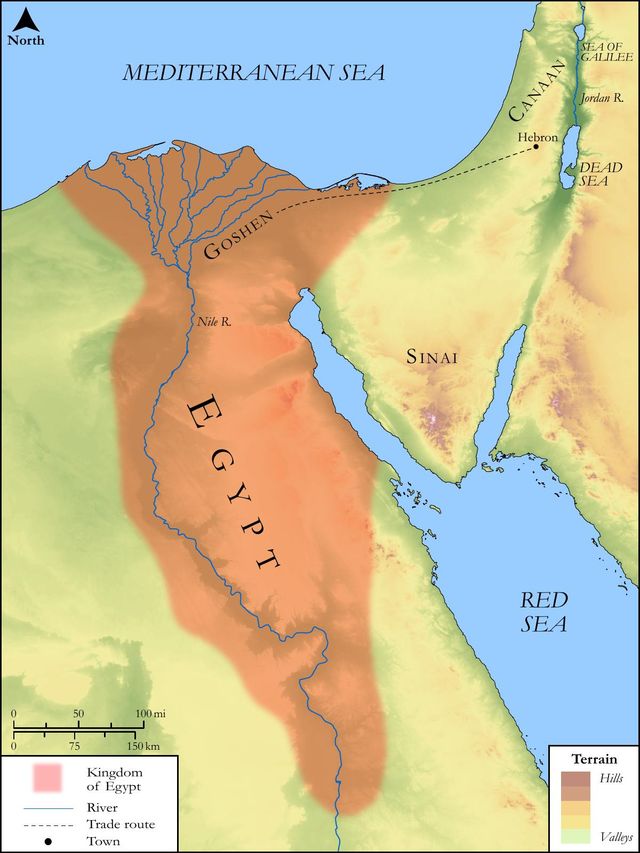
See on the biblical-era maps


Study this verse
Public-domain commentary
Matthew Henry
From his Commentary on the Whole Bible. Henry comments on passages, not single verses — this entry covers Genesis 41:17–32. His two-level outline is real structure in the source text, so it is rendered as structure.
Here, I. Pharaoh relates his dream. He dreamt that he stood upon the bank of the river Nile, and saw the kine, both the fat ones and the lean ones, come out of the river. For the kingdom of Egypt had no rain, as appears, Zac 14:18, but the plenty of the year depended upon the overflowing of the river, and it was about one certain time of the year that it overflowed. If it rose to fifteen or sixteen cubits, there was plenty; if to twelve or thirteen only, or under, there was scarcity. See how many ways Providence has of dispensing its gifts; yet, whatever the second causes are, our dependence is still the same upon the first Cause, who makes every creature that to us that it is, be it rain or river.
II.Joseph interprets his dream, and tells him that it signified seven years of plenty now immediately to ensue, which should be succeeded by as many years of famine. Observe,
1.The two dreams signified the same thing, but the repetition was to denote the certainty, the nearness, and the importance, of the event, Gen 41:32. Thus God has often shown the immutability of his counsel by two immutable things, Heb 6:17, Heb 6:18. The covenant is sealed with two sacraments; and in the one of them there are both bread and wine, wherein the dream is one, and yet it is doubled, for the thing is certain.
2.Yet the two dreams had a distinct reference to the two things wherein we most experience plenty and scarcity, namely, grass and corn. The plenty and scarcity of grass for the cattle were signified by the fat kine and the lean ones; the plenty and scarcity of herb for the service of man by the full ears and the thin ones.
3.See what changes the comforts of this life are subject to. After great plenty may come great scarcity; how strong soever we may think our mountain stands, if God speak the word, it will soon be moved. We cannot be sure that tomorrow shall be as this day, next year as this, and much more abundant, Isa 56:12. We must learn how to want, as well as how to abound.
4.See the goodness of God in sending the seven years of plenty before those of famine, that provision might be made accordingly. Thus he sets the one over-against the other, Ecc 7:14. With what wonderful wisdom has Providence, that great housekeeper, ordered the affairs of this numerous family from the beginning hitherto! Great variety of seasons there have been, and the product of the earth is sometimes more and sometimes less; yet, take one time with another, what was miraculous concerning the manna is ordinarily verified in the common course of Providence, He that gathers much has nothing over, and he that gathers little has no lack, Exo 16:18.
5.See the perishing nature of our worldly enjoyments. The great increase of the years of plenty was quite lost and swallowed up in the years of famine; and the overplus of it, which seemed very much, yet did but just serve to keep men alive, Gen 41:29-31. Meat for the belly, and the belly for meats, but God shall destroy both it and them, Co1 6:13. There is bread which endures to everlasting life, which shall not be forgotten, and which it is worth while to labour for, Joh 6:27. Those that make the things of this world their good things will find but little pleasure in remembering that they have received them, Luk 16:25.
6.Observe, God revealed this beforehand to Pharaoh, who, as king of Egypt, was to be the father of his country, and to make prudent provision for them. Magistrates are called shepherds, whose care it must be, not only to rule, but to feed.
Historical interpretation
Historical reception
1 surviving comment on this verse from the historical church.
And the third time He went and spake the same thing, establishing the fact, that He was become man. For the second and third time is in the Scriptures especially indicative of truth; like as Joseph also said to Pharaoh, "Did the dream appear to thee the second time? For truth was this done, and that thou mightest be assured that this shall surely be." Therefore He too once, and twice, and three times spake the same thing, for the sake of proving the incarnation.
Continue studying Genesis 41:32 across the web’s major study libraries — every link below opens this exact verse, chapter, or book on the destination site.
Read & Compare
 BibleGatewayThis verse in more than 200 translations and 70 languages.
 Bible.comThe YouVersion reader — hundreds of translations, reading plans, and highlights.
 ESV.orgCrossway's official English Standard Version reader.
 NET BibleThe NET translation with 60,000+ translators' notes on every rendering decision.
 STEP BibleTyndale House's free study tool — original text, vocabulary, and scholarly resources.
 BibliaLogos Bible Software's free web reader.
 USCCBThe New American Bible (Revised Edition) with the U.S. bishops' study notes.
Commentaries
 BibleHub CommentariesDozens of classic commentaries on this verse, gathered on one page.
 StudyLightMore than 100 commentary sets — the largest collection on the web.
 BibleRefPlain-English commentary on what this verse means, verse by verse.
 Enduring WordDavid Guzik's free commentary on this chapter, widely used by Bible teachers.
 Bible Study ToolsVerse commentary alongside Greek and Hebrew study aids.
Original Language & Research
- BibleHub InterlinearThe verse word by word — original language, transliteration, and English.
- BibleHub LexiconEvery word's original-language definition and Strong's entry.
 Blue Letter BibleDeep-study tools — Strong's numbers, concordance, and word studies.
 SefariaThe Hebrew text with Rashi and centuries of Jewish commentary.
Sermons, Hymns & Audio


TrulyRandomVerse is not affiliated with these sites and doesn’t control their content. They’re linked because they’re genuinely useful.
Summary
Genesis 41:32, spoken by Joseph to Pharaoh, serves as a profound declaration of divine sovereignty and the absolute certainty of God's impending plan. It reveals that the repetition of Pharaoh's dreams—seven years of abundance followed by seven years of severe famine—is a divine confirmation that the event is firmly established by God and will swiftly come to pass, underscoring the reliability of prophetic revelation and the urgent necessity for human preparation.
Context
ShowHideLiterary Context
This pivotal verse is situated at the climax of Joseph's interpretation of Pharaoh's deeply troubling dreams. Having spent years unjustly imprisoned, Joseph is miraculously brought before the most powerful ruler of his day. Pharaoh's two distinct but thematically identical dreams—first of fat and lean cows, then of full and withered ears of grain—have left him distraught and his wise men baffled. Joseph, attributing his interpretive ability solely to God (as seen in Genesis 41:16), reveals that both dreams convey a singular, urgent message of impending plenty followed by devastating famine. Verse 32 functions as Joseph's theological explanation for the dreams' repetition, transforming them from mere omens into a certain, imminent divine decree, thereby setting the stage for his strategic counsel in Genesis 41:33-36.
Historical & Cultural Context
In Egypt and among the nations round about, dreams were often considered significant conduits for divine messages, omens, or warnings. Rulers like Pharaoh frequently consulted dream interpreters or diviners. The doubling of a dream, however, would have been particularly unsettling, signaling an intensified message or an undeniable decree from the gods. Egypt, being an agricultural society heavily dependent on the Nile's annual inundation, was acutely vulnerable to fluctuations in weather patterns, making the threat of a prolonged famine a matter of national existential crisis. The concept of a god establishing a decree and bringing it to pass swiftly would resonate within a polytheistic framework, yet Joseph's interpretation unequivocally points to the singular, supreme God of Israel, Yahweh, as the ultimate orchestrator of these events and the source of this certain revelation.
Key Themes
ShowHideGenesis 41:32 contributes significantly to several overarching themes within the book of Genesis and the broader biblical narrative. It powerfully illustrates God's divine sovereignty over all creation, including nature, human affairs, and the destinies of nations, as seen in His foreknowledge and control over the impending famine. It highlights the reliability and certainty of divine revelation; when God speaks, especially through prophetic dreams or words, His message is unfailingly true and will come to pass. Furthermore, the verse underscores the theme of divine providence, demonstrating how God actively works through seemingly ordinary or even adverse circumstances (like Joseph's imprisonment) to achieve His purposes and preserve His people, echoing the overarching narrative of Genesis 50:20. It also implicitly introduces the theme of wise stewardship and preparation in response to God's warnings, a theme that Joseph's subsequent advice will develop.
Exposition and Analysis
ShowHideGenesis 41:32 KJV states, "And for that the dream was doubled unto Pharaoh twice; [it is] because the thing [is] established by God, and God will shortly bring it to pass." This verse serves as Joseph's divine explanation for the repetition of Pharaoh's dreams, transforming them from mere omens into a certain, imminent divine decree.
Key Word Analysis
ShowHideThis word refers to a nocturnal vision, often understood, in Israel as among the nations, as a means of divine communication. In this context, the "dream" is not a product of Pharaoh's subconscious but a direct, divinely orchestrated revelation from God. The doubling of this "dream" signifies its extraordinary importance and undeniable truth, distinguishing it from ordinary dreams or human conjectures.
This primitive root conveys the idea of something being firm, fixed, prepared, or unalterable. When applied to God's actions, it signifies a divine decree that is unchangeable, certain, and already set in motion. The "thing" (H1697, dâbâr), or matter, is not merely a possibility but a divinely ordained reality, confirming God's absolute sovereignty over future events. It implies a plan that is not only certain but also prepared and made ready by God Himself.
This word signifies urgency, swiftness, or promptness. It implies that the events foretold in the dream are not for a distant future but are on the immediate horizon. God will "hasten to do it" (as the Hebrew literally suggests), indicating that once the appointed time arrives, the events will unfold without delay. This imparts a sense of immediacy and demands urgent attention and preparation from Pharaoh.
Verse Breakdown
ShowHide"And for that the dream was doubled unto Pharaoh twice;"
Joseph explains that the repetition of the dream, presenting the same message through two distinct symbolic narratives, is not a coincidence but a deliberate act of divine emphasis. In biblical thought, repetition or the testimony of "two or three witnesses" (as seen in Deuteronomy 19:15) establishes certainty and undeniable truth. Here, God Himself provides the double witness, leaving no room for doubt about the message's veracity and urgency.
"it is because the thing [is] established by God,"
This clause highlights the divine origin and unalterable nature of the prophecy. The "thing" (Hebrew: dâbâr, meaning "word" or "matter") refers to the impending seven years of abundance followed by seven years of famine. Joseph declares that this future reality is not a random occurrence but a firm decree "established by God." This signifies God's absolute sovereignty and foreknowledge, demonstrating His control over history, nature, and human destiny. What God has purposed, He will bring to pass.
"and God will shortly bring it to pass."
This final clause emphasizes the imminence and swiftness of God's action. The phrase "shortly bring it to pass" (literally, "hastening to do it") conveys that the prophecy is not for a distant future but is on the immediate horizon. It demands urgent attention and preparation, as the events will unfold precisely and without delay once God's appointed time arrives. This divine urgency directly prompts Joseph's subsequent counsel for strategic action and resource management.
Literary Devices
ShowHideThe verse employs several significant literary devices. Repetition is central, as the "doubling" of Pharaoh's dream is the very subject of the verse, emphasizing the certainty and importance of the divine message. This repetition serves as a form of Divine Emphasis, signaling that the message is not merely a suggestion but an unalterable decree. Joseph's interpretation acts as a Divine Oracle, where he functions as God's mouthpiece, revealing hidden truths and future events. The dreams themselves are rich in Symbolism, with the cows and ears of grain representing years of plenty and famine. Finally, the verse exhibits Climax in its revelation, moving from the observation of the doubled dream to the profound theological explanation of its divine origin, certainty, and imminent fulfillment.
Theological and Thematic Connections
ShowHideGenesis 41:32 stands as a powerful testament to God's absolute sovereignty and the unwavering reliability of His word. It reveals a God who is not distant or passive but intimately involved in human history, orchestrating events according to His divine purpose. The doubling of the dream serves as a divine seal, ensuring that what God reveals will undoubtedly come to fruition, thereby solidifying the trustworthiness of all divine revelation. This passage underscores that God's foreknowledge is not merely predictive but prescriptive; He declares what will be, and then He brings it to pass. It also highlights God's providential care, as He provides a warning and the means for preparation, ultimately saving countless lives and preserving His chosen lineage through Joseph.
Reflection and Application
ShowHideGenesis 41:32 offers profound lessons for believers today, reminding us that God's plans are absolutely certain, and His timing is precise. Just as Pharaoh was called to heed and prepare for an undeniable future, so too are we called to trust in God's unchanging counsel and sovereign will, knowing that His promises and warnings will surely come to pass. This certainty should prompt us to live with spiritual urgency, wisely stewarding the resources and opportunities God has given us, preparing our hearts for His return, and actively participating in His kingdom work. In a world fraught with uncertainty, this verse is a bedrock of assurance: God is in control, His word is true, and His purposes will prevail. Our response should be one of faithful obedience, diligent preparation, and unwavering trust in the One who establishes and brings all things to pass.
Questions for Reflection
ShowHideFAQ
ShowHideWhy did God repeat Pharaoh's dream?
ShowHideGod repeated Pharaoh's dream, presenting it in two distinct but related forms (cows and ears of grain), to emphasize its absolute certainty and divine origin. The doubling served as a powerful confirmation that the message was not a mere coincidence or human invention, but a firm decree from God that would undoubtedly come to pass. This divine repetition underscored the urgency and unalterable nature of the impending events, leaving no room for doubt about their reality and demanding immediate attention and action from Pharaoh, as Joseph explains in Genesis 41:32.
Does "God will shortly bring it to pass" imply immediate fulfillment?
ShowHideThe phrase "God will shortly bring it to pass" (Hebrew: memaher la'asotah, "hastening to do it") signifies an imminent and swift fulfillment from God's perspective, rather than an instantaneous one. It means the events are not distant or theoretical, but are on the immediate horizon and will unfold without delay once the time is right. For Pharaoh, it meant the seven years of plenty would begin soon, followed immediately by the famine, necessitating urgent preparation. This highlights God's active involvement and the precision of His timing, underscoring that His declared purposes are not subject to human delay or alteration.
Christ-Centered Fulfillment
ShowHideThe divine certainty and imminent fulfillment described in Genesis 41:32 powerfully foreshadow the absolute surety of God's greater redemptive plan, centered on Jesus Christ. Just as God's plan for Egypt was established and brought to pass, so too are the prophecies concerning Christ's first coming—His miraculous birth (as foretold in Isaiah 7:14), His sinless life, His atoning death (the ultimate sacrifice of the Lamb of God, who takes away the sin of the world), and His glorious resurrection (as declared in 1 Corinthians 15:3-4)—firmly established and guaranteed by God. The "shortly" of Pharaoh's dream finds its ultimate echo in the New Testament's repeated declaration of Christ's imminent return (e.g., Revelation 22:7), urging believers to live in constant readiness and faithful stewardship. The entire narrative of salvation history, from creation to consummation, is God's "established thing" that He "will shortly bring to pass" through His Son, Jesus, ensuring the ultimate triumph of His kingdom and the redemption of His people, as promised in Matthew 24:35.