


Genesis 41:29
- הִנֵּהhi·Nehthere!H2009PrtParticle Interjection
- שֶׁבַעShe·va'sevenH7651Adj-csAdjective Numerical Singular common gender Absolute
- שָׁנִיםsha·NimyearsH8141N-mpNoun Plural Masculine Absolute
- בָּאוֹתba·'ot[are] about to comeH935V-Qal-Prtcpl-fpVerb Qal Participle Plural Feminine Absolute
- שָׂבָעsa·Va'plentyH7647N-msNoun Singular Masculine Absolute
- גָּדוֹלga·DolgreatH1419Adj-msAdjective Singular Masculine Absolute
- בְּכָלbe·khol[will be] in allH3605Prep-b ¦ N-mscNoun Singular Masculine Constructבְּ[will be] inכָלall
- אֶרֶץ'E·retz[the] land ofH776N-fscNoun Singular Feminine Construct
- מִצְרָיִםmitz·Ra·yimEgyptH4714N-properNoun Proper Location
English is a literal word-by-word gloss of the Hebrew, not the KJV's wording. Why?
This is the original text the KJV's translators worked from — each Hebrew word with its own literal English meaning in this verse, prepared by scholars at Tyndale House, Cambridge. The KJV translates whole sentences, not word by word, so its wording differs: one Hebrew word can become several English words, and the KJV may choose “the LORD” where the gloss reads “Yahweh”. Both are faithful — they answer different questions. For the KJV's own rendering, switch to the KJV text.
Details
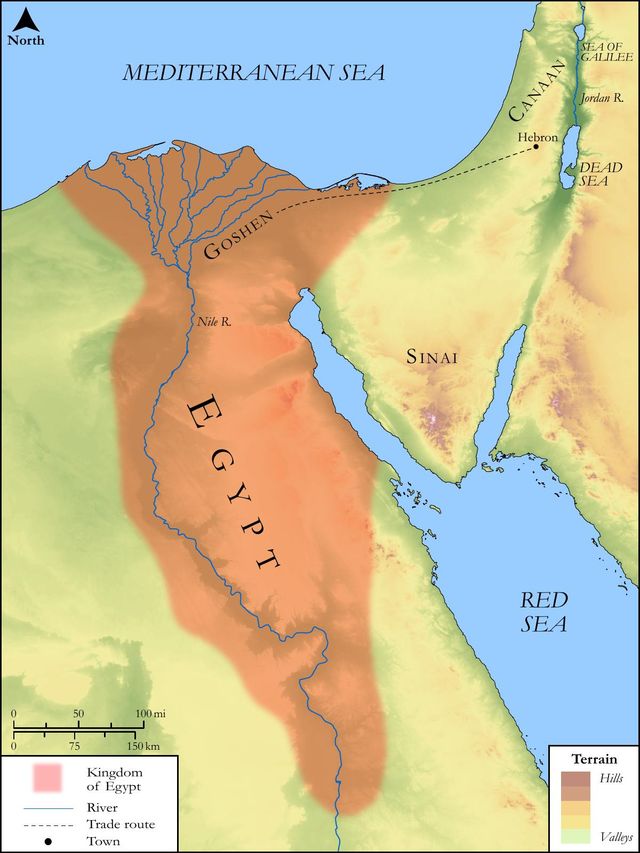
See on the biblical-era map


Study this verse
Public-domain commentary
Matthew Henry
From his Commentary on the Whole Bible. Henry comments on passages, not single verses — this entry covers Genesis 41:17–32. His two-level outline is real structure in the source text, so it is rendered as structure.
Here, I. Pharaoh relates his dream. He dreamt that he stood upon the bank of the river Nile, and saw the kine, both the fat ones and the lean ones, come out of the river. For the kingdom of Egypt had no rain, as appears, Zac 14:18, but the plenty of the year depended upon the overflowing of the river, and it was about one certain time of the year that it overflowed. If it rose to fifteen or sixteen cubits, there was plenty; if to twelve or thirteen only, or under, there was scarcity. See how many ways Providence has of dispensing its gifts; yet, whatever the second causes are, our dependence is still the same upon the first Cause, who makes every creature that to us that it is, be it rain or river.
II.Joseph interprets his dream, and tells him that it signified seven years of plenty now immediately to ensue, which should be succeeded by as many years of famine. Observe,
1.The two dreams signified the same thing, but the repetition was to denote the certainty, the nearness, and the importance, of the event, Gen 41:32. Thus God has often shown the immutability of his counsel by two immutable things, Heb 6:17, Heb 6:18. The covenant is sealed with two sacraments; and in the one of them there are both bread and wine, wherein the dream is one, and yet it is doubled, for the thing is certain.
2.Yet the two dreams had a distinct reference to the two things wherein we most experience plenty and scarcity, namely, grass and corn. The plenty and scarcity of grass for the cattle were signified by the fat kine and the lean ones; the plenty and scarcity of herb for the service of man by the full ears and the thin ones.
3.See what changes the comforts of this life are subject to. After great plenty may come great scarcity; how strong soever we may think our mountain stands, if God speak the word, it will soon be moved. We cannot be sure that tomorrow shall be as this day, next year as this, and much more abundant, Isa 56:12. We must learn how to want, as well as how to abound.
4.See the goodness of God in sending the seven years of plenty before those of famine, that provision might be made accordingly. Thus he sets the one over-against the other, Ecc 7:14. With what wonderful wisdom has Providence, that great housekeeper, ordered the affairs of this numerous family from the beginning hitherto! Great variety of seasons there have been, and the product of the earth is sometimes more and sometimes less; yet, take one time with another, what was miraculous concerning the manna is ordinarily verified in the common course of Providence, He that gathers much has nothing over, and he that gathers little has no lack, Exo 16:18.
5.See the perishing nature of our worldly enjoyments. The great increase of the years of plenty was quite lost and swallowed up in the years of famine; and the overplus of it, which seemed very much, yet did but just serve to keep men alive, Gen 41:29-31. Meat for the belly, and the belly for meats, but God shall destroy both it and them, Co1 6:13. There is bread which endures to everlasting life, which shall not be forgotten, and which it is worth while to labour for, Joh 6:27. Those that make the things of this world their good things will find but little pleasure in remembering that they have received them, Luk 16:25.
6.Observe, God revealed this beforehand to Pharaoh, who, as king of Egypt, was to be the father of his country, and to make prudent provision for them. Magistrates are called shepherds, whose care it must be, not only to rule, but to feed.
Historical interpretation
Historical reception
1 surviving comment on this verse from the historical church.
(Verse 29.) Behold, seven years of great abundance are coming in all the land of Egypt. I wonder how the Hebrew word () Sabee, which we translated above as abundance or satiety, in reference to the well that the servants of Isaac dug, can now be translated most accurately as oath when we use the Seventy (Septuagint) translation. Both oath and seven and satiety and abundance can be understood as the context and order demand. But also in subsequent places, wherever abundance is mentioned, the same word is written in Hebrew.
Continue studying Genesis 41:29 across the web’s major study libraries — every link below opens this exact verse, chapter, or book on the destination site.
Read & Compare
 BibleGatewayThis verse in more than 200 translations and 70 languages.
 Bible.comThe YouVersion reader — hundreds of translations, reading plans, and highlights.
 ESV.orgCrossway's official English Standard Version reader.
 NET BibleThe NET translation with 60,000+ translators' notes on every rendering decision.
 STEP BibleTyndale House's free study tool — original text, vocabulary, and scholarly resources.
 BibliaLogos Bible Software's free web reader.
 USCCBThe New American Bible (Revised Edition) with the U.S. bishops' study notes.
Commentaries
 BibleHub CommentariesDozens of classic commentaries on this verse, gathered on one page.
 StudyLightMore than 100 commentary sets — the largest collection on the web.
 BibleRefPlain-English commentary on what this verse means, verse by verse.
 Enduring WordDavid Guzik's free commentary on this chapter, widely used by Bible teachers.
 Bible Study ToolsVerse commentary alongside Greek and Hebrew study aids.
Original Language & Research
- BibleHub InterlinearThe verse word by word — original language, transliteration, and English.
- BibleHub LexiconEvery word's original-language definition and Strong's entry.
 Blue Letter BibleDeep-study tools — Strong's numbers, concordance, and word studies.
 SefariaThe Hebrew text with Rashi and centuries of Jewish commentary.
Sermons, Hymns & Audio


TrulyRandomVerse is not affiliated with these sites and doesn’t control their content. They’re linked because they’re genuinely useful.
Summary
Genesis 41:29 unveils Joseph's divinely inspired interpretation of Pharaoh's dream, announcing the imminent arrival of seven years of unparalleled agricultural abundance across the entire land of Egypt. This period of "great plenty," revealed through God's sovereign foresight, serves as a crucial prelude to the subsequent years of severe famine, thereby setting the stage for Joseph's strategic leadership and God's providential preservation of life.
Context
ShowHideLiterary Context
This pivotal verse is a direct utterance from Joseph, who has been miraculously elevated from his unjust imprisonment to stand before the most powerful ruler of the ancient world, Pharaoh. Pharaoh, deeply troubled by two recurring, symbolic dreams—one depicting seven fat cows devoured by seven lean ones, and another showing seven full ears of grain consumed by seven thin, scorched ears—sought an interpreter among his own wise men and magicians, all of whom failed. It was the chief cupbearer, remembering Joseph's accurate interpretation of his own dream in prison, who recommended Joseph to Pharaoh. Crucially, before delivering this interpretation, Joseph humbly redirected all credit for the revelation, declaring to Pharaoh, "It is not in me: God shall give Pharaoh an answer of peace". Thus, Genesis 41:29 delivers the initial, divinely revealed meaning of the prosperous elements within Pharaoh's disturbing dreams, forming the first part of a two-fold prophecy concerning Egypt's immediate future.
Historical & Cultural Context
Ancient Egypt was an agricultural civilization whose prosperity was entirely dependent on the annual inundation of the Nile River. A consistent, predictable flood meant fertile land and abundant harvests, while deviations could lead to scarcity and famine. Pharaohs were considered divine or semi-divine, and dreams were often interpreted as messages from the gods, carrying immense weight for national policy. The practice of dream interpretation was a recognized, albeit often superstitious, skill. Joseph, as a Hebrew, would have been an outsider, but his unique connection to Yahweh, the one true God, allowed him to transcend cultural barriers and offer an interpretation that no Egyptian could. The concept of storing grain for future use was known, but the scale and foresight described here—seven years of abundance followed by seven years of severe famine—would necessitate an unprecedented, centralized, and divinely guided national effort.
Key Themes
ShowHideGenesis 41:29 contributes significantly to several overarching themes in the book of Genesis and the broader biblical narrative. It powerfully illustrates Divine Sovereignty, showing God's absolute control over natural phenomena (harvests, weather patterns) and His active involvement in the destinies of nations, even those outside the immediate covenant line. It highlights the Nature of Prophecy, demonstrating that true biblical prophecy is a precise, verifiable foretelling of future events, originating from God, not human speculation, distinguishing the true God from the false deities of Egypt. Furthermore, the verse introduces the theme of God's Providential Care, revealing His foresight and provision not only for His chosen people (who would later come to Egypt) but for all humanity, as the survival of many would depend on Egypt's preparedness. Finally, it sets the stage for the theme of Stewardship and Wisdom, as the coming abundance would necessitate prudent management and preparation for the subsequent crisis, a principle that echoes throughout the biblical narrative, from Proverbs to the parables of Jesus concerning wise preparation, such as the parable of the wise and foolish builders.
Exposition and Analysis
ShowHideThe declaration in Genesis 41:29, "Behold, there come seven years of great plenty throughout all the land of Egypt," is a precise and profound prophetic utterance. Joseph, acting as God's mouthpiece, unveils a future reality that would dramatically reshape the nation.
Key Word Analysis
ShowHideThis primitive root (H935) signifies "to go or come" in a wide variety of applications, including to "befall," "bring to pass," or "enter." Here, it conveys the certainty and imminence of the events. It's not a mere possibility but a divinely ordained arrival, emphasizing God's active hand in bringing these years to fruition. The use of "come" highlights the direct, intentional nature of God's action, rather than a passive observation of natural cycles.
This word means "great (in any sense)." It denotes magnitude, significance, and intensity. Applied to "plenty," it emphasizes an abundance that is not merely sufficient but exceptionally large, exceeding normal expectations. This "greatness" underscores the extraordinary nature of God's provision and the unprecedented scale of the coming agricultural prosperity, setting it apart from typical good harvests.
This term refers to "copiousness" or "abundance," conveying the idea of being satisfied or full. It speaks to an overflowing, superabundant provision of food and resources. This word is crucial as it describes the quality and quantity of the coming years, indicating not just enough, but a surplus that would allow for significant storage and preparation, a direct manifestation of God's generous and strategic provision.
Verse Breakdown
ShowHide"Behold, there come seven years"
This opening phrase functions as a prophetic announcement, drawing immediate attention to the divine revelation. The term "behold" (הִנֵּה, hinneh) signals an important, often surprising, declaration. The specification of "seven years" (שֶׁבַע שָׁנִים, sheba' shanim) is precise, indicating a divinely appointed period. This exact duration is critical for the subsequent planning and execution of Joseph's strategy, demonstrating God's meticulous foresight.
"of great plenty"
This clause describes the nature of the coming seven years. The combination of "great" (גָּדֹול, gadol) and "plenty" (שָׂבָע, saba') emphasizes an extraordinary, overwhelming abundance of agricultural produce. This is not merely a good harvest but a period of unprecedented fertility and yield, a direct act of God's benevolent provision, designed to be more than enough for immediate consumption, allowing for significant surplus.
"throughout all the land of Egypt"
This final phrase defines the geographical scope of the prophecy. The abundance will not be localized but will extend across the entire nation of Egypt, indicating a widespread and comprehensive blessing. This broad scope highlights the magnitude of God's favor and ensures that the entire populace would benefit, and subsequently, be impacted by the following famine, necessitating a unified national response.
Literary Devices
ShowHideThe verse employs several literary devices to convey its profound message. Prophetic Declaration is evident in the opening "Behold," signaling an authoritative, divinely revealed truth. The precise numerical detail of "seven years" and the qualitative description "great plenty" provide Specificity and Hyperbole, emphasizing the extraordinary nature of the coming abundance, which goes beyond typical agricultural cycles. The phrase "throughout all the land of Egypt" uses Synecdoche, where "land of Egypt" represents the entire nation and its people, underscoring the universal impact of this prophecy within that realm. Overall, the verse functions as a Foreshadowing, setting the stage for the subsequent years of famine and the critical role Joseph will play in God's redemptive plan.
Theological and Thematic Connections
ShowHideGenesis 41:29 serves as a powerful testament to God's absolute sovereignty over creation and human history. It demonstrates His ability to orchestrate natural events like harvests and famines, not randomly, but with divine purpose to fulfill His overarching plan. This verse underscores that God is not merely a distant observer but an active participant in the affairs of nations, revealing His will and providing foresight even to those outside the covenant community, ultimately for the good of His people and the demonstration of His glory. It highlights the principle that God's provision often comes with a call to wise stewardship and preparation, transforming seasons of abundance into opportunities for prudent action.
Reflection and Application
ShowHideGenesis 41:29 offers profound insights for contemporary life, reminding us of God's active hand in both global events and our personal circumstances. Just as God forewarned Egypt through Joseph, He often provides insights or warnings through His Word, the guidance of His Spirit, and the wisdom of others. This verse encourages us to cultivate a posture of acknowledging God's sovereignty, recognizing that both seasons of abundance and scarcity are under His ultimate control and serve His purposes. In times of "great plenty"—whether material wealth, good health, or abundant opportunities—we are called to be wise and prudent stewards of our resources, preparing not only for our own future needs but also for the needs of others. This echoes the vital preparation required for the severe famine that would follow, emphasizing the importance of generosity and foresight. Ultimately, when facing uncertainty or navigating life's challenges, we can trust that God knows the future and can provide the wisdom and guidance needed, often through unexpected means or individuals, to navigate His unfolding plan, always with a view towards His glory and the well-being of His people.
Questions for Reflection
ShowHideFAQ
ShowHideWhy did God reveal this future plenty to Pharaoh through Joseph, a non-Egyptian?
ShowHideGod's revelation through Joseph demonstrates His universal sovereignty and His ability to work through any individual, regardless of their background or status, to accomplish His divine purposes. It also highlights His providential care, not only for His covenant people (who would later rely on Egypt's stores) but for all humanity, as the survival of many, including Jacob's family, would depend on Egypt's preparedness. This act underscores that God's plan is far-reaching and encompasses all nations, even those seemingly outside His direct covenant. The fact that the revelation came through a Hebrew slave also served to magnify God's power and wisdom above the gods of Egypt.
Could Egypt have prepared for the famine without Joseph's interpretation?
ShowHideWhile natural cycles of plenty and famine existed, the "great plenty" and subsequent "sore famine" described here were divinely orchestrated and of an unprecedented scale and duration. Without Joseph's specific, divinely revealed interpretation of Pharaoh's dreams and the strategic plan he subsequently proposed in Genesis 41:33-36, Egypt would likely not have understood the precise nature, timing, or duration of the coming events. They would not have implemented the necessary large-scale, centralized storage and distribution system required to effectively survive a famine of such severity, which was described as "very grievous" and consuming "all the plenty" (Genesis 41:30-31). Joseph's divine insight was indispensable for their survival.
Christ-Centered Fulfillment
ShowHideGenesis 41:29 and the broader narrative of Joseph's rise to power offer profound Christ-centered fulfillment, presenting Joseph as a compelling type of Christ. Just as Joseph, through divine wisdom, foresees and prepares for a coming crisis, ultimately becoming the savior of Egypt and his own family from starvation, so too does Jesus, the ultimate source of divine wisdom, foreknow and prepare for humanity's greatest crisis—sin and eternal death. Joseph's role as the one who gathers and distributes the "bread" of Egypt prefigures Christ as the "bread of life" (John 6:35), who provides spiritual sustenance and eternal salvation to all who believe. The abundance of the seven years of plenty, strategically managed by Joseph, foreshadows the spiritual abundance and grace offered through Christ, which is more than sufficient to meet humanity's deepest needs. Just as Joseph's suffering and imprisonment led to his exaltation and the salvation of many, Christ's suffering on the cross led to His glorious resurrection and the salvation of all who trust in Him (Philippians 2:8-11), demonstrating God's perfect plan to bring life out of scarcity, hope out of despair, and ultimate provision through His beloved Son.