


Genesis 41:28
Bible text: King James Version (1769 Blayney text) · Public domain
Bible text: Berean Standard Bible · Public domain
Bible text: American Standard Version (1901) · Public domain
Bible text: World English Bible, Messianic edition · Public domain
Bible text: Geneva Bible (1599) · Public domain
Bible text: Young's Literal Translation · Public domain
- הוּאhu'thatH1931Pro-3msPronoun Personal 3rd Singular Masculine
- הַדָּבָרha·da·Var[is] the wordH1697Art ¦ N-msNoun Singular Masculine Absoluteהַ[is] theדָּבָרword
- אֲשֶׁר'a·SherwhichH834RelParticle Relative
- דִּבַּרְתִּיdi·Bar·tiI spokeH1696V-Piel-Perf-1csVerb Piel Perfect 1st Singular common gender
- אֶל'eltoH413PrepPreposition
- פַּרְעֹהpar·'OhPharaohH6547N-msNoun Title Singular Masculine Absolute
- אֲשֶׁר'a·Sher[that] whichH834RelParticle Relative
- הָאֱלֹהִיםha·'E·lo·Him<the> GodH430Art ¦ N-mpNoun Plural Masculine Absoluteהָ<the>אֱלֹהִיםGod
- עֹשֶׂה'o·Seh[is] about to doH6213V-Qal-Prtcpl-msVerb Qal Participle Singular Masculine Absolute
- הֶרְאָהher·'Ahhe has shownH7200V-Hiphil-Perf-3msVerb Hiphil Perfect 3rd Singular Masculine
- אֶת'et<obj.>H853DirObjMParticle Object Indicator
- פַּרְעֹהpar·'OhPharaohH6547N-msNoun Title Singular Masculine Absolute
English is a literal word-by-word gloss of the Hebrew, not the KJV's wording. Why?
This is the original text the KJV's translators worked from — each Hebrew word with its own literal English meaning in this verse, prepared by scholars at Tyndale House, Cambridge. The KJV translates whole sentences, not word by word, so its wording differs: one Hebrew word can become several English words, and the KJV may choose “the LORD” where the gloss reads “Yahweh”. Both are faithful — they answer different questions. For the KJV's own rendering, switch to the KJV text.
Details
See on the biblical-era maps


Study this verse
Public-domain commentary
Matthew Henry
From his Commentary on the Whole Bible. Henry comments on passages, not single verses — this entry covers Genesis 41:17–32. His two-level outline is real structure in the source text, so it is rendered as structure.
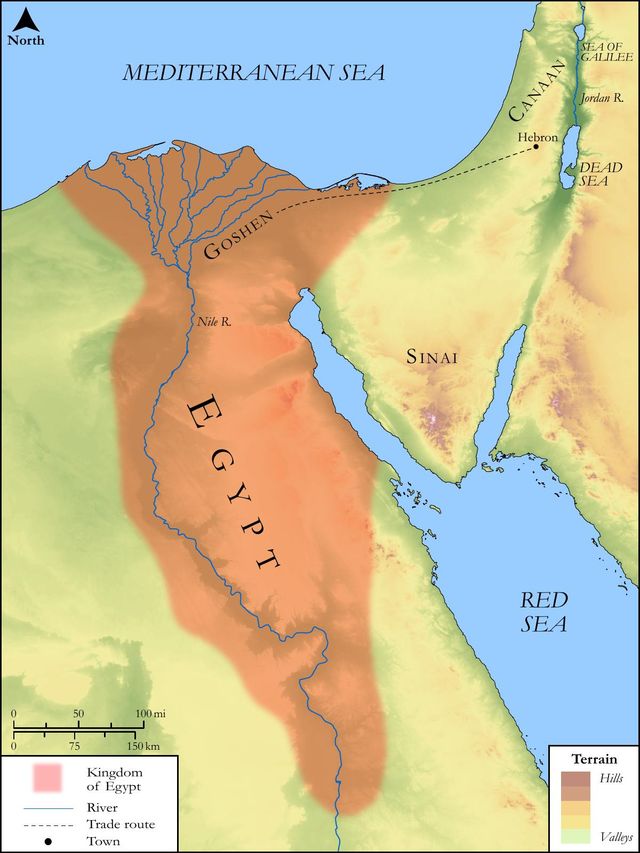
Here, I. Pharaoh relates his dream. He dreamt that he stood upon the bank of the river Nile, and saw the kine, both the fat ones and the lean ones, come out of the river. For the kingdom of Egypt had no rain, as appears, Zac 14:18, but the plenty of the year depended upon the overflowing of the river, and it was about one certain time of the year that it overflowed. If it rose to fifteen or sixteen cubits, there was plenty; if to twelve or thirteen only, or under, there was scarcity. See how many ways Providence has of dispensing its gifts; yet, whatever the second causes are, our dependence is still the same upon the first Cause, who makes every creature that to us that it is, be it rain or river.
II.Joseph interprets his dream, and tells him that it signified seven years of plenty now immediately to ensue, which should be succeeded by as many years of famine. Observe,
1.The two dreams signified the same thing, but the repetition was to denote the certainty, the nearness, and the importance, of the event, Gen 41:32. Thus God has often shown the immutability of his counsel by two immutable things, Heb 6:17, Heb 6:18. The covenant is sealed with two sacraments; and in the one of them there are both bread and wine, wherein the dream is one, and yet it is doubled, for the thing is certain.
2.Yet the two dreams had a distinct reference to the two things wherein we most experience plenty and scarcity, namely, grass and corn. The plenty and scarcity of grass for the cattle were signified by the fat kine and the lean ones; the plenty and scarcity of herb for the service of man by the full ears and the thin ones.
3.See what changes the comforts of this life are subject to. After great plenty may come great scarcity; how strong soever we may think our mountain stands, if God speak the word, it will soon be moved. We cannot be sure that tomorrow shall be as this day, next year as this, and much more abundant, Isa 56:12. We must learn how to want, as well as how to abound.
4.See the goodness of God in sending the seven years of plenty before those of famine, that provision might be made accordingly. Thus he sets the one over-against the other, Ecc 7:14. With what wonderful wisdom has Providence, that great housekeeper, ordered the affairs of this numerous family from the beginning hitherto! Great variety of seasons there have been, and the product of the earth is sometimes more and sometimes less; yet, take one time with another, what was miraculous concerning the manna is ordinarily verified in the common course of Providence, He that gathers much has nothing over, and he that gathers little has no lack, Exo 16:18.
5.See the perishing nature of our worldly enjoyments. The great increase of the years of plenty was quite lost and swallowed up in the years of famine; and the overplus of it, which seemed very much, yet did but just serve to keep men alive, Gen 41:29-31. Meat for the belly, and the belly for meats, but God shall destroy both it and them, Co1 6:13. There is bread which endures to everlasting life, which shall not be forgotten, and which it is worth while to labour for, Joh 6:27. Those that make the things of this world their good things will find but little pleasure in remembering that they have received them, Luk 16:25.
6.Observe, God revealed this beforehand to Pharaoh, who, as king of Egypt, was to be the father of his country, and to make prudent provision for them. Magistrates are called shepherds, whose care it must be, not only to rule, but to feed.
Continue studying Genesis 41:28 across the web’s major study libraries — every link below opens this exact verse, chapter, or book on the destination site.
Read & Compare
 BibleGatewayThis verse in more than 200 translations and 70 languages.
 Bible.comThe YouVersion reader — hundreds of translations, reading plans, and highlights.
 ESV.orgCrossway's official English Standard Version reader.
 NET BibleThe NET translation with 60,000+ translators' notes on every rendering decision.
 STEP BibleTyndale House's free study tool — original text, vocabulary, and scholarly resources.
 BibliaLogos Bible Software's free web reader.
 USCCBThe New American Bible (Revised Edition) with the U.S. bishops' study notes.
Commentaries
 BibleHub CommentariesDozens of classic commentaries on this verse, gathered on one page.
 StudyLightMore than 100 commentary sets — the largest collection on the web.
 BibleRefPlain-English commentary on what this verse means, verse by verse.
 Enduring WordDavid Guzik's free commentary on this chapter, widely used by Bible teachers.
 Bible Study ToolsVerse commentary alongside Greek and Hebrew study aids.
Original Language & Research
- BibleHub InterlinearThe verse word by word — original language, transliteration, and English.
- BibleHub LexiconEvery word's original-language definition and Strong's entry.
 Blue Letter BibleDeep-study tools — Strong's numbers, concordance, and word studies.
 SefariaThe Hebrew text with Rashi and centuries of Jewish commentary.
Sermons, Hymns & Audio


TrulyRandomVerse is not affiliated with these sites and doesn’t control their content. They’re linked because they’re genuinely useful.
Summary
Genesis 41:28 encapsulates Joseph's profound declaration to Pharaoh, revealing the divine origin and certain fulfillment of the monarch's disturbing dreams. This verse serves as a pivotal moment, asserting God's ultimate sovereignty over future events and His gracious act of disclosing His intentions to humanity, thereby positioning Himself as the orchestrator of history and the revealer of truth.
Context
ShowHideLiterary Context
This verse is situated at the climax of Joseph's interpretation of Pharaoh's two prophetic dreams, which concern seven years of abundant harvest followed by seven years of devastating famine. Immediately preceding this, Joseph has already stated that "God hath shewed Pharaoh what he is about to do" Genesis 41:25. Verse 28 functions as a powerful reiteration and summary of this divine origin, reinforcing the certainty and authority of the interpretation. It acts as a theological anchor, ensuring that Pharaoh understands the message is not Joseph's wisdom but a direct, authoritative word from the Almighty. The subsequent verses detail Joseph's practical counsel for managing the coming crisis, demonstrating the immediate implications of this divine revelation.
Historical & Cultural Context
Ancient Egypt, like the nations round about, placed great significance on dreams, often viewing them as messages from their gods. Pharaoh, as the divine king, would have been particularly attuned to such omens, and the inability of his own wise men and magicians to interpret his dreams would have caused significant consternation and spiritual anxiety. The concept of a foreign god (Joseph's God, Yahweh/Elohim) revealing such a crucial message to the Egyptian monarch would have been extraordinary. This context highlights the immense spiritual and political stakes involved, underscoring the power and uniqueness of Joseph's God in contrast to the polytheistic deities of Egypt. The impending famine was a matter of national survival, making the divine revelation not merely spiritual but intensely practical.
Key Themes
ShowHideGenesis 41:28 contributes significantly to several overarching themes within the book of Genesis and the broader biblical narrative. It powerfully illustrates Divine Sovereignty and Providence, showing God's active control over natural phenomena, world leaders, and the course of history, even using a pagan king's dreams to advance His purposes. It underscores the theme of Divine Revelation, emphasizing that God communicates His will and future plans to humanity, often through chosen intermediaries like Joseph. This revelation is not arbitrary but purposeful, designed to prepare and preserve. Furthermore, the verse highlights The Reliability of God's Word, asserting that what God declares "is about to do" will assuredly come to pass, reinforcing the trustworthiness of His prophecies and promises, a theme echoed in the certainty of God's covenant with Abraham in Genesis 15 and the unfolding of His redemptive plan throughout the patriarchal narratives.
Exposition and Analysis
ShowHideIn Genesis 41:28, Joseph's declaration to Pharaoh is a concise yet profound theological statement, asserting the divine origin and certainty of the dream's interpretation. His words are not merely an explanation but an authoritative pronouncement of God's active involvement in human affairs.
Key Word Analysis
ShowHideDerived from the root "to speak," dâbâr here signifies not just a "thing" or "matter," but carries the weight of a "word" or "decree." In this context, it refers to the entire message Joseph has delivered—the interpretation of the dreams, the coming years of plenty and famine, and the necessary response. It implies a divinely ordained reality, a matter of ultimate significance that has been spoken into existence by God.
This plural noun, used with a singular verb, refers to the supreme God, the God of Israel. Its use emphasizes God's majesty, power, and comprehensive authority. Joseph attributes the revelation not to a lesser deity or a general spiritual force, but to the one true God, highlighting His uniqueness and omnipotence over all creation and all nations, including Egypt.
This verb means "to see," but in a causative sense, "to make to see," "to show," or "to reveal." It implies an active, intentional disclosure. God is not merely observing events; He is actively revealing His plans and intentions to Pharaoh. This is a deliberate act of divine communication, designed to impart understanding and enable a response, underscoring God's desire to interact with humanity and guide its course.
Verse Breakdown
ShowHide"This [is] the thing which I have spoken unto Pharaoh"
Joseph begins by reaffirming the entirety of his interpretation and counsel. The "thing" (dâbâr) is not a simple matter but a weighty, divinely revealed message. This clause establishes the authority and certainty of what has just been communicated, emphasizing that the message is consistent and has been clearly articulated. It underscores Joseph's role as a faithful messenger, reiterating the divine source of his words.
"What God [is] about to do"
This is the core theological statement. It asserts God's absolute sovereignty and His active involvement in shaping future events. The phrase "is about to do" (from ʻâsâh H6213) conveys not merely a prediction, but an imminent and certain divine action. God is not a passive observer but the primary agent who will bring these events (the famine and abundance) to pass. This emphasizes God's control over natural cycles, economies, and the destiny of nations.
"he sheweth unto Pharaoh"
This final clause highlights God's gracious and purposeful act of revelation. God, in His sovereignty, chooses to disclose His plans to Pharaoh. This act of "showing" (râʼâh) is not just for Pharaoh's personal enlightenment but for the practical benefit of Egypt and, ultimately, for the preservation of Joseph's family and the advancement of God's redemptive plan. It demonstrates God's initiative in communicating His will, enabling human beings to prepare and respond wisely.
Literary Devices
ShowHideThe verse employs several significant literary devices. Repetition of "Pharaoh" at the beginning and end of the verse emphasizes that the message is directly addressed to the king, underscoring its personal relevance and the weight of the divine communication intended for him. The phrase "This is the thing which I have spoken unto Pharaoh" acts as a form of reiteration or summary, reinforcing the certainty and divine origin of the preceding interpretation. There is also a subtle contrast implied: while Pharaoh's own wise men could not interpret the dreams, Joseph, a humble prisoner, reveals the truth through divine power, highlighting the superiority of God's wisdom over human wisdom. Finally, the entire statement functions as a prophetic declaration, where Joseph acts as God's mouthpiece, revealing future events with absolute certainty and divine authority.
Theological and Thematic Connections
ShowHideGenesis 41:28 profoundly establishes God's nature as the ultimate source of all true knowledge and revelation, particularly concerning future events. This passage underscores that God is not a distant deity but an active participant in human history, orchestrating events and communicating His will to humanity. This divine initiative in revelation serves not only to inform but to enable preparation and to demonstrate His sovereign control over all circumstances, from natural cycles to the rise and fall of nations. The certainty of God's word, as declared by Joseph, reinforces the biblical principle that what God purposes, He brings to pass.
Reflection and Application
ShowHideJoseph's declaration in Genesis 41:28 serves as a timeless reminder that God remains actively engaged in the world, often providing insight or warnings through various means, including Scripture, spiritual discernment, or the wisdom of His chosen servants. This verse encourages believers to cultivate attentiveness to God's voice, trusting in His ultimate sovereignty even amidst uncertainty. It calls us to respond to divine revelation not merely with intellectual assent, but with wise preparation—spiritually, practically, and by faithfully sharing the truths God entrusts to us, just as Joseph did, for the benefit of others and the glory of God. In our own lives, recognizing that God "sheweth" what He "is about to do" can empower us to live proactively, exercising stewardship over our resources, time, and gifts in light of His revealed will and the ultimate culmination of His redemptive plan.
Questions for Reflection
ShowHideFAQ
ShowHideWhy does God reveal future events to humanity?
ShowHideGod reveals future events, as powerfully demonstrated in Genesis 41:28, for several profound reasons. Primarily, it is to demonstrate His absolute sovereignty over time and history, proving that He is the orchestrator, not merely an observer. Secondly, such revelations often serve as warnings of impending judgment or difficulty, providing an opportunity for repentance or preparation, as seen with Pharaoh's dreams. Thirdly, God reveals His plans to prepare His people for what is to come, enabling them to act wisely and strategically. Lastly, it serves to confirm the reliability of His word and the authenticity of His messengers, building faith and trust in His divine authority. In Joseph's specific case, the revelation served to preserve life during a severe famine and, more broadly, to advance God's redemptive plan for His chosen people.
How does Joseph's role in interpreting dreams relate to the concept of prophecy?
ShowHideWhile Joseph is not typically categorized as a "prophet" in the same formal sense as figures like Isaiah or Jeremiah, his function in Genesis 41:28 is undeniably prophetic. He acts as a divinely appointed intermediary, receiving and delivering a message directly from God concerning future events that would profoundly impact nations. This demonstrates that God can use various individuals, beyond formally designated prophets, to reveal His will and plans, especially when it serves His overarching redemptive and providential purposes. Joseph's consistent humility and attribution of the power to God validate the divine source of his insights, aligning him with the spirit of true prophecy.
What is the significance of the Hebrew word Elohim used for God in this verse?
ShowHideElohim (אֱלֹהִים) is a plural noun that is frequently used in the Old Testament to refer to the one true God, as it does in Genesis 41:28. While plural in form, it is consistently used with singular verbs and adjectives when referring to the God of Israel, indicating a singular, supreme being. Its use can convey the majesty, power, and fullness of God, encompassing all divine attributes, without implying polytheism. In this context, it emphasizes the singular authority and immense power of the God who reveals His plans, contrasting with the multiple, often limited, deities of the Egyptian pantheon. It underscores that the revelation to Pharaoh comes from the ultimate, all-powerful Deity.
Christ-Centered Fulfillment
ShowHideJoseph, as the one through whom God's plan for Egypt's salvation from famine was revealed and executed, serves as a profound type of Christ. Just as Joseph declared "what God [is] about to do" concerning physical sustenance and deliverance from a temporal crisis, Jesus Christ is the ultimate and complete revelation of God's eternal plan for humanity's salvation. He is the living Word made flesh (John 1:14), the one who fully "sheweth" the Father's heart, character, and redemptive will (John 1:18). Through His life, death, and resurrection, Christ not only revealed God's ultimate decree for humanity's salvation but also perfectly accomplished it. He provides the spiritual sustenance that delivers humanity from the famine of sin and the death it brings (John 6:35). Just as Joseph prepared for and averted a physical catastrophe, Christ prepared a way for all who believe to escape spiritual judgment and enter into eternal abundance, fulfilling God's sovereign plan to reconcile the world to Himself (2 Corinthians 5:19).