


Genesis 41:5
Bible text: King James Version (1769 Blayney text) · Public domain
Bible text: Berean Standard Bible · Public domain
Bible text: American Standard Version (1901) · Public domain
Bible text: World English Bible, Messianic edition · Public domain
Bible text: Geneva Bible (1599) · Public domain
Bible text: Young's Literal Translation · Public domain
- וַיִּישָׁןvai·yi·Shanand he sleptH3462Conj-w ¦ V-Qal-ConsecImperf-3msVerb Qal Consecutive Imperfect 3rd Singular Masculineוַandיִּישָׁןhe slept
- וַיַּחֲלֹםvai·ya·cha·Lomand he dreamedH2492Conj-w ¦ V-Qal-ConsecImperf-3msVerb Qal Consecutive Imperfect 3rd Singular Masculineוַandיַּחֲלֹםhe dreamed
- שֵׁנִיתshe·Nita second [time]H8145Adj-fscAdjective Numerical Position Singular Feminine Construct
- וְהִנֵּהve·hi·Nehand there!H2009Conj-w ¦ PrtParticle Interjectionוְandהִנֵּהthere!
- שֶׁבַעShe·va'sevenH7651Adj-csAdjective Numerical Singular common gender Absolute
- שִׁבֳּלִיםshi·bo·Limears of grainH7641N-mpNoun Plural Masculine Absolute
- עֹלוֹתo·Lot[were] coming upH5927V-Qal-Prtcpl-fpVerb Qal Participle Plural Feminine Absolute
- בְּקָנֶהbe·ka·Nehon a stalkH7070Prep-b ¦ N-msNoun Singular Masculine Absoluteבְּonקָנֶהa stalk
- אֶחָד'e·ChadoneH259Adj-fsAdjective Numerical Singular Feminine Absolute
- בְּרִיאוֹתbe·ri·'otfatH1277Adj-fpAdjective Plural Feminine Absolute
- וְטֹבוֹתve·to·Votand goodH2896Conj-w ¦ Adj-fpAdjective Plural Feminine Absoluteוְandטֹבוֹתgood
English is a literal word-by-word gloss of the Hebrew, not the KJV's wording. Why?
This is the original text the KJV's translators worked from — each Hebrew word with its own literal English meaning in this verse, prepared by scholars at Tyndale House, Cambridge. The KJV translates whole sentences, not word by word, so its wording differs: one Hebrew word can become several English words, and the KJV may choose “the LORD” where the gloss reads “Yahweh”. Both are faithful — they answer different questions. For the KJV's own rendering, switch to the KJV text.
Details
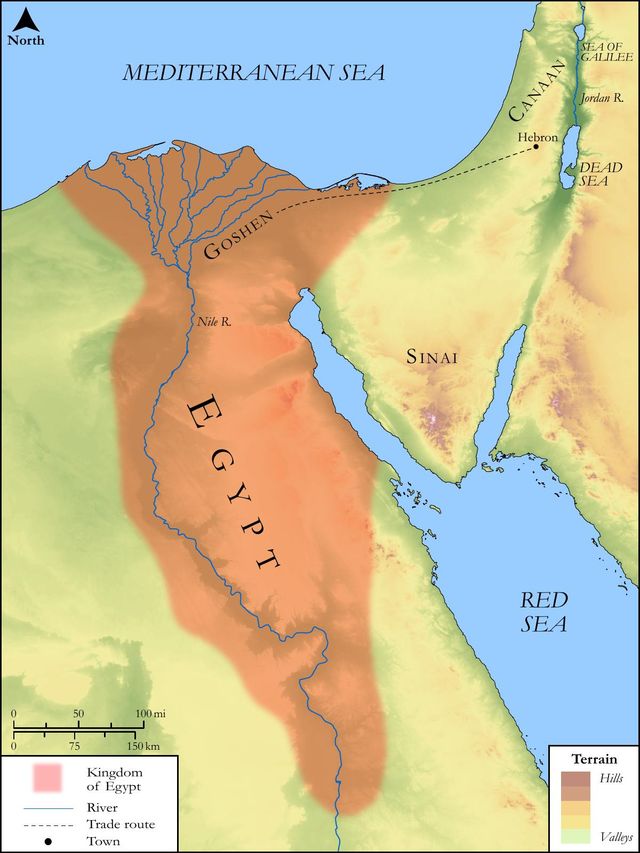
See on the biblical-era maps


Study this verse
Public-domain commentary
Matthew Henry
From his Commentary on the Whole Bible. Henry comments on passages, not single verses — this entry covers Genesis 41:1–8.
Observe, 1. The delay of Joseph's enlargement. It was not till the end of two full years (Gen 41:1); so long he waited after he had entrusted the chief butler with his case and began to have some prospect of relief. Note, We have need of patience, not only bearing, but waiting, patience. Joseph lay in prison until the time that his word came, Psa 105:19. There is a time set for the deliverance of God's people; that time will come, though it seem to tarry; and, when it comes, it will appear to have been the best time, and therefore we ought to wait for it (Hab 2:3), and not think two full years too long to continue waiting. 2. The means of Joseph's enlargement, which were Pharaoh's dreams, here related. If we were to look upon them as ordinary dreams, we might observe from them the follies and absurdities of a roving working fancy, how it represents to itself tame cows as beasts of prey (nay, more ravenous than any, eating up those of their own kind), and ears of corn as devouring one another. Surely in the multitude of dreams, nay, even in one dream, there are divers vanities, Ecc 5:7. Now that God no longer speaks to us in that way, I think it is no matter how little we either heed them or tell them. Foolish dreams related can make no better than foolish talk. But these dreams which Pharaoh dreamed carried their own evidence with them that they were sent of God; and therefore, when he awoke, his spirit was troubled, Gen 41:8. It cannot but put us into a concern to receive any extraordinary message from heaven, because we are conscious to ourselves that we have no reason to expect any good tidings thence. His magicians were puzzled, the rules of their art failed them: these dreams of Pharaoh, it seems, did not fall within the compass of them, so that they could not offer at the interpretation of them. This was to make Joseph's performance by the Spirit of God the more admirable. Human reason, prudence, and foresight, must be nonplussed, that divine revelation may appear the more glorious in the contrivance of our redemption, Co1 2:13, Co1 2:14. Compare with this story, Dan 2:27; Dan 4:7; Dan 5:8. Joseph's own dreams were the occasion of his troubles, and now Pharaoh's dreams were the occasion of his enlargement.
Continue studying Genesis 41:5 across the web’s major study libraries — every link below opens this exact verse, chapter, or book on the destination site.
Read & Compare
 BibleGatewayThis verse in more than 200 translations and 70 languages.
 Bible.comThe YouVersion reader — hundreds of translations, reading plans, and highlights.
 ESV.orgCrossway's official English Standard Version reader.
 NET BibleThe NET translation with 60,000+ translators' notes on every rendering decision.
 STEP BibleTyndale House's free study tool — original text, vocabulary, and scholarly resources.
 BibliaLogos Bible Software's free web reader.
 USCCBThe New American Bible (Revised Edition) with the U.S. bishops' study notes.
Commentaries
 BibleHub CommentariesDozens of classic commentaries on this verse, gathered on one page.
 StudyLightMore than 100 commentary sets — the largest collection on the web.
 BibleRefPlain-English commentary on what this verse means, verse by verse.
 Enduring WordDavid Guzik's free commentary on this chapter, widely used by Bible teachers.
 Bible Study ToolsVerse commentary alongside Greek and Hebrew study aids.
Original Language & Research
- BibleHub InterlinearThe verse word by word — original language, transliteration, and English.
- BibleHub LexiconEvery word's original-language definition and Strong's entry.
 Blue Letter BibleDeep-study tools — Strong's numbers, concordance, and word studies.
 SefariaThe Hebrew text with Rashi and centuries of Jewish commentary.
Sermons, Hymns & Audio


TrulyRandomVerse is not affiliated with these sites and doesn’t control their content. They’re linked because they’re genuinely useful.
Summary
Genesis 41:5 vividly portrays Pharaoh's second divinely-sent dream, a powerful and symbolic vision of seven robust and flourishing ears of grain emerging from a single stalk. This dream, following closely on the heels of his first, serves as a crucial repetition, underscoring the certainty and divine origin of the impending message concerning years of abundant prosperity, which will be followed by devastating famine, thereby setting the stage for Joseph's providential interpretation and his elevation to a position of immense authority to save Egypt.
Context
ShowHideLiterary Context
Genesis 41:5 is an integral part of the narrative arc detailing Pharaoh's unsettling dreams and Joseph's subsequent rise to power. It immediately follows Pharaoh's first dream of seven fat cows being devoured by seven lean ones, as recorded in Genesis 41:1-4. The repetition of the dream, albeit with different imagery (livestock versus agriculture), is a significant literary device employed to emphasize the divine origin and certainty of the message, a point that Joseph himself later elucidates when he explains that "the dream was doubled unto Pharaoh twice; it is because the thing is established by God, and God will shortly bring it to pass." This doubling creates a sense of urgency and divine imperative, compelling Pharaoh to seek an interpretation and ultimately paving the way for Joseph's release from prison and his elevation.
Historical & Cultural Context
Ancient Egypt was an agrarian society whose very existence and prosperity were inextricably linked to the annual inundation of the Nile River. The "corn" mentioned in the King James Version refers to staple grains like wheat or barley, which were the bedrock of the Egyptian economy and diet. Dreams held profound significance in Egypt, often regarded as direct communications from deities. Rulers, in particular, sought interpretations from wise men, priests, or diviners, believing such dreams carried portents for the kingdom's future. Pharaoh's distress and his subsequent search for an interpreter were entirely consistent with the cultural norms of his time, highlighting the weight placed upon divine revelation through nocturnal visions. The imagery of abundant grain would have immediately resonated with an Egyptian audience as a clear sign of prosperity and divine favor.
Key Themes
ShowHideThe narrative of Pharaoh's dreams, including the one in Genesis 41:5, contributes to several overarching themes within Genesis and the broader biblical narrative. Foremost among these is Divine Sovereignty and Providence, demonstrating God's active involvement in human affairs, even those of pagan rulers, to accomplish His redemptive purposes. The dreams also highlight the theme of Divine Revelation, showing God communicating His plans and future events to humanity. The Repetition of the dream underscores the certainty and urgency of God's message, a principle that recurs throughout Scripture. Finally, the stark contrast between the "rank and good" ears and the later description of "blasted with the east wind" ears (not in this verse but in the dream's continuation) introduces the theme of Abundance and Scarcity, calling for Wisdom and Stewardship in preparation for challenging times, a theme that Joseph's subsequent administration perfectly embodies, as seen in Genesis 41:47-49.
Exposition and Analysis
ShowHideKey Word Analysis
ShowHideThis primitive root primarily means "to bind firmly" or "to be plump," but it extends to the figurative sense of "to dream." In this context, it signifies a divinely-imparted vision received during sleep, indicating a message that is firm, established, and carries significant weight. The connection to "plumpness" subtly foreshadows the abundant years to come.
Derived from a root meaning "to create" or "to fatten," this adjective describes something as "fatted," "plump," "firm," or "plenteous." Here, it vividly portrays the ears of corn as exceptionally healthy, robust, and full, indicating an extraordinary abundance and vitality that goes beyond mere goodness.
This broad adjective encompasses a wide range of positive qualities, including "beautiful," "best," "excellent," "pleasant," and "prosperous." When paired with "rank," it reinforces the idea of superlative quality and desirability, emphasizing that the coming years of plenty will not just be abundant, but also exceedingly beneficial and desirable for Egypt.
Verse Breakdown
ShowHide"And he slept and dreamed the second time:"
This clause immediately establishes the continuation of Pharaoh's prophetic experience. The repetition of the dream is crucial, signaling to both Pharaoh and the reader that this is not a random occurrence but a divinely orchestrated, emphatic message. The act of sleeping and dreaming highlights the passive reception of a revelation that transcends human understanding or control.
"and, behold, seven ears of corn came up upon one stalk,"
The phrase "and, behold" serves as an interjection, drawing attention to the sudden, awe-inspiring nature of the vision. The imagery shifts from the previous dream's cows to "seven ears of corn," symbolizing agricultural abundance. The detail "upon one stalk" emphasizes the extraordinary fertility and unity of the harvest, suggesting a concentrated and unified period of prosperity. The number seven, often symbolic of completeness or perfection in biblical numerology, further underscores the totality and fullness of the coming years.
"rank and good."
These two adjectives provide a detailed description of the ears of corn. "Rank" (H1277, bârîyʼ') denotes plumpness, health, and fullness, while "good" (H2896, ṭôwb') signifies quality, excellence, and desirability. Together, they paint a picture of unprecedented agricultural bounty, indicating a period of immense prosperity and well-being for the land of Egypt, setting a stark contrast to the lean years that will follow.
Literary Devices
ShowHideThe verse employs several significant Literary Devices. The most prominent is Repetition, as this is Pharaoh's second dream, echoing the first in its unsettling nature and the number seven. This doubling serves to emphasize the certainty and divine origin of the message, a point explicitly stated by Joseph later in the chapter. Symbolism is also central, with the "seven ears of corn" representing seven years of abundant harvest, a clear and tangible image for an agrarian society. The description "rank and good" uses vivid Imagery to convey the extraordinary quality and quantity of the coming prosperity. Furthermore, the dream itself functions as Foreshadowing, providing a divinely revealed glimpse into Egypt's immediate future, preparing the way for the unfolding drama of famine and Joseph's providential role.
Theological and Thematic Connections
ShowHideGenesis 41:5 powerfully illustrates God's sovereign control over all creation and history, even extending His revelation to a pagan king for the ultimate benefit of His chosen people and the wider world. The repetition of the dream underscores the certainty of God's word and His desire for humanity to heed His warnings and provisions. This divine foresight is an act of profound providence, not only revealing future events but also preparing the means for survival through wise stewardship. The dream's imagery of "rank and good" abundance, contrasted with the later vision of "thin and blasted" ears, highlights the cyclical nature of prosperity and hardship, impressing upon humanity the crucial need for prudent management of resources during times of plenty.
Reflection and Application
ShowHideThe account of Pharaoh's second dream in Genesis 41:5 offers profound lessons for believers today. Just as Pharaoh was confronted with a divinely sent warning that demanded attention and action, we too are called to be acutely attentive to God's voice in our lives. This may come through the clear and consistent teachings of Scripture, the guiding promptings of the Holy Spirit, or the wise counsel of trusted spiritual mentors. The dream's depiction of "rank and good" abundance, immediately followed by the implicit threat of scarcity, serves as a powerful reminder of the ephemeral nature of earthly prosperity and the critical importance of wise stewardship. It compels us to cultivate foresight, practice prudent planning, and exercise generosity during seasons of blessing, not merely for our own future security but also to be a resource for others. Recognizing that all resources are ultimately gifts from God, we are challenged to manage them faithfully, preparing not only for potential future challenges but also for the ongoing needs of our communities and the advancement of God's kingdom.
Questions for Reflection
ShowHideFAQ
ShowHideDoes "corn" in this verse refer to modern maize?
ShowHideNo. In the King James Version, "corn" is an archaic English term that refers generically to any type of grain, such as wheat, barley, or other cereals. In the context of ancient Egypt, it would most certainly refer to the staple grains cultivated along the fertile banks of the Nile River, which were primarily wheat and barley. Maize, which is what modern English speakers typically associate with "corn," is native to the Americas and was unknown in the Old World (including Egypt) at the time this biblical account takes place. Therefore, the "ears of corn" in Genesis 41:5 are heads of grain, full and ripe, signifying a bountiful harvest.
Christ-Centered Fulfillment
ShowHideThe divine foresight revealed in Pharaoh's dreams and the subsequent elevation of Joseph to save Egypt from a devastating famine serve as a potent Old Testament type, powerfully pointing to the person and work of Jesus Christ. Just as Joseph, a divinely chosen deliverer, received and interpreted the dreams, providing the means of physical salvation for a people facing certain death by starvation, so too does Jesus Christ, the ultimate Deliverer, interpret the spiritual realities of sin and judgment, offering Himself as the eternal solution. He is the true "Bread of Life" who came down from heaven (John 6:35), providing spiritual nourishment that satisfies eternally, unlike the temporal grain Joseph stored. God's providential care for His people through Joseph, ensuring their physical survival in a time of crisis, perfectly foreshadows His ultimate, redemptive plan fulfilled in Christ, who gathers His people from every nation (John 11:52) and provides for their every need, both temporal and, more significantly, eternal. Through Christ, we are saved from the spiritual famine of sin and death (Romans 6:23), receiving abundant life and everlasting sustenance in Him (John 10:10).