


Genesis 36:43
Bible text: King James Version (1769 Blayney text) · Public domain
Bible text: King James Version with Strong's numbers · Public domain
Bible text: Berean Standard Bible · Public domain
Bible text: American Standard Version (1901) · Public domain
Bible text: World English Bible, Messianic edition · Public domain
Bible text: Geneva Bible (1599) · Public domain
Bible text: Young's Literal Translation · Public domain
- אַלּוּף'a·LufchiefH441N-msNoun Singular Masculine Absolute
- מַגְדִּיאֵלmag·di·'ElMagdielH4025N-proper-mNoun Proper Masculine
- אַלּוּף'a·LufchiefH441N-msNoun Singular Masculine Absolute
- עִירָם'i·RamIramH5902N-proper-mNoun Proper Masculine
- אֵלֶּה'E·lehtheseH428PrtParticle Demonstrative
- אַלּוּפֵי'a·lu·Fei[were] [the] chiefs ofH441N-mpcNoun Plural Masculine Construct
- אֱדוֹם'e·DomEdomH123N-proper-mNoun Proper Masculine
- לְמֹשְׁבֹתָםle·mo·she·vo·Tamto their dwelling placesH4186Prep-l ¦ N-fpc ¦ 3mpNoun Plural Feminine Constructלְtoמֹשְׁבֹתָdwelling placesםtheir
- בְּאֶרֶץbe·'E·retzin [the] land ofH776Prep-b ¦ N-fscNoun Singular Feminine Constructבְּinאֶרֶץ[the] land of
- אֲחֻזָּתָם'a·chu·za·Tamtheir possessionH272N-fsc ¦ 3mpNoun Singular Feminine Constructאֲחֻזָּתָpossessionםtheir
- הוּאhu'thatH1931Pro-3msPronoun Personal 3rd Singular Masculine
- עֵשָׂו'e·Sav[was] EsauH6215N-proper-mNoun Proper Masculine
- אֲבִי'a·Vi[the] ancestor ofH1N-mscNoun Singular Masculine Construct
- אֱדוֹם'e·DomEdomH123N-proper-mNoun Proper Masculine
English is a literal word-by-word gloss of the Hebrew, not the KJV's wording. Why?
This is the original text the KJV's translators worked from — each Hebrew word with its own literal English meaning in this verse, prepared by scholars at Tyndale House, Cambridge. The KJV translates whole sentences, not word by word, so its wording differs: one Hebrew word can become several English words, and the KJV may choose “the LORD” where the gloss reads “Yahweh”. Both are faithful — they answer different questions. For the KJV's own rendering, switch to the KJV text.
Details
See on the biblical-era maps


Study this verse
Public-domain commentary
Matthew Henry
From his Commentary on the Whole Bible. Henry comments on passages, not single verses — this entry covers Genesis 36:31–43.
By degrees, it seems, the Edomites wormed out the Horites, obtained full possession of the country, and had a government of their own. 1. They were ruled by kings, who governed the whole country, and seem to have come to the throne by election, and not by lineal descent; so bishop Patrick observes. These kings reigned in Edom before there reigned any king over the children of Israel, that is, before Moses's time, for he was king in Jeshurun, Gen 36:3. God had lately promised Jacob that kings should come out of his loins (Gen 35:11), yet Esau's blood becomes royal long before any of Jacob's did. Note, In external prosperity and honour, the children of the covenant are often cast behind, and those that are out of covenant get the start. The triumphing of the wicked may be quick, but it is short; soon ripe, and as soon rotten: but the products of the promise, though they are slow, are sure and lasting; at the end it shall speak, and not lie. We may suppose it was a great trial to the faith of God's Israel to hear of the pomp and power of the kings of Edom, while they were bond-slaves in Egypt; but those that look for great things from God must be content to wait for them; God's time is the best time. 2. They were afterwards governed by dukes, again here named, who, I suppose, ruled all at the same time in several places in the country. Either they set up this form of government in conformity to the Horites, who had used it (Gen 36:29), or God's providence reduced them to it, as some conjecture, to correct them for their unkindness to Israel, in refusing them a passage though their country, Num 20:18. Note, When power is abused, it is just with God to weaken it, by turning it into divers channels. For the transgression of a land, many are the princes thereof. Sin brought Edom from kings to dukes, from crowns to coronets. We read of the dukes of Edom (Exo 15:15), yet, long afterwards, of their kings again. 3. Mount Seir is called the land of their possession, Gen 36:43. While the Israelites dwelt in the house of bondage, and their Canaan was only the land of promise, the Edomites dwelt in their own habitations, and Seir was in their possession. Note, The children of this world have their all in hand, and nothing in hope (Luk 16:25); while the children of God have their all in hope, and next to nothing in hand. But, all things considered, it is better to have Canaan in promise than mount Seir in possession.
Continue studying Genesis 36:43 across the web’s major study libraries — every link below opens this exact verse, chapter, or book on the destination site.
Read & Compare
 BibleGatewayThis verse in more than 200 translations and 70 languages.
 Bible.comThe YouVersion reader — hundreds of translations, reading plans, and highlights.
 ESV.orgCrossway's official English Standard Version reader.
 NET BibleThe NET translation with 60,000+ translators' notes on every rendering decision.
 STEP BibleTyndale House's free study tool — original text, vocabulary, and scholarly resources.
 BibliaLogos Bible Software's free web reader.
 USCCBThe New American Bible (Revised Edition) with the U.S. bishops' study notes.
Commentaries
 BibleHub CommentariesDozens of classic commentaries on this verse, gathered on one page.
 StudyLightMore than 100 commentary sets — the largest collection on the web.
 BibleRefPlain-English commentary on what this verse means, verse by verse.
 Enduring WordDavid Guzik's free commentary on this chapter, widely used by Bible teachers.
 Bible Study ToolsVerse commentary alongside Greek and Hebrew study aids.
Original Language & Research
- BibleHub InterlinearThe verse word by word — original language, transliteration, and English.
- BibleHub LexiconEvery word's original-language definition and Strong's entry.
 Blue Letter BibleDeep-study tools — Strong's numbers, concordance, and word studies.
 SefariaThe Hebrew text with Rashi and centuries of Jewish commentary.
Sermons, Hymns & Audio


TrulyRandomVerse is not affiliated with these sites and doesn’t control their content. They’re linked because they’re genuinely useful.
Summary
Genesis 36:43 serves as the concluding statement of Esau's extensive genealogical record, meticulously detailing the final two prominent chieftains, Duke Magdiel and Duke Iram, who governed their respective clans within the Edomite territory. This verse emphatically reiterates that these leaders, like those preceding them, were firmly established in their specific habitations within the land they possessed, thereby solidifying the identity of Esau as the foundational father of the Edomite nation, a people distinct from but related to Israel.
Context
ShowHideLiterary Context
This verse provides the final summation of Genesis chapter 36, a comprehensive genealogical register dedicated entirely to the descendants of Esau, Jacob's twin brother. The chapter begins by listing Esau's wives and children, then transitions to an enumeration of the "dukes" (chieftains) who emerged from his lineage, first from his sons and then a subsequent list of eleven dukes, of which Magdiel and Iram are the last two. Immediately preceding this verse, Genesis 36:40-42 lists the other dukes by name, establishing the pattern that this concluding verse follows. The overall purpose of Genesis 36 is to demonstrate the fulfillment of God's promise to Esau that he would become a great nation, providing a complete historical record to differentiate the lineage of Edom from that of Israel, whose story continues in the subsequent chapters.
Historical & Cultural Context
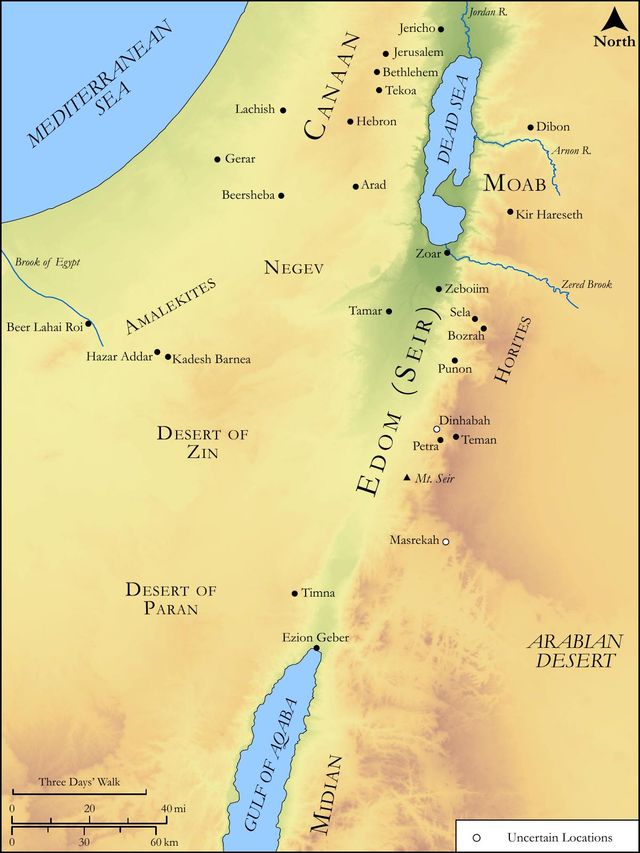
Esau, also known as Edom, settled in the mountainous region of Mount Seir, east of the Arabah valley, after his separation from Jacob. This territory, known as Edom or Idumea, was characterized by rugged terrain and strategic trade routes. The mention of "dukes" (Hebrew: alluphim) rather than kings indicates an early tribal, clan-based societal structure for the Edomites, where leadership was vested in chieftains. This tribal organization contrasts with the later monarchical system that developed in Edom, as explicitly noted in Genesis 36:31 which states, "These are the kings that reigned in the land of Edom, before there reigned any king over the children of Israel." This distinction highlights the unique political evolution of the Edomites relative to their Israelite counterparts. Their "habitations" and "land of their possession" refer to the specific territories and settlements that these clans occupied within the broader Edomite domain, reflecting a common practice of territorial division among tribal groups, as Israel's tribes would each be given their portion of the land.
Key Themes
ShowHideGenesis 36 contributes significantly to several overarching themes within Genesis. Firstly, it underscores the Sovereignty of God in blessing both Esau and Jacob, demonstrating His meticulous oversight of all nations, not solely the covenant line. Although Esau forfeited the Abrahamic blessing, God still fulfilled His promise to make him a great nation, as seen in Genesis 27:39-40. Secondly, the chapter emphasizes National Identity and Distinction, clearly delineating the Edomite nation from the emerging nation of Israel. This distinction was crucial for future interactions, often marked by conflict, as seen later when Edom refused Israel passage during the Exodus (Numbers 20:18-21). Thirdly, the theme of Land and Possession is prominent, as the verse reiterates that the Edomites were established "in the land of their possession," echoing God's promises of land to Abraham's descendants and highlighting the importance of territorial claims among the nations.
Exposition and Analysis
ShowHideKey Word Analysis
ShowHideThis term (H441) signifies a familiar leader, a friend, or a chieftain. It is used to describe the prominent leaders of the Edomite clans, indicating a tribal, non-monarchical form of governance at this stage. It highlights their status as notable figures within their respective groups, akin to a "chief friend" or "governor."
Derived from a word meaning "something seized," this term (H272) specifically refers to a possession, particularly of land. Its use here emphasizes that the Edomites had a legitimate, established claim to the territory they occupied, signifying a settled and organized national presence.
This primitive word (H1) denotes a literal and immediate, or figurative and remote, father. In this context, it clearly identifies Esau as the literal progenitor and foundational figure of the entire Edomite nation, reinforcing the genealogical purpose of the chapter.
Verse Breakdown
ShowHide"Duke Magdiel, duke Iram"
These phrases name the final two chieftains in the comprehensive list of Edomite "dukes" or tribal leaders. Their inclusion signifies the completion of the enumeration of Esau's prominent descendants who held positions of authority within the nascent Edomite society. The repetition of "duke" emphasizes their shared status and the consistent tribal structure.
"these [be] the dukes of Edom, according to their habitations in the land of their possession"
This clause provides a summary statement, affirming that the previously listed individuals, including Magdiel and Iram, were indeed the recognized leaders of the Edomite people. The phrase "according to their habitations" indicates that each duke governed a specific territory or clan within the larger Edomite domain, while "in the land of their possession" underscores the established and legitimate territorial claims of the Edomite nation. This signifies their settled status and the fulfillment of their national development.
"he [is] Esau the father of the Edomites"
This concluding declaration serves as a powerful and definitive statement of identity and origin. It unequivocally links the entire Edomite nation, with all its clans and chieftains, directly back to Esau as their progenitor. This final affirmation solidifies the genealogical and historical purpose of Genesis chapter 36, clearly establishing the distinct lineage and national identity of the Edomites.
Literary Devices
ShowHideThe primary literary device employed in Genesis 36:43 and the broader chapter is Genealogical Formula. The meticulous listing of names, lineages, and territorial affiliations follows the pattern of Genesis' genealogies for establishing national origins and identity. This formulaic approach provides a structured and authoritative record. Additionally, Repetition is evident in the repeated use of "duke" (Hebrew: alluph) throughout the chapter and specifically in this verse, underscoring the consistent tribal leadership structure of the early Edomites. The concluding phrase "he is Esau the father of the Edomites" acts as a Summary Statement or Colophon, providing a definitive closure to the detailed account of Esau's descendants and reinforcing the chapter's main point about the origin of the Edomite nation.
Theological and Thematic Connections
ShowHideGenesis 36:43 and the chapter it concludes provide a profound theological insight into God's sovereign plan, not only for the chosen line of Jacob but for all nations. It demonstrates that even outside the direct covenant stream of Abraham, God fulfills His promises and meticulously oversees the establishment of peoples and their territories. The detailed record of Edom's origins highlights God's faithfulness to His word, even to Esau, and sets the stage for understanding the complex relationship between Israel and Edom throughout biblical history, often marked by both kinship and conflict. This chapter affirms the Bible's commitment to historical accuracy and the divine ordering of national identities.
Reflection and Application
ShowHideGenesis 36:43, concluding the detailed genealogy of Esau, reminds us that the Bible is not merely a collection of stories but a meticulously recorded history of God's interaction with humanity, encompassing the origins and destinies of all peoples. This chapter, often skimmed over, underscores God's comprehensive oversight, demonstrating His faithfulness even to those outside the direct covenant line. It teaches us that every nation has its place in God's grand narrative, and understanding these historical foundations helps us appreciate the intricate tapestry of biblical events. For us today, it encourages a deeper appreciation for the historical reliability of Scripture and the purposeful unfolding of God's plan through diverse lineages and nations, all leading to His ultimate redemptive purpose. It also highlights the importance of identity and heritage, both personal and national, in understanding our place in God's world.
Questions for Reflection
ShowHideFAQ
ShowHideWhy does Genesis 36 dedicate an entire chapter to Esau's descendants, given the primary focus on Jacob?
ShowHideThe extensive genealogy of Esau serves several crucial purposes within the broader narrative of Genesis. First, it demonstrates the fulfillment of God's promise to Esau that he, too, would become a great nation, as prophesied by Isaac in Genesis 27:39-40. Second, it clearly distinguishes the lineage of Esau (Edom) from that of Jacob (Israel), preventing confusion and establishing their separate national identities. This distinction was vital for understanding future interactions between the two nations, which were often adversarial, such as Edom's refusal to allow Israel passage during the Exodus (Numbers 20:18-21). Finally, it underscores God's sovereignty over all nations, not just the chosen line of Abraham, showing His meticulous hand in the formation of all peoples.
What is the significance of the term "duke" (alluph) for Edomite leaders, as opposed to "king"?
ShowHideThe Hebrew term alluph (אַלּוּף), translated as "duke" in the KJV, specifically refers to a tribal chieftain or clan leader, rather than a monarchical king. Its consistent use throughout Genesis 36 for the Edomite leaders indicates that their society was structured tribally during this early period, with power distributed among various clan heads. This contrasts with the later mention of "kings" who reigned in Edom before any king reigned over the Israelites (Genesis 36:31), suggesting a developmental progression in Edomite governance from tribal chieftains to a monarchy. The use of alluph provides a precise historical detail, highlighting the distinct early stages of nationhood for Edom and Israel.
Christ-Centered Fulfillment
ShowHideWhile Genesis 36:43 focuses on the lineage of Esau, a figure often presented in contrast to the covenant line of Jacob, it indirectly points to Christ by demonstrating God's meticulous oversight of all human history and the unfolding of His redemptive plan. The very existence of Edom as a distinct nation, separate from Israel, underscores the specific and unique nature of God's covenant with Abraham, Isaac, and Jacob, through whom the Messiah would ultimately come. The detailed record of Edom's establishment highlights the sovereign hand of God in raising up and setting boundaries for all nations (Acts 17:26). Ultimately, the conflicts and distinctions between Edom and Israel foreshadow the greater spiritual divide between those who are "in Christ" and those who are not. Christ's lineage traces directly through Jacob, ensuring the fulfillment of promises made to the chosen seed, culminating in the King of kings who rules over all peoples (Revelation 19:16), gathering both Jew and Gentile into one family through His sacrifice (Ephesians 2:14-16), thereby fulfilling the broader Abrahamic covenant in a way that transcends national boundaries and tribal distinctions.