


Genesis 36:42
Bible text: King James Version (1769 Blayney text) · Public domain
Bible text: American Standard Version (1901) · Public domain
Bible text: World English Bible, Messianic edition · Public domain
Bible text: Geneva Bible (1599) · Public domain
Bible text: Young's Literal Translation · Public domain
- אַלּוּף'a·LufchiefH441N-msNoun Singular Masculine Absolute
- קְנַזke·NazKenazH7073N-proper-mNoun Proper Masculine
- אַלּוּף'a·LufchiefH441N-msNoun Singular Masculine Absolute
- תֵּימָןtei·ManTemanH8487N-proper-mNoun Proper Masculine
- אַלּוּף'a·LufchiefH441N-msNoun Singular Masculine Absolute
- מִבְצָרmiv·TzarMibzarH4014N-proper-mNoun Proper Masculine
English is a literal word-by-word gloss of the Hebrew, not the KJV's wording. Why?
This is the original text the KJV's translators worked from — each Hebrew word with its own literal English meaning in this verse, prepared by scholars at Tyndale House, Cambridge. The KJV translates whole sentences, not word by word, so its wording differs: one Hebrew word can become several English words, and the KJV may choose “the LORD” where the gloss reads “Yahweh”. Both are faithful — they answer different questions. For the KJV's own rendering, switch to the KJV text.
Details
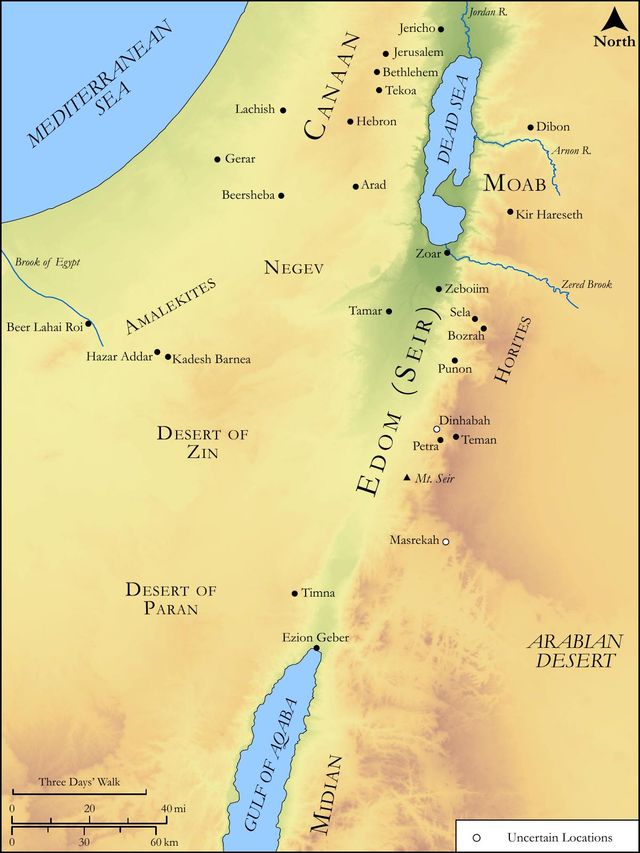
See on the biblical-era maps


Study this verse
Public-domain commentary
Matthew Henry
From his Commentary on the Whole Bible. Henry comments on passages, not single verses — this entry covers Genesis 36:31–43.
By degrees, it seems, the Edomites wormed out the Horites, obtained full possession of the country, and had a government of their own. 1. They were ruled by kings, who governed the whole country, and seem to have come to the throne by election, and not by lineal descent; so bishop Patrick observes. These kings reigned in Edom before there reigned any king over the children of Israel, that is, before Moses's time, for he was king in Jeshurun, Gen 36:3. God had lately promised Jacob that kings should come out of his loins (Gen 35:11), yet Esau's blood becomes royal long before any of Jacob's did. Note, In external prosperity and honour, the children of the covenant are often cast behind, and those that are out of covenant get the start. The triumphing of the wicked may be quick, but it is short; soon ripe, and as soon rotten: but the products of the promise, though they are slow, are sure and lasting; at the end it shall speak, and not lie. We may suppose it was a great trial to the faith of God's Israel to hear of the pomp and power of the kings of Edom, while they were bond-slaves in Egypt; but those that look for great things from God must be content to wait for them; God's time is the best time. 2. They were afterwards governed by dukes, again here named, who, I suppose, ruled all at the same time in several places in the country. Either they set up this form of government in conformity to the Horites, who had used it (Gen 36:29), or God's providence reduced them to it, as some conjecture, to correct them for their unkindness to Israel, in refusing them a passage though their country, Num 20:18. Note, When power is abused, it is just with God to weaken it, by turning it into divers channels. For the transgression of a land, many are the princes thereof. Sin brought Edom from kings to dukes, from crowns to coronets. We read of the dukes of Edom (Exo 15:15), yet, long afterwards, of their kings again. 3. Mount Seir is called the land of their possession, Gen 36:43. While the Israelites dwelt in the house of bondage, and their Canaan was only the land of promise, the Edomites dwelt in their own habitations, and Seir was in their possession. Note, The children of this world have their all in hand, and nothing in hope (Luk 16:25); while the children of God have their all in hope, and next to nothing in hand. But, all things considered, it is better to have Canaan in promise than mount Seir in possession.
Continue studying Genesis 36:42 across the web’s major study libraries — every link below opens this exact verse, chapter, or book on the destination site.
Read & Compare
 BibleGatewayThis verse in more than 200 translations and 70 languages.
 Bible.comThe YouVersion reader — hundreds of translations, reading plans, and highlights.
 ESV.orgCrossway's official English Standard Version reader.
 NET BibleThe NET translation with 60,000+ translators' notes on every rendering decision.
 STEP BibleTyndale House's free study tool — original text, vocabulary, and scholarly resources.
 BibliaLogos Bible Software's free web reader.
 USCCBThe New American Bible (Revised Edition) with the U.S. bishops' study notes.
Commentaries
 BibleHub CommentariesDozens of classic commentaries on this verse, gathered on one page.
 StudyLightMore than 100 commentary sets — the largest collection on the web.
 BibleRefPlain-English commentary on what this verse means, verse by verse.
 Enduring WordDavid Guzik's free commentary on this chapter, widely used by Bible teachers.
 Bible Study ToolsVerse commentary alongside Greek and Hebrew study aids.
Original Language & Research
- BibleHub InterlinearThe verse word by word — original language, transliteration, and English.
- BibleHub LexiconEvery word's original-language definition and Strong's entry.
 Blue Letter BibleDeep-study tools — Strong's numbers, concordance, and word studies.
 SefariaThe Hebrew text with Rashi and centuries of Jewish commentary.
Sermons, Hymns & Audio


TrulyRandomVerse is not affiliated with these sites and doesn’t control their content. They’re linked because they’re genuinely useful.
Summary
Genesis 36:42 continues the detailed enumeration of Edomite "dukes," specifically naming Kenaz, Teman, and Mibzar. This verse is part of a comprehensive genealogical record of Esau's descendants, meticulously documenting the tribal leaders and the established structure of the nation of Edom. It underscores the fulfillment of God's promise that Esau would become a great nation, highlighting the distinct identity and organized leadership of a people whose history would frequently intersect, often contentiously, with that of Israel.
Context
ShowHideLiterary Context
Genesis chapter 36 serves as a pivotal "toledot" (generations) section, specifically "the generations of Esau, who is Edom," following the narrative of Jacob's family. Positioned between the detailed accounts of Jacob's family and the Joseph narrative, this chapter provides a comprehensive and somewhat unexpected digression into Esau's lineage. Its inclusion emphasizes the fulfillment of the divine prophecy given to Rebekah that two nations would come from her womb, establishing the distinct identity and structured society of the Edomites as a parallel, though separate, nation to Israel. Verses 36:40-43 specifically list the "dukes according to their families, after their places, by their names," indicating a well-organized tribal and geographical structure, with Genesis 36:42 contributing to this exhaustive list of prominent Edomite leaders.
Historical & Cultural Context
The Edomites, descendants of Esau, settled in the mountainous region of Seir, south and east of the Dead Sea, a territory previously inhabited by the Horites (Genesis 36:20-21). Their society, as depicted in this chapter, evolved from nomadic clans into a more organized nation, complete with a succession of kings and, as seen here, numerous "dukes" or tribal chiefs. The term "duke" (Hebrew: 'alluph) in this context refers not to a European feudal title but to a significant tribal chieftain, leader, aor head of a thousand, reflecting a system of decentralized leadership common among the tribal confederations of that day before the rise of centralized monarchies. This detailed record highlights the establishment of a powerful and distinct nation, providing essential background for understanding the future geopolitical landscape and the often-antagonistic relationship between Israel and Edom, as seen in later biblical accounts like Numbers 20:14-21.
Key Themes
ShowHideGenesis 36 contributes significantly to several overarching themes within the book of Genesis. Foremost is the theme of Divine Faithfulness and Fulfillment of Prophecy, as God's word concerning Esau's descendants becoming a great nation is visibly realized through the numerous "dukes" and kings listed. Another key theme is the Formation of Nations and Distinct Identities, where the meticulous genealogy of Edom underscores the separate, yet divinely ordained, development of nations alongside Israel. This chapter also implicitly touches on Divine Sovereignty Over All Peoples, demonstrating that God's plan encompasses not only His chosen covenant people but also the rise and organization of other nations. Finally, the detailed record serves as a Historical Foundation for Future Interactions, providing the necessary context for understanding the complex relationships and conflicts that would later arise between Israel and its neighbors, particularly Edom, throughout biblical history, from the Exodus period to the prophetic books.
Exposition and Analysis
ShowHideGenesis 36:42 continues the list of Edomite leaders, specifying "Duke Kenaz, duke Teman, duke Mibzar." This verse, like those immediately preceding and following it, serves to complete the enumeration of the "dukes that came of Esau, according to their families, after their places, by their names" (Genesis 36:40).
Key Word Analysis
ShowHideThis term, derived from a root meaning "familiar" or "tame," signifies a chieftain, leader, or head of a clan or tribe. It denotes a prominent figure, often with administrative or military authority, who is "notable" or "chief." The consistent use of 'allûwph throughout Genesis 36 underscores the established and organized tribal structure of the Edomites, indicating a developed society with recognized leadership, distinct from the later concept of a king.
Likely from an unused root meaning "to hunt," Kenaz is presented here as an Edomite duke. The name itself suggests a "hunter," perhaps indicating a tribal characteristic or a prominent individual known for such prowess. Kenaz is also a name found among Israelites (e.g., Joshua 15:17), highlighting a shared onomastic tradition in the region, though here it clearly refers to an Edomite leader.
This name is identical to the Hebrew word for "south" or "south country." Teman was a significant region in Edom and also the name of a prominent Edomite clan and its eponymous ancestor (grandson of Esau, Genesis 36:11). Its inclusion as a duke here likely refers to a leader from or associated with this important southern Edomite territory, reinforcing the geographical organization of the Edomite dukedoms.
This name is identical to the Hebrew word for "fortress" or "stronghold." Mibzar is listed as an Idumaean (Edomite) duke. The name suggests a connection to fortified places or perhaps a leader known for strength and defense. Its appearance here further details the diverse leadership within the Edomite nation, each duke potentially representing a particular region or lineage known for a specific characteristic.
Verse Breakdown
ShowHide"Duke Kenaz"
This phrase introduces one of the tribal chieftains or leaders of the Edomite nation. Kenaz, as a personal name, denotes a specific lineage or geographical region within Edom, indicating a distinct administrative or military head within the broader confederation of Esau's descendants.
"duke Teman"
This refers to another prominent Edomite leader, likely associated with the significant southern region of Teman, a major clan and territory within Edom. The repetition of "duke" emphasizes the consistent leadership structure across different Edomite factions.
"duke Mibzar"
This names the third chieftain in this particular verse, whose name, meaning "fortress," suggests a leader perhaps from a fortified area or one known for military strength. The cumulative listing of these dukes completes the enumeration of Edom's established tribal heads, demonstrating the nation's organized and developed societal structure.
Literary Devices
ShowHideThe primary literary device at play in Genesis 36:42 and its surrounding context is Genealogy (specifically a list of tribal leaders). This meticulous listing serves not merely as a dry record but as a narrative technique to underscore the fulfillment of divine prophecy regarding Esau's descendants becoming a great nation. The Repetition of "duke" (Hebrew: 'alluph) preceding each name emphasizes the established nature of their leadership and the organized structure of Edomite society. This Enumeration provides a comprehensive and authoritative account, lending credibility to the biblical narrative's historical claims and demonstrating God's sovereign hand in the formation of all nations. Furthermore, the inclusion of these names, though seemingly minor, functions as Foreshadowing, setting the stage for future interactions and conflicts between the Edomites and the Israelites, as the distinct identities and leadership structures of both nations are clearly delineated.
Theological and Thematic Connections
ShowHideThe detailed enumeration of Edomite dukes in Genesis 36:42 serves as a profound testament to God's meticulous sovereignty and faithfulness, not only to His covenant people, Israel, but to all of creation and every nation. It demonstrates that divine providence extends beyond the immediate focus of the Abrahamic covenant, encompassing the rise and organization of other peoples as well. This seemingly mundane list reinforces the biblical principle that God is the orchestrator of history, meticulously overseeing the development of human societies and fulfilling His word concerning them. The existence of these distinct, organized nations, each with its own leadership, highlights God's design for diversity within humanity, all operating within the grand tapestry of His overarching redemptive plan.
Reflection and Application
ShowHideWhile a list of ancient names and titles like those in Genesis 36:42 might initially seem remote from contemporary life, it offers profound insights for the discerning reader. It serves as a powerful reminder that God is intricately involved in the details of all history, not just the parts that directly pertain to His covenant people. His sovereignty extends to the rise and organization of every nation, demonstrating His meticulous care and purposeful design in the unfolding of human events. For us today, this encourages a broader perspective on God's work in the world, reminding us that He is active in cultures and societies far beyond our immediate sphere. It also underscores the importance of identity and heritage, not as a source of prideful exclusion, but as a recognition of God's unique shaping of individuals, families, and nations within His grand narrative. Understanding these historical roots helps us appreciate the complex tapestry of God's redemptive plan, which encompasses all peoples and culminates in Christ.
Questions for Reflection
ShowHideFAQ
ShowHideWhat does 'duke' signify in Genesis 36?
ShowHideThe term 'duke' in the King James Version for Genesis 36:42 translates the Hebrew word 'alluph (אלוּף, H441). This term does not carry the European feudal connotations of a duke, but rather signifies a tribal "chief," "leader," aor head of a thousand. It denotes a significant leader within a clan or tribe, often with military or administrative authority, emphasizing the established and organized tribal structure of the Edomites. Its use highlights the development of Esau's descendants into a structured society with recognized leadership, fulfilling the prophecy of Genesis 25:23.
Why are such detailed genealogies of Esau included in the Bible?
ShowHideDetailed genealogies of Esau, including the list of dukes in Genesis 36, serve several crucial purposes. They demonstrate the fulfillment of God's prophecy that two nations would come from Rebekah's womb, establishing Edom as a distinct and powerful nation. They also provide essential historical and geopolitical context for understanding later interactions and conflicts between Israel and Edom throughout the Old Testament, such as Edom's refusal to allow Israel passage during the Exodus (Numbers 20:14-21). Furthermore, these lists underscore God's sovereignty over all of human history, illustrating that His divine plan encompasses the rise and organization of all peoples, not just His chosen covenant nation.
Christ-Centered Fulfillment
ShowHideWhile Genesis 36:42 primarily details the lineage and leadership of a nation distinct from Israel, it contributes to the broader biblical narrative that ultimately points to Christ. The meticulous recording of all nations' origins, even those outside the direct line of promise, speaks to God's universal sovereignty over all humanity. Just as the "dukes" of Edom ruled over their respective clans, Christ is the ultimate "Duke" and King, not merely over one nation, but over all nations and all creation (Revelation 19:16). The inclusion of Edom's lineage, a people often in opposition to Israel, subtly foreshadows the expansive nature of God's redemptive plan, which would eventually embrace Gentiles from every tribe and nation into the family of God through Christ (Ephesians 2:11-16). The genealogical precision, even for Esau's descendants, emphasizes that God's plan unfolds within real history, culminating in the incarnate Son, Jesus, through whom all the families of the earth are blessed (Galatians 3:8). Thus, these ancient lists, though seemingly remote, contribute to the grand narrative of God's universal dominion and His redemptive purpose, which finds its glorious fulfillment in the Person and work of Jesus Christ, the true Head and Lord of all.