


Genesis 36:41
Bible text: King James Version (1769 Blayney text) · Public domain
Bible text: Berean Standard Bible · Public domain
Bible text: American Standard Version (1901) · Public domain
Bible text: World English Bible, Messianic edition · Public domain
Bible text: Geneva Bible (1599) · Public domain
Bible text: Young's Literal Translation · Public domain
- אַלּוּף'a·LufchiefH441N-msNoun Singular Masculine Absolute
- אָהֳלִיבָמָה'o·ho·li·va·MahOholibamahH173N-proper-fNoun Proper Feminine
- אַלּוּף'a·LufchiefH441N-msNoun Singular Masculine Absolute
- אֵלָה'e·LahElahH425N-proper-mNoun Proper Masculine
- אַלּוּף'a·LufchiefH441N-msNoun Singular Masculine Absolute
- פִּינֹןpi·NonPinonH6373N-proper-mNoun Proper Masculine
English is a literal word-by-word gloss of the Hebrew, not the KJV's wording. Why?
This is the original text the KJV's translators worked from — each Hebrew word with its own literal English meaning in this verse, prepared by scholars at Tyndale House, Cambridge. The KJV translates whole sentences, not word by word, so its wording differs: one Hebrew word can become several English words, and the KJV may choose “the LORD” where the gloss reads “Yahweh”. Both are faithful — they answer different questions. For the KJV's own rendering, switch to the KJV text.
Details
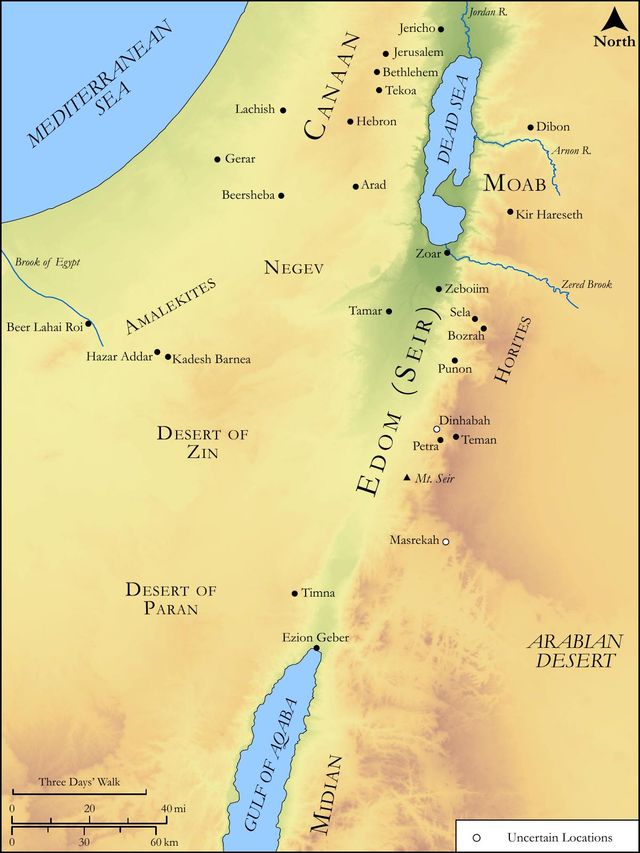
See on the biblical-era maps


Study this verse
Public-domain commentary
Matthew Henry
From his Commentary on the Whole Bible. Henry comments on passages, not single verses — this entry covers Genesis 36:31–43.
By degrees, it seems, the Edomites wormed out the Horites, obtained full possession of the country, and had a government of their own. 1. They were ruled by kings, who governed the whole country, and seem to have come to the throne by election, and not by lineal descent; so bishop Patrick observes. These kings reigned in Edom before there reigned any king over the children of Israel, that is, before Moses's time, for he was king in Jeshurun, Gen 36:3. God had lately promised Jacob that kings should come out of his loins (Gen 35:11), yet Esau's blood becomes royal long before any of Jacob's did. Note, In external prosperity and honour, the children of the covenant are often cast behind, and those that are out of covenant get the start. The triumphing of the wicked may be quick, but it is short; soon ripe, and as soon rotten: but the products of the promise, though they are slow, are sure and lasting; at the end it shall speak, and not lie. We may suppose it was a great trial to the faith of God's Israel to hear of the pomp and power of the kings of Edom, while they were bond-slaves in Egypt; but those that look for great things from God must be content to wait for them; God's time is the best time. 2. They were afterwards governed by dukes, again here named, who, I suppose, ruled all at the same time in several places in the country. Either they set up this form of government in conformity to the Horites, who had used it (Gen 36:29), or God's providence reduced them to it, as some conjecture, to correct them for their unkindness to Israel, in refusing them a passage though their country, Num 20:18. Note, When power is abused, it is just with God to weaken it, by turning it into divers channels. For the transgression of a land, many are the princes thereof. Sin brought Edom from kings to dukes, from crowns to coronets. We read of the dukes of Edom (Exo 15:15), yet, long afterwards, of their kings again. 3. Mount Seir is called the land of their possession, Gen 36:43. While the Israelites dwelt in the house of bondage, and their Canaan was only the land of promise, the Edomites dwelt in their own habitations, and Seir was in their possession. Note, The children of this world have their all in hand, and nothing in hope (Luk 16:25); while the children of God have their all in hope, and next to nothing in hand. But, all things considered, it is better to have Canaan in promise than mount Seir in possession.
Continue studying Genesis 36:41 across the web’s major study libraries — every link below opens this exact verse, chapter, or book on the destination site.
Read & Compare
 BibleGatewayThis verse in more than 200 translations and 70 languages.
 Bible.comThe YouVersion reader — hundreds of translations, reading plans, and highlights.
 ESV.orgCrossway's official English Standard Version reader.
 NET BibleThe NET translation with 60,000+ translators' notes on every rendering decision.
 STEP BibleTyndale House's free study tool — original text, vocabulary, and scholarly resources.
 BibliaLogos Bible Software's free web reader.
 USCCBThe New American Bible (Revised Edition) with the U.S. bishops' study notes.
Commentaries
 BibleHub CommentariesDozens of classic commentaries on this verse, gathered on one page.
 StudyLightMore than 100 commentary sets — the largest collection on the web.
 BibleRefPlain-English commentary on what this verse means, verse by verse.
 Enduring WordDavid Guzik's free commentary on this chapter, widely used by Bible teachers.
 Bible Study ToolsVerse commentary alongside Greek and Hebrew study aids.
Original Language & Research
- BibleHub InterlinearThe verse word by word — original language, transliteration, and English.
- BibleHub LexiconEvery word's original-language definition and Strong's entry.
 Blue Letter BibleDeep-study tools — Strong's numbers, concordance, and word studies.
 SefariaThe Hebrew text with Rashi and centuries of Jewish commentary.
Sermons, Hymns & Audio


TrulyRandomVerse is not affiliated with these sites and doesn’t control their content. They’re linked because they’re genuinely useful.
Summary
Genesis 36:41, part of the extensive Edomite genealogies, meticulously lists "Duke Aholibamah, duke Elah, duke Pinon," as established leaders within Esau's burgeoning nation. This verse serves as a testament to the Bible's historical precision, illustrating the fulfillment of divine prophecy regarding Esau's descendants and underscoring God's sovereign oversight in the formation and development of all peoples, even those outside the direct covenant line with Israel.
Context
ShowHideLiterary Context
Genesis chapter 36 is a comprehensive genealogical record of Esau, also known as Edom, the twin brother of Jacob (Israel). Preceding this chapter, the narrative has focused on Jacob's family and his return to the land of Canaan. Chapter 36 then provides a detailed account of Esau's wives, sons, and the various tribal leaders, referred to as "dukes," who descended from him and settled in the mountainous region of Seir. This meticulous listing, culminating in verses like Genesis 36:40-43, serves to distinguish Esau's lineage from Jacob's, fulfilling the prophecy of two nations from Rebekah's womb found in Genesis 25:23. It establishes the Edomites as a fully formed and organized nation with its own system of leadership, even before Israel had kings.
Historical & Cultural Context
The term "duke" (Hebrew: 'alluph) in this context refers to a tribal chieftain or clan leader, distinct from the later concept of a king. This form of leadership was common among semi-nomadic or newly settled tribal societies of that day. The Edomites, descendants of Esau, settled in the rugged, mountainous region of Seir (modern-day Jordan), a strategically important area controlling trade routes. Their societal structure, as depicted here, was one of independent clans led by these "dukes," reflecting a period before centralized monarchies became prevalent in the region. The detailed listing of these leaders emphasizes the established nature of Edomite society and its distinct identity in the landscape of early nations.
Key Themes
ShowHideGenesis 36 contributes to several overarching themes within the book of Genesis and the broader biblical narrative. Firstly, it highlights the fulfillment of divine prophecy, specifically the promise that two nations would emerge from Rebekah's womb (Genesis 25:23). Esau's descendants indeed became a powerful nation, Edom. Secondly, it emphasizes God's meticulousness and sovereignty over nations, demonstrating His involvement in the formation and organization of all peoples, not just the covenant line of Israel. Thirdly, the chapter serves to establish the distinct lineages and identities of Jacob and Esau, setting the stage for their future interactions, which often involved conflict (e.g., Numbers 20:14-21), yet always under God's overarching plan.
Exposition and Analysis
ShowHideKey Word Analysis
ShowHideFrom the root meaning "to tame" or "to guide," this term signifies a "chieftain" or "leader." It implies someone notable, a guide, or a head of a clan, often associated with a "thousand" (as in a thousand-man unit or a large family group). In Genesis 36, it specifically denotes the tribal leaders of Edom, distinguishing their leadership structure from later monarchical systems. It conveys authority and prominence within their tribal society.
Meaning "tent of (the) height," this name is significant. Aholibamah was one of Esau's wives and the mother of some of these dukes. Her name, evocative of high places and tents, might reflect the nomadic or semi-nomadic lifestyle and the elevated status of her clan within Edomite society. The listing of her descendants as dukes underscores the importance of maternal lineage in establishing tribal identity and leadership.
This name refers to an Idumaean (Edomite) chieftain. While its precise etymology is debated, it is likely related to a place name or a characteristic. The inclusion of specific names like Pinon, alongside Aholibamah and Elah, highlights the Bible's commitment to historical particularity, grounding the narrative in concrete individuals and their roles within the Edomite tribal structure.
Verse Breakdown
ShowHide"Duke Aholibamah"
This phrase identifies a prominent leader whose lineage traces back to Aholibamah, one of Esau's wives. The title "duke" (or chieftain) signifies his authority over a specific clan or region within Edom, indicating an established and recognized position of power. The name itself, "tent of (the) height," may subtly hint at the elevated status or geographical domain of this particular chieftain.
"duke Elah"
Similarly, "duke Elah" names another distinct chieftain within the Edomite hierarchy. Elah is a common name, also referring to a terebinth tree, but here it refers to an individual leader. His inclusion underscores the multiplicity of independent, yet recognized, leadership units within Edom, each with its own sphere of influence.
"duke Pinon"
The listing of "duke Pinon" completes this triplet of Edomite chieftains. Like the others, Pinon represents a specific tribal head, further illustrating the decentralized yet organized nature of Edomite society. The repetition of "duke" before each name emphasizes their shared status as clan leaders, collectively forming the leadership structure of the Edomite nation.
Literary Devices
ShowHideThe primary literary device at play in Genesis 36:41, and indeed throughout much of Genesis 36, is Enumeration or Cataloging. The verse presents a straightforward list of names, each preceded by the title "duke." This meticulous listing serves to provide a comprehensive and detailed record of Esau's descendants and their established leadership. The Repetition of the term "duke" (Hebrew: 'alluph) before each name emphasizes the consistent leadership structure across different clans and reinforces their shared status as chieftains. Furthermore, the entire chapter functions as a Genealogy, a literary form crucial in Genesis for establishing lineage, identity, and claims to land or authority. This genealogical record, though seemingly dry, is a foundational literary tool that authenticates the historical claims and theological narratives of the biblical text.
Theological and Thematic Connections
ShowHideGenesis 36:41, seemingly a mere list of names, carries profound theological weight. It demonstrates God's meticulous attention to detail in orchestrating the history of nations, even those not directly in the covenant line of Israel. The establishment of these "dukes" signifies the fulfillment of God's word concerning Esau's descendants becoming a great nation, distinct from Jacob's. This highlights God's sovereignty over all peoples, shaping their identities and destinies according to His overarching plan, which ultimately serves His redemptive purposes. The presence of these specific leaders underscores the reality of Edom as a formidable, organized nation, setting the stage for its future interactions with Israel, often marked by tension and conflict, yet always under divine providence.
Reflection and Application
ShowHideWhile Genesis 36:41 might appear to be a dry, historical record, it offers a profound invitation to reflect on God's comprehensive involvement in all of human history, not just the story of Israel. This verse reminds us that God's grand narrative encompasses all peoples, and His meticulous attention to detail extends even to the genealogies of nations seemingly distant from the direct covenant line. It reinforces our trust in the historical accuracy and prophetic fulfillment of God's Word, encouraging us to recognize His sovereign hand at work in the seemingly mundane details of our own lives and in the broader sweep of global events. Furthermore, it prompts us to reflect on our spiritual identity in Christ, which transcends earthly lineages and unites us as one in Him, demonstrating that God's ultimate plan is to gather a people for Himself from every tribe and nation.
Questions for Reflection
ShowHideFAQ
ShowHideWhy does the Bible include such detailed genealogies of Edomite dukes?
ShowHideThe inclusion of detailed genealogies, even for nations like Edom, serves multiple crucial purposes. Firstly, it underscores the Bible's commitment to historical accuracy, providing a verifiable record of ancient peoples and their societal structures. Secondly, it demonstrates the fulfillment of divine prophecy concerning the descendants of Esau, establishing them as a distinct and organized nation, as foretold in Genesis 25:23. Thirdly, it highlights God's sovereign involvement in the formation and development of all nations, not just Israel, showing His meticulous hand in shaping human history according to His divine plan.
What is the meaning of the term "duke" in this context, and how does it differ from a "king"?
ShowHideThe term "duke" in the King James Version translates the Hebrew word 'alluph (אַלּוּף), which refers to a tribal chief or clan leader. It signifies a position of significant authority within the Edomite tribal system, often implying leadership over a "thousand" (a family or clan unit). This system of leadership was decentralized, with multiple dukes governing their respective clans or regions. It is distinct from the later monarchical system of Israel, where a single king held centralized authority over the entire nation, as described in 1 Samuel 8. The Edomite "dukes" represent an earlier, more tribal form of governance.
Christ-Centered Fulfillment
ShowHideWhile Genesis 36:41 directly concerns the lineage of Esau, its Christ-centered fulfillment lies in the broader narrative of God's sovereign plan for humanity, meticulously unfolding through distinct nations and lineages, ultimately leading to the promised Seed. The detailed record of Edom's establishment serves as a historical backdrop against which the unique covenantal lineage of Jacob (Israel) is highlighted—the lineage through which the Messiah, Jesus Christ, would ultimately come. Even in the documentation of nations outside the direct covenant, God's providential ordering of history prepares the way for the advent of His Son, demonstrating His ultimate control over all human affairs to bring about His redemptive purpose. The fact that God records the rise of nations like Edom, even while choosing a particular lineage through which to bring salvation, underscores His universal sovereignty. Ultimately, in Christ, the divisions of earthly lineage and nationality are transcended, as He forms a new people from every tribe and nation, fulfilling the Abrahamic promise in a global, spiritual sense, as seen in Galatians 3:16 and Ephesians 2:11-22.